


The streaming and e-commerce giants have cracked a strategic code that most businesses are still struggling to understand: how to deploy intelligent systems at massive scale to drive measurable business outcomes. Netflix has perfected content recommendation algorithms that keep 270+ million subscribers engaged.
Spotify’s music discovery engine powers billions in user engagement annually. Amazon’s AI-powered recommendation system drives massive cross-selling and upselling revenue.
Yet here’s the critical insight: these titans aren’t just using technology-they’re architecting their entire business models around AI as a first-class strategy, and they’re doing it with approaches that your business can adopt today.
The business case is clear: companies with strategic AI adoption realize ROI of $10.30 on every dollar invested, compared with just$2.10 for traditional approaches and $3.70 for early experimental projects related to AI. More than 80% of Netflix’s content recommendations drive actual viewership, accounting for more than $1 billion in annual churn prevention savings.
Globally, 78% of companies now leverage AI in at least one business function-a 43% increase from 55% in 2023-indicating high and rapid enterprise-wide adoption.
For businesses taking a wait-and-see approach to incorporating AI, that window is rapidly closing. Yet for those preparing to act, the path ahead is clear-separate AI development from core application infrastructure, measure business impact obsessively, and iterate continuously based on real outcomes.
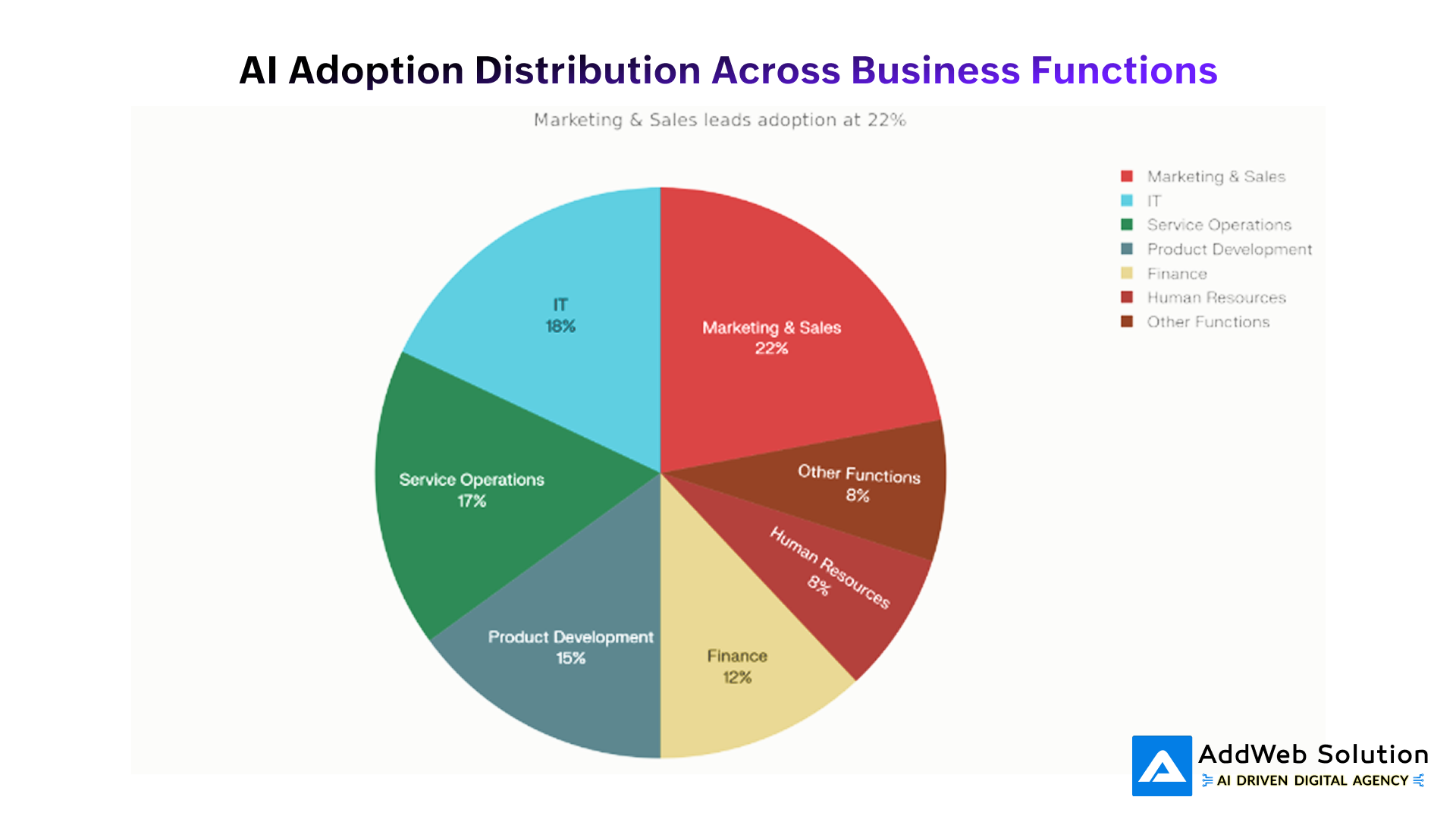
Distribution of AI Adoption by Business Function (2025)
A Strategic Advantage: A Rationale Behind Choosing Python & AI
But in order to talk about strategies, it’s important to talk about the overall reason they decided to rely so heavily on AI systems. The reason has something important to say about why companies adopt AI in the first place. It has nothing to do with overall technological trends.
The Netflix experience is a perfect example. They had a critical challenge in 2007. They were a DVD rental company, but their entire business was under threat from streaming technology. They decided to shift their streaming technology, but their next challenge is even more daunting—with so many choices, consumers are confused.
Their plan is simple: Develop a smart recommendation system able to sense what a viewer wants before he wants it himself. It is so effective on Netflix that over 80% of all views on Netflix happen through their recommendation system, not by user search.
Spotify went down a different route but ended up at the same destination. It had more than 100 million tracks in its database, so surfing or searching was not a feasible option for them.
Their unique selling point had to be the understanding of what their users wanted to listen to. So, they poured significant money into developing artificial intelligence solutions that could analyze listening patterns, forecast changes in those patterns, and serve up people-friendly playlists.
The style of Amazon was more infrastructure-oriented. In other words, they were not simply focusing on building the technology solutions for one type of business problem; they were building the foundational infrastructure that could be used across the organization: recommendation algorithms, demand forecasting, supply chain optimization, or detecting fraud. This infrastructure pattern has become the model that Amazon distributes across the world in its AWS offerings.
“The key insight is, these companies implemented AI not because it was the next big thing, but because it solved a business problem in a way where it created a competitive advantage.”
Netflix’s recommender system, for example, leads to a decrease in customers churning, thereby increasing the overall viewer engagement by a significant margin. Spotify’s recommender system leads to higher user engagement, resulting in a substantial increase in user retention. Amazon’s recommender system
For your enterprise, this presents an incredibly valuable frame shift: instead of wondering “Should I use AI?” you should be considering “What are the problems in my business that might be solved by AI, and what would be the value of those solutions?”
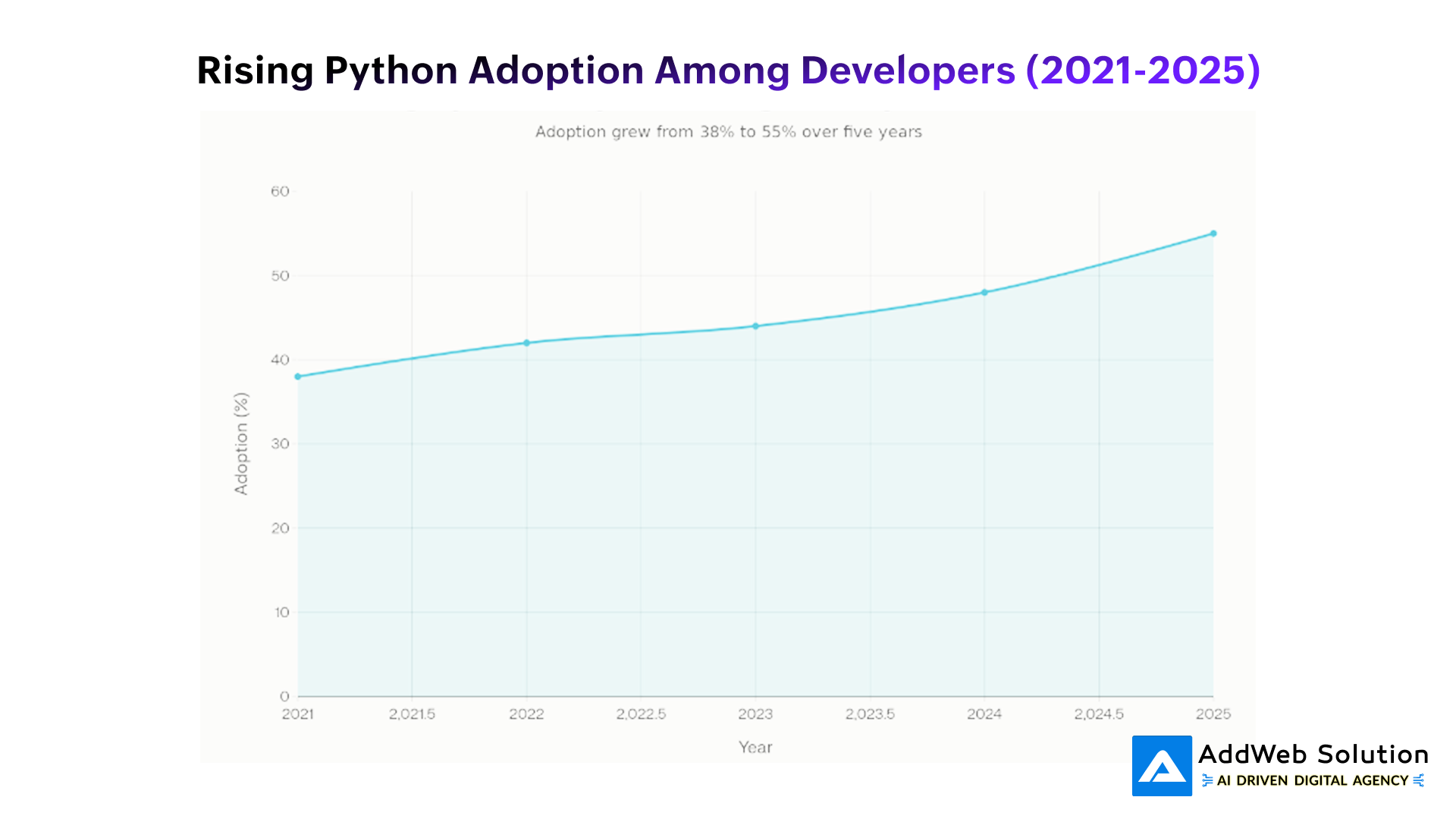
Python Adoption Growth in Software Developers (2021-2025


Netflix’s Approach: The Recommendation Engine as a Revenue Engine
Netflix has a scale which is incomprehensible to most firms, at least 230 million subscribers, 10,000+ content titles, and hundreds of millions of views a day. Ironically, their AI strategy can all be boiled down to one principle: keeping viewers. All that Netflix does in AI is this.
Netflix’s Recommendation Engine is based on several intelligence levels operating simultaneously:
First Layer: Understanding What Users Like. Netflix collects behavioral data͖ info like what people watch, for how long, whether they rewind, whether they skip, whether it gets added to a list. These types of behaviors are a hundred times more valuable than anything a user might claim about their likes. Netflix knows, for instance, that audiences might not like to admit to watching something (guilt watching)͖ a process where the system knows a user’s likes better than the user does, as it doesn’t ask them for their likes.
Second Layer: Finding Similar Users. Finding Similar Users. Netflix finds viewers with similar taste profiles. When Viewer A and Viewer B rate the same TV shows in a similar way, the system considers that Viewer A and Viewer B have similar tastes. When Viewer B rates a different TV show highly, the system recommends that TV show to Viewer A with certainty. It’s a very efficient strategy for regular viewers, but it’s less efficient for new viewers who don’t have any TV show watch history. The problem is solved by using a mix of strategies.
Third Layer: Decoding the Content Itself. Netflix tries to look into the qualities of each content title, such as genre, themes, production values, cast, reception, moments captured in the content, and more. That enables them to suggest content to new users even before the users start using the service, relying on the new subscriber’s content choices.
Fourth Layer: Contextual Intelligence. The truth is that the content you consumed in one context is different from the content you consumed in another. You consumed different content at 8 PM as compared to 11 PM. You consumed different content while you are at home as compared to when you are alone in the house. Devices also define the content that you consumed.
The effect of this multi-layered strategy on businesses has been staggering, with 80% of content discovery driven by recommendations, thereby blocking a churn of $1 billion every year. It’s staggering to think that if this recommendation function were lost on Netflix, they would be forfeiting $1 billion per year. This aspect alone would be worth more to most organizations than their entire budget.
Translated for your business, the Netflix experience teaches the following three principles:
- Collect behavioral data obsessively. User behavior is more honest than what users tell you.” Watch what your customers do, not what they say.
- Use multiple recommendation approaches in parallel. Similar user-based systems are excellent at recommending to existing clients but poorly suited to new clients. Mix different approaches—behavioral similarities and content and context differences—for all clients.
- Focus on measuring the impact of the business and not just the accuracy of the algorithm. “Netflix does not care if their recommendation algorithm is 95 percent accurate. They care about if it helps them retain their customers and increase viewing time. Make sure your AI system is evaluated based on its affect on the bottom line and not the academic world,” says Jason Mars, co-founder,4890 Inc
Spotify’s Approach: Personalization at Extreme Scale
The problem at hand that Spotify faces is different from Netflix in one key aspect: the size of the catalogue. Netflix has over 10,000 titles. Spotify has more than 100 million songs.
The methods used by traditional recommendation systems are not applicable at this scale. The secret to how they overcame this was to develop three different kinds of intelligences:
First Approach: Collaborative Filtering. potify has created detailed listen profiles. Billions of listens uncover patterns – what groups of listeners like what songs, what groups of listeners have similar listen profiles, which songs are frequently skipped as compared to frequently saved.
When two listeners like the same type of music, the site learns to find patterns for the first listener of what the other listener has not listened to. This method enables the “Discover Weekly” feature. This feature is Spotify’s engagement crown jewel.
Second Approach: Contextual Understanding. One thing Spotify realized is that listening habits are not fixed—they vary with time and context. The playlist you would love to have in the gym is different from the one you need to unwind. The playlist to have at 8:00AM is different from the one you need at 11:00PM.
The system identifies the context in which the user is listening, which includes the time, day, activity the user is engaged in (which the system deduces from the listening habits), and season. The user’s system identifies whether the user is most probably exercising, commuting, or working, and plays back the relevant songs.
Third Approach: Sequential Intelligence. Now it gets more complex. What they found is that listening to music is a sequential process. The song you listen to can actually trigger a certain kind of music you’d like to listen to next. If it’s 11 PM and you listened to heavy metal music, chances are you won’t listen to pop songs right away, but maybe blues and jazz.
Their software uses this kind of intelligence and calculates not only the kind of music you like, but also the kind you’d probably listen to right next.
The Business Impact: The impact that Spotify has with its personalization is a direct correlation with user retention and engagement. Wherever users are getting high-quality recommendations, they are spending more time on the site, finding more songs, creating more playlists, and sticking with their subscriptions for a long time.
For Your Business: Spotify’s Lesson
Spotify’s lesson for your business is this: Personalization must be multi-dimensional, not generic.
- Behavioral dimension: What does this specific user do and like?
- Contextual dimension: What situation is the user in right now?
- Sequential dimension: What did the user just experience, and how does that inform what they want next?
For e-commerce, it could involve: “Products to buy based on: 1) Similar purchases, 2) Trends in the user’s geographical location/season, 3) Viewed recently (sequential)”. For B2B commerce, it would involve: “Recommendations based on: 1) Similar business entities, 2) Current business problems they’re trying to solve, 3) Solutions they have recently adopted”.
Get Scalable Python Solutions Tailored for 2026 and Beyond

Pooja Upadhyay
Director Of People Operations & Client Relations
Amazon’s Philosophy: Infrastructure First, Applications Second
Amazon did something completely different from Netflix and Spotify. Instead of being a great solution for a specific problem, Amazon built a great infrastructure for making AI affordable for the whole organization. This approach was so successful for Amazon that it started selling it as a product worldwide through AWS.
Amazon realized the crucial piece: the constraint for most companies is not the development of AI, it is the infrastructure supporting the management and deployment of the AI system. A company that trains the recommendation system 50% faster than the competition has a key advantage. A company that can serve predictions at the scale of millions of users without the cost scaling is a leader. Amazon built infrastructure in these areas.
The AI Infrastructure Strategy of Amazon consists of the following
- Purpose-Built Hardware: AWS provides specialized processors for AI-related tasks. These processors provide a cost savings of 40-50% when compared to other processors. If a firm is processing millions of tasks for model training or making predictions, this infrastructure expenditure will pay for itself in a short while.
- Managed Services: Amazon SageMaker makes the underlying infrastructure complexity go away. There is no longer a need for organizations to handle the task of cluster management or the construction of serving infrastructure because they can simply upload the data and the models they wish to create, and the rest is done by the service. AI development is democratized because organizations do not require a staff of experts in AI infrastructure in order to be able to launch sophisticated AI solutions.
- Cost Optimization: Amazon introduced the concept of pay-as-you-go. You are not required to invest money in buying the infrastructure that takes up space. You pay for every computation performed. For example, if you are using artificial intelligence solutions that require varying amounts of computation, this service can prove to be revolutionary for you since you are not required to invest in servers that are not used.
- Integrated Services: Amazon integrated AI services across its ecosystem. Recommendation, demand forecasting, fraud detection, anomaly detection—all accessible through APIs without building anything from scratch. Companies can start with AWS-managed services and transition to custom models as needs evolve.
The Business Impact: Amazon’s infrastructure philosophy fundamentally changed how AI is deployed globally. Companies that previously couldn’t afford ML infrastructure can now access it through pay-as-you-go cloud services. The barrier to entry for AI adoption dropped dramatically.
For Your Business: Amazon’s lesson is clear: outsource infrastructure complexity when possible. Unless AI infrastructure is your core competitive advantage, using managed services makes more sense than building your own. Your team can focus on business logic and model optimization rather than managing servers and scaling infrastructure.
The ROI mathematics are usually compelling: cloud services are more expensive per unit at scale, but the operational overhead of self-managed infrastructure is usually much higher.
Global AI Adoption: The Competitive Window is Closing
The data painting a clear picture: the AI revolution is no longer coming—it’s here and accelerating across all industries. Understanding these metrics is crucial because they define your competitive position.
Adoption is Reaching Critical Mass: 78% of global companies use AI in at least one business function, up from 55% in 2023. This represents acceleration that’s essentially inevitable—if competitors are adopting AI and gaining efficiency, cost reduction, or customer satisfaction advantages, staying on the sidelines becomes increasingly untenable. More specifically, companies are now using AI in an average of three different business functions, suggesting the transition from experimental projects to embedded operations.
ROI Differentials are Widening: The gap between strategic AI adopters and laggards is growing dramatically. Strategic adopters see $10.30 ROI per dollar invested; traditional implementations see $2.10 ROI. That’s nearly a 5x difference. Over time, this compounds into massive competitive advantages. A company investing $1M in strategic AI realizes $10.3M in value; a competitor investing the same $1M traditionally realizes just $2.1M. After five years, the cumulative value gap is enormous.
Budget Commitments are Accelerating: Average monthly AI spending is rising from $62,964 (2024) to $85,521 (2025)—a 36% increase. More dramatically, organizations planning to spend over $100,000/month in AI tools jumped from 20% to 45%. These aren’t marketing claims—these represent real budget allocations. Significant money is flowing toward AI implementation.
Productivity Gains Are Real: Employees using AI report 40% productivity improvements on average, with controlled studies showing 25-55% gains depending on function. Federal Reserve research found workers using generative AI save 5.4% of work hours weekly, with frequent users saving over 9 hours per week. For a company with 100 employees, that’s 27,000+ hours annually—equivalent to 13 full-time employees freed up for higher-value work.
Investment is Accelerating Further: 58% of businesses plan to increase AI investment in coming years, with 85% of advanced AI adopters planning even more investment. This means the gap between leaders and laggards is widening in real-time. Companies getting AI right today are compounding advantages: more data, better-trained systems, higher employee productivity, happier users. Companies delaying face increasingly difficult catch-up.
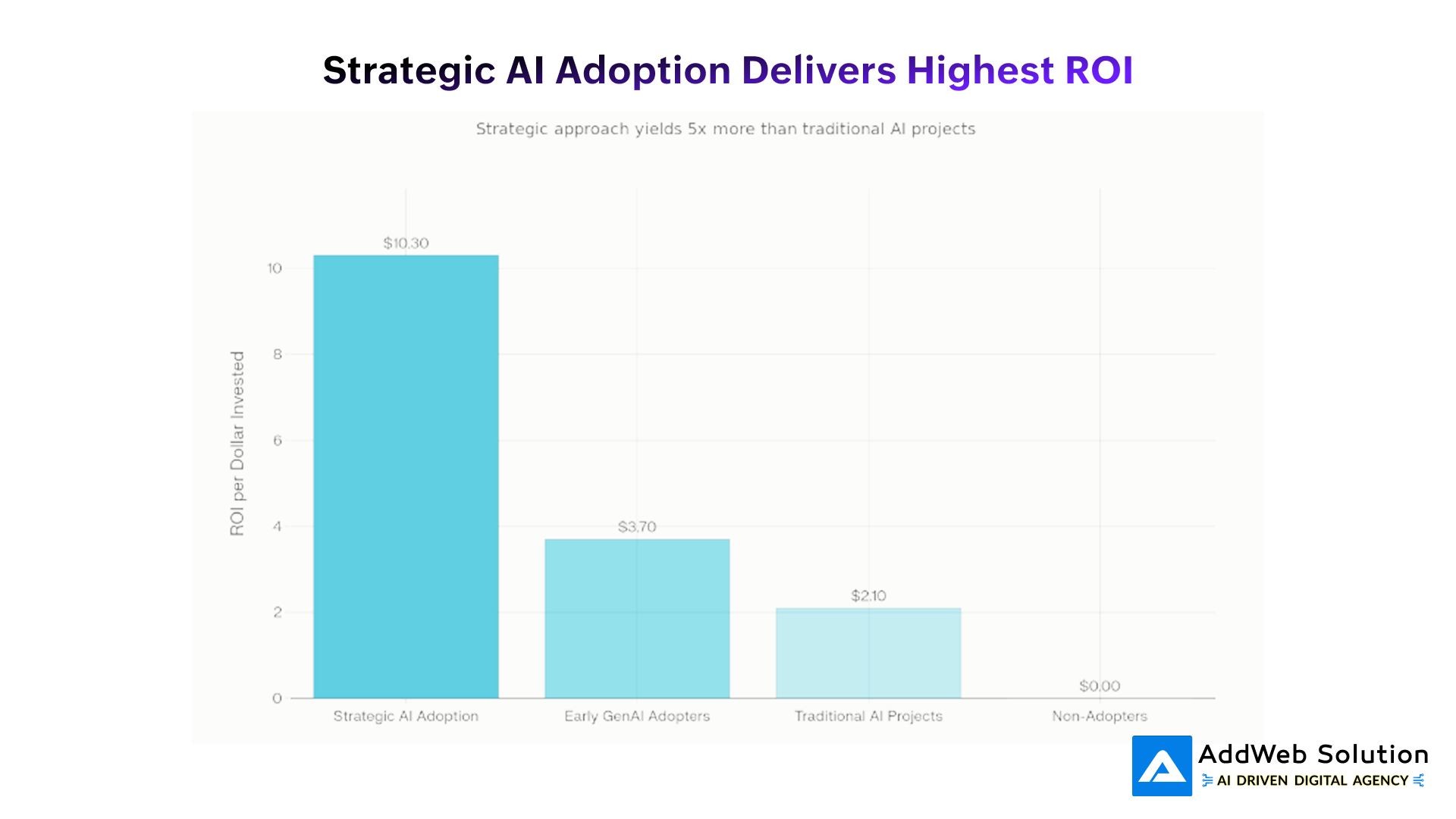
AI ROI Comparison: Strategic Adoption vs. Traditional Approaches
Real Business Impact: What Companies Actually Achieved
Rather than theoretical benefits, let’s examine documented results from companies that successfully deployed AI:
Sales and Revenue Transformation: Organizations using AI for sales see 25-47% productivity increases from automating repetitive tasks, allowing teams to focus on selling activities. AI-powered lead scoring delivers 25% pipeline growth and 76% win rates. Companies using AI journey orchestration see 32% conversion increases by automatically adapting content and timing based on customer behavior. End-to-end revenue intelligence platforms help sales teams reach 96% forecasting accuracy compared to 66% with human judgment alone. These aren’t marginal improvements—they’re transformational changes in business performance.
Customer Experience Revolution: Netflix’s $1 billion in annual churn prevention savings comes entirely from its recommendation engine. This single AI application justifies a massive investment. Similarly, customer service teams report 90% of CX leaders see positive ROI from implementing AI tools for support. Retail and e-commerce businesses deploying AI shopping assistants see 25% higher conversion rates, with shoppers using AI assistants 25% more likely to complete purchases.
Operational Efficiency: JPMorgan’s AI implementation resulted in 360,000 hours of annual time savings with 80% fewer compliance errors. NTT DATA achieved 100% workflow automation through AI implementation. These aren’t anecdotes—they’re large enterprises with documented results.
Cross-Industry Application: The patterns repeat across industries. Retail uses AI for inventory optimization and personalized recommendations. Financial services use AI for fraud detection and risk assessment. Healthcare uses AI for diagnostics and operational efficiency. Manufacturing uses AI for predictive maintenance. The technology works across domains because the underlying principle is universal: AI excels at finding patterns in data that humans can’t see manually.
How to Structure AI Integration in Your Business
The companies achieving the highest ROI follow a consistent framework for AI integration:
Clear Strategic Alignment: Before exploring any AI project, answer foundational questions: What specific business problem does AI solve? What would solving this problem be worth in revenue, cost savings, or customer satisfaction? Is AI the best solution or should we consider alternatives? Companies that skip this step often end up with AI projects that are technically impressive but business-irrelevant.
Use Case Prioritization: Not all AI opportunities are equal. Start with high-impact, lower-complexity use cases to build organizational confidence and demonstrate value. Netflix didn’t try to build a perfect recommendation engine overnight—they started with one feature, measured impact, and iteratively improved. Similarly, companies should identify quick-win AI projects that deliver measurable business impact within 3-6 months.
Measurement from Day One: Define business metrics before building any AI system. What does success look like? For Netflix, it’s reduced churn and increased viewing time. For Amazon, it’s increased revenue per user. For customer service, it’s reduced resolution time and higher satisfaction scores. Without clear metrics, you can’t measure ROI and can’t justify continued investment.
Phased Implementation Roadmap: The companies getting the best results follow a Pilot → Scale → Optimize framework. Start with pilot projects on small subsets of data or users. Measure results rigorously. Only after proving value do you scale to broader application. This approach minimizes risk and maximizes learning.
Cross-Functional Collaboration: Successful AI implementation requires breaking down organizational silos. Sales teams must collaborate with operations. Marketing must align with data teams. This ensures AI projects address real business needs and get proper resources.
Investment in Talent: Companies achieving the best AI results either train existing teams or hire new talent. Alternatively, they partner with external providers who have AI expertise. Either way, they recognize that technology alone doesn’t deliver results—people do.
Common Pitfalls: What Not to Do
As important as knowing what works is understanding what fails:
Pitfall 1: Building Everything In-House. Many companies decide to hire data scientists and build ML infrastructure from scratch. This is expensive, time-consuming, and usually unnecessary unless AI is your core competitive advantage. Netflix builds recommendations because recommendations are central to their business. Most companies shouldn’t. Use managed services for infrastructure; build custom models only when you have proprietary data advantages.
Pitfall 2: Ignoring the Quality Problem. AI systems are only as good as their data. Garbage data produces garbage predictions. Companies often underestimate the effort required for data cleaning, validation, and governance. Plan to spend significant effort on data quality before expecting AI systems to deliver value.
Pitfall 3: Treating AI as a One-Time Project. Build a model, deploy it, declare victory. Six months later, performance degrades because user behavior shifted or market conditions changed. Netflix retrains recommendation models continuously. Plan for ongoing model maintenance, retraining, and optimization, not one-time implementation.
Pitfall 4: Not Measuring Business Impact. Many companies measure technical metrics (accuracy, precision, recall) but not business impact. Measure what matters: revenue, cost savings, customer satisfaction, churn reduction. This justifies continued investment and identifies what actually works.
Pitfall 5: Over-Engineering Early. Some companies build massive distributed systems and complex infrastructure before proving basic AI concepts work. Start with simple, commodity solutions. Scale infrastructure only when bottlenecks become clear.
Pitfall 6: Ignoring Change Management. AI implementations often change how teams work. Sales teams get new lead prioritization. Customer service teams use AI assistants. Operations teams rely on predictive analytics. Without proper training and change management, teams resist new systems. Invest in organizational change management alongside technology implementation.
Building Your AI Advantage: A Practical Starting Point
Rather than paralysis by overthinking, companies should start with a single, high-impact AI project. The goal isn’t perfection—it’s learning and building organizational capability.
Potential Starting Projects:
For e-commerce businesses: Implement product recommendations using collaborative filtering or content-based approaches. Measure impact on conversion rates and average order value.
For SaaS applications: Build AI chatbots to handle common customer support questions. Measure impact on resolution time and customer satisfaction.
For B2B companies: Use predictive analytics to identify high-probability sales opportunities. Measure impact on sales cycle length and win rates.
For content platforms: Implement personalized content recommendations. Measure impact on user engagement and session duration.
For any business: Analyze customer data to identify churn risk before customers leave. Measure impact on retention and customer lifetime value.
Implementation Timeline:
Months 1-2: Define the business problem precisely. What specific metric will AI improve? Collect and analyze existing data. Understand data quality challenges.
Months 2-3: Implement initial AI solution. Use existing tools and services rather than building from scratch. Start with a small pilot.
Months 3-4: Measure results rigorously. Compare business metrics before and after AI implementation. Calculate ROI. Share results with stakeholders.
Months 4+: Scale successful pilots. Optimize based on learnings. Plan next AI initiatives. Build momentum and organizational capability.
Expected Business Impact:
- Quick win projects: Show measurable ROI within 3-6 months
- Typical investment: $50K-$200K depending on complexity
- Timeline to payback: 12-18 months typically, with revenue impact beginning in months 2-3
- Ongoing costs: API services and model retraining typically cost 10-20% of initial build annually
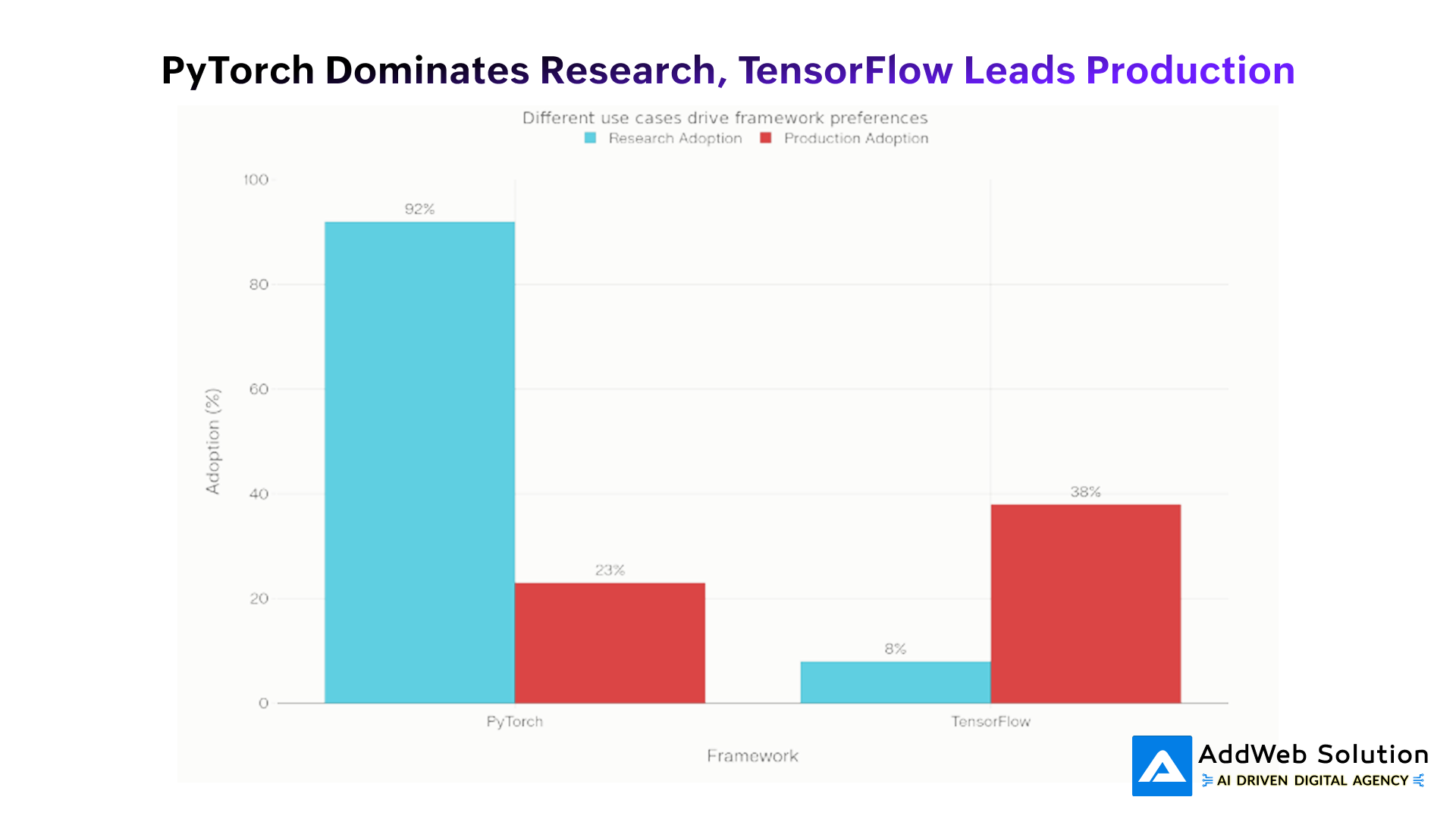
Framework Adoption: Research vs. Production Environment
Why Now is the Right Time
The convergence of factors makes 2025-2026 the optimal time to integrate AI into your business strategy:
Proven Business Models: We’re past the “will AI deliver ROI?” question. Companies have proven it does—multiple times, across industries, at scale. Netflix’s $1 billion churn savings, JPMorgan’s 360,000-hour savings, Amazon’s revenue growth from recommendations—these establish the business case definitively.
Accessible Technology: Five years ago, building AI required PhD-level expertise. Today, managed services, cloud platforms, and pre-built models make AI accessible to teams with basic technical skills. You don’t need AI researchers; you need thoughtful product managers and data analysts.
Cost Reduction: AI inference costs have dropped 10-20x since 2022. What cost dollars per thousand predictions now costs cents. This makes AI economic for more business problems than ever before.
Talent Availability: 49% of developers now have experience with AI tools. Hiring AI expertise is easier than two years ago. The talent bottleneck has eased significantly.
Competitive Necessity: With 78% of companies using AI already, non-adoption is increasingly visible as lack of innovation. Competitors are gaining efficiency, cost reduction, and customer satisfaction advantages. The competitive cost of waiting is real and growing.
The Path Forward
The companies that will dominate the next decade won’t be those that use AI best—they’ll be those that integrate AI into core business logic systematically and continuously improve based on real outcomes.
Netflix didn’t become a market leader because they had the best recommendation algorithm in 2010. They became a leader because they integrated recommendations into every part of the user experience, measured what worked, and relentlessly improved. You can apply the same approach regardless of your business size.
Start with strategic clarity: What specific business problem could AI solve? What’s that worth?
Focus on high-impact opportunities: Choose AI projects that address real business needs and deliver measurable results within 3-6 months.
Measure obsessively: Define business metrics before building. Track whether AI initiatives are actually improving these metrics. Use data to make decisions, not intuition.
Build organizational capability: Start with manageable pilots. Scale what works. Build momentum across the organization.
Iterate continuously: The companies winning with AI aren’t winning because they built a perfect system once. They’re winning because they treat AI as a continuous process—train, deploy, measure, optimize, repeat.
This is what Amazon, Netflix, and Spotify know. This is what your business should copy. Not their specific technology or algorithms, but their strategic approach: integrate AI into your core business logic, measure business impact obsessively, and iterate continuously based on real outcomes. Start today. The competitive advantage belongs to companies that move now, not those planning perfect strategies indefinitely.
⁂
- https://news.microsoft.com/en-xm/2025/01/14/generative-ai-delivering-substantial-roi-to-businesses-integrating-the-technology-across-operations-microsoft-sponsored-idc-report/
- https://www.hostinger.com/tutorials/how-many-companies-use-ai
- https://aws.amazon.com/ai/machine-learning/
- https://www.aboutamazon.com/news/aws/aws-infrastructure-generative-ai
- https://explodingtopics.com/blog/companies-using-ai
- https://www.cloudzero.com/state-of-ai-costs/
- https://www.fullview.io/blog/ai-statistics
