


This blog was originally published on November 11, 2025, and has been fully updated on Jun 19, 2026. All statistics, trends, technology references, and best practices have been revised to reflect the current landscape of custom software development.
You know that sinking feeling? Someone clicks into your WooCommerce store, spends five minutes browsing products, and vanishes without a trace. Happens hundreds of times a day for most store owners. The question that keeps you up at night is always the same: what went wrong? Or more importantly, could you have stopped it?
Here’s the thing about running an online store in 2026 — it’s a completely different ballgame than even three or four years ago. Your customers aren’t just browsing anymore. They’re comparing prices across fifty different sites simultaneously. They’re reading reviews on TikTok while standing in their living room deciding whether to pull the trigger on a purchase. Competition isn’t just intense; it’s absolutely brutal.
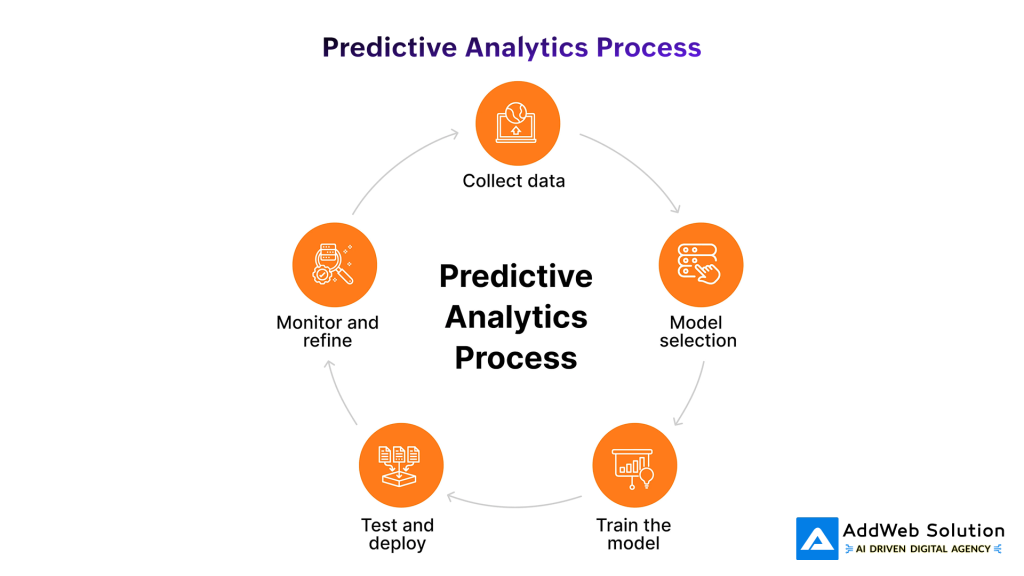
The predictive analytics process involves collecting data, selecting a model, training it, deploying, and continuously refining for improved accuracy
For WooCommerce merchants trying to figure this out, the real challenge isn’t attracting eyeballs. It’s converting those eyeballs into actual revenue. And this is where things get genuinely interesting, because technology has finally caught up to the problem in a meaningful way.
Forget crystal balls. Predictive analytics is something better. It’s like having access to a playbook of what your customers will do before they actually do it. It’s powered by real data, patterns your brain could never spot manually, and algorithms that learn and adapt every single day. By 2026, this isn’t some futuristic fantasy anymore. It’s accessible, it’s affordable, and honestly, it’s becoming the difference between stores that are crushing it and stores that are just treading water.
The Conversion Problem That Keeps Everyone Up at Night
Let me hit you with something sobering: the average online store converts around 1.89% of its visitors into paying customers. Think about that for a second. Out of every hundred people who visit your store, almost ninety-eight leave without buying a single thing. For a store getting ten thousand monthly visitors, that’s only about 189 customers. For stores getting a hundred thousand visitors? Roughly 1,890 conversions.
On mobile, which is now responsible for more than half of all ecommerce traffic—conversion rates are even grimmer. They’re hovering around 1.8% while desktop manages a slightly better 3.9%. The tablet sits somewhere in the middle at 2.5%.
But here’s what’s actually fascinating about the funnel breakdown: every single stage of the buying process is a hemorrhage point. Say you get 1,000 people landing on a product page (good job, by the way). Only about 450 of them actually add something to their cart. That means 550 people didn’t even think your product was worth putting in a shopping cart.
Then the real brutal part happens. Of those 450 cart additions, only 280 people make it to your checkout page. Some probably saw your shipping costs and went “oh hell no.” Others got distracted. Some are still comparison shopping and came back to your site just to check something.
By the time people enter their payment information, you’re down to 190. Less than half made it this far. And that final step—actually completing the transaction and hitting the payment button? Only 95 out of the original 1,000 actually do it. That’s a 9.5% final conversion rate.

WooCommerce conversion funnel showing customer drop-off at each stage, from initial product views to final purchase completion
Every single drop-off point represents real money. Real customers who were interested enough to visit, interested enough to check out your products, but not interested enough to actually spend their hard-earned cash with you.
The brutal truth? Most store owners don’t even know why people are leaving. They just watch the numbers and wonder where they went wrong.

Additional
Read

- Transform Your Store Built on the WordPress Platform into a Smart Storefront
- Not Just a Plugin: Why WooCommerce Feels Like a Full-Stack E-Commerce System
So What’s Predictive Analytics Actually About?
People throw this term around like it’s some magical black box technology that only MIT graduates understand. Let me demystify it because honestly, it’s more straightforward than the mystery sounds.
Predictive analytics is basically your store’s ability to look backward at tons of historical information—what your customers bought, how long they spent on pages, what they browsed, when they came back, seasonal patterns, pricing responses—and then use that information to make educated guesses about the future.
It’s not guessing like “ehhh, I think more people will shop in December.” It’s sophisticated analysis that can tell you: “Customers who spend more than 90 seconds on the product page, click on the zoom feature to examine details, and check the reviews are 67% likely to purchase within the next 24 hours.”
That’s the real power. Not prediction in a woo-woo sense. Prediction in a statistical, numbers-backed sense.
The interesting part? Modern AI models doing this work achieve accuracy rates between 90-95% when they’re forecasting customer purchases and behavior patterns. Your gut feeling? That usually tops out around 60-70% accuracy at best.
Real Numbers from Real Stores
Let’s talk about what actually happens when stores embrace this technology. We’re not dealing in hypotheticals here.
Businesses that implement predictive analytics don’t just see incremental improvements. We’re talking about the kind of changes that actually move the needle on revenue.
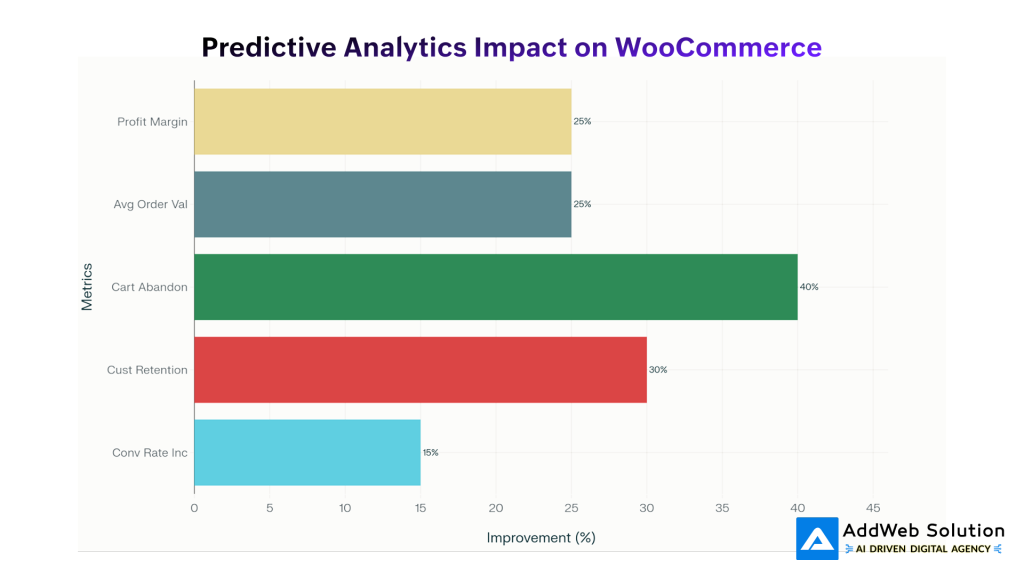
Key performance improvements achieved through predictive analytics implementation in WooCommerce stores, with cart abandonment showing the highest reduction at 40%
Here’s what the numbers actually look like:
• Cart abandonment drops by 40-60% — That’s not slight improvement. That’s transformational. Think about recovering even a fraction of those people who got 95% of the way through your checkout process. If you’re a mid-sized store currently losing $50,000 yearly to abandoned carts, a 40% reduction is $20,000 in recaptured revenue. Without spending extra money on advertising.
• Customer retention improves by 30% — The system identifies customers who are getting ready to disappear before they actually disappear. Instead of wondering why your repeat purchase rate is lower than you’d like, you’re actively preventing people from churning.
• Your average order value climbs 20-40% — When the right products get recommended to the right person at the right time. This isn’t aggressive upselling that annoying customers. This is “oh wow, that person is interested in blue running shoes, and people who buy those shoes also buy orthotics 60% of the time, so let me show them related orthotics.” It feels helpful, not pushy.
• Profit margins improve by 25% — Through smarter pricing and inventory management. You’re not sitting on dead stock that becomes a write-off. You’re not missing out on sales because you ran out of inventory.
• Conversion rates increase 15% or more — Across the board when everything combines together—better product recommendations, smarter cart recovery, genuine personalization, and pricing that makes sense.
Real-world example: An online fashion retailer implemented predictive analytics and within six months they saw:
- Average order value jumped 22%
- Cart abandonment dropped 18%
- Inventory that used to sit dead decreased by 30%
- Repeat purchases from at-risk customers went up 12%
They didn’t change their product mix. They didn’t redesign their website. They just started making better decisions based on data.
How Actually Implementing This Works
Let me break down the practical ways stores are applying this technology right now.
Product Recommendations That Don’t Feel Robotic
Amazon generates roughly 35% of its revenue from its recommendation engine. Not 3.5%. Thirty-five percent. That single feature is basically a cash printing machine for them. And it works because it’s built on predictive analysis—understanding what customers want before they know they want it.
When your WooCommerce store can recognize that people who bought the blue model of a product also viewed the green model, then usually checked out the accessories, then come back three days later to purchase the premium version—those patterns become incredibly valuable. You’re not guessing anymore. You’re pattern matching at scale.
Modern recommendation systems actually look at stuff like:
- How fast someone scrolls (engagement level)
- Where they’re clicking
- How long they hover over prices
- Whether they’ve added things to wishlists before
- What time of day they’re browsing
All of that combines into a profile of what this specific person is likely to find interesting. It adapts in real-time too, which means the recommendations improve the more they’re used.
Distribution of predictive analytics use cases in WooCommerce stores, showing product recommendations as the most adopted application at 35%
Inventory That Actually Makes Sense
Here’s a problem almost nobody talks about: the silent profit killer of overstocking. Buy too much of something and it becomes dead weight. Buy too little and you miss out on sales. Your competitors probably had the same constraint as you did this month, but they figured out the inventory equation better.
Predictive systems eliminate this guessing game by analyzing:
- Historical sales data
- Seasonal patterns
- Competitor pricing movements
- Upcoming events or trends that might affect demand
- Supply chain variables
Stores using demand forecasting report:
- Making 5-15% more profit on the same sales volume (no dead inventory)
- Customer retention goes up 5-10% (people aren’t disappointed by out-of-stock messages)
- Better cash flow management
- Reduced storage costs
Pricing That Moves with the Market
Static pricing is basically giving money away in today’s environment. Markets change every day. Competitors adjust their prices constantly. Customer demand fluctuates based on everything from weather to what went viral on social media.
Dynamic pricing powered by machine learning lets your prices adjust automatically in response to real market conditions:
How it works:
- High demand + low stock → Prices move up to protect margin
- Slow movement + approaching inventory deadline → Prices adjust downward to move units
- Competitor drops their price → Your system detects and responds intelligently
- Seasonal demand spikes → Automatic price optimization
This isn’t aggressive algorithm-based gouging that makes customers angry. It’s subtle adjustments that make mathematical sense. Amazon saw 25% profit improvements using dynamic pricing. Even smaller WooCommerce stores are reporting 15-37% revenue increases within the first month of implementing it thoughtfully.
Understanding Your Customers Beyond Demographics
Here’s the thing about generic email marketing blasts—customers recognize them immediately. They know they’re getting a copy-paste message that was sent to fifty thousand other people. It’s noise.
Predictive segmentation goes way deeper than “customers from California” or “customers aged 25-34.” It uses RFM analysis (Recency, Frequency, Monetary value) to actually understand who your real power users are versus your occasional browsers versus your price-conscious deal hunters.
Your customer segments look like this:
▪️ Champions — Buy regularly, spend good money, totally loyal. Invest in keeping them happy.
▪️ Potential Loyalists — Could become Champions with the right engagement. Worth nurturing.
▪️ At-Risk Customers — Used to buy but haven’t returned recently. They need a win-back campaign.
▪️ Price Shoppers — Only convert during sales. Different strategy needed.
Deliver personalized experiences that grow revenue in 2026 with WooCommerce insights

Pooja Upadhyay
Director Of People Operations & Client Relations
Cart Abandonment Recovery That Actually Works
Seventy percent of carts get abandoned. That’s not a typo. Seven out of ten people who put items in a cart don’t finish the purchase. The reasons are all over the place:
- Surprise at shipping costs
- Got distracted
- Decided to compare prices elsewhere
- Payment method issues
- Performance concerns with checkout taking too long
But here’s where it gets smart: predictive systems analyze what happened in each specific abandonment:
Key signals the system tracks:
- First-time visitor or returning customer?
- Did they add a discount code?
- How much time did they spend entering payment info?
- What device were they using?
- Where did they get stuck in the process?
Based on those signals, the system triggers personalized recovery sequences:
- Email with discount code to someone who looked at prices
- SMS to mobile users (usually better response rates)
- Live chat support to someone who seemed confused
- Retargeting ads to people who just got distracted
The timing gets optimized too. Some customers want to be reminded immediately. Others respond better to follow-ups 6-12 hours later. Machine learning figures this out automatically.
Result? Recovering 15-30% of abandoned carts, which is basically free money you were previously leaving on the table.
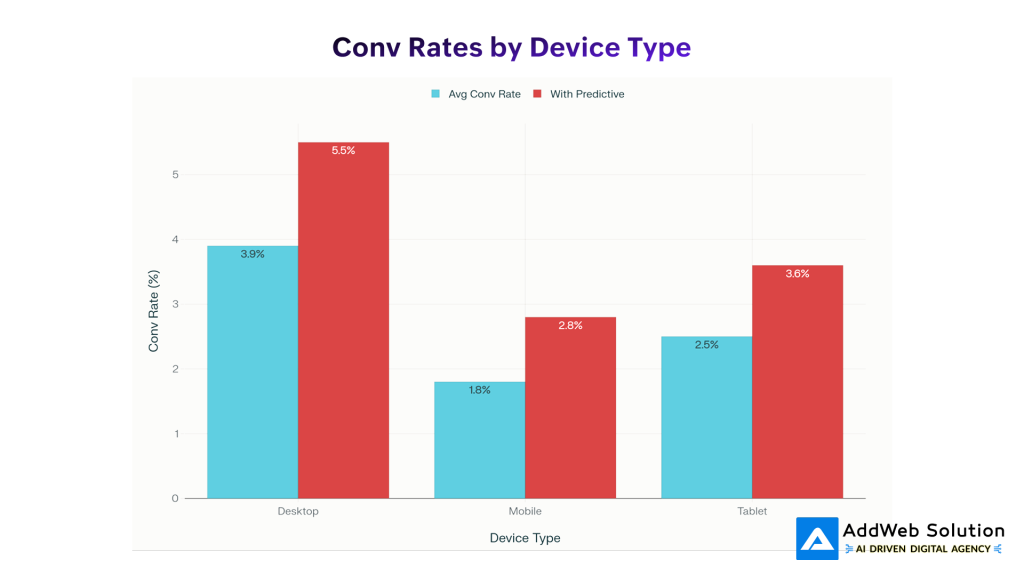
Comparison of WooCommerce conversion rates across devices, showing significant improvements when predictive analytics is implemented
The breakdown:
- Desktop: 3.9% → 5.5% (40% improvement)
- Mobile: 1.8% → 2.8% (56% improvement)
- Tablet: 2.5% → 3.6% (44% improvement)
Notice how predictive analytics lifts conversion rates across all devices. That’s an improvement without needing to spend more on advertising.
Making This Actually Happen: Your Real Roadmap
Here’s what the timeline actually looks like when you implement this technology—not the fantasy version, the realistic one.
Months 1-3: Foundation Building
- You’re getting your hands dirty with data integration
- Setting up tools, connecting WooCommerce data streams, configuring systems
- It’s not glamorous
- You’re not seeing immediate returns because systems are still learning
- But you’re building the foundation everything else will stand on
- Expect zero ROI during this phase—you’re investing in infrastructure
Months 4-6: Quick Wins
- Initial insights bubble up from your data
- Quick wins appear—basic recommendations, customer segmentation, early cart recovery
- Usually generate 8-10% ROI (low-hanging fruit)
- You’re learning what works with your specific customers
Months 7-9: Strategic Integration
- System has enough data and tuning
- Insights become reliably actionable
- Making strategic decisions based on predictive patterns instead of hunches
- Multiple systems working together
- ROI climbs to around 15%
Months 10-12: Compound Returns
- Everything compounds together
- You’ve optimized based on months of learnings
- System knows your customer base intimately
- Multiple revenue-generating systems running in parallel
- 22%+ total ROI
- System just getting warmed up

ROI growth trajectory over the first 12 months of predictive analytics implementation in WooCommerce stores
The gradual climb shows realistic expectations:
- Month 1-3: Building foundation (0% ROI)
- Month 6: 8% returns
- Month 9: 15% returns
- Month 12: 22%+ returns
- System accelerates as it learns
Picking the Right Tools
WooCommerce merchants have several legitimate options.
Metorik is purpose-built for WooCommerce specifically. It does comprehensive analytics, customer segmentation, forecasting, and tracks subscription metrics like monthly recurring revenue and churn rate. The interface is actually intuitive for non-technical people. Pricing starts around $20 monthly and scales with your business.
DataCue focuses specifically on real-time personalized product recommendations and banners, adapting to individual shopping patterns as they happen. It’s narrowly focused but really good at what it does.
Google Analytics with Enhanced Ecommerce is cheaper (often free if you’re already using it) but requires more manual configuration to unlock predictive features. Works for stores just getting started.
UpsellWP specifically targets predictive upselling by analyzing what people bought and browsed to suggest relevant add-ons at smart moments.
AI Product Recommendations plugins use OpenAI technology to generate intelligent suggestions without manual configuration. Modern and effective if recommendations are your main priority.
The key isn’t finding the “best” tool. It’s matching the tool to your specific problems. A store bleeding customers to churn needs different capabilities than one struggling with inventory or low conversion rates.
Starting with Clear Objectives
Don’t just install technology and hope something good happens. That’s like buying gym equipment and expecting abs.
Before you start:
- What specific problem are you trying to solve? Is it cart abandonment? Low repeat purchase rates? Inventory management costs? Mobile conversion rates? Pick one thing initially.
- What would fixing this problem be worth to your business? If recovering 30% of abandoned carts is worth $20,000 yearly, that changes your ROI calculation.
- What data do you actually have access to? Complete purchase histories? Browsing behavior? Customer demographics? Dynamic pricing only makes sense if you have solid historical sales data.
- Who on your team will own this? Predictive analytics isn’t something you set-and-forget. Someone needs to check results, interpret insights, and make adjustments.
Data Quality Actually Determines Everything
This can’t be overstated: garbage data equals garbage predictions, no matter how sophisticated the AI is.
Before diving in, make sure you’re capturing:
- Complete purchase histories with accurate timestamps and customer identification
- Browsing behavior (what pages were visited, how long, what order, search terms used)
- Cart activity including what was added, removed, abandoned
- Customer information (email, location, device type, first-time vs. returning)
- Product interaction data (reviews read, ratings viewed, wishlists, comparisons)
- Marketing attribution (where did they come from, which campaigns, which emails)
Clean, well-integrated data sources feed accurate predictions. Messy, incomplete data creates confident-sounding but completely wrong predictions.
The Incremental Approach Actually Works Better
You don’t need to implement everything simultaneously. The smartest stores start with one high-impact use case:
Week 1-4: Install a recommendation engine on product pages and watch what happens.
Month 2: Test automated cart abandonment recovery via email. Measure recovery rate.
Month 3: Implement basic customer segmentation. Run targeted campaigns to different groups.
Month 4: Add predictive inventory alerts for best-selling products.
Month 5: Experiment with dynamic pricing on select SKUs. Measure revenue impact.
Monitor each step closely. Once you validate one application generates real ROI, expand to the next. This reduces risk and builds internal confidence in the technology.
What Success Actually Looks Like Right Now
WooCommerce isn’t the startup darling anymore—it’s the established powerhouse. It owns 38.76% of the ecommerce platform market. Over 6 million stores run on it. These stores collectively generate about 7% of global online sales. What’s remarkable is the store retention rate—92% of merchants who try WooCommerce stick with it. That’s up from 85% two years ago, and that improvement is partly because merchants are discovering tools and techniques that actually work to grow their business.
The stores performing above the typical 2-4% conversion rate aren’t necessarily spending more on advertising or carrying better products. They’ve just tightened the entire customer experience using data-driven decisions:
✦ Know which visitors will convert before the visitor knows
✦ Show the right product at the right moment
✦ Recover abandoned carts with precision instead of crossed fingers
✦ Price products to maximize both volume and margin
✦ Identify at-risk customers before they leave
✦ Personalize every touchpoint based on actual behavior
The technology itself keeps getting better. AI-powered systems now process billions of data points in real time to create uniquely optimized experiences for each individual visitor. Soon voice commerce integration and conversational checkout will shift optimization efforts from visual design to auditory interaction. Omnichannel consistency—seamless experience across web, app, social, and maybe even physical touchpoints—is coming next.
The Technology Amplifies Your Judgment; It Doesn’t Replace It
Here’s something worth remembering: predictive analytics isn’t about removing humans from decisions. It’s about removing blind spots.
The most successful implementations combine machine learning processing power with actual merchant intuition. The AI handles the heavy lifting:
→ Processing thousands of signals per second
→ Identifying patterns no human could ever spot
→ Optimizing across countless variables simultaneously
Your job shifts. You’re not manually analyzing spreadsheets for hours anymore. You’re interpreting what the data reveals and deciding how to strategically act on those insights. You’re still:
→ Writing compelling product descriptions
→ Providing excellent customer service
→ Building brand trust and customer relationships
Technology makes you better at these things by giving you information instead of forcing you to guess.
The Moment When Everything Clicks
The stores winning in 2026 won’t be the oldest or the biggest. They’ll be the ones that learned to see around corners. To anticipate customer needs before the customer even fully realizes they have that need. To create experiences that feel naturally personalized because they are.
Predictive analytics gives you that capability. Not as some sci-fi fantasy that lives in the future. But as practical toolkit available right now for WooCommerce stores of any size. The investment—whether in money, technical effort, or organizational learning—pays for itself within months through measurably better conversions, retention, and profitability.
The actual question isn’t whether predictive analytics works. The evidence on that is overwhelming.
The real question is whether you’re ready to move from just reacting to store metrics and wondering why they are the way they are, to actively predicting what will happen and steering customer journeys strategically.
Because while you’re deliberating, your competitors are already implementing.
Every single click still matters. But now you can predict which ones will turn into purchases, which ones need a nudge, and which ones were probably never going to close anyway. That knowledge changes everything.
Reference Link:
https://woocommerce.com/posts/conversion-rate-optimization-for-woocommerce/
https://woocommerce.com/products/product-recommendations/
https://woocommerce.com/products/dynamic-pricing/
https://woocommerce.com/lp/commerce-insights-report/
https://matomo.org/blog/2025/09/ecommerce-analytics-tools/
https://wordpress.org/plugins/metorik-helper/
https://n8n.io/workflows/4880-segment-woocommerce-customers-for-targeted-marketing-with-rfm-analysis/
