


The intersection of Laravel and artificial intelligence really transformed the way development teams shipped intelligent applications. What used to take months of complicated backend infrastructure and machine learning knowledge can now be done in weeks by leveraging Laravel’s elegant architecture along with accessible AI services.
With 78% of organizations globally already adopting AI in at least one business function, those businesses that do not integrate intelligent features run the risk of falling behind any competitor who does so more quickly. The significant advantage for Laravel developers is that they can bridge this gap without having to leave the framework they know and love, while combining rapid development cycles with enterprise-grade AI.

Enterprise AI Adoption Growth Trajectory (2017-2025)
The Current AI Landscape and Why Speed Matters
The business imperative to adopt AI has never been clearer. Globally, enterprise AI adoption soared to 78% in 2024–2025, up dramatically from just 20% in 2017. This acceleration reflects a fundamental shift: AI is no longer an experiment for tech-forward companies; it’s table stakes across industries. Technology is seeing 88% of the companies report generative AI in active use, trailed closely by professional services at 80%, and advanced industries at 79%.
What fuels this rampant adoption? The answer is two-fold: business impact and developer accessibility. Businesses are finding real-world ROI with AI-powered features—chatbots that reduce support costs, recommendation engines driving revenue, and predictive analytics lowering churn. Meanwhile, the democratization of AI via APIs has made these capabilities available to teams of any size. Gone are the days when you needed a PhD in machine learning; you need a framework that lets you ship fast.
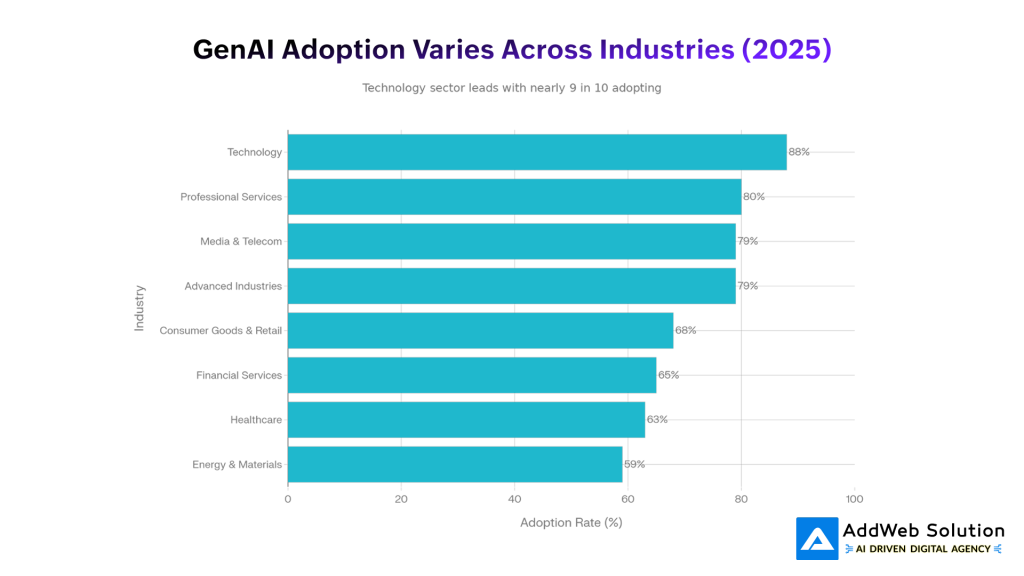
GenAI Adoption by Industry Sector (2025)
This context is critical for Laravel developers. 70% of startups using Laravel reported time-to-market 50% faster compared to other frameworks. And when you combine the legendary development speed of Laravel with the transformational power of AI, you get teams delivering intelligent products that competitors can’t match in the time it takes to build basic CRUD apps.
Why Laravel Can Be Your Secret Weapon for AI Integration
Laravel wasn’t designed for AI originally, yet it has emerged as one of the most pragmatic frameworks for building AI-powered products. That isn’t an accident: because Laravel puts great stock in developer ergonomics, and building with AI demands clarity, modularity, and tooling that gets out of the way.
RESTful APIs and Service Integration
Laravel excels at one of the core requirements for AI development: seamless integration with external services. Modern AI services—OpenAI, Google Cloud AI, Hugging Face, AWS Bedrock—expose their capabilities through REST APIs. Laravel’s HTTP client, Guzzle, and its built-in handling of request/response objects make using these APIs feel organic rather than bolted on.
This simplicity scales. Whether you’re calling OpenAI, Claude, or a custom model through a Python microservice, Laravel’s consistent HTTP patterns mean you write cleaner, more maintainable code.
Model-View-Controller Architecture for AI Workflows
Laravel’s MVC pattern provides clear separation between AI logic, business rules, and presentation. In AI-powered applications, this structure becomes invaluable. Your controller handles the HTTP request, your service class orchestrates the AI call, and your view renders intelligent results. No tangled dependencies, no unclear data flow.
A typical workflow for Laravel AI is as follows:
Controller → Receives user request (chatbot message, form submission)
Service → Call AI API, process response, apply business rules
Model → Stores interaction history, retrieval context, user preferences
View → Displays AI output with fallbacks and error handling
This separation also makes testing a whole lot easier. You can mock AI responses, test your business logic in isolation, and catch edge cases before they see the light of day.
Job Queues and Asynchronous Processing
Not all AI operations return instantaneously. Image generation, large language model fine-tuning, batch embeddings—they just take a while. Laravel’s queue system, backed by Redis or RabbitMQ, or even sync for development, allows you to offload heavy AI operations to background jobs without blocking user requests.
Imagine a content moderation system: the user uploads an image, Laravel immediately returns a success response, and then dispatches a job to make the AWS Rekognition call for content analysis. When complete, store the result and notify the user. To users, it’s instant feedback; to your app, the AI call runs on its schedule.
Event Broadcasting and Real-Time AI
For applications requiring real-time AI features—live chat assistants, real-time sentiment analysis, collaborative document co-generation—the event broadcasting system in Laravel, along with WebSockets, provides a clean, declarative way to stream AI responses to users.
Laravel Reverb is the new managed WebSocket solution in Laravel that lets you enable real-time communication at 50% of the cost compared to third-party solutions. In a chatbot that streams ChatGPT’s responses as they are generated in real time, instead of polling an endpoint, this changes the user experience to true streaming updates.
Building Specific AI Features: From Concept to Production
Intelligent chatbots
Use Case: Customer support, product guidance, internal knowledge assistants.
Laravel, quite surprisingly, makes building production-grade chatbots quite accessible. The BotMan package provides native Laravel integration with OpenAI and Dialogflow, as well as custom models. You define conversation flows, Laravel handles the routing, and AI handles the intelligence.
It takes care of real-time UI updates without you having to involve another JavaScript framework. The chat feels immediate; the state is handled by Laravel with ease. Add on context injection-essentially, pulling relevant documentation or previous tickets-and you build out an advanced support bot much more quickly than you’d imagine.
AI-powered recommendation engines
Use Case: E-commerce product recommendations, content personalization, job matching.
Traditional recommendation systems rely on collaborative filtering or content-based algorithms. Modern AI-powered recommendations use vector embeddings—semantic representations of products, articles, or users that make similarity matching almost trivial.
Here’s how Laravel teams can build that:
- Use OpenAI’s embedding API to get the embeddings for each product/article.
- Store embeddings in Postgres with the pgvector extension, or any vector database
- Query for similar items using vector similarity searches
- Blend ML scores with business rules (respecting stock, margins, compliance)
The Laravel code is pretty simple. You create a service that will pre-make and store the embeddings, then query, using Laravel Scout-integration with Algolia, MeiliSearch, or other search engines-or direct database queries.
The impact? Companies using AI-powered recommendation systems see 25% higher engagement and 15–30% revenue lift. Laravel lets you ship this weeks faster than custom machine learning infrastructure.


Predictive and Intelligent Forms
Use Case: Lead Qualification, Dynamic Surveys, Suggesting Form Fields.
AI form builders have gotten great results: a 25% increase in completion rates, a reduction of 30% in manual effort, and a 50% increase in qualified leads. Similar systems can be built using AI by Laravel developers to suggest form fields, intelligently validate entries, and route the submissions intelligently.
Architecture involved:
frontend-Vue.js, React or Blade that will dynamically present form fields
Backend Service → Calls AI to analyze user input and suggest next fields
Validation Layer: Uses AI for semantic validation, not just regex patterns
Routing Logic → AI decides which team/department should handle this submission.
This is transforming static forms into conversations. A user starts typing and your form starts asking progressively smarter questions. Completion rates skyrocket because the experience just feels personal, and slick.
Real-time generation and transformation of content
Use Case: Email personalization, dynamic landing pages, summarizing content.
That’s where Laravel’s queued jobs shine. A user triggers an action-applying a request for a summary or personalizing a template, for example-Laravel then queues a job that calls an AI API, stores the result, and notifies the user. From the user’s perspective, all this feels instant.
Example: An e-commerce site generates personalized email campaigns by:
- User triggers campaign creation
- Laravel will queue one job per customer segment.
- Each position creates customized subject lines and copy using OpenAI
- The results are saved in the database for future times.
- Campaign ready to send in seconds
The beauty? That makes for natural parallelization across queue workers within Laravel. Send 10,000 personalized emails in the time that it would take to generate one serially.
The Business Impact: Metrics That Matter
Numbers tell the story better. For teams integrating Laravel with AI, several gains are reported along multiple dimensions:
Development Speed
The most consistent metric would be 50% faster time-to-market. Startups using Laravel ship features that would take competitors months to build in weeks. This advantage compounds when AI is added, which further reduces boilerplate (no ML training needed, just API calls).
Or in other words, content marketing tools, which classically would have to build up search, recommendation, and personalization algorithms from scratch, are now able to use Laravel and OpenAI APIs to ship in 6 weeks instead of 6 months.
Cost Efficiency
Laravel itself is free. No licensing. Typical Laravel developer costs 20–40% less than specialized ML engineers. You’re not hiring research scientists; you’re hiring skilled backend engineers who understand how to integrate services efficiently.
Real-world example: A fintech company built a custom admin panel and billing system using a Laravel agency. Total cost: $28,500 over 12 weeks. A traditional software development house would have quoted $60,000+. The difference? Laravel’s ecosystem eliminated weeks of boilerplate development.
Maintenance and Scalability
30% decrease in maintenance cost comes from the clean architecture of Laravel and the fact that AI logic is externalized. You are not maintaining training pipelines; you are maintaining API integrations, which are way simpler.
And scaling? Laravel Vapor – serverless deployment and Laravel Octane – high-performance application server let your AI-powered app handle 400% more concurrent requests while shaving 60% off your infrastructure costs. An app serving 1,000 concurrent users today can handle 4,000 tomorrow without code changes.
User Impact Metrics
For end users, the benefits manifest clearly:

These aren’t incremental gains. They’re business-changing metrics.
Laravel AI Tools and the Developer Ecosystem
The Laravel ecosystem has evolved rapidly to support AI integration. Instead of manual HTTP calls, developers now have purpose-built tools:
Native Laravel AI Packages
openai-php/laravel – Official wrapper for OpenAI API, includes caching and rate-limiting out of the box
Laravel Boost – AI-powered coding assistant that understands your Laravel codebase and suggests implementations
Laravel MCP – Model Context Protocol integration for building AI-aware applications that work with modern LLMs
Development Environment Tools
GitHub Copilot – Real-time code suggestions as you type, trained on billions of open-source Laravel projects
Cursor – AI-first code editor that understands your entire Laravel project, enables agent-mode execution, and reduces development time significantly
Laravel Telescope – Debugging tool that now includes AI-powered recommendations for query optimization and performance issues
Deployment and Infrastructure
Laravel Forge/Vapor – Managed hosting that abstracts infrastructure complexity. Vapor specifically enables serverless deployment, meaning you pay only for what you use (critical for AI API call costs)
Laravel Octane – High-performance application server. Paired with Redis caching, it enables efficient handling of AI response caching, reducing redundant API calls
Practical Implementation: Getting Started Today
For teams ready to build, here’s the pragmatic path:
Week 1: Set Up and Integrate First API
- Create a new Laravel project: composer create-project laravel/laravel ai-app
- Install the OpenAI package: composer require openai-php/laravel
- Configure your API key in .env
- Build a simple form → AI API call → result display flow
This teaches you the pattern. All subsequent integrations follow the same structure.
Week 2–3: Build Your Core Feature
Whether it’s a chatbot, recommendation engine, or intelligent form:
- Define the user journey
- Identify where AI adds value (usually in content generation, analysis, or personalization)
- Choose your AI provider (OpenAI, Anthropic Claude, Google Gemini, open-source via Hugging Face)
- Implement using Laravel’s established patterns
- Add caching to reduce API costs (Redis or LaravelCache)
Week 4: Production Hardening
- Add error handling – AI APIs fail sometimes; graceful degradation is essential
- Implement rate limiting – Protect your API quota and user experience
- Set up monitoring – Track API call latency, cost, and error rates using Laravel’s logging
- Add security – Validate user input, encrypt sensitive data, use environment variables for secrets
- Deploy with confidence – Use Laravel Vapor for serverless or Laravel Forge for traditional hosting
Security and Compliance: Non-Negotiable Considerations
Building AI products in Laravel requires attention to security that many tutorials gloss over. When handling sensitive data—user inputs sent to AI APIs, AI-generated outputs stored in databases, personal information used for personalization—security becomes a business-critical concern.
Data Privacy and API Security
Never send sensitive customer data to third-party AI APIs without explicit consent. If your chatbot needs context about a user’s account, pass anonymized data or use private, self-hosted models.
Store API keys in environment variables, never in code. Rotate keys regularly. Monitor API usage for unusual patterns that might indicate compromise.
Compliance (GDPR, HIPAA, etc.)
Depending on your industry and user base, regulations require specific safeguards:
- GDPR (EU users): Ensure AI processing is documented, implement data deletion on request
- HIPAA (healthcare): Use only HIPAA-compliant AI providers (AWS HealthLake, specialized services)
- PCI-DSS (payment data): Never send payment information to external AI APIs
Companies that fully meet compliance requirements spend $1.2 million less on average when a breach occurs, according to research. The investment in security pays for itself.
Model Transparency and Explainability
When an AI system makes consequential decisions—denying credit, filtering content, routing support tickets—users deserve to understand why. Design your Laravel application to log AI reasoning, store confidence scores, and provide humans with override capabilities.
Overcoming Common Challenges
API Cost Management
OpenAI API calls, while cheap at scale, add up. Implement caching aggressively. Cache ChatGPT responses for identical queries, cache embeddings, cache classification results.
For high-volume applications, this cuts API costs by 40–60%.
Latency and User Experience
AI API calls typically take 1–5 seconds. Don’t block user interactions waiting for responses. Queue the AI work, return immediately to the user, and update when complete using WebSockets or polling.
Model Selection and Reliability
Start with proven models. GPT-3.5-turbo costs less and performs well for most tasks. GPT-4 offers higher quality but costs more. Anthropic’s Claude excels at reasoning. Open-source models (Llama 2, Mistral) via Hugging Face reduce vendor lock-in.
Never rely on a single API provider. Build abstraction layers so switching between OpenAI, Claude, and others requires only configuration changes, not code refactors.
Start building smarter Laravel apps today! Scalable AI-powered features await your next release.

Pooja Upadhyay
Director Of People Operations & Client Relations
The Future: Where Laravel and AI Are Heading
The trajectory is clear. In 2025 and beyond, expect:
Native Laravel AI packages that handle common patterns (embeddings, semantic search, conversational memory) out of the box
Tighter integration with LLM frameworks – Laravel developers will use ReAct agents and similar patterns as first-class features, not bolted-on experiments
Cost-efficient private models – As open-source models improve, more teams will self-host, reducing dependency on expensive APIs
AI-native development tools – GitHub Copilot and Cursor will understand Laravel-specific patterns so deeply that suggesting entire features becomes normal
Regulatory maturity – Clear compliance guidelines for AI in different industries will make building responsibly straightforward instead of ambiguous
Conclusion: The Time to Build Is Now
Laravel in the age of AI isn’t about learning new frameworks or hiring different talent. It’s about leveraging the framework and team you already have, amplified by AI’s transformative capabilities. Teams building chatbots, recommendation engines, and intelligent user experiences with Laravel report shipping 50% faster and maintaining 30% lower costs than teams using other approaches.
The competitive advantage is temporary. As AI adoption approaches 80% of global enterprises, the question isn’t whether to build AI-powered products—it’s whether you can build them fast enough. Laravel, combined with pragmatic use of modern AI APIs, gives you that edge.
Start small. Pick one feature where AI adds clear value. Integrate an API. Ship to users. Learn from their feedback. Iterate. The path to building intelligent products is no longer mysterious—it’s clear, well-documented, and increasingly accessible to Laravel teams of any size. The frameworks, tools, and APIs are ready. The only question left is: are you ready to ship?
⁂
- https://www.hostinger.com/in/tutorials/how-many-companies-use-ai
- https://learn.g2.com/ai-adoption-statistics
- https://survey.stackoverflow.co/2025/ai
- https://laravel.com/blog/introducing-websockets-for-laravel-cloud-powered-by-laravel-reverb
- https://laravel.com/blog/introducing-laravel-mcp-build-with-the-universal-ai-standard
- https://www.forbes.com/sites/bernardmarr/2025/06/03/mind-blowing-ai-statistics-everyone-must-know-about-now-in-2025/
- https://explodingtopics.com/blog/companies-using-ai
- https://www.reddit.com/r/laravel/comments/j7a5we/what_do_you_use_to_speed_up_your_development_in
