


Business analysts, marketers, and domain experts currently build sophisticated AI solutions without writing code. This transformation is powered by Python’s AutoML revolution, which tears down technical barriers that have long made the development of AI the preserve of specialist programmers.
The market for AutoML is set to reach $10.5 billion by 2026, which is a 32.6% YoY increase. Those organizations that have put AutoML platforms into place are reporting that model development times are reduced by 60-80% compared to traditional methods. That’s not just about speed; that’s about fundamentally reimagining who gets to participate in the AI revolution.

AutoML market size is projected to grow from $5.43 billion in 2024 to $24.42 billion by 2030, demonstrating explosive adoption.
Why Python Powers the No-Code AI Movement
Python has evolved from 8.5% to 26.14% in the TIOBE rating for 2020 and 2025, respectively, to become the undisputed leader of AI and Machine Learning, now powering over 51% of all data science projects in the world. This explosive growth could be reflected in the machine learning market, expected to reach $113.10 billion in 2025.

No-code machine learning platforms in 2025 ranked by simplicity, usability, and completeness of use cases.
But what really makes Python so powerful is its ability to abstract away complexity without being limited in capability. This accessibility has democratized AI development, allowing professionals of all kinds to build complex models without extensive programming backgrounds. The job market certainly reflects this demand-1.25 million ML positions are currently open worldwide, with senior Python developers commanding salaries from $120,000 to $200,000.
Understanding AutoML: The Democratization Engine
AutoML automates the tedious tasks of model selection, training, and optimization. Traditional workflows require domain experts to execute some manual data preprocessing, feature engineering, algorithm selection, and hyperparameter tuning that could take months.
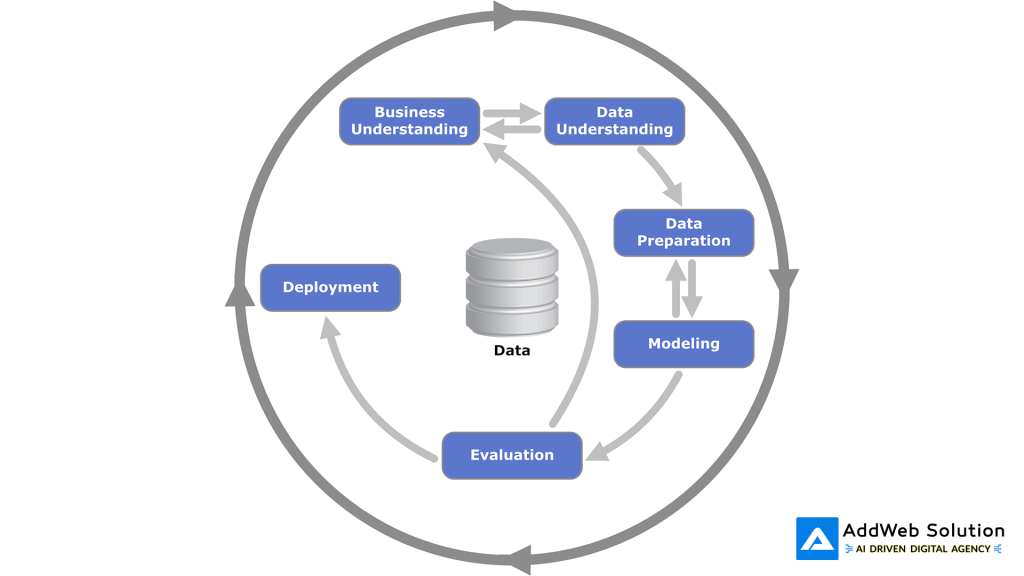
AutoML workflow showing the iterative process from business understanding to deployment, with focused data handling and modeling steps.
Automating all of this pipeline down to days or hours, AutoML platforms represent important automation in:
- Data Preprocessing: Handling missing values, outliers, and normalization on its own; believed to take up to 60-70% of a data scientist’s time.
- Feature Engineering: It automatically creates and transforms features in order to identify which of the variables has more predictive power.
- Algorithm Selection: Trains multiple models and then automatically selects which works best.
- Hyperparameter Optimization: Automatic model parameter tuning using Bayesian optimization.
- Model Validation: Automates cross-validation and provides robust, production-ready solutions..
In other words, business teams using AutoML independently deploy as many as 3.5 times more predictive models per year than business teams relying on traditional data science support.
Leading Python AutoML Libraries

Comparative analysis showing PyCaret leads in ease of use, while H2O AutoML and AutoGluon excel in performance.
The most accessible option for starters, PyCaret is allowing users to execute an entire ML workflow in a few lines of code. It currently supports more than 100 models with 8.1K GitHub stars and 3.9 million downloads, providing automated feature engineering.
AutoGluon, from AWS represents, currently, the state-of-the-art performance. AutoGluon with a 5-minute training budget outperforms all other AutoML systems given a full hour. It excels on difficult tasks involving multimodal data: images, text, and tabular information.
H2O AutoML focuses on enterprise deployments, with currently 10.6K GitHub stars and 15.1 million downloads. It is strong on big data, with integrations with Hadoop, Spark, and Kubernetes.
TPOT uses genetic programming for automatic pipeline optimization, reaching 97% accuracy on an Iris dataset and 98% on MNIST.
Auto-sklearn works with Python’s standard ML library and, thus, finds favor in academic circles, especially when reproducibility is a factor.
No-Code Platforms for Non-Programmers
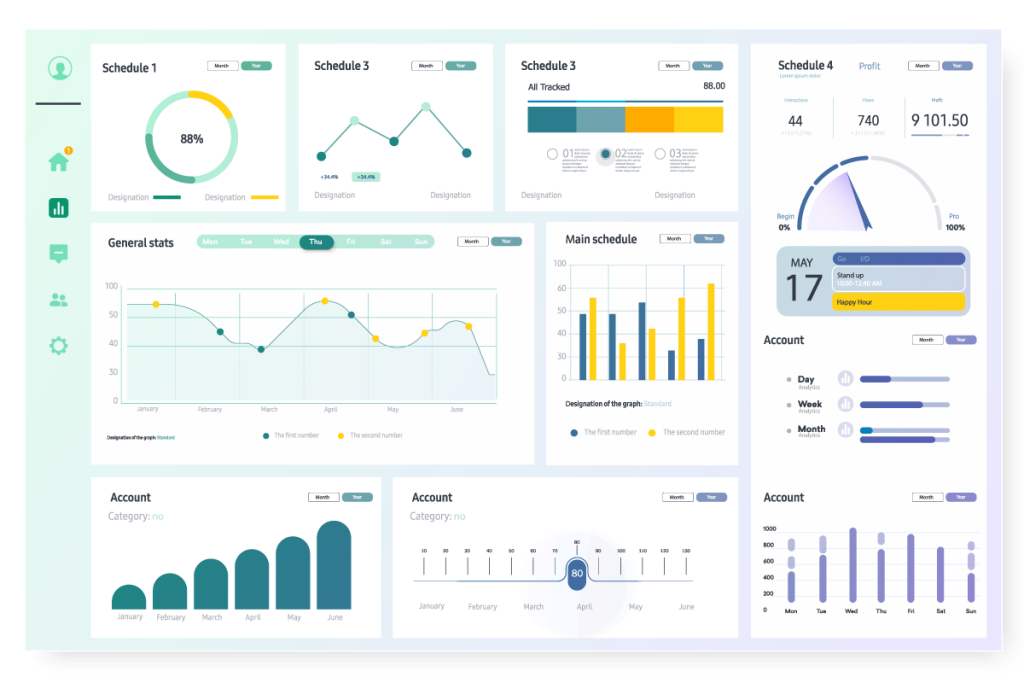
Business analytics dashboard showing multiple chart types and metrics for data-driven decision making.
Obviously, AI allows users to create ML models in minutes with no coding. Users can just upload their data for instant insights with drag-and-drop interfaces.
Akkio is your AI assistant for predictive analytics and forecasting using natural language interfaces.
With Google Cloud AutoML, pre-built APIs for vision, NLP, and structured data projects enable enterprise-grade automation.
AutoML in Microsoft Azure tightly integrates with the Microsoft stack, providing insights across Excel, Teams, and more.

Start your no-code AI journey with No-Code Development. Get in touch for a personalized plan.

Pooja Upadhyay
Director Of People Operations & Client Relations

No-code AI tool users comprise business analysts at 28% and marketing professionals at 22%.
Business analysts utilize no-code AI tools 28% of the time, while marketing professionals use them 22%, domain experts 18%, and citizen data scientists 15% of the time.
Business Impact: The Numbers Tell the Story
Development Speed: Companies realize 60-80% reductions in model development time. What previously took 3-4 months now takes one week to a month, including Consensus Corporation, which reduced its deployment from 3-4 weeks down to 8 hours.
Volume of model deployment: Teams can deploy 3.5 times more predictive models annually and fast-track experimentation for multiple business use cases.
Ensure ROI achievement in companies within 12-18 months, a 50% reduction compared to the traditional 24-36 months.
Decision Making: Teams reach 45% higher rates of data-driven decision-making with AutoML than without AutoML.
Collaboration: 52% improvement in cross-functional collaboration of technical and business teams.

The BFSI sector leads AutoML adoption at 70.4%, while marketing and retail industries are at 45% and 42%, respectively.

Industry Adoption Rates
- BFSI: 70.4% adoption for fraud detection, credit risk, and algorithmic trading
- Marketing: 45% for campaign analysis, lead scoring, and segmentation
- Retail & E-commerce: 42% adoption of demand forecasting and personalization
- Logistics: 38% adoption for route optimization and capacity planning
- Manufacturing – 35% adoption for predictive maintenance and quality control
- Healthcare: 34% adoption for medical imaging and patient triage
Real-World Success Stories
Predictive Maintenance: Global automotive supplier reduces unplanned downtime by 35%, reports positive ROI within 12-18 months.
Customer Retention: Trupanion identifies two-thirds of customers who will churn before they actually leave and thus enables proactive retention.
E-commerce: Netflix uses AutoML in recommendation algorithms to continuously improve personalization.
Fraud Detection: 75% of real-time transactions are monitored by ML-powered systems in financial institutions.
Key Challenges to Consider
Limited Customization: No-code tools may limit capabilities if a highly specialized scenario is required.
Black Box Models: The complex models mask the decision-making process, which is a problem in regulated industries.
Data Quality: AutoML’s effectiveness depends on the quality of the input data. Garbage in, garbage out.
Integration Gaps: The functionality may be limited because integrations from third-party apps probably are not supported.
Vendor Lock-In: Heavy dependence on specialized platforms results in difficulty migrating.
Security: Free tools usually lack the features for handling sensitive data.
2026 Trends
Integrating Explainable AI: AutoML with SHAP values and visual analytics make the decisions transparent to non-technical stakeholders.
Multimodal AI: The platforms are expanding to handle images, text, and structured data seamlessly.
Industry Solutions: Vertical-specific AutoML with pre-trained models for healthcare, finance, and retail.
Autonomous Systems: By the end of 2025, 25% of organizations will have piloted agentic AI; this will grow to 50% by 2027.
Implementation Best Practices
Start Small: Start with limited-scope projects to demonstrate quick wins, then scale up.
Data Quality First: Consider proper data governance before commencing AutoML.
Expertise Fusion: Combine domain expertise with the pattern recognition of machine learning.
Explainability: One should choose platforms that feature strong explainability for regulated environments.
Foster Collaboration: Engage non-technical stakeholders in modeling activities to ensure business alignment.
Why This Revolution Matters
Breaking Bottlenecks: AutoML frees the business analyst from the data science resource constraints to answer urgent questions themselves.
Empower Citizens: The business experts analyze, build models on their own without relying on IT-marketing predicts campaign outcomes, HR forecasts churn, operations optimizes logistics.
Leveling the Field: SMEs now need to compete with enterprise giants on analytics sophistication rather than the size of their data science teams.
Cultural Shift: Instead of being buried in highly specialized departments, AutoML embeds analytical thinking throughout organizations.
Conclusion
Python’s AutoML is leading to a revolution in who participates in the AI economy, and this trend will continue to blur lines between technical and non-technical roles as platforms become more sophisticated and accessible by 2026.
In contrast, business analysts who do embrace these tools become the pioneers of data-driven decision-making. Domain expertise merged with automated machine learning develops a competitive advantage that pure technical skill or business knowledge alone could not provide.
The fact that the AutoML market is set to reach $24.42 billion by 2030 is indicative of real transformation. And real value is apparent when organizations are reducing development time by 60-80%, improving data-driven decisions by 45%, enjoying 52% gains in collaboration.
Or, in other words, the question is no longer whether to adopt AutoML; it is how fast organizations can integrate these capabilities. Democratization of AI is a fact today. Business analysts who seize this opportunity will define the next generation of data-driven innovation.
The revolution is here. The tools are ready. Are you ready to join it?
Sources
- https://www.geeksforgeeks.org/python/top-automl-python-libraries/
- https://www.digitalocean.com/community/conceptual-articles/python-libraries-for-machine-learning
- https://machinelearningmastery.com/10-must-know-python-libraries-for-llms-in-2025/
- https://github.com/autogluon/autogluon/releases
- https://milvus.io/ai-quick-reference/what-is-the-relationship-between-automl-and-explainable-ai-xai
- https://towardsdatascience.com/explainability-interpretability-and-observability-in-machine-learning-515a2ac8234a/
- https://www.automl.org/ixautoml/
