


Here’s something nobody wants to admit at industry conferences: most agencies are slowly collapsing under their own weight. They started with passion, built a solid reputation, and won exciting new clients. Then came the projects. More projects. A lot more. And suddenly, the magic that made them successful in the early days started to unravel.
The problem isn’t ambition. It’s not a lack of talent. It’s something far more insidious and far more fixable. Your delivery process for WordPress projects is broken, and it’s suffocating your growth.
Let me show you what’s actually happening behind the scenes at agencies across the globe.
The Uncomfortable Truth About Agency Scaling
If you think your delivery challenges are unique, think again. The numbers tell a brutal story. According to recent project management research, only 35% of projects are completed successfully. For agencies specifically, the picture is even grimmer. One in five IT projects delivers the intended benefits on time and within budget—that’s a 95% failure rate on the metrics that actually matter to your clients.
But wait, it gets worse.
70% of software projects exceed their initial budget, with cost overruns averaging 27%. And only 34% of organizations complete projects on time. Your Delivery for WordPress projects isn’t unique – it’s caught in the same trap as every other agency struggling to scale.

Primary Reasons WordPress Agencies Fail to Scale Delivery
So why are agencies failing at scale? It’s not one problem. It’s a cascading series of failures that compound over time. Let’s break down what’s actually killing your delivery pipeline.
The Five Horsemen of Agency Delivery Failure
1. Lack of Standardized Project Management (The Silent Killer)
This is the big one, and it’s happening in your agency right now, whether you realize it or not.
When you had three employees, project management happened in Slack messages and lunch conversations. It worked. Everyone knew what was happening because they were all in the same room. Your founder could context-switch between projects without losing a beat. Communication was implicit.
Then you hired four more people. Still manageable. Then ten. Then you realized you needed to start working with offshore developers to keep up with demand. And suddenly, that implicit communication? It’s gone. Completely gone.
What replaces it is chaos masked as efficiency. Tasks slip through the cracks. Feature requirements get misinterpreted. Code reviews happen sporadically or not at all. Clients ask for updates, and the answer is always “it’s almost done” because nobody actually knows the current status.
Here’s the hard truth: without standardized processes, you can’t scale. Period. You’ll hit a ceiling somewhere between 5 and 10 concurrent projects, and you’ll be stuck there until you fix this.
The fix: Implement a formal project management methodology (Agile, Waterfall, or Hybrid). Use tools like Asana, Monday.com, or Linear to make project status visible and trackable. Create SOPs (Standard Operating Procedures) for every repeatable task. Write down your workflows. Make them boring and explicit, so anyone—whether they’re sitting next to you or 12 time zones away—can understand what’s happening.
2. Communication Breakdowns Across Distributed Teams
Communication is infrastructure, not an afterthought. Yet most agencies treat it like both.
When you work with offshore partners or have distributed teams, communication failures become the single biggest drain on velocity. Studies show that poor communication is the primary reason one-third of all projects fail. Even more alarming: $75 million of every $1 billion spent on projects is put at risk by ineffective communication, with companies wasting that money entirely.
Think about the last time miscommunication cost your agency money. A developer interpreted requirements one way. The client expected something completely different. Four days of rework. Budget blown. Client upset. Team drained.
And if you’re working with offshore developers? Multiply this problem by every time zone difference.
The offshore problem is specific and painful. Time zone differences mean feedback loops take 24+ hours. A client message comes in at 5 PM. Your offshore team sees it at 5 AM the next day. They ask clarifying questions. By the time they get answers, the momentum is dead. The original question has spawned three follow-ups. Now the developer is context-switching between projects while waiting, losing focus.
The fix: Create a formal communication framework. Define how information flows. Use asynchronous-first communication tools (written updates, detailed Slack threads, recorded video updates instead of real-time meetings). Schedule overlapping work hours with offshore partners specifically for critical discussions. Use project management tools as the single source of truth. Write everything down. When something exists in writing, it’s harder to misinterpret. To ensure clarity, establish clear protocols for using your company text messaging service, such as defining when and how two-way messaging should occur to avoid miscommunication.


3. Quality Assurance is Treated as an Afterthought
Here’s a reality check: most agencies don’t have a QA process. They have a “launch checklist” that someone skims before deployment.
This is directly tied to the fourth chart I’m about to show you. Fixing bugs during planning costs 1 unit. During implementation? 6 units. During testing? 15 units. After launch? 100 units.
Let that sink in. A bug that costs $100 to fix during planning might cost $10,000 to fix after the client is paying you to maintain their site. And that’s not just financial—it’s emotional. Your client is angry. Your team is stressed. You’re eating the cost because you don’t want to charge the client for your own mistakes.

The Cost Escalation: Why Prevention is Cheaper Than Reaction
Yet what’s the typical agency approach to QA? “We’ll test it before it goes live.” If you’re lucky, there’s a staging environment. More likely, someone’s testing on their local machine and hoping it works in production.
Real QA means: automated testing for core functionality, manual testing for user flows, performance testing, security scanning, cross-browser compatibility testing, and regression testing after every update. It means having a checklist. It means having a person or team whose only job is to find problems.
Does that sound expensive? It’s not. It’s a fraction of the cost of delivering broken work or having to rework projects after launch.
The fix: Implement a QA process that includes:
- Automated testing for critical paths (contact forms, payment processing, user registration)
- Performance testing before launch (page load times, responsiveness under load)
- Security vulnerability scanning (plugin vulnerabilities, Outdated WordPress platform core)
- Regression testing after every update
- Cross-browser and device compatibility testing
Use tools like Wordfence, Sucuri, GTmetrix, and WebPageTest. Make QA a gate between development and production. Nothing ships without QA sign-off.
How Small agencies scale delivery for WordPress projects, without hiring full-time teams?

Pooja Upadhyay
Director Of People Operations & Client Relations
4. Employee Turnover and Loss of Institutional Knowledge
This one hurts because it’s usually not your fault directly, but it kills your scaling plans anyway.
When a developer leaves your agency, they don’t just take their salary with them. They take knowledge about your current projects, your code standards, the decisions behind your architecture, and the tribal knowledge about which plugins play nice with each other and which ones fight.
A new developer comes in. They need training. They need onboarding. They can’t immediately jump into complex projects because they’re still learning your systems. Your team loses productivity during the transition. And here’s the kicker: high turnover is expensive. Recruiting, hiring, and onboarding a new developer can cost 50-150% of that role’s annual salary.
But the real cost is invisible. It’s in the lost projects, the delayed timelines, and the rework that happens because the new person didn’t know the history.
The fix: Document everything. Create runbooks for common tasks. Documentation for development with your own WordPress stack: Make architecture decisions in writing so new people can understand the “why” behind your choices, not just the “what.” Invest in team stability—better compensation, better work environment, better career paths. When people want to stay, they do.
5. Scope Creep and Budget Disasters
This is the financial killer for agencies.
52% of all projects experience scope creep. But here’s the thing that makes WordPress agencies special: scope creep compounds because you’re dealing with plugins, integrations, and customizations. A client asks for “just one more feature.” It seems small. But that small feature requires plugin compatibility testing, database changes, and security review. Suddenly you’ve spent 20 hours on something that was supposed to take 2.
The outcome? 52% of projects have scope modifications, leading to costs that increase by 30% or more per 10% of scope increase. Your $20k project becomes a $26k problem that you’re now eating because you didn’t lock down the scope with your client.
And nobody is protecting you here. According to project management data, only 34% of organizations complete projects within budget. That means 66% of agencies are losing money on a regular basis. You’re probably among them.
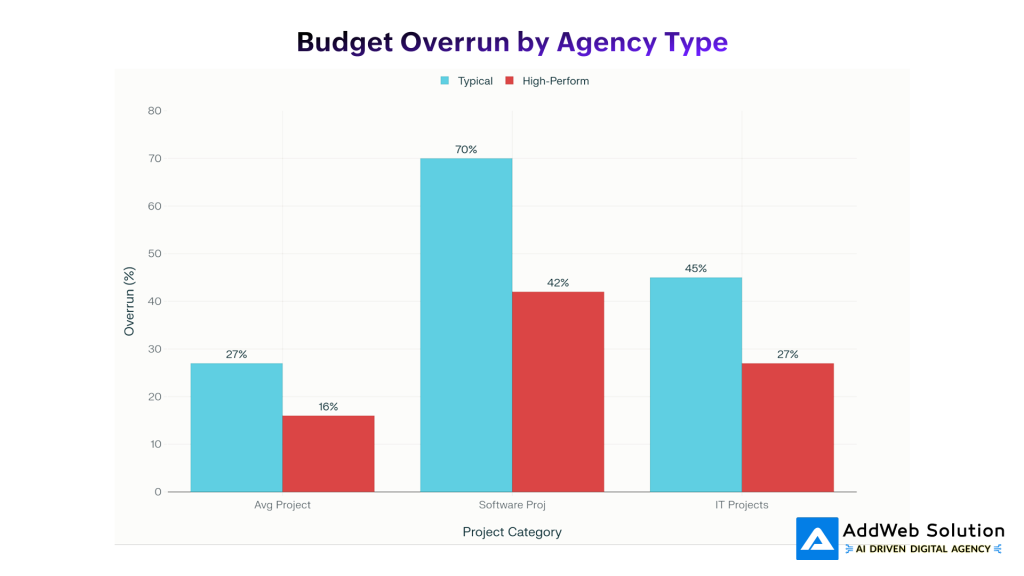
Impact of Structured Processes: Reducing Budget Overruns
The fix: Create clear scope documents before any work begins. Use a change control process. When clients want changes, document the impact and cost. Make the client choose—do they want to expand the scope and timeline, or do they want to ship on schedule? Track scope creep in real-time using your project management tool. Make it visible. When stakeholders see how much scope creep is actually happening, they start protecting against it.
The Numbers That Should Keep You Up at Night
Let me paint the full picture with some actual data about what’s happening at agencies right now:
| Metric | Reality |
| Projects completed on time | 34% |
| Projects completed on budget | 34% |
| Projects meeting original scope | 31% |
| Average project cost overrun | 27% |
| Software projects exceeding budget | 70% |
| Projects experiencing scope creep | 52% |
| IT project success rate (on time, on budget, full benefits) | 1 in 200 |
| Money wasted every 20 seconds due to poor management | $1 million |
Look at these numbers. Two-thirds of your projects are shipping late and over budget. That’s not a process problem—that’s a business model problem if you let it continue.
Why Your Offshore Partners Aren’t Solving This
Here’s a trap most scaling agencies fall into: they think hiring offshore developers will fix delivery problems. It won’t. In fact, it usually makes them worse, at least initially.
The offshore model doesn’t solve the underlying problem—unscaled processes. If your internal team can’t deliver consistently with clear communication, what makes you think adding distributed teams across time zones will suddenly fix it?
What actually happens:
- Communication compounds. Instead of one team struggling with internal communication, now you have two teams trying to communicate with each other while someone acts as a translator.
- Context gets lost. An offshore developer works on a feature. They finish. They hand it off. The next day, your internal team discovers the code doesn’t work with your existing setup. Now there’s 24 hours of lost time just for clarification.
- Accountability becomes fuzzy. Whose fault is it when something breaks? The offshore team says the requirements were unclear. Your internal team says the offshore team didn’t follow the spec. Meanwhile, your client is waiting.
- Quality suffers. Offshore teams are optimizing for speed and utilization, not quality. Without proper QA gates, you’re shipping code that your client will find bugs in, which means 24-hour feedback loops before fixes can begin.
This isn’t a criticism of offshore developers. Many are excellent. The problem is that offshore models only work if your internal systems are already dialed in. They amplify your existing processes. If your processes are broken, offshore teams will make the pain more visible.
The fix before going offshore: Get your internal processes tight first. Then, offshore becomes a force multiplier. Without it, offshore becomes a liability.

The reality of unscaled WordPress delivery: chaos, stress, and missed deadlines
The Path Forward: What Scaled Agencies Actually Do Differently
Organizations that have cracked the scaling code are doing something different. They’re not necessarily smarter or more talented. They’re more systematic.
High-performing organizations (those completing 80%+ of projects on time, on budget, within scope) do these things:
1. They create formal communication plans for nearly twice as many projects as underperforming agencies. It’s not rocket science—they write down how information will flow. They define who needs to know what, when, and in what format.
2. They implement structured project management practices. They use tools. They track status. They don’t rely on memory or status meetings.
3. They standardize QA processes. They don’t ship unless QA signs off. Period.
4. They embrace documentation. Code is commented. Decisions are recorded. Architecture is documented. When someone leaves, the knowledge stays.
5. They implement change management. They don’t let scope creep happen silently. Every change is evaluated for impact.
6. They build redundancy into their teams. They don’t have single points of failure where one person leaving cripples a project.
7. They invest in offshore partnerships strategically, only after their internal systems are solid. Then they’re using offshore teams to expand capacity, not to fix internal problems.
Ready to scale your agency?
Contact our growth team today and let’s talk strategy.
Pooja Upadhyay
Director Of People Operations & Client Relations
What You Need to Do Today
If you’re running an agency and you recognize yourself in this article, stop. This is not a ding on you. This is a wake-up call.
Start here:
- Audit your current state. Look at your last 10 projects. How many shipped on time? On budget? With no major rework post-launch?
- Identify your biggest bottleneck. Is it communication? QA? Undefined scope? Pick one.
- Fix that bottleneck systematically. Don’t bandage it. Replace the broken process with a documented, repeatable one.
- Measure the impact. After 30 days, run the same audit. Did things improve?
- Repeat. Pick the next bottleneck. Repeat.

This is what scaling looks like. It’s not hiring more people. It’s getting better at delivering with the people you have. The people you hire after that are for growth, not for survival.
The goal: A streamlined, scalable delivery system for WordPress projects
The agencies that fail are the ones that keep trying to outrun their problems. The ones that scale are the ones that turn around and fix them.
Your WordPress delivery isn’t failing because the market is too competitive or because WordPress is too complex. It’s failing because your processes are unscaled.
That’s actually good news. Processes can be fixed. Unlike talent or market timing, they’re completely within your control.
