


You’re scrolling through the App Store, reading descriptions. “Native iOS experience.” “Optimized for Android.” “Built from the ground up for your device.”
Sounds convincing, right? But here’s something most companies won’t tell you: there’s a good chance that “native” app was actually built with Flutter.
Welcome to one of tech’s worst-kept secrets—and one of its most fascinating contradictions. Companies are marketing Flutter apps as native experiences while simultaneously reaping massive development cost savings. It’s not exactly lying, but it’s not the full truth either. And honestly? Most users can’t tell the difference anymore.
Let me pull back the curtain on this industry practice and show you exactly what’s happening behind those polished app store listings.
What Does “Native” Really Mean Anyway?
Let’s start with some clarity. A truly native app means different things depending on who you ask.
For purists, native development means writing separate codebases: Swift or Objective-C for iOS, Kotlin or Java for Android. Each app is custom-built using platform-specific tools—Xcode for Apple, Android Studio for Google. The result? Apps that squeeze every drop of performance from the device and feel completely at home on their respective platforms.
But Flutter has changed the game. It compiles to native ARM code, uses platform channels to access device features, and renders UI through its own Skia graphics engine. Technically, the compiled output is “native” in execution. But the development? Cross-platform all the way.
So when companies say “native,” they might mean “runs natively” rather than “built natively.” Subtle difference. Massive implications.
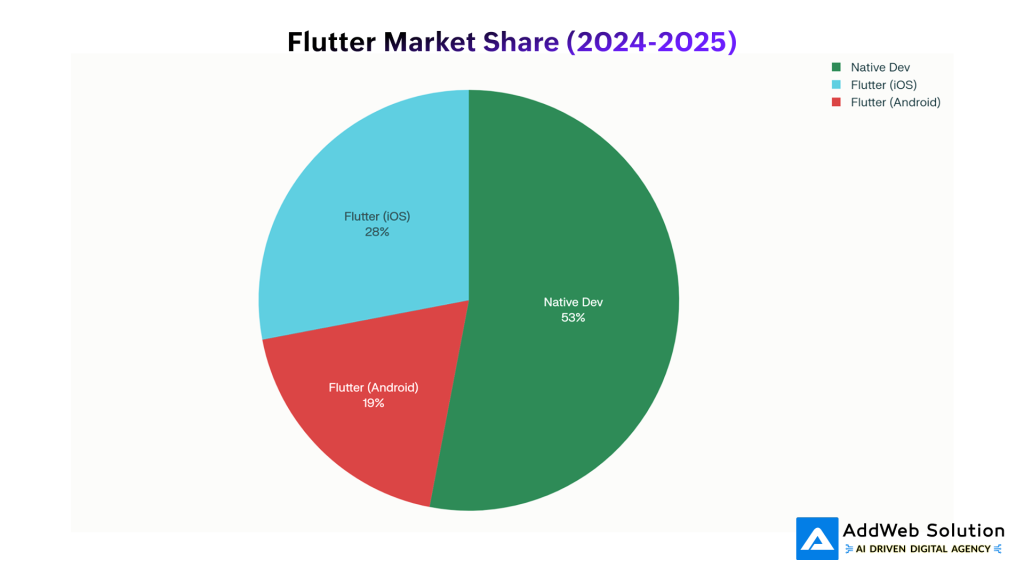
Flutter’s market penetration shows 28% of new iOS apps and 19% of new Android apps are built with Flutter as of 2024-2025, indicating strong adoption in the cross-platform development space
The numbers tell an interesting story. As of 2025, Flutter powers nearly 28-30% of all new free iOS app submissions—up from just 10% in 2021. On Android, that figure sits around 19%. Yet walk through any app marketplace, and you’ll rarely see “Built with Flutter” badges.
The Rise of Flutter: Google’s Cross-Platform Gambit
Google launched Flutter in 2017, but it didn’t gain serious traction until around 2019. Fast forward to 2025, and Flutter has become a juggernaut.
Here’s what the data reveals:
- 2.8 million active developers use Flutter monthly
- 46% of cross-platform developers chose Flutter in 2023, making it the most popular framework
- 500,000+ Flutter apps published on Google Play Store alone
- 170,000+ GitHub stars—more than React Native’s 120,000
- Enterprise adoption grew 58% in 2023
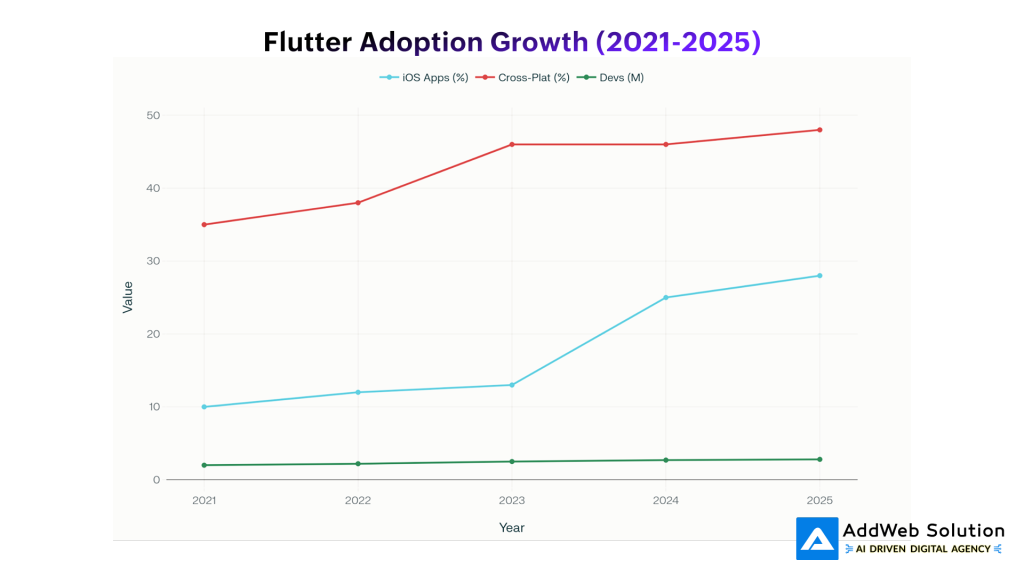
Flutter’s adoption has surged dramatically from 10% of new iOS apps in 2021 to nearly 30% in 2025, with active developers growing from 2 million to 2.8 million, demonstrating the framework’s rapid market acceptance
Flutter’s appeal is simple: write once, deploy everywhere. One Dart codebase can generate apps for iOS, Android, web, and desktop. The framework’s hot reload feature lets developers see changes instantly, and its widget-based architecture provides pixel-perfect control over UI design.
Big names are using it too—quietly. Google Ads, BMW, Alibaba’s Xianyu (serving 50 million users), Nubank, eBay Motors, Philips Hue, and even parts of Google Pay run on Flutter.
Why Companies Hide Their Flutter Implementation
This is where things get interesting. If Flutter is so powerful and cost-effective, why don’t companies shout it from the rooftops?
Brand perception matters. Many businesses worry that admitting to cross-platform development suggests corner-cutting or inferior quality. The word “native” carries prestige. It signals investment, performance, and platform dedication.
Competitive positioning. Revealing your tech stack can expose strategic decisions to competitors. If a rival knows you’re using Flutter, they can estimate your development costs, timelines, and capabilities.
User expectations. Despite Flutter’s performance improvements, some users still associate cross-platform frameworks with lag, inconsistency, and “not quite right” experiences. Marketing teams would rather emphasize seamless experiences than technical architecture.
Legacy perceptions. Early cross-platform tools like PhoneGap and Cordova were notoriously clunky. Flutter suffers from guilt by association, even though it’s fundamentally different.
The irony? Most end-users genuinely can’t tell the difference anymore. Flutter’s Impeller rendering engine, introduced as the default in recent versions, eliminates much of the shader jank that plagued earlier iterations. Performance benchmarks show Flutter achieving 96% of native Android performance and 91% of native iOS performance.

Performance benchmark comparison reveals Flutter achieves 91% of native iOS performance and 96% of native Android performance, with competitive frame rendering times across both platforms
How to Actually Detect a Flutter App
Want to play detective? Here are proven methods to identify Flutter apps in the wild:
For Android Users:
- Enable “Show Layout Bounds” in Developer Options. Native apps display component boundaries everywhere. Flutter apps only show the root canvas.
- Check for libflutter.so in the APK using tools like APK Analyzer: apkanalyzer files list app.apk | grep flutter.so.
- Use FlutterShark or LibChecker apps from the Play Store—they scan installed apps and identify Flutter implementations.
- Long-press the back button. Flutter apps show a noticeably wider ripple animation than native apps.
For iOS Users:
- Scroll content and tap the status bar clock. Native iOS apps scroll back to the top. Flutter apps often don’t.
- Check the IPA package contents. Look for Flutter-specific modules or frameworks inside.
Cross-Platform:
- Reverse engineering. Tools like Blutter can parse Dart AOT snapshots from compiled apps, revealing Flutter’s underlying architecture.
- Three-finger scroll test (on pre-3.19 Flutter versions). Lists scroll at 1.5x speed with three fingers—a quirk that’s since been fixed.
Developers have created entire communities around identifying Flutter apps. FlutterHunt catalogs known Flutter implementations, and security researchers regularly analyze Flutter apps for vulnerabilities.

The Performance Reality: Flutter vs True Native
Let’s talk numbers. Performance debates often devolve into tribal warfare, so I’m sticking to benchmarks.
Frame Rendering:
- iOS (60Hz budget: ~16.7ms): Flutter averages 1.72ms with 95th percentile at 2.45ms. Plenty of headroom.
- Android (120Hz budget: ~8.3ms): Flutter averages 4.01ms with p95 at 5.09ms—comfortably under budget.
- Native Android sits right at the budget (8.34ms average), giving little margin for spikes.
Resource Consumption:
- CPU usage: Flutter apps consume roughly 2x the CPU of native equivalents.
- Memory: Flutter uses about twice the RAM compared to native apps.
- App size: Flutter apps tend to be 2-6MB larger due to the bundled engine.
Real-World Speed:
Flutter compiles directly to native machine code using Ahead-of-Time (AOT) compilation. This avoids the JavaScript bridge that hampers React Native, resulting in smoother animations and faster startup times.
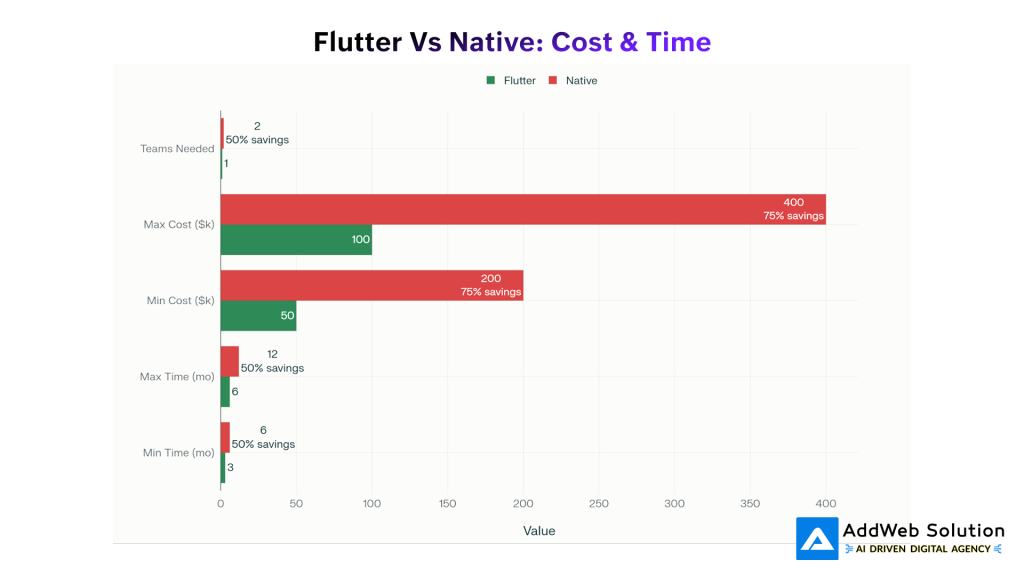
Flutter development delivers significant cost and time advantages, reducing development time by 40-60% and cutting costs by up to 75% compared to native development for iOS and Android platforms
But here’s the catch: native development still wins in extreme edge cases—high-end gaming, augmented reality, intensive 3D graphics, and apps requiring cutting-edge platform features the moment they launch.
For everything else? The performance gap has narrowed to the point of irrelevance for most users.
Real Companies Using Flutter (While Staying Quiet About It)
Let’s name names. These companies leverage Flutter extensively, though you won’t always see it advertised:
| Company | App/Service | Users | Why Flutter |
| Alibaba | Xianyu marketplace | 50M+ users | Recruitment challenges, iOS engineer shortage |
| Ads, Pay (India), Earth | Millions | Cross-platform efficiency, brand consistency | |
| BMW | Connected car app | Global | Complex data handling, multi-platform reach |
| Nubank | Digital banking | 50M+ customers | Reduced build time from 70 mins to 9.9 mins |
| eBay | Motors app | Millions | Fast feature parity across iOS/Android |
| Groupon | Deals platform | Global | Seamless integration without full rewrite |
| Philips | Hue smart lighting | Millions | Streamlined development, efficient performance |
| Toyota | Infotainment systems | Automotive | Embedded device support, premium feel |
| New York Times | KenKen puzzle app | Readers worldwide | Engagement, cross-platform launch |
| Hamilton Musical | Fan app | Theater fans | Built in 3 months, fast deployment |
Alibaba’s case is particularly telling. Facing a shortage of iOS developers, they turned to Flutter. Internal tests showed better performance than expected, and the flexible team structure solved their hiring bottleneck.
Nubank, one of Latin America’s largest digital banks, cut their life insurance solution development from 12 months to just 3 months using Flutter. They also improved build times by 87% and achieved consistency across platforms that would’ve been impossible with native development.
The Business Case: Why Flutter Makes Financial Sense
Strip away the tech jargon, and Flutter’s appeal boils down to cold, hard economics.
Cost Savings:
- Native development for iOS + Android: $200k-$400k+ for even simple apps
- Flutter development: $50k-$100k for the same scope
- Savings: 50-75% of development costs
Time to Market:
- Native: 6-12 months (building separate codebases)
- Flutter: 3-6 months (single codebase)
- 40-60% faster development cycles reported by teams
Team Structure:
- Native requires two specialized teams: Swift/Objective-C developers for iOS, Kotlin/Java for Android
- Flutter needs one team proficient in Dart
- Easier recruitment and lower ongoing salary costs
Maintenance:
- Native: Doubled maintenance burden with separate codebases
- Flutter: Single codebase to update, debug, and optimize
- 90%+ code reusability across platforms
For startups, bootstrapped companies, or businesses with tight budgets, this math is irresistible. Flutter lets lean teams compete with well-funded rivals who can afford full native development.
AddWeb Solution, a leading global IT firm, has helped numerous clients leverage Flutter’s cost advantages to launch powerful cross-platform apps without breaking the bank. Our Flutter expertise transforms complex business requirements into elegant, performant applications that users love—often at a fraction of traditional development costs.
When Native Still Wins
Let’s be honest: Flutter isn’t perfect. There are scenarios where native development remains the smarter choice.
Go Native If:
- You need cutting-edge platform features immediately. New iOS or Android APIs take time to reach Flutter through plugins.
- Performance is absolutely critical. High-end 3D games, AR/VR apps, or real-time video processing benefit from native optimization.
- Your app is deeply integrated with hardware. Complex Bluetooth Low Energy (BLE) interactions, advanced sensor fusion, or USB/serial device communication are easier natively.
- You want pixel-perfect adherence to platform design guidelines. Native development ensures your app feels indistinguishable from system apps.
- You already have established native teams and codebases. Rewriting working apps in Flutter rarely makes business sense unless you’re consolidating platforms.
- You’re targeting a single platform. If you’re only building for iOS or Android, native gives you maximum control and performance.
Big Tech companies like Meta, Apple, and Amazon maintain native flagship apps because they have the resources, the legacy codebases, and the need for absolute performance optimization. For them, the trade-offs aren’t worth it.
But for the other 95% of businesses? Flutter delivers more than enough.
The Future of App Development
Here’s where things get speculative—but the trends are clear.
Flutter isn’t slowing down. Google continues aggressive investment, with Flutter 3.x and beyond bringing desktop maturity, improved web performance, and better tooling. The framework’s shift from a mobile-first tool to a comprehensive multi-platform ecosystem positions it as a long-term competitor to native development.
Impeller, the new rendering engine, is now the default and eliminates most of the performance complaints that plagued earlier versions. Dart 3.x brings null safety, pattern matching, and enhanced async capabilities.
Some predictions for 2025-2027:
- Wasm (WebAssembly) support will mature, enabling even better web performance.
- Embedded systems (automotive, IoT, smart home) will increasingly adopt Flutter.
- AI integration will become standard, with Flutter apps leveraging on-device ML models seamlessly.
- The native vs. cross-platform debate will fade as performance gaps continue narrowing.
But there’s a counterpoint. Some developers are exploring forks like Flock due to governance concerns. Flutter’s dependency on Google creates vendor lock-in anxiety, especially for competitors.
Native development isn’t dying. It’s evolving. Tools like SwiftUI and Jetpack Compose are making native development faster and more enjoyable. Kotlin Multiplatform offers another approach—sharing business logic while keeping UI native.
The truth? There’s no one-size-fits-all answer. The “best” choice depends on your budget, timeline, team expertise, performance requirements, and long-term maintenance plans.
Interesting Facts
- Google Ads saw a 33% increase in customer satisfaction after switching to Flutter.
- Reflectly rewrote their entire app from React Native to Flutter in just 2 months.
- Nearly 30% of new iOS apps now use Flutter in some capacity, including “add-to-app” implementations.
- Flutter apps can be reverse-engineered using tools like Blutter, which extracts Dart objects from compiled binaries.
- The three-finger scroll quirk that helped identify Flutter apps was patched in version 3.19.

Reach out to discuss your Flutter native-consistency needs and get a tailored development plan.

Pooja Upadhyay
Director Of People Operations & Client Relations
Conclusion
So what’s the takeaway from all this?
The “hidden lie” isn’t really a lie at all—it’s a semantic game. When companies claim “native,” they’re often referring to the compiled output and user experience rather than the development methodology. Flutter apps run natively. They feel native. For most users, that’s all that matters.
The real story here is economic disruption. Flutter has democratized high-quality app development, allowing smaller teams to build sophisticated cross-platform experiences that were previously only accessible to well-funded organizations. That’s a net positive for innovation.
But transparency matters too. Users deserve to know what they’re getting, and developers benefit from honest conversations about trade-offs. Flutter is phenomenal for many use cases—but it’s not magic.
If you’re building an app in 2025, don’t blindly follow trends. Evaluate your specific needs: budget, timeline, performance requirements, team skills, and long-term maintenance plans. Flutter might save you hundreds of thousands of dollars and months of development time. Or native might be the right call for your edge case.
Either way, make the choice with eyes wide open.
At AddWeb Solution, we specialize in both Flutter and native development, helping clients make informed decisions based on real business needs—not marketing hype. Whether you need the cost efficiency of Flutter or the raw performance of native, our expert team delivers exceptional results tailored to your vision. Visit
