


Sustainable AI app development cover image with green technology and smartphones
The infusion of Artificial Intelligence into mobile apps has transformed user experiences but at a huge environmental expense. As more advanced AI models emerge, energy usage has grown exponentially, with some calculations that AI tools such as ChatGPT consume about 10 times more energy per query than search engines. For Flutter developers creating AI applications, adopting sustainable methods is not only an environmental necessity—it’s a business strategy that saves costs and enhances app performance.
The Energy Challenge in AI Mobile Applications
Current AI use cases encounter record-breaking energy needs that have a direct association with environmental sustainability and expenses. AI inference tasks take as much as 0.0029 kWh per query, while the conventional search operation takes 0.0003 kWh per query. This staggering discrepancy becomes even more pronounced when factoring in that AI power usage may contribute up to 3-4% of total electricity demand by the year 2030.

Comparison of energy usage between various AI processing architectures, illustrating dramatic savings when processing is on-device
The energy use issue goes beyond mere processing capability. To train sophisticated models such as GPT-4, 1,750 MWh of electricity is needed, whereas ordinary operation of AI systems can amount to as much electricity as powering 21,600 typical American homes per year. For mobile, these requirements equate to more battery drain, higher server expense, and heavy infrastructure needs.
Flutter’s Contribution to Sustainable AI Development
Flutter presents itself as a perfect platform for sustainable AI development based on its built-in efficiency strengths. The single codebase strategy of the framework cuts down on development energy use by up to 30% during the testing period. Its cross-platform efficiency also negates the need for individual development cycles, saving computational resources and time input.


The main sustainability advantages of Flutter are:
Cross-Platform Efficiency: Flutter’s single development strategy has the developer coding once and deploying on numerous platforms, minimizing the overall computational cost of having to hold multiple codebases.
Optimized Rendering: Flutter’s rendering engine, Skia (replaced by Impeller), gives accurate pixel control while conserving energy, which is essential for AI-driven visual applications.
Hot Reload Capability: Hot reload shortens development time and power consumption by allowing real-time updating of code without full application restarts.
Strategic Methods for Energy Optimization
Model Quantization: The Cornerstone of Efficient AI
Model quantization is one of the most powerful methods for limiting energy consumption in AI within mobile devices. This method entails lowering model parameter precision from 32-bit floating point to lower-bit representations like 8-bit integers. The effect is dramatic—quantized models are capable of 100 to 1,000x energy saving relative to cloud computing.
Contemporary quantization methods preserve model precision at the cost of dramatically enhanced efficiency. Post-training quantization (PTQ) supports developers to optimize their existing models without having to retrain, whereas quantization-aware training (QAT) makes certain that models preserve more than 99% of their initial accuracy even at INT8 levels.
TensorFlow Lite Integration for Mobile Optimization
TensorFlow Lite is the foundation for deploying effective AI models on mobile platforms. This library, which runs on over 4 billion devices, offers complete optimization tools specifically tailored for resource-restricted environments.
Some of the primary benefits of TensorFlow Lite integration include:
Lowest Latency: TensorFlow Lite cuts inference time radically, allowing for real-time AI processing that is necessary for mobile applications.
Offline Capabilities: Edge inference removes reliance on the internet, lowering data transmission fees and enhancing reliability in isolated environments.
Power Efficiency: Best-in-class models use less battery power, increasing device usage time and enhancing user experience.
Edge Computing: Processing AI Locally
Edge computing is a paradigm shift away from cloud-based AI processing to local device computation. This method provides staggering energy savings by removing constant data transmission between devices and distant servers.
Advantages of edge AI processing:
- 90% decrease in energy usage over cloud-based inference
- Improved data privacy through off-device keeping of sensitive data
- Lower bandwidth needs reduce network infrastructure load
- Increased reliability through offline operation capabilities

Detailed comparison of Flutter AI optimization approaches demonstrating energy savings, performance improvements, and implementation complexity
Real-World Case Studies and Applications
Google’s Data Center Optimization Success
Google DeepMind’s application of AI-driven cooling systems is an indicator of the possibilities of major energy reductions. Through the use of machine learning algorithms to control cooling systems, Google was able to reduce energy consumption in its data centers by as much as 40%. This achievement is an indicator of how AI can minimize its own energy usage through smart system management.
Microsoft’s Azure AI Energy Management
Microsoft’s Azure AI solution used in their Redmond campus applies machine learning algorithms to process data collected by thousands of sensors, allowing real-time optimization of heating, cooling, and lighting systems. This has reduced 15-20% energy usage and saved millions of dollars.
Siemens’ Digital Twin Technology
Siemens uses digital twin technology combined with AI to design virtual copies of the manufacturing process. The method can predict equipment failure, optimize resource allocation, and waste, making manufacturing processes more sustainable and environmentally friendly with less environmental footprint.
Tesla’s AI-Powered Energy Efficiency
Tesla’s Autopilot system illustrates how AI can be used to maximize energy efficiency in real-world use. The AI-driven system maximizes vehicle energy use through the analysis of real-time sensor data and the control of speed, route, and battery management. This has resulted in longer battery life and less energy use, establishing Tesla as a forerunner in environmentally friendly transportation.
Advanced Optimization Techniques
Hybrid AI Architectures
Hybrid AI models provide a balanced method of energy efficiency through the blend of lightweight models for straightforward tasks with heavier models for intricate operations. This approach minimizes computational needs by saving resource-hungry processing for when it is needed.
- Implementation methods consist of:
- Pipeline-based solutions that segment tasks into sensible segments
- Modular structures that provide selective AI participation
- Dynamic model changing depending on computational needs
Batch Processing and Scheduling
Batch processing methods can drastically lower energy usage by grouping several requests into individual operations. This strategy maximizes the use of resources and lessens task switching overheads.
Off-peak scheduling enables energy-hungry AI tasks to execute during off-peak hours of diminished energy demand and cost, supporting grid stability with lowered operational costs.
Dynamic Resource Management
Sophisticated Flutter AI applications can utilize dynamic voltage and frequency scaling (DVFS) to dynamically adjust processor performance according to existing workload requirements. This method maximizes energy consumption by scaling computational power to actual needs instead of constantly running at full capacity.
Implementation Workflow for Sustainable Flutter AI
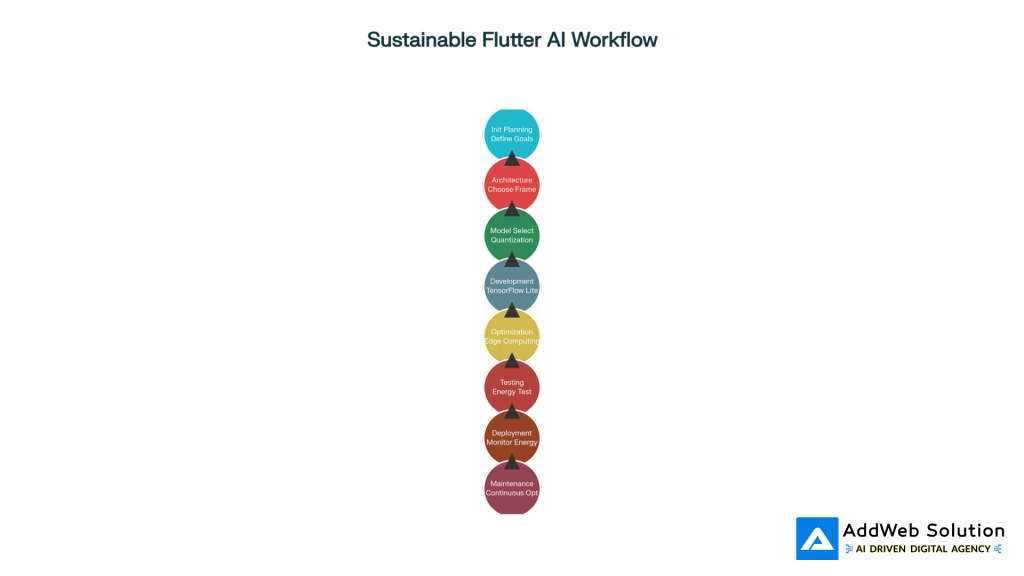
Step-by-step workflow for creating sustainable AI applications with the Flutter framework
The sustainable development process starts with a definite definition of sustainability goals, setting precise targets for energy efficiency as well as environmental performance indicators. This initial foundation for all future development decisions ensures consistency with overall environmental goals.
Architectural design emphasizes selecting efficient frameworks and patterns. Flutter’s cross-platform nature makes it a great fit, with serverless architectures and microservices adding further efficiency through resource optimization.
Model Optimization
Model optimization is achieved through applying quantization methods, choosing suitable TensorFlow Lite models, and setting edge processing functionality. This process directly affects the energy footprint and behavior of the application.
Learn to optimize Flutter-AI pipelines for lower energy costs

Pooja Upadhyay
Director Of People Operations & Client Relations
Energy Performance Measurement and Monitoring
Good energy management necessitates thorough measurement and monitoring mechanisms. Google’s approach to measuring AI energy usage takes into account system dynamic power, machine idle power consumption, CPU and RAM utilization, data center overhead, and water usage.
The important metrics for Flutter AI apps are:
- Energy consumption per operation (kWh/transaction or query)
- Carbon emissions per user interaction (gCO2e/session)
- Resource utilization efficiency (CPU utilization, GPU utilization, memory utilization)
- Battery impact on mobile devices (drain rate during AI operations)
Contemporary monitoring software such as CodeCarbon targets AI and machine learning energy use directly, offering granular monitoring of computational carbon impact. This software helps developers pin down areas of optimization and monitor improvement over time.
Future Trends and Opportunities
The future of sustainable AI growth is toward a number of emerging technologies and methodologies. On-device AI computation will continue to grow more advanced, with AI chips specifically built for mobile use cases providing 100 to 1,000-fold improvements in energy consumption compared to cloud-based options.
Quantization methods keep advancing, with new methods such as per-channel quantization and mixed-precision training allowing for even more efficiency improvement without sacrificing model accuracy.
Green AI projects are spurring innovation of carbon-conscious software that autonomously optimizes processing as a function of energy grid conditions and carbon emissions. Such systems can lower carbon footprint by 80-90% through smart scheduling and resource allocation.
Business Impact and ROI
Adopting sustainable AI practices yields real business advantages that go beyond environmental stewardship. Energy-efficient technology lowers operational expenses through reduced server infrastructure costs, lower data transfer costs, and extended battery life resulting in higher user satisfaction.
Development using Flutter for cross-platform development saves development costs by avoiding the need for individual native apps while upholding performance levels. This saves time directly by mapping to quicker time-to-market and lower resource demands.
Edge computing solutions minimize reliance on costly cloud infrastructure and enhance app dependability and customer experience via lowered latency and offline functions.
Conclusion
Green AI development in Flutter apps is both a business imperative and environmental obligation. By precise utilization of optimization methods such as model quantization, TensorFlow Lite support, and edge computing, developers can gain staggering reductions in energy usage without compromising or even enhancing app performance.
The industry leaders Google, Microsoft, and Tesla provide evidence that impressive energy savings can be realized through smart AI deployment. With mobile AI applications becoming more widespread, embracing sustainable development practices will be crucial to competitive gains and compliance.
For companies such as AddWeb Solution, adopting sustainable AI development makes them visionary partners who can provide eco-friendly solutions that satisfy both performance and sustainability objectives. The synergy of Flutter’s performance, sophisticated optimization methods, and real-time monitoring provides a robust platform for developing the next generation of sustainable AI software.
