


Low-Code to Pro Code: The FlutterFlow AI Revolution and How It’s Changing App Development
The world of app development is seeing a seismic change with the advent of artificial intelligence, revolutionizing conventional development methods. FlutterFlow AI is a defining point in this movement, bridging the midpoint between easier low-code development and advanced pro-code functionality. With the low-code application development market set to hit $248.31 billion by 2033 and AI mobile app development set to reach $221.9 billion by 2034, this merger is transforming application development, design, and deployment. FlutterFlow AI brings app development to the masses while still ensuring professional-level output, allowing both citizen developers and professionals to create advanced applications in minimal time. This groundbreaking platform isn’t only revolutionizing development workflows, it’s reimagining what’s possible when human imagination meets AI.
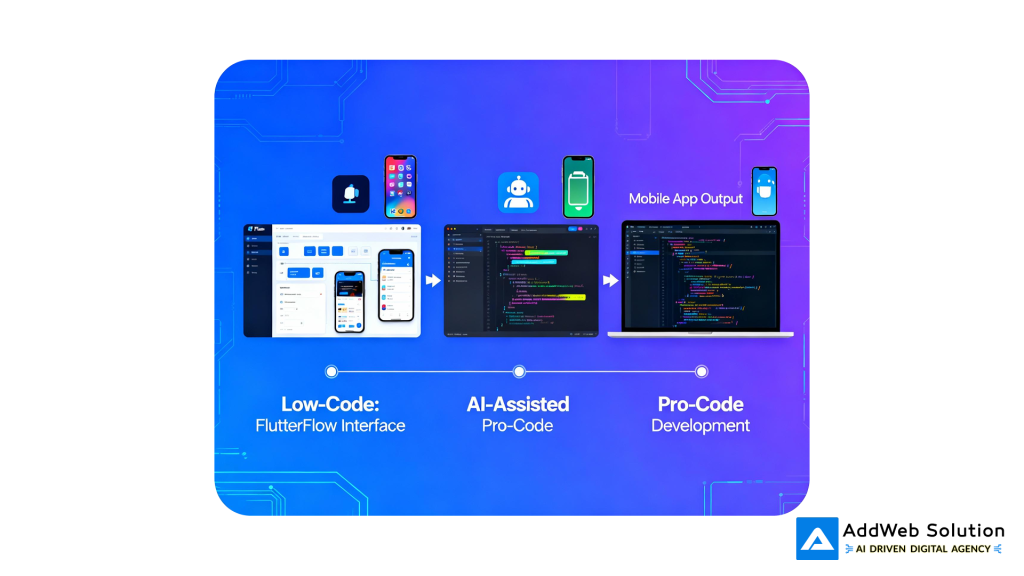
FlutterFlow AI revolutionizing app development from low-code to pro-code
Key Takeaways
Market Explosion: The market for low-code development is growing at record levels at a 26.8% CAGR, while AI app development exhibits a 18.6% CAGR, reflective of monumental industry disruption
Speed Revolution: FlutterFlow AI cuts development time from 6-12 months to only 1-3 months, with certain projects being done in weeks instead of months
Cost Transformation: The cost of development falls from $70,000-$100,000+ for conventional development to merely $3,000/month for low-code platforms, equating to savings of as much as $99,700
AI Integration Breakthrough: FlutterFlow’s AI capabilities native to the platform, such as Image-to-Component, Prompt-to-Component, and AI Agent Builder, break through the technical hurdles that usually needed expert AI expertise
Professional Output: Low-code as it is, FlutterFlow produces clean, exportable Flutter code, guaranteeing professional-level apps without vendor lock-in
Market Validation: Glimpses of real-world success such as AB.Money becoming a number-one app in Eastern Europe’s App Store and Blue Pass revolutionizing maritime operations illustrate tested enterprise capabilities
Index
Introduction: From Low-Code to Pro-Code
Understanding the Development Landscape
FlutterFlow AI: Groundbreaking Capabilities
Market Impact and Industry Transformation
Comparative Analysis: FlutterFlow AI vs Traditional Development
Real-World Applications and Success Stories
Challenges and Limitations
Future Trends and Predictions
Implementation Best Practices
Conclusion
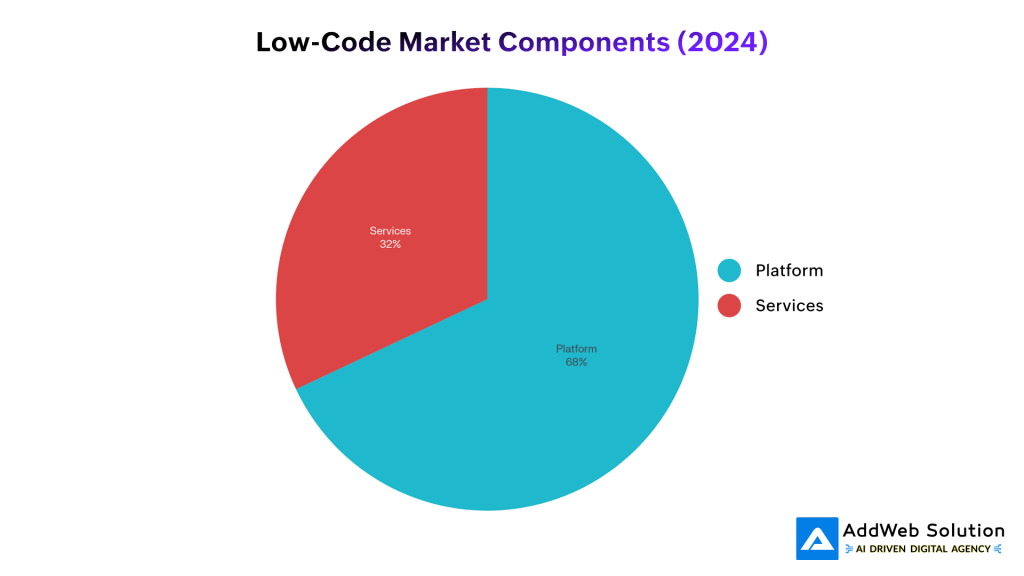
Low-Code Development Market Component Breakdown 2024


Understanding the Development Landscape
The transition from legacy coding to AI-augmented low-code platforms is one of the biggest changes in software development history. Legacy pro-code development, though providing full customization and control, requires vast technical knowledge and significant time investments. Legacy app development, as per recent industry surveys, costs 6-12 months with a price tag of $20,000 to $50,000 per app for simple to medium complexity apps.
With the advent of low-code platforms, this paradigm has been fundamentally changed. They facilitate quick application development with visual interfaces, pre-existing components, and streamlined workflows. The global market for low-code development platforms, which was worth $30.8 billion in 2024, will grow to $248.31 billion by 2033, reflecting the industry’s faith in this methodology.
The Technical Skills Gap Crisis
The driving force behind this shift is the dire lack of technical skills. Industry data today indicate shocking developer availability gaps, with 85.2 million worker deficit by 2030. This deficit has brought forth a number of serious challenges:
- 82% of companies can’t hire or retain software developers
- The need for business apps is 5X greater than existing IT capacity
- 84% of companies are going with low-code tools to bridge the technical divide
These figures highlight why companies are increasingly looking to low-code platforms as not only options, but imperatives for digital transformation.
The AI Revolution in Development
Artificial intelligence is emerging as the great leveler in app-making. The AI app development space, worth $40.3 billion in 2024, is projected to grow to $221.9 billion by 2034, reflecting a strong 18.6% CAGR. The growth is evidence of AI’s ability to automate resource-intensive development activities ranging from code writing to testing and optimization.
AI integration in low-code solutions such as FlutterFlow is the union of simplicity and high-end sophistication. By introducing machine learning algorithms, natural language understanding, and computer vision, these solutions allow users to develop intelligent apps without extensive technical know-how in AI development.
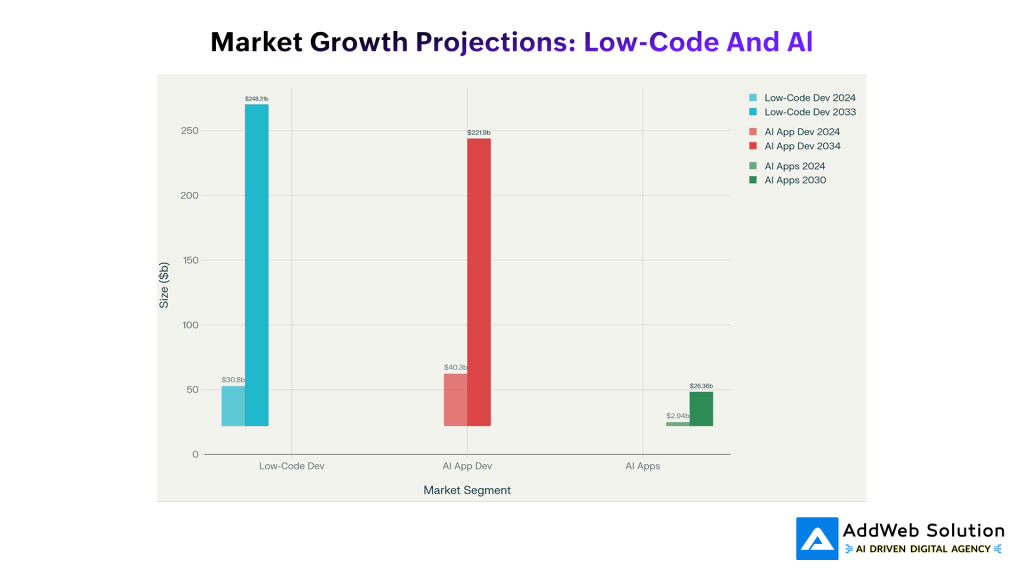
Market Growth Projections for Low-Code and AI Development Industries
FlutterFlow AI: Revolutionary Capabilities
FlutterFlow AI is at the leading edge of the low-code to pro-code revolution, providing a range of AI-driven development tools in one complete package that opens up app development to anyone while still ensuring professional-grade apps. From its inception in 2020 by ex-Google engineers, the platform has grown phenomenally, with 8,300% web search growth in five years and 2.7 million users per month.
Core AI Features Revolutionizing Development
FlutterFlow’s artificial intelligence feature goes well beyond basic drag-and-drop operations, with advanced machine learning algorithms that are aware of design patterns, user intent, and coding best practices.
Image to Component Technology: This innovative capability enables the developer to import any UI mockup, hand sketch, or screenshot, and FlutterFlow AI generates corresponding components. The platform inspects visual structure, detects UI components such as buttons, forms, and navigation elements, and proceeds to create functional Flutter widgets. This feature obliterates the conventional chasm between technical execution and design conception.
Prompt to Component Generation: FlutterFlow AI uses natural language processing to understand plain English descriptions and generates the associated UI components. For instance, asking “create a product card with image, title, price, and add to cart button” produces a fully formed, styled component with the correct responsive behavior. This allows non-technical stakeholders to directly contribute to the development process.
AI Agent Builder: In March 2025, this feature was the most ambitious integration of FlutterFlow with AI. The Agent Builder accommodates three prominent AI providers—Google Gemini, OpenAI, and Anthropic Claude—so developers can develop smart, conversational interfaces in their apps. These AI agents are capable of managing customer support, sending personalized recommendations, and automating intricate business processes.
Technical Architecture and Integration
FlutterFlow AI runs on a highly advanced technical base providing ease of use and professional output quality. The architecture of the platform consists of several main components:
Native Flutter Code Generation: While most low-code platforms output proprietary code, FlutterFlow generates clean, readable Flutter code that developers can export and further develop using conventional means. This eliminates vendor lock-in and provides long-term sustainability for apps.
Multi-Provider AI Integration: The adaptability of the platform to integrate with multiple AI providers—Google Gemini via Vertex AI, OpenAI’s GPT models, and Anthropic’s Claude—enables developers to select the most suitable AI capabilities for their respective use cases. The multi-provider solution offers resilience and best performance in terms of different application requirements.
Real-time Collaboration and Testing: FlutterFlow has in-built testing and collaboration capabilities, and teams can quickly iterate on AI-driven components and exchange feedback in real-time. The cloud-based structure of the platform guarantees uniform performance regardless of the development environment.

FlutterFlow UI/UX livestream showcases drag and drop functionality to create a visually see-through Kanban board
Market Impact and Industry Transformation
The rise of FlutterFlow AI and similar platforms is catalyzing fundamental changes across the app development ecosystem. These transformations extend beyond individual development teams to impact entire industries, business models, and competitive landscapes.
Enterprise Adoption and Validation
Business adoption of AI-augmented low-code platforms has picked up significantly. Fortune 500 organizations indicated 38% adoption of no-code platforms, with rates probably much higher today considering recent market ramp-up. This corporate endorsement proves that low-code platforms enabled by AI can support critical business needs at scale.
FlutterFlow’s user base is comprised of varied businesses in various industries. TrustEHR, a healthcare app, utilized FlutterFlow to restructure their digital framework within four months. SparkCharge, which changed the mobile EV charging industry, moved their entire platform to FlutterFlow within three months, showcasing the ability of the platform to cope with intricate, real-world applications.
Economic Impact and Cost Transformation
The financial impact of AI-fueled low-code development is significant. Conventional development methods entail high initial investments, with notably medium-complexity apps ranging from $50,000-$120,000 and development timelines of up to six months. FlutterFlow AI reduces these hurdles exponentially:
- Development budgets plummet from $70,000-$100,000+ to $3,000/month
- Time-to-market shortens from 6-12 months to 1-3 months
- Resource demands decrease by up to 70%
These reductions in costs allow small companies and startups to rival big organizations, making advanced mobile applications more accessible. The typical business saved two IT developers from being hired with low-code technologies, generating $4.4 million in business value over the course of three years.
Developer Ecosystem Evolution
Instead of displacing legacy developers, AI-augmented low-code platforms are changing the role of developers and broadening the community of developers. By 2026, developers not in traditional IT departments will represent a minimum of 80% of the user base for low-code development platforms. This growth generates several new types of developers:
Citizen Developers: Domain experts among business users with minimal coding abilities can now develop business applications. 41% of workers are now defined as “business technologists”, employees who develop tech capability for business purposes without traditional IT schooling.
Hybrid Developers: Low-code platforms are widely adopted by traditional developers for quick prototyping and MVP creation, followed by a switch to pro-code for advanced customization. This hybrid method merges the speed benefits of low-code with the adaptability of conventional development.
AI-Augmented Developers: AI capabilities are utilized by professional developers to speed up mundane development work, while channeling their skill set to high-level problem-solving and architectural choices instead of tedious coding work.
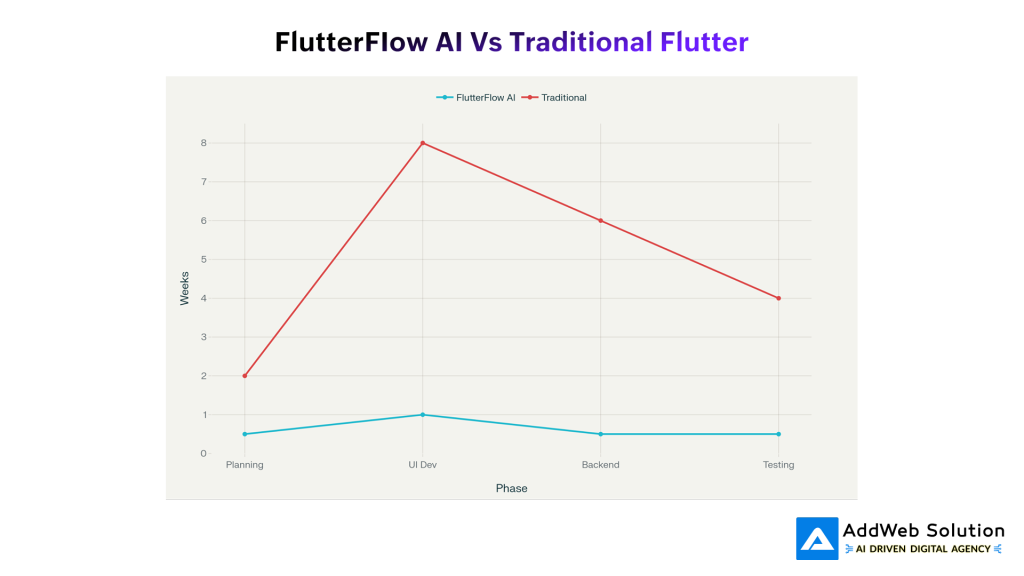
Development Timeline Comparison: FlutterFlow AI vs Traditional Flutter
Comparative Analysis: FlutterFlow AI vs. Traditional Development
Organizations need to understand the practical differences between FlutterFlow AI and traditional Flutter development to make strategic technology decisions. The analysis is conducted across key performance indicators, capabilities, and trade-offs in various dimensions.
Development Speed and Productivity
The most immediately noticeable variation between FlutterFlow AI and conventional development is development speed. FlutterFlow can shave 6-12 months off development time to 1-3 months, with some projects taking only weeks instead of months. This speed arises from many factors:
Automated UI Generation: In traditional Flutter development, widget creation, styling, and layout setup must be done manually. FlutterFlow AI’s Prompt to Page and Image to Component capabilities do this for you, creating fully styled, complete interfaces from basic descriptions or images.
Pre-built Integrations: Native Firebase, API, and third-party service integrations come built into FlutterFlow, saving the custom integration effort involved in traditional development. These integrations are thoroughly tested, well-documented, and maintained by the FlutterFlow team.
AI-Aided Logic Generation: AI capabilities of the platform also go beyond UI generation to propose business logic suggestions and auto-workflows. This support eases the mental burden on developers and decreases typical implementation faults.
Customization and Control Trade-offs
Legacy Flutter development provides full control over all aspects of application behavior and look. Developers are able to add custom animations, tailor performance for unique use cases, and make use of any Flutter package or native platform feature. Flexibility in this approach is accompanied by higher complexity and development time.
FlutterFlow AI allows for extensive customization without compromising on ease of use. Custom Functions and Custom Actions are supported by the platform, enabling developers to extend functionality beyond the native capabilities. These customizations do work within the framework of FlutterFlow, but the latter might restrict some sophisticated usages.
Performance Considerations: Default Flutter apps can be optimized to a particular performance level, with the developers being in full control of state management, widget optimization, and resource usage. Applications generated using FlutterFlow are optimized well for most scenarios, but might not reach the same degree of hand-coded application optimization for performance-sensitive applications.
Code Quality and Maintainability
A critical consideration in platform selection is long-term code maintainability and evolution. FlutterFlow addresses this concern by generating clean, exportable Flutter code. Applications can be exported at any time and continued using traditional Flutter development tools, ensuring no vendor lock-in.
The code produced is in line with Flutter best practices and design patterns, hence easily readable and maintainable by Flutter developers. This is a departure from most low-code platforms, which produce proprietary code, constricting future development opportunities.
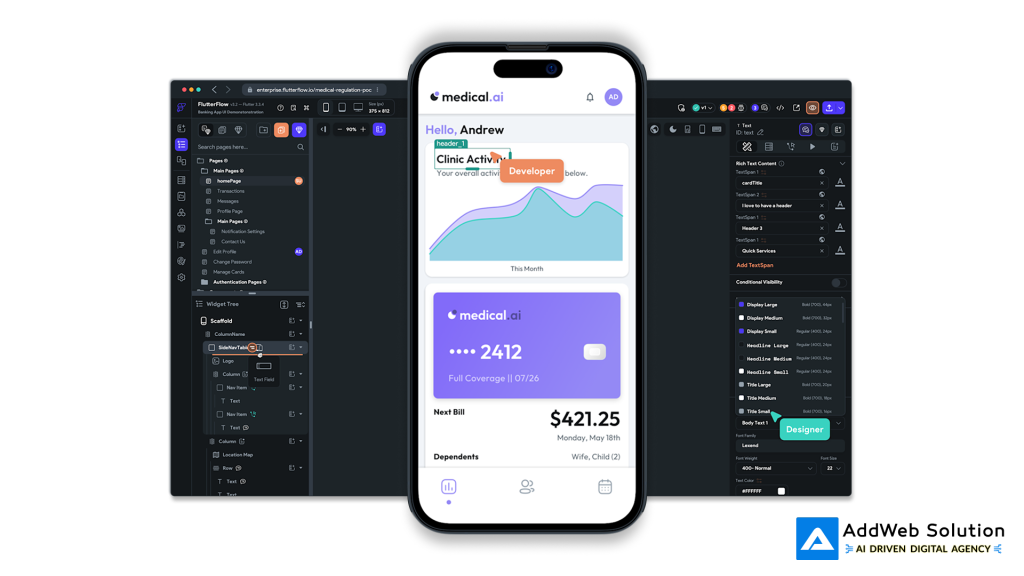
FlutterFlow visual drag-and-drop interface displaying app layout and live preview on mobile
Real-World Applications and Success Stories
The practical impact of FlutterFlow AI becomes most apparent through examination of real-world implementations across diverse industries and use cases. These case studies demonstrate the platform’s versatility and enterprise-readiness.
Healthcare Innovation
TrustEHR is an impressive showcase of FlutterFlow’s strength in highly regulated sectors. This cross-platform healthcare app brings patients, providers, and insurers together on a single digital platform. The development team took advantage of FlutterFlow’s visual interface and native security functions to develop appointment scheduling, medical record management, and secure communication channels.
The project’s success metrics are quite staggering: TrustEHR retooled their whole digital infrastructure in only four months, which is the kind of timeframe that would otherwise take 12-18 months employing conventional development methodologies. The application processes sensitive healthcare information and remains compliant with industry regulations, which shows FlutterFlow’s enterprise-level security prowess.
Maritime Industry Transformation
The Blue Pass app demonstrates FlutterFlow’s capability to modernize complicated, legacy sectors. Designed for the maritime industry of the UAE, Blue Pass integrates maritime firms’ databases and commercial vessels’ databases and greatly improves operational efficiency. The app took just one month to develop with two developers and includes several user dashboards, navigation interfaces, and an admin portal.
This project is significant in that it showcases FlutterFlow’s scalability. The shipping industry needs robust apps that can deal with complex logistics, regulatory compliance, and real-time data processing. Blue Pass meets these needs while significantly cutting development time and expenditures.
Financial Services Excellence
AB.Money registered unprecedented success in the financial services app market, that was highly competitive. This lifestyle meditation application built on FlutterFlow, secured first position in the educational App Store category in the Eastern European market. The app built within a period of less than two months has a rating of 4.8 in the App Store and 5.0 in Google Play with more than 250,000 users.
The financial statistics are also noteworthy: AB. Money earned more than $100,000 in client-reported revenue, illustrating that FlutterFlow apps can become commercially viable on par with natively developed apps. This proof of success vindicates the platform’s ability to develop market-ready, revenue-generating apps.
AI Integration Showcase
FarmGPT is a demonstration of FlutterFlow’s AI integration feature and is the winner of FlutterFlow AI Hackathon 2024. The multilingual farm assistant assists farmers in enhancing crop and livestock management using AI-driven disease identification and farming tips. The application features:
- Computer vision-based AI organic plant disease identification
- Weather forecasting for agricultural planning in real-time
- Multilingual functionality providing global access
- Integration of video tutorials for applying suggested solutions
FarmGPT’s success proves that FlutterFlow can embed advanced AI functionality in viable, real-world use cases. The project solves pressing worldwide issues in food security and sustainable agriculture while highlighting the capabilities of the platform.
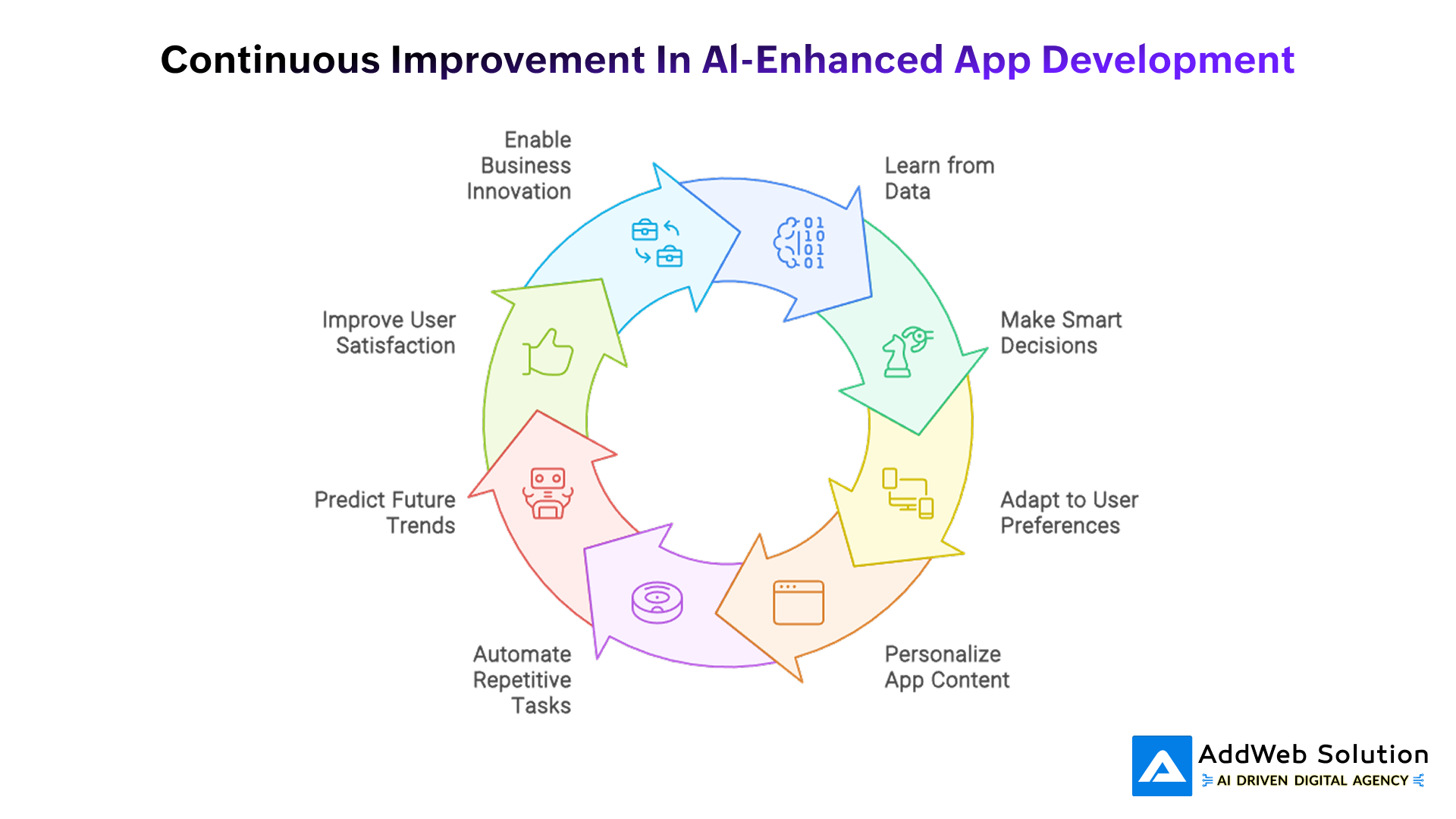
The process in continuous improvement cycle in AI-powered app development showing major steps from data learning to user satisfaction
Challenges and Limitations
While FlutterFlow AI has tremendous benefits, familiarity with its limitations is required for making smart development choices. The constraints vary across types of projects and development situations.
Technical Limitations and Workarounds
Custom Code Restrictions: The visual development nature of FlutterFlow automatically restricts the sophistication of custom code implementation. Although Custom Functions and Custom Actions are supported by the platform, developers cannot directly access the full range of Flutter functionality within the visual editor. Advanced third-party package integration or highly domain-specific logic might need to be exported as code and continued using traditional development.
Native Feature Access: Detailed device features like Bluetooth interactions, low-level hardware access, and platform-specific SDKs are not entirely supported through FlutterFlow’s interface. Those apps that need these features will need to create custom implementations or export to standard Flutter development for completion.
Performance Optimization Limitations: FlutterFlow apps are not likely to attain as much performance optimization as manually written Flutter apps. For games with heavy user interaction, sophisticated animations, or real-time data processing, native development might be better suited.
Scalability and Enterprise Implications
Project Size Constraints: FlutterFlow has incomplete project size constraints that become evident as applications expand in complexity. Heavy applications with many pages and widgets might hit platform limitations that call for architectural refactoring or code exporting.
Version Control Impediments: Conventional development teams significantly depend on version control tools such as Git to collaborate and manage code. FlutterFlow’s cloud-first strategy, though providing collaborative features, can be difficult to integrate with current enterprise development processes.
Dependence on Platform Evolution: Apps developed in FlutterFlow rely upon ongoing platform evolution and the addition of new features. FlutterFlow breaking changes may affect app behavior, although code export facilitates a migration route.
Cost Considerations at Scale
Whereas FlutterFlow provides great cost savings for startup development, pricing models can be restrictive to companies as they grow. Features like advanced capabilities, team collaboration feature sets, and usage of APIs are tied to subscription levels that can drive up total cost of ownership in large-scale implementations.
Migration Complexity: Companies that outgrow FlutterFlow’s functionality might experience potential migration difficulties. Although code export is supported, such a switch to standard Flutter development can involve tremendous development work, particularly for apps based significantly on FlutterFlow-specific widgets or logic.
Advantages of leveraging FlutterFlow and AI for app building are rapid development, enhanced user experience, cost savings, future-proofing, and scalability
Future Trends and Predictions
The intersection of AI and low-code is coming faster, with FlutterFlow at the forefront of a number of upcoming trends that will shape the application development landscape of the next generation.
Multimodal AI Integration
FlutterFlow’s plan involves multimodal AI features that will handle text, images, voice, and video all at once. These features will allow applications to interpret and react to various input types, making for more intuitive and inclusive user experiences. Initial applications such as FarmGPT, which blends image processing with multilingual text analysis, show the possibilities of multimodal applications.
- Upcoming apps will utilize these features to:
- Provide real-time image examination and text creation
- Interface creation controlled by voice
- Augmented reality support for natural language instructions
- Multi-lingual support for visual and audio interfaces
AI Agent Orchestration
The progression towards AI agent orchestration, in which several specialized agents work together to accomplish complex tasks, is a marked improvement in application intelligence. FlutterFlow’s AI Agent Builder is the platform for achieving these orchestrated systems, allowing applications to:
- Coordinate multiple AI services for end-to-end task completion
- Preserve context across various AI interactions
- Adjust behavior based on user history and preferences
- Interoperate with business processes to automate workflow management
Consolidation in the Market and Evolution of Platforms
Industry observers see a wave of consolidation coming in the low-code platform space as AI capabilities become de facto rather than distinguishing characteristics. FlutterFlow’s early adoption of AI and solid technical underpinnings put it well ahead in this consolidation wave.
Platform Interoperability: Development will probably prioritize interoperability across various low-code platforms and conventional development tools. FlutterFlow’s future-proofing through the generation of exportable Flutter code reflects this future direction, providing future-proofing no matter what happens with future platform development.
Improved Developer Experience: AI will increasingly automate mundane development work, freeing developers to concentrate on innovative problem-solving and architectural choices. FlutterFlow’s development path indicates sustained improvement of AI capabilities without sacrificing developer control over key application features.
Enterprise Integration Evolution
Enterprise adoption of AI-powered low-code platforms will gain momentum as organizations begin to see the strategic value of accelerated application development. FlutterFlow’s enterprise capabilities will likely evolve to incorporate:
- Sophisticated security and compliance features for regulated industries
- Enterprise-class deployment options, such as on-premise installations
- Integration with enterprise systems through improved API capabilities
- Sophisticated analytics and monitoring of application performance and user behavior
These advancements will make AI-augmented low-code platforms standard tools for digital transformation and not replacements for conventional development.
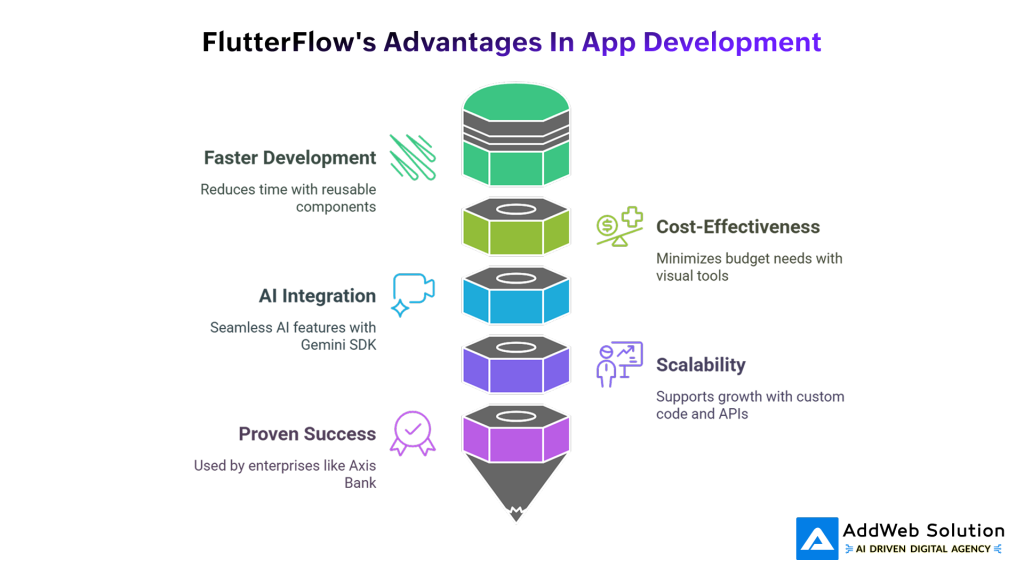
Benefits of FlutterFlow in app development, such as rapid development, cost savings, AI support, scalability, and established success
Implementation Best Practices
Effectively working with FlutterFlow AI demands strategic planning and a strict adherence to tried-and-tested methodologies that ensure the full benefits of the platform are realized while limiting possible shortcomings.
Project Selection and Evaluation Criteria
Appropriate Project Features: FlutterFlow AI is particularly effective in certain project forms and situations. Organizations should give top priority to FlutterFlow for:
- MVP deployment and quick prototyping, in which time-to-market is vital
- Small to medium-sized applications with basic business functionalities
- Projects involving AI integration without deep custom development
- Cross-platform apps with mobile, web, and desktop focus at the same time
- Small teams with minimal Flutter knowledge but deep domain understanding
Project Complexity Analysis: Apps needing heavy custom animations, intricate state management, or specific platform integrations can be more ideal for standard Flutter development or a hybrid model meshing FlutterFlow foundations with custom extensions.
Optimization of Development Workflow
Incremental Development Strategy: Adopt a phased development strategy that utilizes the rapid prototyping of FlutterFlow while being flexible enough for future improvement:
Foundation Phase: Employ FlutterFlow AI to develop core app architecture and generic UI components
Integration Phase: Integrate business logic and API calls through FlutterFlow’s inbuilt features
Enhancement Phase: Introduce custom features using FlutterFlow’s custom code feature or export for conventional development
Optimization Phase: Optimize performance and incorporate advanced features as required
Team Structure and Skills Development: Effective FlutterFlow implementation demands hybrid team structures merging domain skills with technical expertise. Organizations must invest in training initiatives that enable business users to grasp FlutterFlow capabilities while allowing technical members to offer advice and expert implementation assistance.
Quality Assurance and Testing
Continuous Testing Integration: FlutterFlow applications demand wide-ranging testing strategies that also cover visual development and generated code quality. Implement automated testing for:
- UI component behavior across multiple device types and screen sizes
- API integration quality and error handling
- Code efficiency performance benchmarks for generated code
- Cross-platform consistency to provide consistent behavior across target platforms
Code Review and Maintenance: Put in place review procedures for FlutterFlow projects that assess both visual design choices and underlying code quality. Code exports and reviews on a regular basis allow for potential issues to be discovered before affecting application performance or maintainability.
Learn the impact of FlutterFlow AI on modern app development

Pooja Upadhyay
Director Of People Operations & Client Relations
Migration and Exit Strategy Planning
Code Export Strategy: Establish specific protocols for code export and migration to legacy Flutter development if the project needs surpass FlutterFlow capabilities. This entails:
- Periodic code exports for backup and analysis
- Documentation of FlutterFlow-specific implementations needing change during migration
- Testing protocols for exported code to preserve functionality
- Team training in Flutter development for seamless transition assistance
Organizations embracing these best practices maximize the value from FlutterFlow AI while preserving strategic latitude for future development requirements. The platform’s evolution continues to meet many of today’s limitations, so ongoing assessment and adjustment are key elements of effective long-term implementation plans.
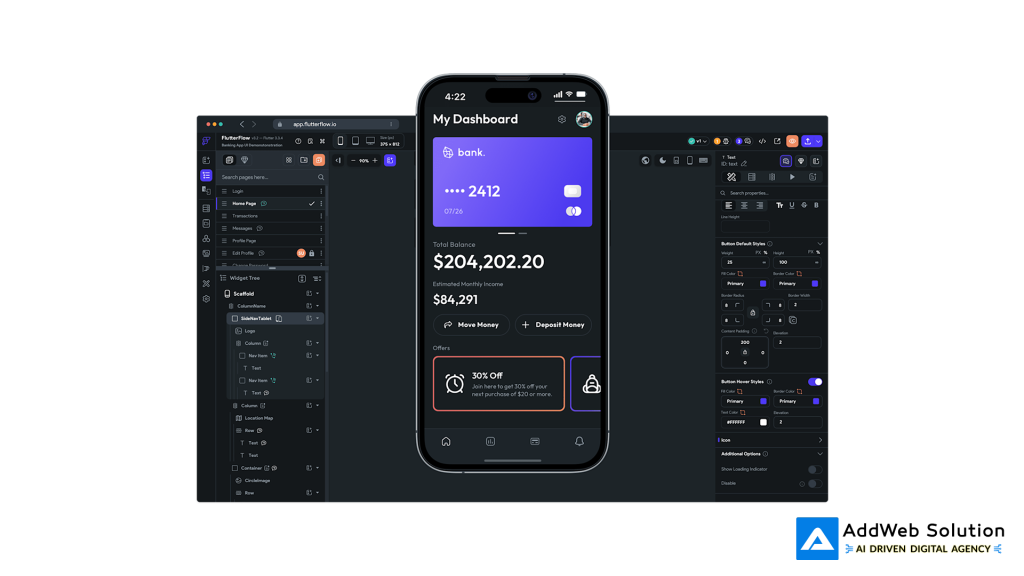
FlutterFlow interface demonstrating drag-and-drop app construction with visual design and modification
Statistics and Market Data
Low-Code Development Market Statistics
Market Size Growth: The low-code development platform market globally was worth $30.8 billion in 2024 and will reach $248.31 billion by the year 2033, growing at a CAGR of 26.1%
Platform Dominance: 68% of the market is covered by the platform, while services cover 32%
Geographic Distribution: North America possesses 38% market share with $15.31 billion in revenue, while the US alone covers 82% of the North American market with $9.8 billion
Enterprise Adoption: 38% adoption of no-code solutions is exhibited by Fortune 500 companies, with 75% of businesses expected to use a minimum of four low-code platforms by 2024
Development Speed: Low-code platforms cut development time by 50%-90% over conventional methods, with some apps developed 10 times as fast
AI App Development Market Growth
Market Valuation: The market for AI app development is estimated at $40.3 billion in 2024 and growing to $221.9 billion by 2034 with an 18.6% CAGR
AI Apps Segment: The market for AI apps alone stood at $2.94 billion in 2024 and is growing to $26.36 billion by 2030 at a 38.7% CAGR
Component Breakdown: The Solutions segment holds 68% market share, while 60% of the implementations are cloud-based deployments
North America dominates with 29.4% of the world’s market share, thanks to sophisticated infrastructure and increased AI take-up rates
Developer Scarcity and Cost Burden
Talent Gap Crisis: The worldwide scarcity of talent across sectors is estimated at 85.2 million employees by 2030, with 82% of companies incapable of attracting enough developers
Cost Savings: The typical firm saves $4.4 million across three years by not employing two software developers due to low-code adoption
Salary Comparison: The Typical US software developer’s salary is $110,140, whereas low-code platforms begin at $3,000/month for in-depth development ability
Development Cost Savings: Legacy development costs $70,000-$100,000+ whilst low-code costs around $3,000/month, equaling savings of up to $99,700
Time Investment: Traditional development is 6-12 months, whereas low-code platforms are 1-3 months
FlutterFlow Specific Metrics
User Growth: FlutterFlow has seen 8,300% growth in web searches within five years, with 2.7 million monthly users
Funding Success: The company raised a total of $28 million, including a $25.5 million Series A round in January 2024, led by Google Ventures
Success Rate: Several FlutterFlow apps have ranked in the top categories on the App Store, with AB. Money is becoming #1 in Eastern Europe’s education category
Development Speed: Builds such as Blue Pass were done in one month by two developers, and TrustEHR was revamped in four months, showing realistic implementation timelines
- https://www.statista.com/outlook/tmo/artificial-intelligence/worldwide
- https://www.fortunebusinessinsights.com/low-code-development-platform-market-102972
- https://www.precedenceresearch.com/low-code-development-platform-market
- https://www.mordorintelligence.com/industry-reports/low-code-development-platform-market
- https://www.grandviewresearch.com/industry-analysis/ai-apps-market-report
- https://www.gminsights.com/industry-analysis/low-code-development-platform-market
- https://www.technavio.com/report/low-code-development-platform-market-industry-analysis
