


In a time when cyber threats change faster than the news cycle, government agencies face a tough challenge: building digital systems that are easy for millions of citizens to use while staying secure against constant attacks. Across more than 150 countries, many governments have arrived at the same solution. Drupal, an open-source content management system, has become a trusted foundation for public sector websites. Its popularity isn’t driven by hype or pricing, but by security built into its core. This article looks at why governments rely on Drupal, how its architecture prioritizes security, and how Drupal 11 and the Starshot initiative are shaping the future of digital governance.

Why Governments Demand More Than Off-the-Shelf Solutions
Government websites are not just regular websites. They are critical public infrastructure. Citizens use them to access sensitive information like taxes, health records, benefits, and legal services. A security breach is more than bad publicity; it can damage public trust and put personal data at risk. This makes the choice of a CMS far more serious.
Research shows that 55.9% of US federal government websites use Drupal. Adoption grows with scale: about 57% of small states use Drupal, nearly 67% of mid-sized states do, and large states with the most complex systems rely on it almost universally. This trend reflects a clear reality. Governments with higher traffic, stricter security needs, and more critical services consistently choose Drupal. Today, it is trusted by public institutions in over 150 countries.
That trust is global. Canada uses Drupal for Service Canada portals that manage employment insurance, pensions, and health services. Australia’s Taxation Office relies on Drupal to serve millions of taxpayers. The UK government uses it across departments for citizen services. Even the White House moved to Drupal in 2015, proving it can support one of the most secure and high-profile government websites in the world.
The Security-by-Design Philosophy: Built-In, Not Bolted-On
Here’s where Drupal diverges fundamentally from other CMS platforms: its approach to security isn’t reactive. It’s architectural.

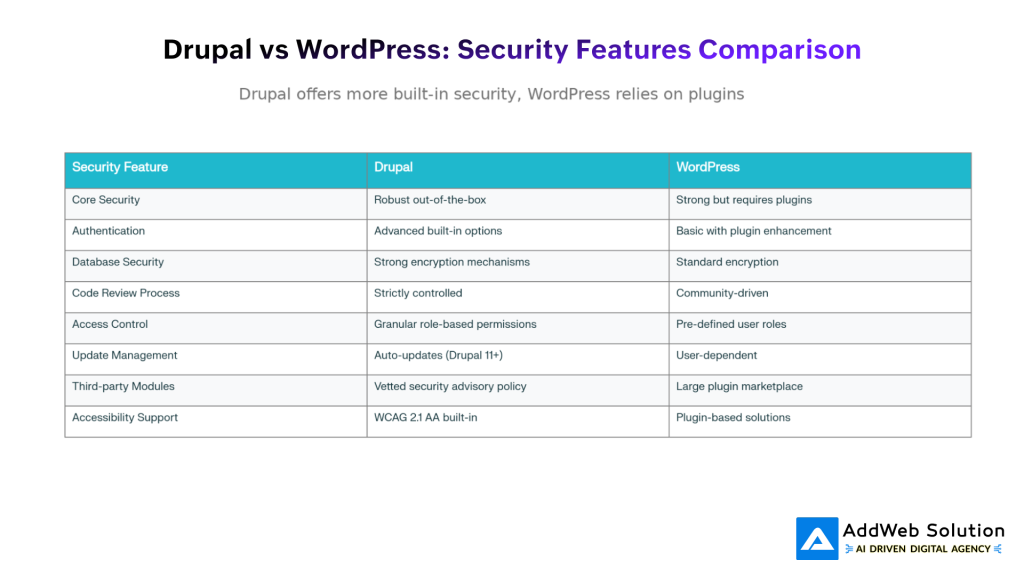
Building a secure website is like building a house. You can either start with strong foundations, or build fast and add locks later. WordPress follows the second path. It keeps a lightweight core and depends heavily on plugins and admins to handle security. When plugins are abandoned or updates are missed, risks quickly add up. Drupal takes a different approach by making security part of the foundation from day one.
Drupal has a dedicated security team of over 20 experts who actively monitor and fix vulnerabilities across the platform. With WordPress, much of that responsibility falls on site owners and third-party plugins. A Sucuri study found that in 2023, 90% of hacked websites were running on WordPress, compared to just 2% on Drupal. This gap reflects how the platforms are built, not just how popular they are.
Looking at long-term data makes the difference even clearer. Since 2002, Drupal has reported only 324 vulnerabilities, and many of those have been systematically addressed over time. In 2024, Drupal reported just two. WordPress, on the other hand, sees frequent vulnerabilities largely because of its massive plugin ecosystem.
The reason comes down to governance. Drupal reviews every contributed module for security before it is approved. WordPress relies more on community trust and reputation. For governments responsible for protecting citizen data, that difference truly matters.


The Technical Architecture: Permissions, Encryption, and Least Privilege
Drupal’s strength in government security does not come from a single feature. It comes from how its security systems work together.
First is access control. Drupal lets teams create highly customized user roles with very specific permissions. Someone editing content for one department can be completely restricted from seeing sensitive data in another. This “only what you need” approach aligns closely with government security standards.
Next is how Drupal handles data on the page. Since Drupal 8, content is safely escaped by default, which greatly reduces the risk of common attacks like cross-site scripting. For government sites, this built-in protection removes the need for constant custom fixes.
Drupal also protects data at the database level. It uses safe query handling to prevent SQL injection and supports encrypted setups across major databases. This means agencies can enforce strict data protection rules without the CMS becoming a weak link.
Finally, Drupal fits into existing government identity systems. It supports two-factor authentication, directory services like LDAP and Active Directory, and even smart card based logins. This makes it easy for government IT teams to integrate Drupal into secure environments without cutting corners.
Real-World Government Examples: When Stakes Are Highest
Governments do not choose Drupal as a trial. They choose it because the risks are real.
When the White House rebuilt its website in 2015, it needed a CMS that could handle extreme traffic, strict security, and collaboration across many teams and systems. Drupal met all of those demands. That decision sent a clear message: if Drupal is trusted for the President’s website, it can be trusted anywhere in government.
Canada’s government made Drupal the standard for Service Canada, which delivers essential services to millions of citizens. The platform had to support both English and French, integrate with older systems, meet accessibility standards, and stay secure across complex workflows. Drupal’s built-in multilingual support and structured content tools made it a natural fit.
In Australia, agencies like the Australian Taxation Office use Drupal to manage tax services, real-time updates, and secure documents for millions of users, especially during peak tax season. Drupal’s scalability and integration capabilities played a key role. The UK government also relies on Drupal across departments where security, accessibility, and public trust are critical. Each department can maintain its identity while following shared standards.
These are not exceptions. They represent the benchmark for government digital services, and Drupal is at the core of them.
The Open-Source Advantage: Transparency Without Vendor Lock-In
Governments around the world are becoming cautious about closed software. If the code cannot be reviewed, trust becomes a problem. This is where Drupal’s open source license makes a real difference.
With Drupal, governments fully control the code. There are no licensing fees, no forced renewals, and no vendor lock in. Agencies can audit the software, customize it, or even maintain their own version if needed. This level of control is especially important for countries with strict data sovereignty rules, where citizen data must stay under national control.
The cost savings are significant. Proprietary CMS platforms can cost governments millions each year in licenses and customization. Drupal removes licensing costs entirely, allowing public funds to go toward security, accessibility, and better services for citizens instead of software fees.
This open approach also fuels a strong global community. Thousands of developers, agencies, and government teams contribute improvements focused on security, accessibility, and public sector needs. That shared effort keeps Drupal evolving and aligned with the real challenges governments face.
Security Features That Matter: The Technical Checklist
When AddWeb Solution evaluates CMS platforms for government clients, we assess specific capabilities:
Content approval workflows: Drupal supports multi-step reviews before anything is published. Content can be checked by editors, legal teams, and senior officials, with every step tracked and recorded.
Revision history and audits: Every content change is saved, versioned, and reversible. This makes compliance, audits, and legal reviews much easier for government teams.
Built-in accessibility: Drupal is designed to meet WCAG 2.1 AA standards out of the box, including keyboard navigation and screen reader support. This ensures services are accessible to all citizens.
API-first design: Drupal works seamlessly with websites, mobile apps, voice assistants, and other platforms. Citizens get the same secure and up-to-date information no matter how they access a service.
Identity system integration: Drupal connects with existing government login systems like LDAP, Active Directory, SAML, and OAuth, allowing secure, centralized access without duplicate credentials.
The Path Forward: Why the Trend Will Continue
As government services grow more complex, Drupal adoption grows with them. That’s because strong security depends on strong architecture. You can’t fix weak foundations with plugins or quick patches.

Drupal’s momentum is increasing with Drupal 11 and the Starshot initiative, making it easier to adopt while strengthening security. More users and contributors mean better reviews, better tools, and safer government deployments.The White House’s move to Drupal made one thing clear: security in government is not optional, it’s essential.
At AddWeb Solution, we help governments design, secure, and scale Drupal platforms. From migrations to new builds, we focus on compliance, performance, and long-term security.
Drupal may not be the most popular CMS, but when public trust and security matter most, it’s the right choice.
Power Your Website with Drupal’s Excellence!

Pooja Upadhyay
Director Of People Operations & Client Relations
