


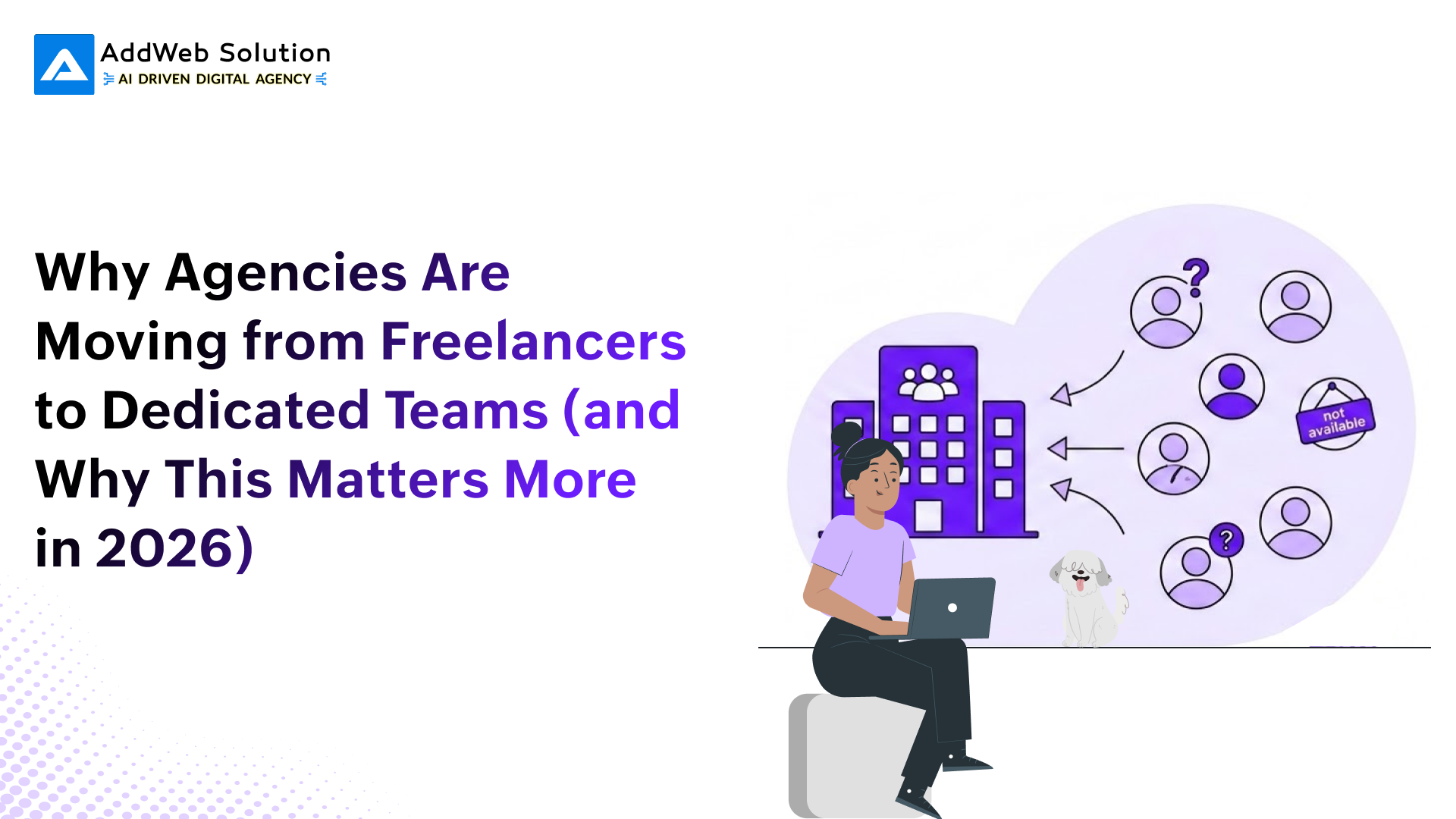
Introduction: The Freelancer Model That Once Worked Is Showing Cracks
For years, freelancers were the default “flexibility layer” for agencies.
Need a React developer?
Bring in a freelancer.
Need to scale quickly?
Add more freelancers.
This model worked – when:
- Projects were smaller
- Timelines were looser
- Tech stacks were simpler
- Client expectations were lower
That reality has changed.
Today, agencies operate in an environment where:
- Delivery cycles are continuous
- Context matters more than speed
- Products live longer
- Accountability expectations are higher
As we move toward 2026, many agencies are quietly shifting away from freelancer-heavy models toward dedicated teams.
Not because freelancers lack skill – but because the model breaks down under modern delivery pressure.
This article explains:
- Why the freelancer model struggles at scale
- What dedicated teams actually solve
- Where freelancers still make sense
- How agencies are rethinking talent structures
Key Takeaways
- Freelancers optimize for speed, not continuity
- Dedicated teams optimize for context, ownership, and trust
- Modern delivery punishes high context loss
- Accountability matters more than individual brilliance
- By 2026, team stability will outperform ad-hoc flexibility
1. Why the Freelancer Model Is Under Strain
Freelancers excel at task execution.
They are often:
- Highly skilled
- Fast to onboard
- Flexible
But modern agency work is no longer task-based.
It is:
- Ongoing
- Interdependent
- Context-heavy
Freelancers rotate.
Context resets.
Ownership fragments.
This creates friction that compounds over time.
2. The Hidden Cost of Context Switching
Context is expensive.
Every time a new freelancer joins:
- Business logic must be re-explained
- Architectural decisions must be revisited
- Edge cases must be rediscovered
This “invisible work” is rarely tracked – but it slows delivery and exhausts senior team members.
As delivery becomes continuous, context loss becomes a structural tax.


3. Accountability vs Availability
Freelancers are available.
Dedicated teams are accountable.
Availability answers:
“Can someone work on this?”
Accountability answers:
“Who owns this end-to-end?”
Modern clients expect:
- Predictable outcomes
- Proactive problem-solving
- Clear ownership
Freelancer-heavy models struggle to deliver this consistently.
4. What Dedicated Teams Actually Provide
Dedicated teams offer:
- Stable context
- Clear ownership
- Predictable velocity
- Stronger quality baselines
They reduce:
- Rework
- Coordination overhead
- Dependency on heroics
Dedicated teams don’t just execute work.
They carry responsibility.
5. Where Freelancers Still Make Sense
This is not an anti-freelancer argument.
Freelancers work well for:
- Short-term spikes
- Specialized, narrow expertise
- One-off audits or reviews
- Non-core work
Problems arise when freelancers are used as structural capacity, not tactical support.
6. Common Talent Strategy Mistakes
Mistake 1: Assuming skill equals delivery success
Context and ownership matter more.
Mistake 2: Over-rotating talent to save cost
Short-term savings create long-term drag.
Mistake 3: Treating freelancers as interchangeable
Interchangeability kills continuity.
Mistake 4: Avoiding team investment to stay “lean”
Lean without stability becomes fragile.
7. Stats That Reflect the Shift
- McKinsey highlights that stable teams outperform rotating contributors in complex work
Source: https://www.mckinsey.com/capabilities/people-and-organizational-performance - Deloitte notes that delivery continuity improves quality and predictability in professional services
Source: https://www.deloitte.com/global/en/services/consulting - Harvard Business Review links team stability to higher trust and better outcomes
Source: https://hbr.org
The data favors continuity.
8. A Timeless Perspective on Ownership
Peter Drucker once said:
“The best way to predict the future is to create it.”
Dedicated teams create the future of delivery by carrying ownership – not just completing tasks.
9. Interesting Facts About Team Stability
- Most delivery delays stem from ownership gaps, not skill gaps
- Stable teams reduce onboarding overhead dramatically
- Context retention improves estimation accuracy
- Team trust compounds faster than individual productivity
10. Frequently Asked Questions
Are freelancers becoming obsolete?
No, their role is becoming more specific.
Are dedicated teams more expensive?
Short-term yes. Long-term often cheaper.
Can agencies mix freelancers and dedicated teams?
Yes – when boundaries are clear.
Is this shift only for large agencies?
No, smaller agencies often benefit earlier.
Ready to scale your agency?
Contact our growth team today and let’s talk strategy.

Pooja Upadhyay
Director Of People Operations & Client Relations
Conclusion
The shift from freelancers to dedicated teams is not about preference.
It’s about delivery reality.
As agency work becomes more continuous, context-heavy, and trust-driven, models optimized for short-term flexibility struggle.
By 2026, agencies that prioritize stable, accountable teams will deliver more predictably – and scale more calmly.
Freelancers still have a role.
They just can’t be the foundation anymore.


