


Picture this: You’re running a business website, but it feels like you’re flying blind. Visitors come and go like shadows in the night, leaving behind nothing but basic traffic numbers. You know people are clicking around, but who are they? What do they want? Why do they leave without buying?
This scenario plays out thousands of times daily across the web, where businesses struggle to transform cold, impersonal data into warm, human insights. But here’s where things get exciting – Drupal doesn’t just manage content, it transforms raw visitor data into compelling stories about your customers.

The Analytics Revolution in Drupal
Traditional websites often treat analytics as an afterthought – a dashboard you check occasionally to see if traffic is up or down. But modern Drupal transforms this approach entirely. When you integrate powerful analytics tools like Google Analytics 4, Highcharts, and specialized tracking modules, something magical happens: your website becomes a customer behavior laboratory.
Consider a real-world example from Zambon Group, a pharmaceutical multinational that implemented Drupal’s data visualization capabilities across their corporate website and dozens of product microsites. They didn’t just get better graphs – they achieved visual and functional consistency across their entire digital presence while reducing implementation times for new digital initiatives by 70%.
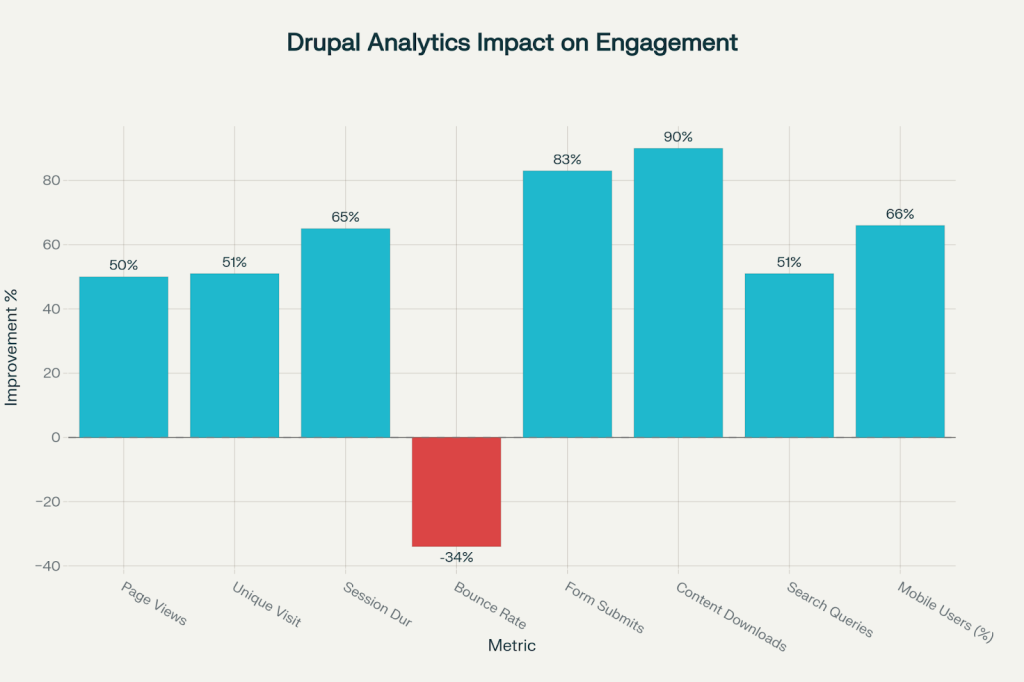
The transformation shown in this data isn’t just about numbers getting bigger. Notice how session duration increased by 65% while bounce rates dropped by 34%. This tells a human story: visitors are finding content that genuinely interests them, staying longer, and engaging more deeply with the website experience.


Understanding Your Customers Through Multiple Lenses
The Traffic Story: Where People Come From Matters
Every visitor arrives with a story. Some discovered you through a late-night Google search (organic traffic), others remembered your domain from a business card (direct traffic), and some clicked through from a social media post their friend shared.
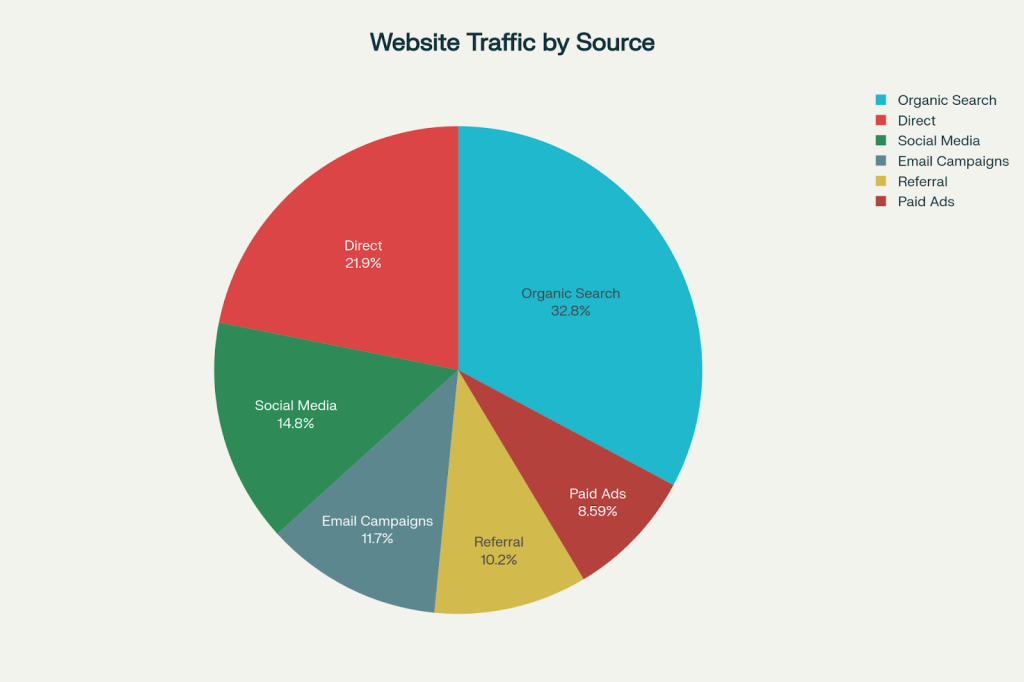
This traffic distribution reveals fascinating insights about customer behavior. Organic search visitors often have higher intent – they’re actively looking for solutions. Direct visitors show strong brand recognition – they remember you well enough to type your URL. Email campaign traffic converts better because these people already know and trust you.
Understanding these patterns helps businesses like Harvard University, which uses Drupal to manage its complex web ecosystem. They discovered that different traffic sources require different content strategies – prospective students arriving from social media need different information than alumni accessing the site directly.
The Customer Journey: From Stranger to Advocate
Modern customer journeys aren’t linear paths – they’re complex, multi-touchpoint experiences that unfold over days, weeks, or months. Drupal’s analytics capabilities shine here because they can track and visualize these intricate paths.

This funnel visualization tells a powerful story. Look at the conversion rates: 65% of aware users become interested, but only 27% move from interest to serious consideration. This insight is golden – it tells you exactly where to focus your optimization efforts. Maybe your interest-stage content is compelling, but your consideration-stage materials need work.
Companies like MIT leverage these insights through Drupal’s flexible analytics framework. They discovered that students exploring graduate programs needed different content at each journey stage – from high-level program overviews during awareness to detailed faculty research during consideration.
The Power of Personalization: Making Data Human
Here’s where Drupal truly excels – transforming anonymous visitors into understood individuals. Through modules like the Personalization module and integration with tools like Marketo and Salesforce, Drupal creates dynamically personalized experiences that adapt in real-time.

These personalization metrics reveal something profound: custom dashboards achieve 52% conversion lift, while personalized CTAs boost conversions by 48%. But why? Because personalization makes people feel understood. When someone visits your site and sees content tailored to their industry, role, or previous behavior, it creates an immediate connection.
Real-World Success Stories: Data-Driven Transformations
Case Study: Financial Services Security Revolution
A leading financial services company with over 20 million customer accounts faced a critical challenge: their aging Drupal 7 website was becoming a security liability. Their migration to Drupal 9 wasn’t just a technical upgrade – it was a complete transformation of how they understood and served customers.
The results spoke volumes:
- 42% improvement in page load times
- Enhanced security features that transformed a liability into a competitive advantage
- Streamlined content management that empowered marketing teams
But the real victory was deeper: they could now track customer behavior with unprecedented precision, leading to more targeted financial products and improved customer satisfaction.
Case Study: Healthcare Network Patient Experience
A regional healthcare provider with 30+ facility websites struggled with inconsistent patient information across fragmented Drupal 7 implementations. Their Drupal migration focused on consolidating patient resources and improving accessibility through advanced analytics.
The transformation delivered measurable human impact:
- 28% increase in patient portal registrations
- Significant reduction in support calls related to website navigation
- Improved patient experience through data-driven content optimization
This wasn’t just about better technology – it was about using data to serve patients more effectively.
The Technical Magic: How Drupal Makes It Happen
Advanced Analytics Integration
Drupal’s strength lies in its seamless integration with powerful analytics platforms. The Google Analytics module, used by nearly 400,000 sites, ranks among the top 20 most popular Drupal modules. But it’s not just about installation – it’s about the sophisticated tracking capabilities:
- Custom event tracking for specific user interactions
- Enhanced measurement for automatic tracking of scrolls, downloads, and video engagement
- Real-time data visualization through modules like Highcharts and D3.js
Sophisticated User Tracking
Modern Drupal implementations can track incredible detail about user behavior through modules like:
- Search Tracker: Captures and analyzes user searches in real-time
- Heatmap modules: Visualize where users click, scroll, and focus attention
- Behavior Analysis: Track comprehensive user interaction patterns
Data Visualization Mastery
Drupal’s visualization capabilities transform raw data into compelling narratives through:
- Charts module: Supports line, bar, pie, area, and scatter charts with Views integration
- D3.js integration: Creates interactive, animated visualizations
- Dashboard modules: Provide comprehensive analytics overviews
Building Your Customer Understanding Strategy
Step 1: Define Your Analytics Goals
Before implementing any tracking, clarify what customer understanding means for your business. Are you trying to:
- Improve conversion rates through better user experience?
- Reduce bounce rates with more engaging content?
- Increase customer lifetime value through personalized experiences?
- Optimize content strategy based on user preferences?
Step 2: Implement Comprehensive Tracking
Modern customer understanding requires multiple data sources:
- Web Analytics: Google Analytics 4 for comprehensive behavior tracking
- Heatmap Analysis: Understanding visual interaction patterns
- Search Analytics: Tracking internal site search behavior
- Form Analytics: Monitoring conversion funnel performance
Step 3: Create Visual Dashboards
Raw data overwhelms; visual insights inspire action. Use Drupal’s charting capabilities to create dashboards that tell stories:
- Traffic source analysis showing customer acquisition patterns
- User journey visualization revealing conversion bottlenecks
- Personalization effectiveness measuring targeted content impact
- Content performance highlighting what resonates with audiences
Step 4: Act on Insights
The most sophisticated analytics mean nothing without action. Use your customer understanding to:
- Optimize high-traffic pages based on user behavior data
- Personalize content for different user segments
- Improve conversion funnels by addressing identified friction points
- Create targeted marketing campaigns based on user preferences
Key Metrics That Matter
When tracking customer understanding, focus on metrics that reveal human behavior:
Engagement Metrics
- Session duration: How long people find your content valuable
- Pages per session: Whether visitors explore beyond initial landing
- Return visitor rate: If people come back for more
- Social sharing: Whether content resonates enough to share
Conversion Indicators
- Micro-conversions: Newsletter signups, content downloads, demo requests
- Macro-conversions: Purchases, service inquiries, account creations
- Conversion path length: How many touchpoints lead to conversion
- Time to conversion: How long the decision-making process takes
Customer Satisfaction
- Net Promoter Score: Likelihood to recommend your business
- Customer Effort Score: How easy interactions are
- Support ticket volume: Whether self-service content works
- User-generated content: Reviews, testimonials, community participation
Customer journey mapping example showing Sarah’s movie experience from decision to return, highlighting her expectations and thoughts
Explore how Drupal goes beyond CMS start your DXP journey today!

Pooja Upadhyay
Director Of People Operations & Client Relations
The Future of Customer Understanding in Drupal
The evolution continues as Drupal integrates with increasingly sophisticated tools:
AI-Powered Insights
Modern Drupal implementations leverage artificial intelligence for predictive analytics, helping businesses anticipate customer needs before customers themselves recognize them.
Advanced Personalization
Beyond simple content swapping, future Drupal personalization will include:
- Dynamic pricing based on user behavior
- Predictive content recommendations using machine learning
- Real-time A/B testing that automatically optimizes experiences
- Cross-platform personalization that follows users across touchpoints
Privacy-First Analytics
With increasing privacy regulations, Drupal’s approach to customer understanding emphasizes consensual data collection and transparent usage. This builds trust while still providing valuable insights.
Making It Personal: The Human Touch in Data
The most successful Drupal implementations remember that behind every data point is a real person with genuine needs, concerns, and aspirations. When Bond University implemented Drupal 9 with advanced analytics, they didn’t just improve technical metrics – they created experiences that better served their educational community.
This human-centered approach to data transforms everything:
- Analytics become empathy tools instead of just measurement systems
- Optimization focuses on user value rather than just conversion rates
- Personalization serves customer needs instead of just business goals
- Design decisions prioritize user experience over internal convenience
Source URLs
- https://www.drupal.org/project/behavanalytics
- https://www.drupal.org/project/dvf
- https://www.drupal.org/project/ga_dashboard
- https://www.drupal.org/project/google_analytics
- https://www.drupal.org/project/visualization_charts
- https://www.drupal.org/project/heatmap
- https://docs.acquia.com/acquia-optimize/how-use-heatmaps
