


This blog was originally published on November 21, 2025, and has been fully updated on Jun 26, 2026. All statistics, trends, technology references, and best practices have been revised to reflect the current landscape of custom software development.
Let’s be honest, managing a monolithic Laravel application that’s been growing for years feels like trying to steer a massive cargo ship. You want to make small adjustments, but even the tiniest course correction takes forever and risks affecting every other part of the vessel. That’s exactly why 74% of organizations are already making the switch to microservices, and another 23% are planning to follow suit.
If you’re sitting with a legacy PHP app that’s become increasingly difficult to manage, you’re not alone. This guide walks through how to thoughtfully transform your monolith into a modern microservices architecture using Laravel, without burning everything down and starting from scratch.
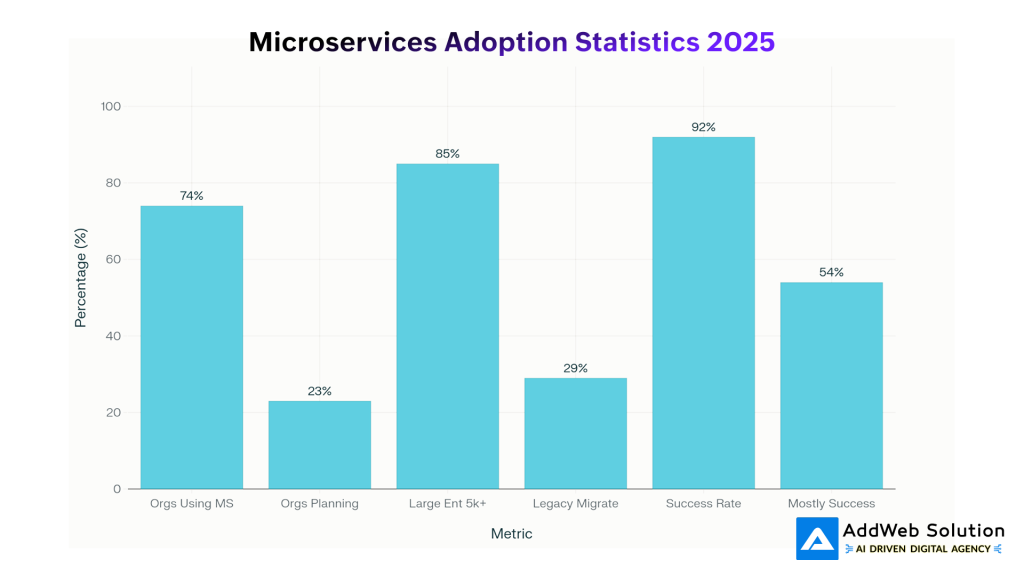
Current microservices adoption rates across organizations show strong uptake with 74% already using the architecture and 92% reporting success.
Why Your Monolith Is Becoming a Problem
Here’s what happens with monolithic applications over time: they work beautifully at first. Everything’s in one place. One team, one codebase, straightforward deployments. But as your app grows, those advantages flip into disadvantages.
Scaling becomes a nightmare. Your product catalog gets hammered during holiday sales, so you need to scale up. But since everything lives in one application, you’re scaling the entire system, even the parts that barely get traffic. That’s expensive and inefficient.
Deployments become terrifying. You want to fix a bug in the checkout system, but you’re anxious because deploying means redeploying everything. One mistake in unrelated code could take down your entire platform. Teams become overly cautious, releases slow to a crawl.]
You’re stuck with yesterday’s technology. That PHP 5.6 legacy code? You’re married to it. Adopting PHP 8, integrating modern APIs, or trying new frameworks becomes a massive undertaking. Technical debt accumulates silently until it’s absolutely crushing.
Team coordination becomes painful. Five developers touching the same codebase create endless merge conflicts. Feature development becomes interdependent. Someone’s waiting on someone else. Nobody’s moving fast.
The interesting part? These problems aren’t actually problems with monoliths themselves, they’re problems with large monoliths. The architecture that got you from zero to market isn’t necessarily the architecture that scales to a million users.
What Microservices Actually Solve
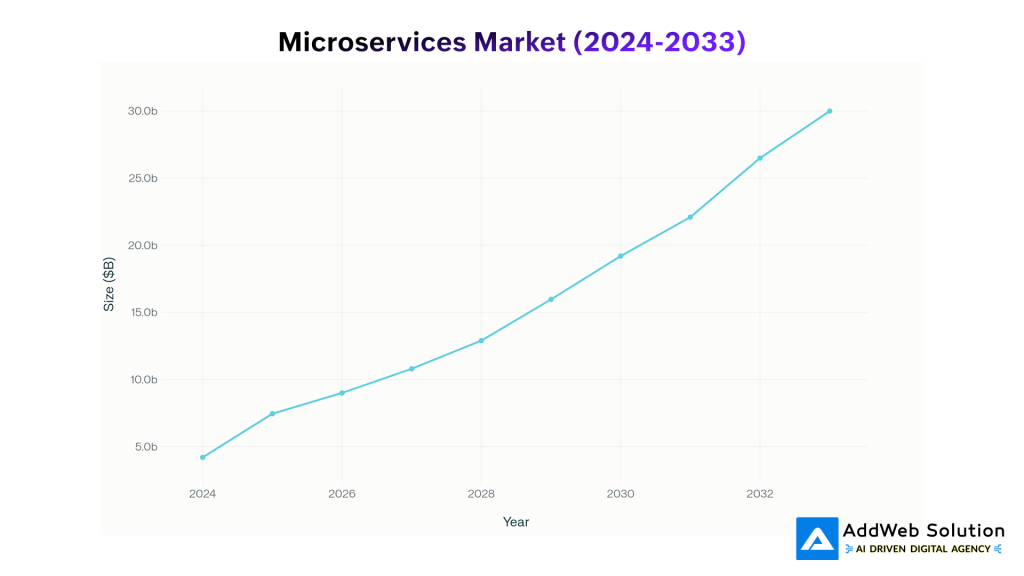
The global microservices architecture market is projected to grow from $4.2B in 2024 to $30B by 2033, representing a CAGR of approximately 18.5%.
The microservices market is growing like crazy, from $4.2 billion in 2024 to $30 billion by 2033. But why? What actually changes when you switch?
You scale what actually needs scaling. Your search feature gets hammered? Scale just that service. Your checkout is fine? Leave it alone. You’re paying for what you actually use.
Deployment becomes boring (in a good way). A team ships a new notification feature without coordinating with anyone else. No massive release windows. No company-wide anxiety about breaking things. Teams move independently and release multiple times per day if they want.
When something breaks, the rest keeps working. Your recommendation engine goes down? Customers can still browse and buy. That’s real resilience. A monolith doesn’t have that luxury.
You can finally use the right tool for each job. Laravel handles your business logic beautifully. But for real-time notifications? Maybe Node.js makes more sense. For heavy analytics? Python with Pandas crushes it. You’re not forced to shoehorn everything into PHP.
Your teams actually move faster. Small teams own entire services. They make decisions. They don’t wait for approval from a central architecture committee. Product moves faster. People are happier.
Before You Start: Do This First
Here’s the thing about migration, it’s seductive to jump straight into building cool new microservices. Resist that urge. Take time upfront to understand what you’re working with.
Actually map your monolith. Seriously. Document the major pieces, how they connect, what data flows where. Which parts change constantly? Which are stable? Which are performance bottlenecks? This takes a week or two, but it saves you months of regrets later.
Get clear on why you’re doing this. “Modernization” is not a goal. Is scaling a real constraint? Do you need to deploy faster to compete? Is compliance driving this? Clear answers guide which services to extract first.
Pick the right migration strategy. The Strangler Fig Pattern is probably your best bet. Here’s how it works: you keep your existing monolith running. Gradually, you extract one service at a time and route traffic to the new service while keeping the monolith as a fallback. Think of it like replacing a tree’s branches one at a time while it’s still standing. If something breaks, you just route back to the old code. It’s safe. It’s gradual. It actually works.


Finding Your Service Boundaries (This Matters More Than You Think)
Where you draw lines between services determines whether your microservices architecture becomes a beautiful, scalable system or a frustrating mess of tangled dependencies.
Think like a business person, not an engineer. Don’t create services based on technical layers (don’t do “database service” or “API service”). Instead, think about distinct business capabilities. In an e-commerce business, you have “Order Processing” and “Inventory Management” and “Customer Management”, those are real business things. Each becomes a service.
Within each business capability, identify what data belongs together. Orders include order items, shipping info, payment status. All that lives in one service. That service owns its own database. No other service touches its data directly, they ask politely through APIs.
Start somewhere manageable. Don’t try to extract your most complicated component first. Pick something simpler, like a notification service or reporting system. Let your team learn the patterns. Build confidence. Then tackle harder stuff.
For databases, commit to the principle: one database per service. Yes, this creates challenges around data consistency. Yes, you’ll need new patterns. But the alternative, sharing databases, basically defeats the entire purpose of microservices. Use event-driven patterns and accept eventual consistency. Services publish events when things happen, other services react to those events.
Actually Building This: The Tools That Help

Diagram illustrating a typical microservice architecture with clients, load balancer, API gateway, domains of microservices, databases, and supporting services like identity provider and service registry.
Laravel vs. Lumen? Lumen is lighter, faster to start up, perfect for simple APIs. Laravel with Octane (a high-performance server running PHP through Swoole) is surprisingly fast now and gives you the full framework. For most teams in 2026, full Laravel with Octane makes more sense.
Your API Gateway acts like a traffic cop. Kong is the popular choice, it routes requests to the right service, handles authentication, enforces rate limits. Alternatively, NGINX works fine if you want something simpler. The key: have one entry point clients talk to.
Services need to communicate. Sometimes you want immediate answers (synchronous), Order Service asks Product Catalog for current prices. Other times, you publish events and let services react asynchronously. Order completed? Publish an event. Inventory updates itself. Email service sends a confirmation. Nobody’s directly coordinating.
Here are the key packages and tools you’ll actually use:

Docker makes this sane. Package each service with its exact PHP version, extensions, config. Runs the same on your laptop and production. No “works for me” surprises.
Kubernetes handles the operational complexity. It automatically scales services up when traffic spikes, scales down when quiet, restarts services that crash, and manages deployments. You describe what you want; Kubernetes figures out how to make it happen.
Monolith vs Microservices: The Real Trade-offs

Microservices aren’t magic. They’re genuinely harder to operate. But if you’re at a scale where monoliths have become slow and painful, microservices make things actually easier.
The Messy Parts (And How to Handle Them)
Data consistency is tricky. Forget distributed transactions, they create more problems than they solve. Instead, embrace eventual consistency and use the SAGA pattern: break long workflows into separate service transactions with compensation logic if something fails. An order goes through steps like “reserve inventory,” “charge payment,” “create order.” If payment fails, undo inventory reservation.
You need real observability. With requests bouncing across multiple services, traditional monitoring breaks. You need: centralized logging (ELK Stack), distributed tracing to follow requests across services, and metrics collection (Prometheus/Grafana). When something breaks, you can actually see what happened.
Security changes. API Gateways handle authentication, so internal services know they’re receiving verified requests. Use mutual TLS for service-to-service communication in production. Each service only gets access to what it actually needs.
Testing becomes more nuanced. Unit tests for individual logic. Integration tests for service conversations. Contract tests to verify API agreements hold up. End-to-end tests for critical workflows. Automated CI/CD runs everything on every change.
Need help planning your migration? Contact our Laravel architecture experts today.

Pooja Upadhyay
Director Of People Operations & Client Relations
How to Actually Succeed at This
- Make service boundaries reflect business reality, not technical architecture
- Commit to database per service even though it’s messier
- Design APIs that won’t break with versioning strategies
- Automate everything possible, deployment, testing, infrastructure
- Start small, iterate, learn before tackling complex components
- Build observability in from day one, don’t retrofit it later
- Assume failures will happen and design services to degrade gracefully
The Real Ending
Migrating from monolith to microservices isn’t a weekend project. It’s a strategic shift that takes months and requires investment in tooling, skills, and new operational practices. But if you’re outgrowing your monolith, if deployments are terrifying, if you’re stuck with yesterday’s technology, it’s worth doing.
The global microservices market is heading toward $30 billion by 2033, and that growth reflects real value companies are getting from this shift. Faster deployments. Independent scaling. Teams moving without blocking each other. Resilient systems that keep running when things go wrong.
Laravel gives you powerful tools to build this. Docker and Kubernetes make it operationally feasible. The patterns are proven. What separates success from failure is usually whether teams take time to plan properly, start with something manageable, and iterate from there.
Your monolith isn’t broken. It did exactly what it was supposed to do, it got you here. But if you’re ready to move faster, scale smarter, and give your teams autonomy, microservices are worth the journey.
Resources:
- https://www.grandviewresearch.com/industry-analysis/chatbot-market
- https://www.grandviewresearch.com/industry-analysis/predictive-analytics-market
- https://laravel-news.com/openai-for-laravel
- https://github.com/openai-php/laravel
- https://github.com/halilcosdu/laravel-chatbot
- https://botman.io/1.5/installation-laravel
- https://christoph-rumpel.com/2018/05/how-i-built-the-laravelquiz-chatbot-with-botman-and-laravel
