


Building a product from scratch is intimidating. You want to validate your idea, secure early feedback, and get to market before your competition. But here’s what most startups discover: trying to build everything from the ground up, the “right way,” eats your entire budget and timeline before you even talk to real users. That’s where the composable Laravel ecosystem changes the game.
By combining Laravel’s robust architecture with low-code/no-code platforms and AI tools, teams are launching MVPs in weeks instead of months, without sacrificing code quality or future scalability. The numbers tell the story: 78% of organizations are now using AI in at least one business function, 70-75% of new application development will use low-code tools by 2026, and startups using MVP approaches have a 60-70% higher success rate than those launching fully-featured products.
This is the modern reality of MVP development in 2025, and Laravel, paired with the right composable tools, is perfectly positioned to lead this shift.

Strong adoption of AI and low-code technologies shows organizations are rapidly modernizing development practices, with 78% already using AI and 92% planning further investment.
What Actually Is a Composable Ecosystem?
Before we talk tactics, let’s clarify what “composable” means in this context. It’s not fancy architecture jargon. It’s simply building applications by combining pre-built, modular pieces rather than coding everything from scratch.
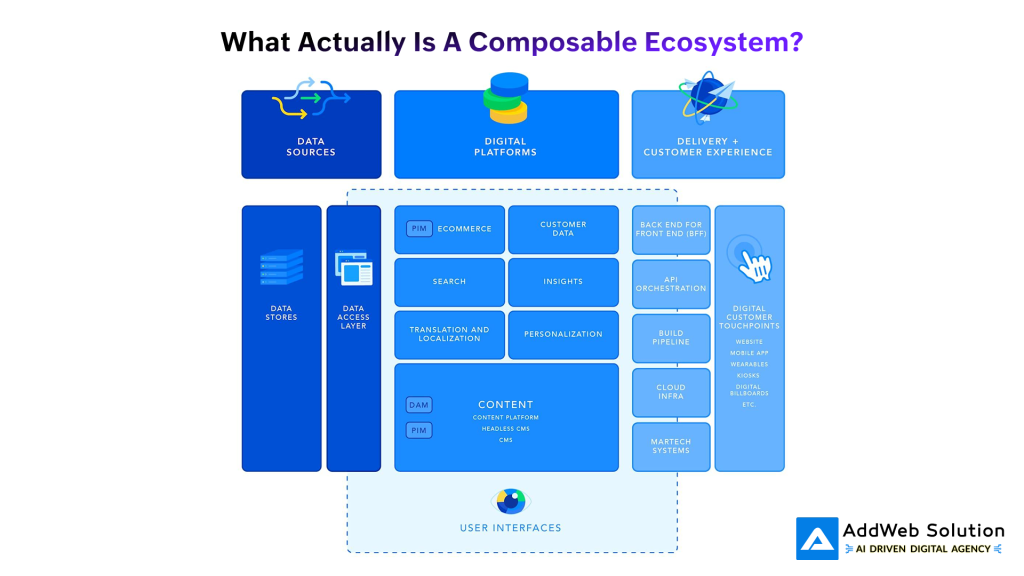
Diagram of composable architecture illustrating data sources, digital platforms, delivery mechanisms, and user interfaces in a modular software ecosystem.
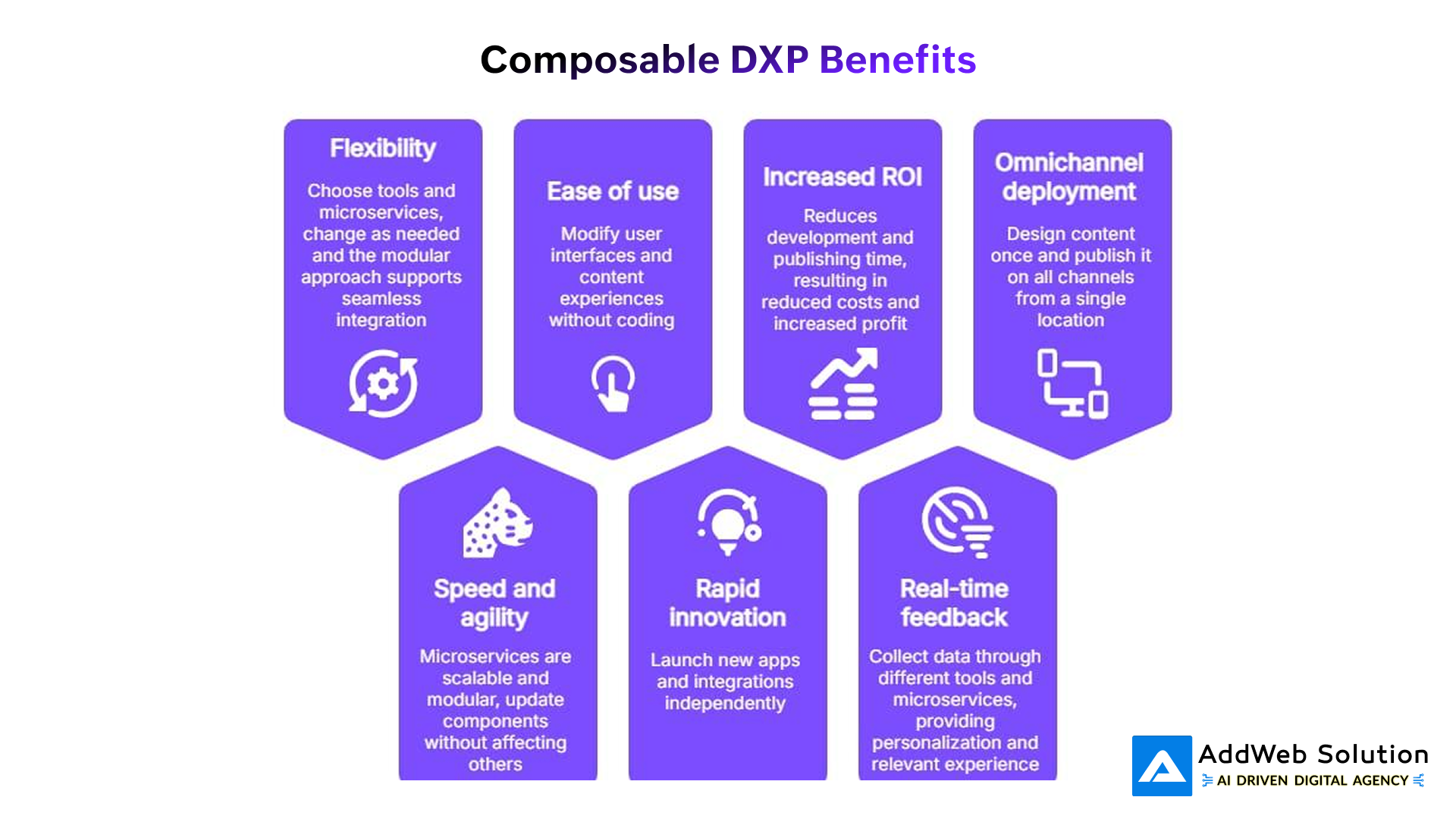
Key benefits of composable technology including flexibility, ease of use, increased ROI, omnichannel deployment, speed, innovation, and real-time feedback.
Think of it like LEGO blocks. Instead of manufacturing custom plastic from raw materials, you snap together existing pieces to build something unique. In software terms, that means: instead of writing authentication code, you use a pre-built authentication layer. Instead of designing an admin panel, you use a visual builder. Instead of manually implementing chatbot logic, you call an AI API.
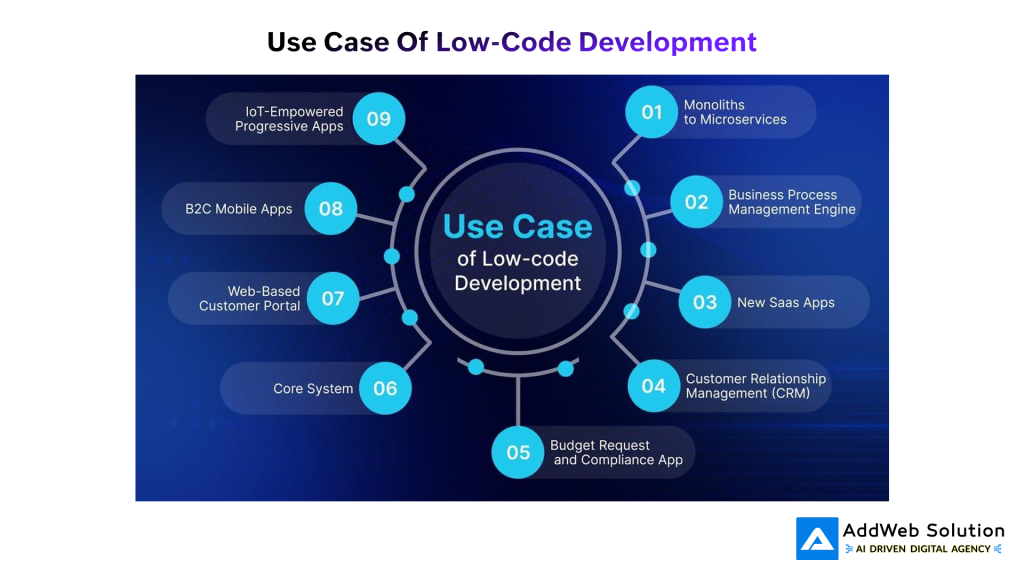
Visual representation of diverse use cases for low-code development platforms.
The key insight: composability isn’t about cutting corners. It’s about strategic focus. You don’t eliminate complexity, you delegate it to specialists who handle that specific problem exceptionally well. Your Laravel application stays clean, focused, and maintainable because each component has a clear responsibility.
For Laravel specifically, composability means leveraging the framework’s strength at orchestration. Laravel becomes the “glue” connecting modular services: payment processors, authentication providers, AI services, admin dashboards, and custom business logic all working together seamlessly.
Why Now? Market Timing and Reality Checks
The convergence of three trends makes 2025 the inflection point for composable Laravel development:
AI is no longer experimental. Generative AI adoption jumped from 33% in 2023 to 71% in 2024. Organizations aren’t debating whether to use AI, they’re figuring out which specific problems to solve with it. For startups, this means AI-powered features are now table stakes, not differentiators. Chat interfaces, content generation, recommendation engines, these are becoming baseline expectations.
Low-code platforms have matured. Five years ago, low-code meant clunky, inflexible tools. Today, 58% of microservices are being built using low-code approaches, and the market expects to grow 22.7% annually through 2027. Enterprise adoption legitimizes these platforms. More importantly, APIs are increasingly standardized, meaning low-code tools integrate smoothly with frameworks like Laravel.
Speed-to-market is survival. 42% of startups fail because they build products nobody wants. The only antidote is validation, talking to real users with a working prototype. An MVP that takes 9+ months to build is useless because the market will have moved on. Laravel teams are now launching 3-4 month MVPs where competitors take 9+ months.
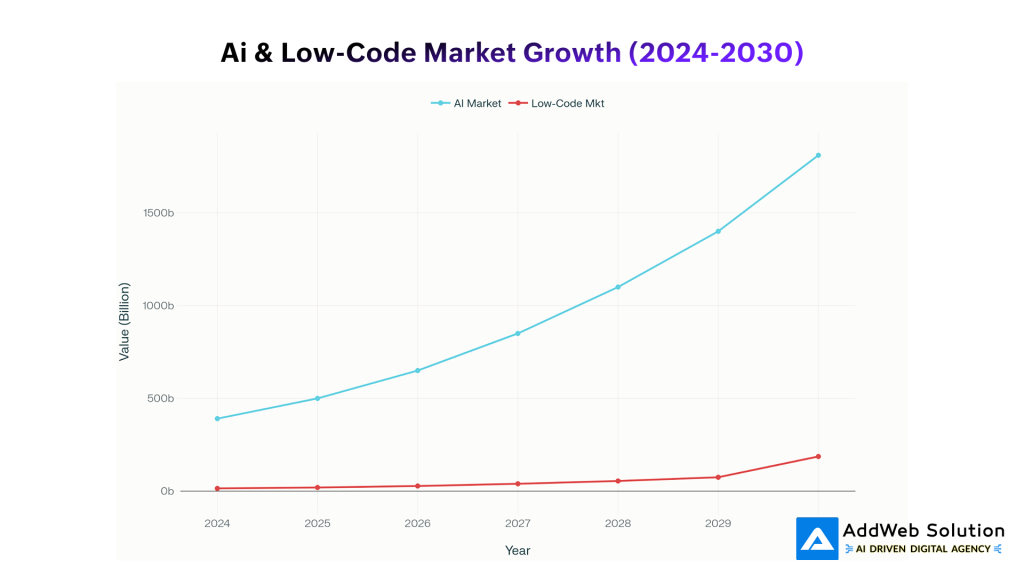
Both AI and low-code/no-code markets show explosive growth through 2030, with AI projected to reach $1.81 trillion and low-code market hitting $187 billion.
The Composable Laravel Stack: What Actually Works in 2025
Here’s what a real, production-ready composable MVP looks like in 2025. This isn’t theoretical, dozens of startups are building this way today.
Backend: Laravel + Lightweight Frameworks
Laravel 12 remains the backbone because it handles the irreducible complexity: database relationships, authentication state, business logic, and API orchestration. For heavier MVPs, full Laravel works great. For simpler APIs, Lumen, Laravel’s lightweight sibling, ships features with minimal overhead, perfect for microservices.
The real magic is what you don’t build: authentication, payment processing, admin dashboards. Laravel’s ecosystem covers these patterns so thoroughly that you can generate boilerplate in seconds using Artisan CLI commands.
Admin Panels: From Hours to Minutes
This is where composability truly shines. Five years ago, building a functional admin dashboard meant weeks of scaffolding, form building, and permission management. Today, Laravel Filament does it in minutes.
Filament is the go-to for MVPs. You define your models, run a generator command, and suddenly you have a professional admin interface with CRUD operations, role-based access control, and activity logs. No JavaScript frameworks. No API layer. Just Laravel models and instant admin panels.
For premium requirements, Laravel Nova provides a polished, professional interface. For content management systems, Backpack for Laravel specializes in content-heavy applications. The point: the choice exists, and implementation is measured in hours, not weeks.
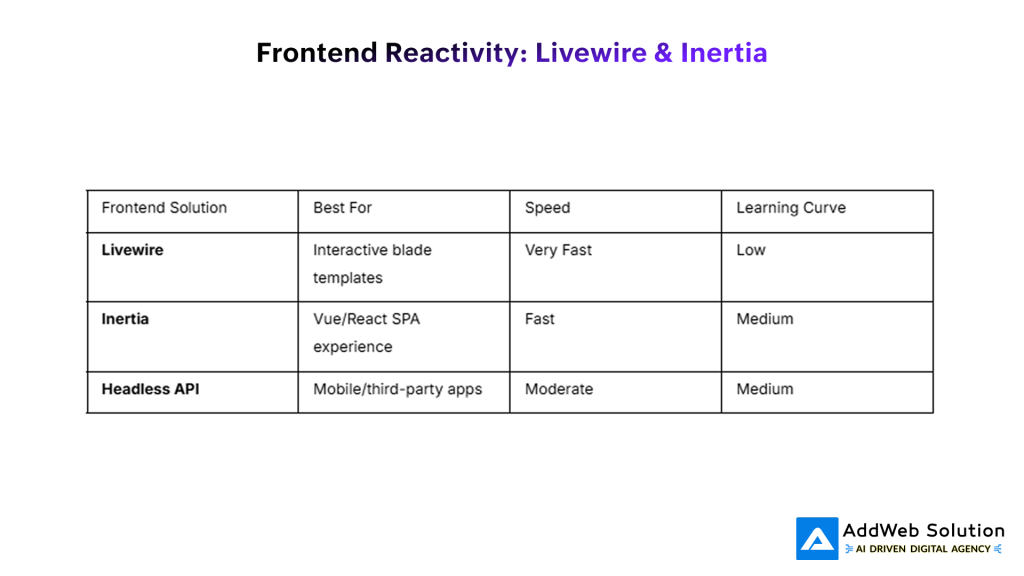
Frontend Reactivity: Livewire & Inertia
For MVPs, you rarely need a separate JavaScript single-page application. Laravel Livewire brings reactivity directly to your Blade templates, forms validate in real-time, notifications appear instantly, all without leaving PHP.
For teams comfortable with modern JavaScript, Laravel Inertia bridges the gap between Laravel’s server-side rendering and Vue or React frontends, providing a unified development experience without duplicating API layers.
For MVPs, Livewire is usually the right choice. It’s faster to implement, reduces context-switching between languages, and keeps your codebase cohesive.
AI Integration: The Commodification of Intelligence
Two years ago, integrating ChatGPT meant complex API calls and custom logic. Today, it’s genuinely simple. The Laravel OpenAI Package provides expressive syntax for GPT-4, embeddings, and DALL-E integration.
Here’s what realistic AI integration looks like for an MVP: customer support chatbots using OpenAI’s API, automated content generation for e-commerce product descriptions, predictive form suggestions that improve over time.
CometChat removes the complexity of real-time messaging entirely, copy-paste a widget, and you have production-grade chat features without building infrastructure. For chatbots, the same principle applies: APIs abstract complexity away.
The composable philosophy wins here. You’re not reinventing conversational AI. You’re orchestrating proven APIs through Laravel.
No-Code Authentication: Auth0 Does It All
Authentication used to consume 20-30% of MVP development time. Today, Auth0 integrates with Laravel in fewer than 10 lines of code, no custom middleware, no configuration gymnastics.
The SDK handles multi-factor authentication, social logins (Google, GitHub, Facebook), enterprise integrations, and compliance out of the box. You define where users should land after login, and the rest is automatic.
For MVPs, this is revolutionary. You validate the core product without building authentication infrastructure.
Deployment: One-Click Scaling
Laravel Forge and Laravel Vapor complete the composable picture. Forge provisions servers and deploys code with git integration. Vapor goes further, it’s serverless deployment on AWS that auto-scales, manages databases, and handles background jobs without DevOps headaches.
For MVPs expecting unpredictable traffic, Vapor is invaluable. You pay for what you use, not for provisioned capacity you might not need.
The Real-World 7-Day MVP Launch
Let’s make this concrete. Here’s how a competent team actually launches a SaaS MVP using the composable Laravel stack:

This timeline is real. Teams like Everflex Health and others have proven it’s possible. The difference between 7 days and 90 days is ruthless focus on composable tools, eliminating accidental complexity, and knowing when to build versus integrate.
AI-Powered Development: The Unspoken Accelerator
Here’s the part people don’t fully appreciate yet: AI-powered development tools are now multipliers for this entire workflow.
GitHub Copilot doesn’t replace developers, it eliminates boilerplate. You describe what you want in pseudocode, and it generates correct Laravel syntax. ChatGPT becomes your pair programmer for edge cases and tricky integrations. This isn’t hype; it’s empirically faster than traditional coding.
For MVPs, this matters enormously. You’re not fighting the language. You’re fighting the problem domain. AI tools eliminate the former, so your team focuses entirely on the latter.


Real Numbers: Cost and Timeline
MVP development cost varies wildly based on scope, but here’s what 2025-2026 looks like:
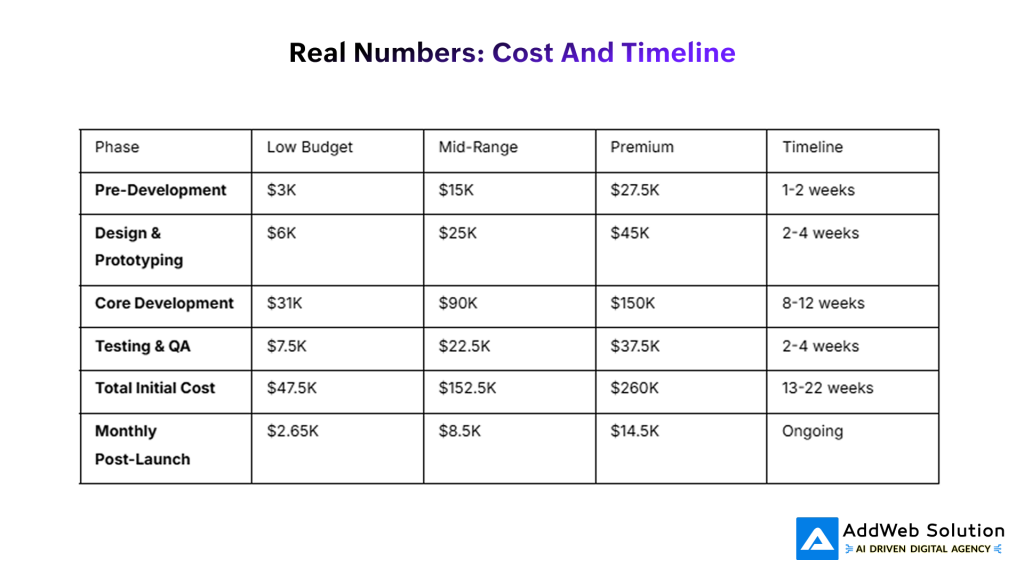
The composable approach compresses these numbers. You’re not paying for authentication infrastructure, admin panels, or deployment DevOps. You’re paying for your unique business logic.
Startups using this approach report 60-70% higher success rates than traditional full-product launches, and they validate ideas in 3-4 months instead of 9+.
The Ecosystem Itself: Your Secret Weapon
Here’s what makes Laravel particularly well-suited to composable MVPs, the ecosystem is absurdly rich:

This isn’t theoretical. Each of these tools is battle-tested, documented, and directly integrates with Laravel.
When Composability Works (And When It Doesn’t)
Composability is powerful but not universal. It works best for:
- B2B SaaS platforms needing user management, billing, and admin dashboards
- Content platforms with multiple content types and publishing workflows
- Marketplace applications with payments, notifications, and complex user flows
- Real-time collaboration tools where chat and notifications are core
It works less well for:
- Highly specialized systems where integrations are rare and bespoke logic dominates
- Extreme scale where single-purpose architectures (Go microservices, Rust APIs) outperform general-purpose frameworks
- Real-time graphics (3D visualization, high-frequency trading) where performance requirements exceed Laravel’s envelope
For most startups and B2B applications, composability is the right default.
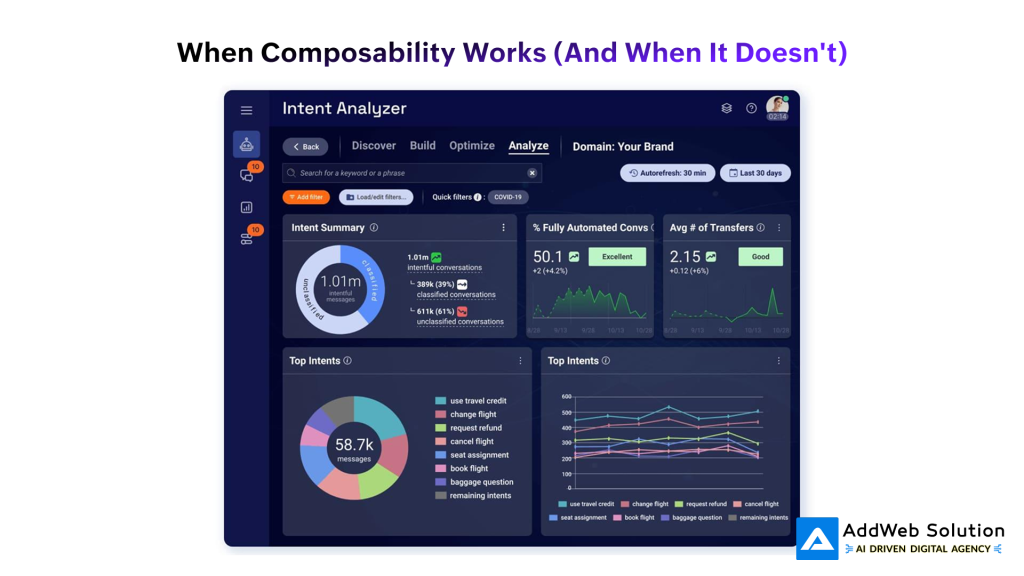
AI chatbot analytics dashboard showing intent classification and conversation automation metrics for customer support.
The Future: Composability Is the Default
The trend is clear. 92% of companies plan to invest more in generative AI over the next three years. 70-75% of new applications will use low-code tools by 2026. This isn’t a niche approach anymore, it’s the mainstream.
In 2026 and beyond, the question won’t be “should we use composable architecture?” It’ll be “which composable pieces fit our specific problem?” Laravel has positioned itself perfectly in this future. With Filament, Livewire, OAuth integration, AI packages, and serverless deployment all native to the ecosystem, Laravel is the composable framework of choice.
For teams launching MVPs in 2025, composability isn’t a luxury, it’s competitive necessity. The fastest, most focused teams win. The composable Laravel ecosystem is how you become that team.
Contact Us to accelerate your MVP with Laravel + low-code tools.

Pooja Upadhyay
Director Of People Operations & Client Relations
Resources:
- https://laravel.com
- https://dev.to/laracopilot/laravel-ecosystem-in-2025-1mca
- https://filamentphp.com
- https://www.reddit.com/r/nocode/comments/10knhc6/laravel_app_with_nocode_lowcode_possible/
- https://www.youtube.com/watch?v=Dq4O0x_RVuA
- https://www.forbes.com/sites/bernardmarr/2025/06/03/mind-blowing-ai-statistics-everyone-must-know-about-now-in-2025/
