


Artificial Intelligence is no longer optional for modern web applications. 78% of organizations now use AI in at least one business function, and the global chatbot market is projected to reach a value of US$27.29 billion by 2030. For Laravel developers, this represents both an opportunity and a practical challenge: how to integrate sophisticated AI capabilities without abandoning the PHP ecosystem they know. The answer is that Laravel is surprisingly well-positioned for exactly this task.
Laravel’s elegant architecture, combined with its robust ecosystem of packages, makes it an ideal foundation on which to build intelligent web applications. Be it conversational interfaces, predictive analytics, or automated content creation, Laravel provides the tools to deliver AI capabilities without complexity. Such a guide will focus on two high-impact use cases: intelligent chatbots and predictive forms that adapt to user behavior in real time.
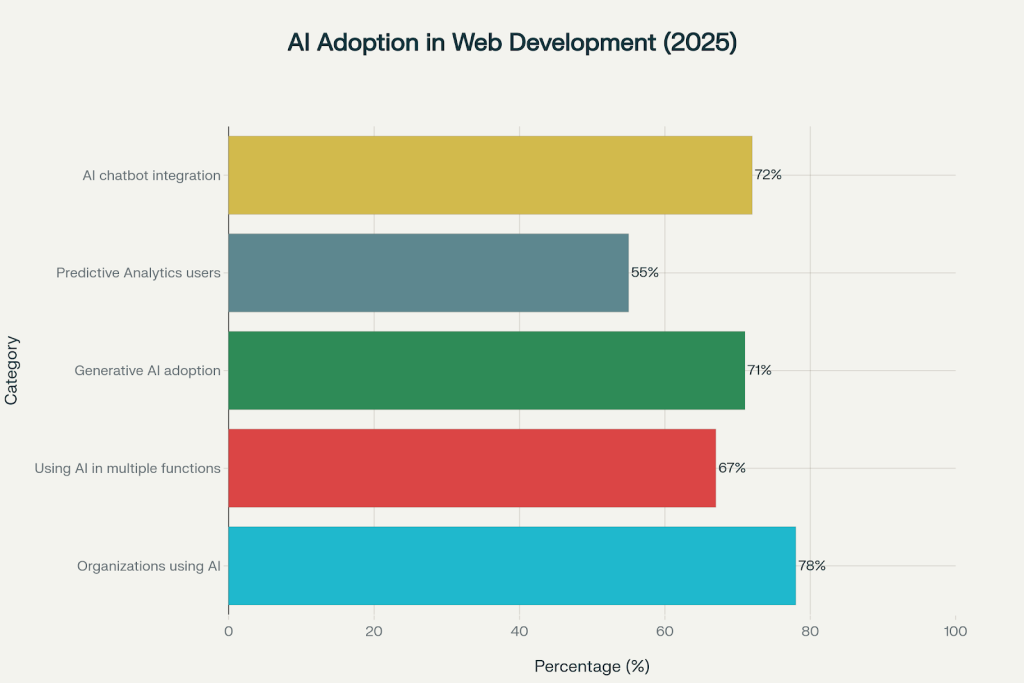
Current AI adoption rates across different business functions in 2025, showing strong integration of AI technologies in web development.
Why Laravel Excels with AI Integration
The suitability of Laravel for AI applications has its roots in several architectural decisions, treating API integration as a first-class concern. Its HTTP client affords fluent interfaces for consuming external AI APIs with built-in retry logic, timeout handling, and concurrent requests. As a matter of fact, Laravel developers, while integrating with OpenAI, Google Cloud AI, or other services, are working with expressive syntax instead of wrestling with low-level details of HTTP.
AI operations involving latency are handled with elegance by Laravel’s queue system. Since GPT responses and image generation take several seconds, moving the operations to background workers will make for responsive user experiences. Laravel Horizon brings real-time monitoring of queued jobs, making it easy to track performance and scale workers based on demand.
Clean abstractions around AI services come naturally with the service container and dependency injection. Create separate service classes for different providers and swap implementation without touching application code; keep interfaces consistent between capabilities. This prevents vendor lock-in and allows teams to try out multiple AI providers at the same time.
The Laravel ecosystem has responded with vigor: Prism provides unified interfaces to multiple LLM providers, Laravel-OpenAI offers native OpenAI integration, and BotMan enables multi-platform chatbot development. These packages respect Laravel conventions out of the box and can be easily integrated with existing applications.

Projected market growth for AI chatbots and predictive analytics through 2030, demonstrating exponential adoption trends.
Building Intelligent Chatbots with Laravel
The chatbot market is growing from $7.76 billion in 2024 to $27.29 billion by 2030, at a CAGR of 23.3%. Chatbots are one of the most impactful AI integrations for Laravel applications, enabling measurable improvements in customer engagement and support efficiency.
The BotMan Framework provides Laravel-native solutions for building chatbots across multiple platforms, including Telegram, Slack, and Facebook Messenger, among others, through web interfaces. One can define conversation flows, pattern matching, state management, and more with the framework’s expressive syntax. Power your chatbots with one codebase across different messaging platforms.
OpenAI GPT Integration through Laravel-OpenAI offers superior natural language understanding for open-ended conversations. Variations of user input, without rigid pattern matching, are handled by GPT-powered chatbots that understand the intent naturally, generate contextually appropriate responses, and maintain coherent multi-turn dialogues. The trade-off is that this may involve higher API costs and careful engineering of prompts.
Hybrid Architecture effectively fuses both approaches: Use BotMan for platform abstraction and control in driving conversation flow, while leveraging GPT for understanding natural language. This strategy brings multiple platform support, natural conversation, structured navigation for complex workflows, and cost optimization using GPT in a judicious manner.
Production-Ready Implementation
Building a production value-delivering chatbot requires addressing conversation state management, context preservation, error handling, and user authentication. A well-architected implementation systematically attends to these.
Then, install the required packages and set environment variables in a safe manner using Laravel configuration. Design conversations with a structured yet flexible flow that could guide the user without making it brittle. Finally, integrate with the different services using specific service classes that enable chatbots to pull information, create records, trigger notifications, or run business processes.
Sophisticated chatbots maintain context across conversation turns, remembering prior exchanges to provide relevant responses. Laravel’s session and cache systems provide infrastructure for maintaining context. Store conversation history, user preferences, and decision points for branching logic.
Predictive Forms: Intelligent Data Collection
While chatbots steal the show, predictive forms represent a more subtle but equally powerful application of AI: smart interfaces adapt in real time to user behavior by making suggestions, intelligently validating inputs, and thereby reducing friction in data collection.
Predictive forms represent an evolution of traditional form experiences, powered by machine learning through autocomplete suggestions for users based on patterns, smart pre-population, the detection of anomalies in submissions, dynamic visibility of fields based on previous inputs, and risk scoring to identify fraud. The supporting predictive analytics market was valued at $18.89 billion in 2024 and is expected to reach $82.35 billion by 2030.
Architecture and Implementation
Predictive forms in Laravel integrate machine learning models with familiar form validation workflows. The architecture separates the frontend interactivity, Laravel backend coordination, and ML inference services.
JavaScript will capture the user’s interactions and send behavioral data to Laravel endpoints for analysis. The server responds with predictions, which the front-end applies to provide immediate feedback. Laravel serves as an orchestration layer: receiving requests, calling ML APIs, applying business logic, and returning structured responses.
For complex models, delegate to Python-based ML services over HTTP. Laravel sends prediction requests across to Flask or FastAPI services, receives predictions, and bakes them into form processing. Laravel’s HTTP client makes this integration straightforward thanks to its built-in retry logic and connection pooling.
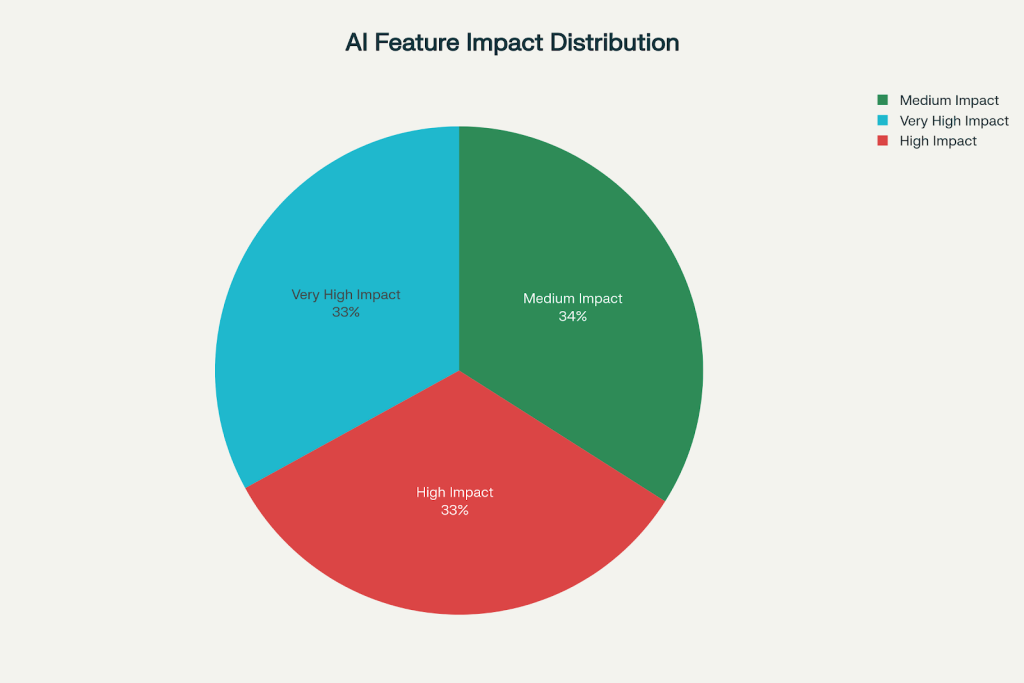
Distribution of AI-powered features in Laravel applications categorized by their business impact potential.
Custom validation rules call prediction services and fail based on the returned confidence scores. All this does is extend the declarative style of Laravel validation to include ML intelligence. Form requests define validation rules, both traditional ones and those powered by ML predictions, thus keeping validation logic centralized and testable.


Laravel AI Tools Comparison
| Tool/Package | Primary Use | Best For | Ease | Support |
| Prism | Universal LLM integration | Multi-provider AI apps | High | Growing |
| Laravel-OpenAI | OpenAI GPT integration | GPT-powered features | High | Excellent |
| BotMan | Multi-platform chatbots | Conversational interfaces | High | Mature |
| PHP-ML | ML algorithms in PHP | Basic ML models | Medium | Good |
| RubixML | Comprehensive ML library | Advanced ML workflows | Medium | Good |
| TensorFlow PHP | Deep learning tasks | Neural networks | Low | Limited |
Then, Prism emerged as the most comprehensive solution for working with multiple providers of LLMs. It unified the API across OpenAI and Anthropic to Google Gemini, and more. Change providers with configuration, not code. Structured output, multi-modal input, streaming responses, built-in testing.
Laravel-OpenAI offers tighter integrations for OpenAI-specific models. The OpenAI official PHP SDK is wrapped into Laravel-friendly facades, offering natural integration with the service container and configuration system. This is useful for fine-tuned models, Assistants API, DALL-E image generation, and Whisper audio transcription.
BotMan remains the golden standard for multi-platform chatbots. Provides consistent abstractions for Telegram, Slack, Facebook Messenger, Teams, and web chat: complex multi-turn dialogues, state across platforms, middleware for extending functionality, and testing utilities.
Production Best Practices
This involves moving AI features to production by considering cost optimization, error handling, security, monitoring, and scaling.
Cost Management: Implement tiered rate limits based on subscription levels, cache frequently requested predictions, use smaller models for simple tasks, and monitor usage patterns. Queue prioritization helps, with background tasks using economy pricing and real-time features justifying premium processing.
Error Handling: AI APIs fail due to rate limits, service outages, or network issues. Implement circuit breakers to stop calling failing services, provide graceful degradation with non-AI fallbacks, and queue requests for retry when services recover. For critical features, maintain multi-provider fallback chains.
Security: store API keys in encrypted environment variables, use Laravel Sanctum for API authentication, implement middleware to sanitize inputs and outputs, keep audit logs; for sensitive data, consider running open-source models locally.
Monitoring: Track API response times and error rates, monitor token usage and costs, measure response quality through user feedback, and log conversations to identify user journeys. Laravel Telescope provides excellent visibility into HTTP requests to AI services.
Get started with hands-on tutorials and practical Laravel AI projects today.

Pooja Upadhyay
Director Of People Operations & Client Relations
Real-World Use Cases
| Feature | Complexity | Impact | APIs/Tools | ROI |
| AI Chatbots | Medium | High | OpenAI, Dialogflow | 3-6 mo |
| Predictive Forms | High | High | ML models, APIs | 6-12 mo |
| Content Generation | Medium | Medium | GPT-4, Claude | 1-3 mo |
| Image Recognition | Medium | Medium | Google Vision, AWS | 3-6 mo |
| Fraud Detection | High | Very High | Custom ML models | 6-12 mo |
| Recommendations | High | Very High | TensorFlow | 6-12 mo |
E-commerce platforms benefit significantly from AI-powered recommendation engines, as these will analyze browsing history and purchase patterns to suggest relevant products. Implementation includes storing user data, training models periodically, exposing predictions through API endpoints, and showing recommendations in templates. AI recommendations increase conversion rates by 20-30% while improving average order values.
SaaS platforms use AI for intelligent onboarding and support. GPT-powered chatbots guide new users through setup, answering questions conversationally, and route complex issues to humans. Predictive forms adapt to user roles, pre-filling configuration based on similar customers. Laravel authentication integrates naturally, and chatbots pull user profiles from Eloquent models to personalize guidance depending on the subscription tier.
Healthcare applications have very high data quality demands. AI-powered form validation keeps clinical data accurate by extracting inconsistent information, detecting wrong codes, verifying insurance information, and offering proposed corrections. Various implementations are integrated using Laravel’s validation with ML models trained on healthcare data.
The Path Forward
With maturing AI capabilities, Laravel’s position as a practical framework for building intelligent applications is strengthening. A number of emerging trends will drive development over the next few years.
Edge AI and Local Model Inference will increasingly augment API calls with local model inference. Smaller, optimized models running directly within applications will ensure low latency, lower cost, and better privacy. Laravel developers will need to understand the deployment patterns for serving ML models alongside applications.
Autonomous AI agents will expand beyond single-purpose features. Frameworks for building autonomous agents that plan and perform tasks will emerge. Laravel applications will serve as coordination layers providing authentication, data access, and business constraints.
Multimodal interfaces move beyond text to voice, images, and video. Laravel applications will increasingly handle multi-modal interactions, requiring developers to think beyond traditional form-based interfaces.
Conclusion
Laravel has certainly proved itself capable of supporting the development of AI-powered web applications that drive real business value. A combination of Laravel’s elegant architecture, robust ecosystem, and practical abstractions with increasingly accessible AI services creates an environment where PHP developers can build sophisticated intelligent features.
It requires the developer to broaden their skill sets: understanding the ML basics, learning prompt engineering, grasping statistical concepts-while, of course, using Laravel’s strong points in API integrations, background process execution, and modular architecture.
For companies, AI-powered Laravel applications represent competitive advantages that translate to higher conversion rates, reduced support costs, improved user satisfaction, and scalable personalized experiences without proportional operational increases.
The technical foundation is in place. Packages and patterns are proven. The business case is clear. The question isn’t whether Laravel can power the next generation of intelligent web applications, the framework’s capabilities have already answered that. The time to build is now.
⁂
Sources:
- https://www.grandviewresearch.com/industry-analysis/chatbot-market
- https://www.grandviewresearch.com/industry-analysis/predictive-analytics-market
- https://laravel-news.com/openai-for-laravel
- https://github.com/openai-php/laravel
- https://github.com/halilcosdu/laravel-chatbot
- https://botman.io/1.5/installation-laravel
- https://christoph-rumpel.com/2018/05/how-i-built-the-laravelquiz-chatbot-with-botman-and-laravel
