


If you’ve ever been in a room full of developers debating framework choices, you know just how impassioned-sometimes even heated-these conversations get. Laravel adherents swear by its elegance and productivity. Node.js advocates won’t stop extolling the virtues of performance and real-time capabilities. Who’s right? Spoiler alert: they both are-but for different reasons.
As we go into 2026, let me take you through how Laravel and Node.js actually compare for building SaaS applications. I won’t be giving you marketing speak. What I’ll share with you is what matters: trusted performance data, productivity metrics that represent actual work, and honest guidance on when to pick one over the other.
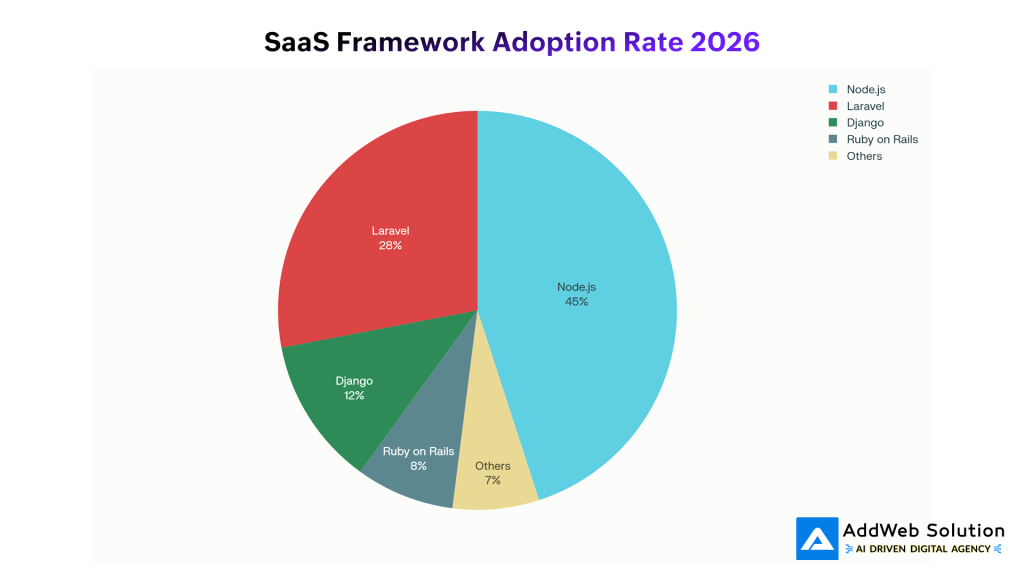
SaaS framework market share projection for 2026, with Node.js leading at 45% and Laravel at 28%.
Let’s start with how these frameworks actually work.
Think of Laravel in the same way as considering a full-service toolkit, replete with everything you need. Someone thoughtfully packed it, ordered it logically, and stapled directions to the inside of the lid. You pick it up and can immediately get to work. You’re not hunting for tools—they’re already there.
This convenience comes with a trade-off. Every request undergoes complete initialization, which means configuration load, bootstrapping middleware, and running through the application lifecycle. It is predictable and reliable but not lightweight.
Node.js, is more like having a supercharged engine that’s always primed for speed, never shutting down. Instead of creating from scratch for every single request, Node.js maintains everything in one single event loop, where it effectively juggles many thousands of tasks without creating new threads for each new request or task. It is highly efficient this way, but you really need to think different about how you structure your code.
But here’s the kicker: Laravel Octane changed that equation. With Swoole keeping the Laravel application in memory, Laravel can match Node.js for efficiency, offering anything from 5-20x performance gains depending on your workload. Like turbocharging that well-organized toolkit.
Performance: Where the Rubber Meets the Road
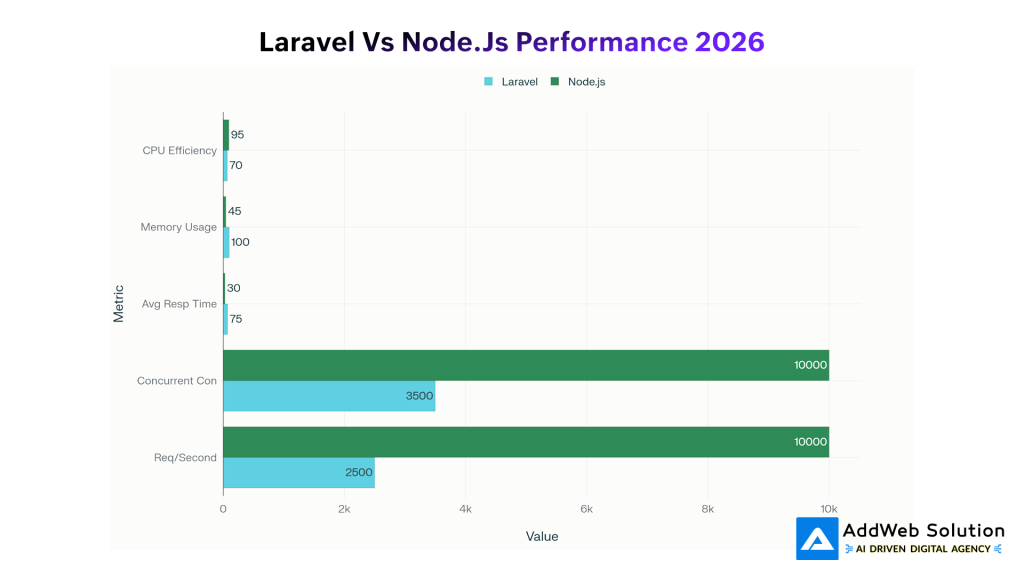
Performance comparison showing Node.js outperforms Laravel in most metrics for SaaS applications.
Real Numbers, Real Scenarios
If you’re building a SaaS platform, one thing is all you care about: how many concurrent users can your infrastructure handle without melting?
Node.js crushes in this field, with 10,000+ requests per second, whereas Laravel can generally handle 2,000-3,000 RPS. So, that is roughly a 5x difference, which matters when you are paying cloud bills per server instance.
But before you declare Node.js the winner, consider the context. LinkedIn saw 20x faster response times after switching to Node.js. Financial services platforms reported 35% speed improvements. Real-time collaboration apps handle 1 million concurrent connections with ease. These aren’t hypothetical benchmarks—they’re production metrics that companies are actually experiencing.
Here’s what is interesting: at the same time, Laravel running on PHP 8.3 got 38% faster compared to PHP 8.1. Your Laravel 10 app today is considerably snappier than the same app running two years ago.


Memory and Cost Impact
Node.js uses 30-60MB of baseline memory, while Laravel typically needs 80-120MB. This may seem trivial until you multiply it across 50 running instances. That’s potentially ₹5,000-10,000 extra monthly cloud costs just from memory overhead.
E-commerce SaaS companies cutting over to Node.js have seen 50% infrastructure cost reductions alongside performance improvements. That’s the kind of number that gets CFO attention.
The Real Question: Do You Actually Need This Performance?
Here’s the thing nobody talks about, though: unless you’re building some kind of chat application, a real-time dashboard, or processing millions of events per day, this performance difference might not matter. Most traditional SaaS applications running Laravel with Octane perform more than adequately.
It’s the difference between a car that goes 250 km/h and one that goes 200 km/h. If most of your driving is in town, does the extra speed change your life?
Developer Productivity: Getting to Market Faster
Productivity comparison: Laravel wins with an out-of-the-box set of features, while Node.js has a simpler learning curve.
Convention over Configuration-the secret weapon of Laravel
Here’s why Laravel developers are often faster to market: the framework basically holds your hand through building a SaaS application.
Need user authentication? It’s built-in. CSRF protection? Automatic. Database ORM? Eloquent is really a sight to work with. Sending e-mails? Configuration and you are off. Permission system? Spatie Laravel Permission exists, and works flawlessly.
The Artisan CLI does all those repetitive tasks you’d normally waste time on, generating the migrations, creating models, and setting up API resources. Commands like php artisan make:model User –migration generate boilerplate in seconds.
Need a complete SaaS starter kit? Laravel Jetstream gives you authentication, two-factor authentication, team management and API tokens without writing a single line of boilerplate code. Build your actual product, not plumbing.
Laravel Nova is a masterpiece when it comes to building admin panels: it literally generates beautiful, functional admin interfaces for your data models with almost no configuration. What would take weeks to build custom in Node.js takes hours in Laravel.
Node.js: Flexibility That Requires Decisions
With Node.js, you get to choose your own adventure: Express.js for routing? Sure. But what about authentication—Passport.js, JWT, or Auth0? What’s your ORM preference—Sequelize, Prisma, or TypeORM? Testing framework: Jest, Mocha, or AVA?
This flexibility is powerful when you know what you want; it’s paralyzing when you’re shipping an MVP and need to make decisions fast.
That said, if you’re already a JavaScript wizard and your entire team writes React, Vue, or Next.js, jumping to Node.js backend development feels natural. You stay in one language, one ecosystem, one mental model.
Real Timeline Impact
Can a decent Laravel developer scaffold a functional SaaS MVP in 2-3 weeks? Absolutely. The same developer would need 4-6 weeks with Node.js, largely because they’re assembling infrastructure rather than just writing business logic.
This matters a great deal to growth-stage startups, where speed determines survival.
Security: Built-in versus Build-It-Yourself
The Authentication Story
Authentication comes out of the box, which contains password hashing including Bcrypt/Argon2, session management, password resets, and email verification.
Two-factor authentication? It’s on Laravel Jetstream. API Tokens? Laravel Sanctum secures your SPA. Complex permission systems? Spatie’s packages integrate seamlessly.
You could actually deliver a secure MVP without concerning yourself about authentication logic whatsoever.
With Node.js, you’re on your own. You are rolling in Passport.js or managing the JWT tokens yourself, doing password hashing, refresh tokens management, and edge case handling.
This isn’t necessarily bad–it’s just a different philosophy. You have total control, but you own the security implementation details.
Protection Against Common Attacks
Laravel automatically prevents CSRF attacks using a simple @csrf Blade directive. SQL injection is prevented through Eloquent ORM’s parameterized queries. XSS attacks are blocked through automatic output escaping in Blade templates.
Node.js requires you to do this yourself: add the csurf middleware for CSRF; add SQL injection prevention by manually using parameterized queries; add XSS protection via xss-clean or helmet.
The trade-off again: Laravel reduces risk through defaults and conventions. Node.js reduces risk through vigilance and deliberate choices.
Ecosystem: Tools and Community
Package Quantity vs. Quality
Node.js has 1.3+ million npm packages. Laravel has 350,000+ Composer packages.
Statistically, you’ll find solutions for virtually anything in npm. But package quality varies dramatically—some are maintained by one person on weekends, others are abandoned entirely.
Laravel’s Composer ecosystem is smaller but generally better curated. First-party packages from Taylor Otwell’s team-Nova, Vapor, Forge, Pulse-are production-ready and extremely well-documented.
Tools That Actually Help
Apart from the framework itself, Laravel offers a set of whole products: Forge for server management, Vapor for serverless deployment, Envoyer for zero-downtime deployments, and Nova for admin panels.
These are not just nice tools but actual productivity multipliers. ₹1,500-3,000/month per tool sounds really expensive until you realize you’ve eliminated days of DevOps work per tool.
Node.js does not have similar official offerings. You construct deployment pipelines out of general-purpose tools, rather than framework-specific solutions.
Scalability: Growth from thousands to millions of users
Real-time Features and Microservices
Looking to build a real-time chat application? Node.js is practically made for it. WebSockets, event streaming, concurrent connection handling—it’s all first-class.
Planning microservices architecture with a dozen independent services? Node.js services start instantly, consume minimal resources, and containerize beautifully. Each team can own independent services without coordination.
Horizontal Scaling
With Node.js’s cluster module, you can spawn worker processes for every CPU core to multiply throughput 4-8x without code changes, and Kubernetes takes care of the rest.
Horizontal scaling with traditional load balancing uses Redis or Memcached to manage sessions across instances. Add Laravel Horizon to distribute background jobs across workers.
Laravel Octane allows Laravel applications to handle concurrent connections similar to Node.js due to coroutine support with intelligent worker configuration.
Multi-Tenant SaaS Scaling
Both frameworks handle multi-tenancy with elegance.
Laravel’s global scopes automatically filter queries by the tenant ID to avoid the risks of data leakage. Node.js with Prisma provides similar safety, since its query filtering is aware of the tenants.
Use Cases: Where Each Framework Shines
Perfect for Node.js:
- Web-based chat applications and other messaging services requiring WebSocket support with real-time updates.
- Collaborative tools (think Google Docs functionality) that demand instantaneous synchronisation
- Microservices architectures using several independent services
- IoT platforms processing streaming sensor data
- API-first platforms serving mobile or web clients exclusively
Perfect for Laravel:
- E-commerce platforms requiring secure payment processing, inventory management, and complex workflows for order processing
- Traditional web applications with server-rendered views and multi-step forms
- Admin dashboards and back-office systems that manage the business operations.
- Content management systems with flexible content modeling
- SaaS MVPs where reaching market quickly matters more than marginal performance gains
Both Work Well:
- Standard REST APIs
- Multi-tenant SaaS platforms
- Enterprise applications aiming at high reliability
Cost Reality: Development and Operations
Building vs. Running
Developers in India, for a mid-complexity SaaS MVP with a timeline of 6-12 weeks, charge between ₹1.75 and 5.5 lakhs. For full applications, the cost is ₹5 to 12 lakhs for 10 to 16 weeks.
Node.js costs vary wildly. You might find cheaper developers, but you’ll often need senior people who have architected Node.js systems before.
Hosting Bills
The advantage in resource efficiency of Node.js means fewer cloud resources for the same throughput. E-commerce platforms saw a 50% reduction in infrastructure costs after making a switch to Node.js.
The cost of shared hosting for Laravel is ₹2,000-10,000 per year. VPS deployment costs ₹5,000-15,000. Serverless deployment with Laravel Vapor is more cost-effective.
With Octane optimizing memory and throughput, Laravel hosting costs are made competitive with Node.js.
Making Your Decision
Before choosing, ask yourself:
Is real-time functionality core to my product? → Node.js
Do I need to ship an MVP in weeks, not months? → Laravel
Is my team already writing JavaScript? → Node.js might feel natural
Are we building traditional SaaS features? → Laravel gets you there faster
Do resource costs dominate my budget? → Node.js has an edge
Do I want built-in security and conventions? → Laravel
Contact Us to accelerate your MVP with Laravel + low-code tools.

Pooja Upadhyay
Director Of People Operations & Client Relations
The Honest Truth
By 2026, both frameworks are powering extremely successful SaaS companies with millions of users. Laravel’s PHP 8.3 improvements and Octane have eliminated performance concerns for most workloads.
The “best” framework is not the one with the highest benchmark scores; it’s the one your team understands deeply, fits with your timeline, and that lets you focus on building amazing product features instead of fighting infrastructure.
Don’t get seduced by “Node.js is 5x faster” if it takes 3x longer to ship your product. Don’t dismiss Laravel because you read some blog post about microservices.
Choose the framework that fits your reality, your team, and your business timeline. That’s the framework that wins.
⁂
- https://dev.to/arasosman/laravel-octane-15-advanced-configuration-techniques-for-maximum-performance-5974
- https://www.simplilearn.com/laravel-vs-node-js-article
- https://kinsta.com/blog/php-benchmarks/
- https://kinsta.com/blog/laravel-authentication/
- https://laravel.com/docs/12.x/authentication
- https://www.nodejs-security.com/blog/owasp-nodejs-best-practices-guide
- https://www.w3schools.com/nodejs/nodejs_cluster.asp
