


The EdTech market is booming on a scale that very few industries have ever seen. We’ve gone from a $163 billion market in 2023 to $247 billion in 2024, and that’s just the beginning. By 2030, the market will hit nearly $908 billion. That’s not growth; that’s transformation.
But the thing is, it’s not just about more money flowing into education. It’s about what that money is buying. Teachers are adopting AI en masse, 83% of K-12 educators now use generative AI in their classrooms. Students? 92% use AI for learning whether their teachers officially support it or not. Mobile learning is exploding-the market is projected to reach $1 trillion by 2032.
It is the point where learning stops being passive and confined to classrooms, but instead is personalized, intelligent, and accessible anywhere.
Of course, creating such next-generation platforms does not come easy. You need backends that are capable of handling millions of learners, effortlessly integrating AI, processing data in real-time, and maintaining security to keep the strict regulations at bay. This is where Laravel gets into the picture-not because it’s trendy-but because it’s a pragmatic tool, making the hard stuff possible.
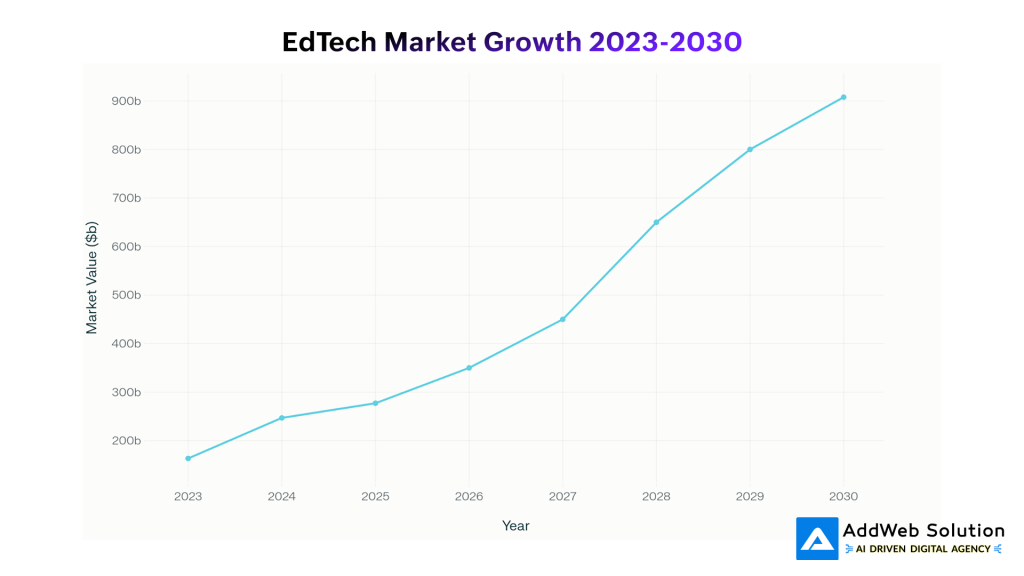
Global EdTech Market Size Growth (2023-2030) with projected CAGR of 13.9%
Why This Moment Matters for Builders
If you are building an education platform in 2025, then you are competing against unlimited resources and AI-powered platforms. You can’t outcompete them on budget, but you can outcompete them on agility: shipping features faster, adapting to learner feedback quicker, scaling intelligently without hiring armies of engineers.
The numbers on adoption tell the real story. Educational organizations are hungry for AI integration-86% adoption rate, personalization is now table-stakes-40% improvement in retention with AI-driven systems, and learners demand mobile-first experiences. The market isn’t waiting for perfect solutions; it’s rewarding platforms that deliver value now.
This is precisely where the pragmatism of Laravel comes into its own. It wasn’t designed specifically for EdTech, but the architecture, clean ORM, built-in authentication, queue systems, WebSocket support maps perfectly onto what learning platforms actually need.


Laravel vs. Other Frameworks: Why Laravel Wins for EdTech
When it comes to picking frameworks for an educational platform, the choices are important. You want something powerful enough to scale, yet intuitive enough that your team can move fast.
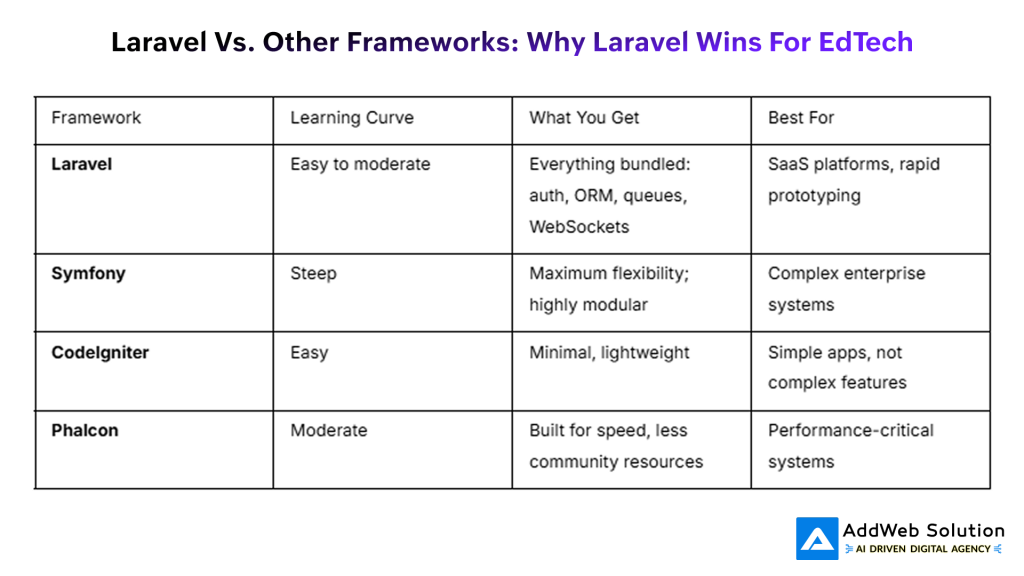
The honest truth? Symfony is incredibly powerful, but it demands senior architects. CodeIgniter moves fast, but leaves you building infrastructure from scratch. Phalcon prioritizes raw speed over developer experience.
Laravel strikes a sweet spot: powerful enough for an enterprise EdTech yet intuitive enough that good mid-level developers can build out sophisticated features, with a mature enough ecosystem that most problems you’ll encounter are solved.
For EdTech, in particular, Laravel gives you things that you’ll actually use:
- Eloquent ORM that makes modeling student-course relationships elegant
- Authentication out of the box with token-based login for mobile apps
- Job queues for handling AI inference without blocking learners
- Real-time broadcasting through WebSockets for live classrooms
- Role-based permissions to manage instructor, student, and admin access
That is not theoretical convenience. That’s concrete time saved and complexity eliminated.
AI-Powered Features That Actually Matter
Chatbots that know your learners
The chatbot market is growing at 23.3% annually and will reach $27 billion by 2030. That’s not just hype; it’s because chatbots solve a real problem: how to provide personalized guidance at scale.
A student finishing a module at midnight shouldn’t have to wait until morning for instructor feedback. A learner confused about prerequisites shouldn’t need to send an email and hope for a response. A chatbot answers immediately, not with robotic generic responses, but with contextual, relevant guidance.
Here’s how you’d actually build this in Laravel:
You stream messages through WebSockets. The student types, Laravel receives the message, pulls their learning profile from the database (via Eloquent), sends that context to OpenAI or Claude, and streams the response back. The whole interaction feels instant. The AI “knows” the student because you gave it context.
What makes this elegant in Laravel? The framework’s service container lets you swap AI providers. Testing with mock responses? Use a fake service. Production using GPT-4? Switch the binding. Your business logic never changes.
And costs? That’s the thing, you’re paying per API token to OpenAI. Cache frequently asked questions. Queue less urgent requests for batch processing at night. Rate-limit calls based on subscription tier. Laravel’s caching and queue systems make this practical without special tooling.
Forms That Anticipate What Learners Need
Predictive forms seem like magic until you understand they’re just applied psychology and math. Instead of forcing learners through rigid registration flows, predictive forms adapt in real-time based on patterns.
A learner hesitates on a field? The form suggests help text. A learner has taken three programming courses? The form pre-selects “interested in advanced topics.” A learner’s browser indicates mobile access? The form shows mobile-optimized options.
This matters because friction kills conversions. Every extra field, every unclear option, every unnecessary decision costs you learners. Predictive forms reduce friction by 15-30%, which directly impacts your bottom line.
Laravel handles this orchestration cleanly. Frontend captures behavioral signals. Backend calls ML services. Predictions flow back. Middleware validates everything. Logging captures data for model improvement. It’s all connected without feeling like spaghetti code.
Real-Time Dashboards That Keep Instructors Sane
Live dashboards showing student engagement, quiz responses, and progress aren’t nice-to-have, they’re essential for modern instruction. But building real-time systems is notoriously hard. Most frameworks make you choose between responsiveness and simplicity.
Laravel simplified this recently with Laravel Reverb, launched in 2024. WebSocket infrastructure that used to require complex external services is now available with a few commands. Students submit quiz answers. Results appear instantly on instructor dashboards. No polling, no delays, no refresh buttons.
This isn’t just user experience polish. Real-time feedback fundamentally changes how instruction works. Instructors can see when learners are confused (submission errors, hesitation patterns) and adjust pace immediately. That’s hard to measure but enormous in impact.
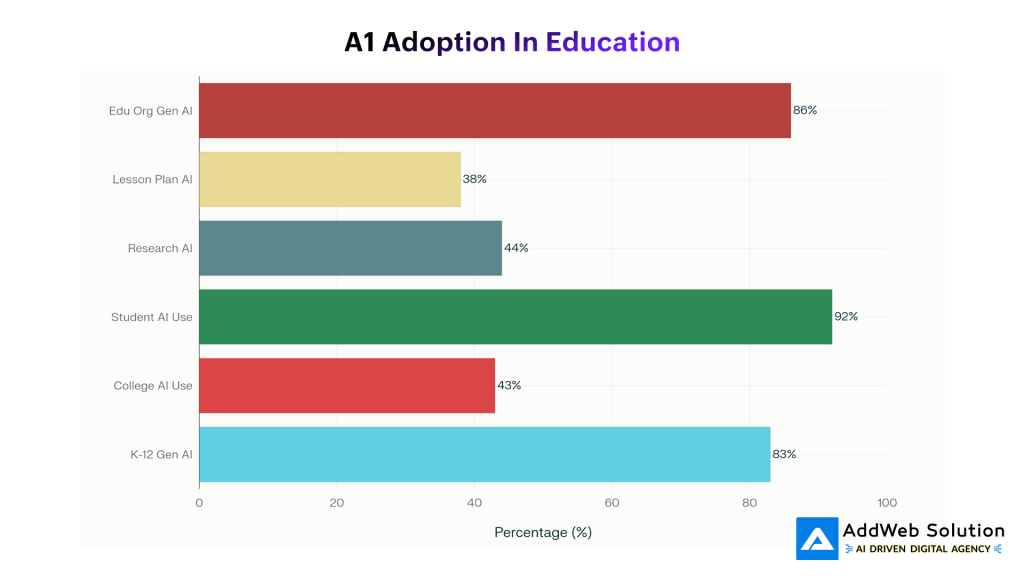
AI Adoption Rate in Education (2024-2025)
Gamification: Making Learning Stick
The gamification market is growing at 25.85% annually and will reach $48.72 billion by 2029. But gamification isn’t about silly badges and leaderboards. It’s about leveraging behavioral psychology to sustain engagement.
Here’s what the data says: learners using gamified platforms complete courses 45% faster. They retain more. They come back more frequently. That’s not marginal improvement; that’s transformation.
Building gamification in Laravel is straightforward but requires thinking about scale:
Points and streaks: Store these in denormalized tables for fast querying. When learners earn points, increment counters immediately. No complex calculations slowing down the response.
Leaderboards: Don’t rank millions of learners by scanning the database. That’s slow. Use Redis sorted sets (via Laravel’s cache) to maintain pre-computed rankings. Updates happen in microseconds.
Notifications: Laravel’s task scheduler runs automatically, reset daily challenges at midnight, send “come back and maintain your streak” reminders, award automatic bonuses.
The result? Learners who would have quit after one course complete five. That’s business impact, not just engagement metrics.
Mobile Learning: Meeting Learners Where They Actually Are
Let’s be honest: if your learning platform doesn’t work great on mobile, it’s going to fail. Seventy percent of learners report higher motivation on mobile. Learners complete courses 45% faster on smartphones than desktops.
Yet many platforms treat mobile as an afterthought. They build web first, bolt on a mobile app later, and end up maintaining two separate codebases.
Laravel’s REST API capabilities make a better approach viable: build one backend API, serve it to web browsers, iOS apps, Android apps, and anything else. Learners access courses on their phone during their commute, switch to tablets for interactive simulations, use desktop for deep work. Each experience is optimized for the device. The backend is singular.
Laravel Sanctum handles authentication for mobile apps cleanly, token-based login without the complexity of OAuth. Your mobile team doesn’t struggle with authentication; they just send tokens in headers.
This architectural approach, one API serving multiple clients, reduces maintenance burden and ensures consistency. When you add a new feature, it works everywhere simultaneously.
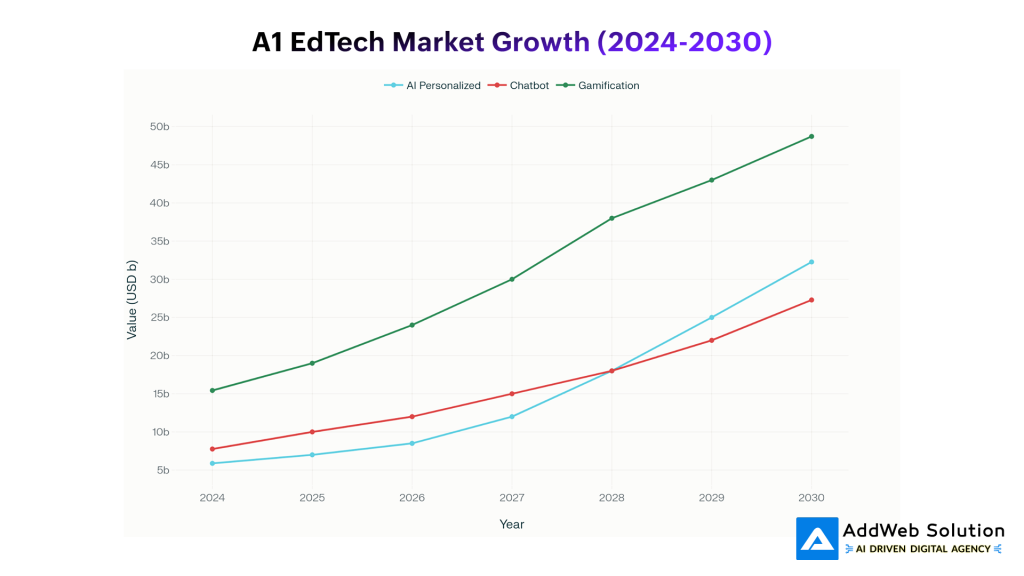
Growth of AI-Powered EdTech Market Segments (2024-2030)
Security and Compliance: Not Optional
EdTech platforms handle sensitive data: grades, learning patterns, potentially biometric information. Multiple regulations govern this:
- FERPA (US): Strict rules about student records and who can access them
- GDPR (Europe): Strong protections for children’s data
- COPPA (US): Special rules for anyone under 13
- CCPA (California): Students can request and delete their data
This isn’t abstract legal stuff. Non-compliance means fines, reputation damage, and lost customer trust.
Laravel provides concrete help here. Role-based access control ensures teachers see only their students’ data, parents see only their children’s progress, and admins see appropriate dashboards. Encryption helpers protect sensitive data at rest. Event systems create comprehensive audit trails.
You still need competent security practices, but Laravel eliminates the infrastructure headaches. Focus on business logic; the framework handles compliance foundations.
The Business Side: Subscriptions and Monetization
Seventy-eight percent of EdTech companies use subscription models now. There’s a reason: subscriptions provide predictable revenue, enable continuous platform improvement, and create ongoing relationships with learners.
Typical structure: free tier for trying out, individual subscriptions ($9-15/month), institution pricing for schools and companies.
Laravel’s Cashier package integrates with Stripe or Paddle, handling recurring charges, cancellation, failed payments, and dunning (retrying failed cards automatically). You don’t build payment infrastructure from scratch; you use tested, production-hardened systems.
Layer on analytics dashboards tracking monthly recurring revenue (MRR), customer lifetime value (LTV), and churn rates. Make data-driven decisions about pricing and retention. That’s how you grow from interesting idea to sustainable business.
What This Looks Like in Practice
Imagine you’re building an AI-powered course platform. Here’s roughly how Laravel enables it:
API Layer: RESTful endpoints serve all clients, web, iOS, Android, integrations. Resource controllers provide conventions so APIs stay consistent and well-documented.
Business Logic: Domain models (Student, Course, Enrollment, Assessment) encapsulate learning rules. Eloquent relationships make querying intuitive.
AI Integration: Service classes abstract external APIs. Swap providers without rewriting code. Fallback logic handles failures gracefully.
Real-Time: Events broadcast important changes (new assignment posted, grade available, message received) via WebSocket to interested clients.
Analytics: Dashboard queries distill learner behavior into actionable insights. Educators see which concepts confuse learners, which content drives engagement.
Background Work: Intensive tasks (generating certificates, processing transcripts, model training) run asynchronously via queues. Users never wait.
Security: Middleware enforces authentication, rate limits, and logging. Authorization policies ensure users access only permitted data.
This isn’t theoretical architecture, it’s how production EdTech platforms actually work.
Accelerate your startup growth with Laravel

Pooja Upadhyay
Director Of People Operations & Client Relations
Looking Forward: What’s Next
Voice-activated learning is becoming mainstream. Visually impaired students listen to content. Students with mobility challenges navigate hands-free. Pronunciation feedback helps language learners. Laravel’s HTTP client integrates voice APIs seamlessly.
Edge AI means running smaller ML models locally within applications. This reduces API costs, improves privacy, and decreases latency. Future EdTech platforms will intelligently choose between local inference and API calls based on complexity.
Autonomous learning agents move beyond single features (one chatbot answering questions) to orchestrated interventions. An agent might identify a struggling learner, recommend prerequisites, connect with a peer tutor, escalate to an instructor if needed, all automatically.
The Bottom Line
EdTech is experiencing genuine transformation driven by AI, mobile access, and demand for personalization. This is an enormous opportunity for builders willing to think carefully about technical architecture.
Laravel isn’t flashy or trendy. It’s practical. It eliminates infrastructure headaches so you focus on delivering value to learners. Its ORM is elegant. Its authentication is secure. Its queue system is battle-tested. Its community is mature and helpful.
For technical leaders evaluating frameworks: Laravel isn’t just for simple websites anymore. It’s a sophisticated tool for building intelligent learning platforms that scale.
The real question isn’t whether Laravel can power next-generation EdTech. The question is which EdTech innovators will seize the opportunity to build with Laravel first.
Resource:
- https://market.us/report/edtech-market/
- https://www.grandviewresearch.com/industry-analysis/education-technology-market
- https://electroiq.com/stats/ai-in-education-statistics/
- https://www.engageli.com/blog/ai-in-education-statistics
- https://www.databridgemarketresearch.com/reports/global-mobile-learning-market
- https://kinsta.com/blog/symfony-vs-laravel/
- https://laravel-news.com/using-sanctum-to-authenticate-a-mobile-app
- https://laravel.com/blog/introducing-websockets-for-laravel-cloud-powered-by-laravel-reverb
- https://elearningindustry.com/voice-technology-in-the-education-industry-rise-of-voice-assistants-in-education
