


It’s not in online debates that this silent revolution reshaping backend development is happening; it’s in boardrooms where CTOs make decisive choices about technology stacks that will define their company’s trajectory. On one side stands Laravel, powering more than 1.5 million websites globally and commanding 64% market share among PHP frameworks. On the other side is FastAPI, which has surged from 29% to 38% adoption in just twelve months-a growth spike that signals a fundamental shift in how developers are upping their game in backend architecture. This isn’t a question about technical preference between languages or frameworks; it’s about time-to-market, team productivity, scalability costs, and whether artificial intelligence is a feature enhancement or your company’s core competitive moat. The real question modern business leaders should be asking themselves: “Which framework gets my specific business to market faster with the team I already have, at the budget I’ve allocated?”
Why This Conversation Matters in 2025
The competitive landscape for web applications has shifted fundamentally. A seven percent drop in user satisfaction occurs with every 100-millisecond delay in page loading. For SaaS companies, this translates directly to revenue, slower applications mean higher churn and lower conversion rates. Framework choice directly impacts customer satisfaction and profitability.
Meanwhile, artificial intelligence has ceased to be a “nice-to-have” feature and is now table stakes for competitive products. Companies are integrating chatbots for customer support, deploying predictive analytics to personalize user experiences, and building intelligent search to reduce friction in discovery. The question ceases to be “Do we need AI?” but “What’s the fastest, most cost-effective way to add AI to our platform?” And here are dramatically different answers provided by Laravel and Python frameworks.
Laravel: The Full-Stack Productivity Machine
Think of Laravel as the Swiss Army knife of web development. It ships with everything needed to build production-ready applications right out of the box: comprehensive authentication systems, database management layers, real-time features via WebSockets, background job queuing, and admin panels that stakeholders can actually understand.
Why are SaaS companies aggressively hiring Laravel developers in 2025? Industry surveys consistently identify three decisive advantages where business value is most deeply felt:
Rapid Development & Time-to-Market
Laravel developers move from zero to MVP (Minimum Viable Product) in 2-3 weeks, a timeline that startups racing to validate product-market fit desperately need. The framework makes architectural decisions for you: authentication uses proven patterns, database queries follow consistent conventions, validation is handled systematically. This “convention over configuration” philosophy means teams spend less time debating “how should we structure this?” and more time building features customers actually want.
A real-world example illustrates this advantage: a SaaS startup building a project management platform used Laravel to launch their MVP in four weeks. The alternative, using a minimal Python framework and building the scaffolding themselves, would have consumed 8-10 weeks. That 4-6 week advantage in market entry meant they gained paying customers and market validation while competitors were still in development phases.
Team Onboarding & Developer Productivity
Laravel has earned a reputation for being exceptionally welcoming to developers transitioning from other technology ecosystems. The documentation is comprehensive and accessible, the syntax is elegant and highly readable, and the community actively shares best practices and patterns. A mid-level developer can become genuinely productive in Laravel within 2-3 weeks, compared to 6-8 weeks for Python frameworks.
This matters enormously for growing teams. If you’re a 15-person company hiring your third backend engineer, that engineer should be contributing meaningfully by week three, not week eight. Laravel’s opinionated structure makes accelerated onboarding possible.
Cost-Effectiveness at Every Stage
Laravel is open-source, eliminating licensing fees entirely. It requires affordable PHP hosting starting at just $5-15 per month for small applications, with enterprise-grade solutions available at reasonable costs. Compare this to Python frameworks, which often require VPS deployment at $25-500+ monthly depending on scale and traffic patterns.
Additionally, Laravel’s comprehensive built-in features reduce custom development. Authentication, validation, error handling, and database migrations are solved problems. You’re not writing infrastructure code, you’re writing business logic.
Performance Reality Check
Standard Laravel handles approximately 700-1,000 requests per second on PHP 8.2. This sounds modest until you understand context: most real-world applications aren’t limited by framework throughput. They’re limited by database queries, external API calls, cache misses, or external service latency.
However, Laravel Octane fundamentally changes this performance profile. By replacing PHP’s default synchronous worker with high-performance alternatives like Swoole or RoadRunner, Laravel Octane increases throughput by up to 3x, delivering 3,000-5,000 requests per second. This optimization remains underselling because it’s less famous than raw benchmarks, yet it represents a game-changer for I/O-heavy applications like e-commerce platforms managing Black Friday traffic spikes.
Laravel’s AI-Powered Renaissance
Laravel hasn’t ignored the AI revolution, it’s embraced it strategically. Rather than competing with Python’s native data science strengths, Laravel adopted a “intelligent bridge” approach through Laravel Boost and the Model Context Protocol (MCP).
Laravel Boost functions as a context bridge for AI agents (Claude, ChatGPT, Cursor). It gives AI direct access to your application’s real-time state: routes, database schemas, model definitions, configuration. Instead of generic AI responses, Boost uses 17,000+ Laravel documentation entries specific to your exact version, eliminating hallucinated solutions that don’t actually work.
The business impact? Problems that traditionally took developers hours to debug are now solved in minutes with AI guidance. A developer recently reported an AI agent identifying and fixing a controller calling 269 database queries (should have been just 6) in seconds, reducing API response time from 618ms to 151ms.
Real Business Applications:
- Customer Support Chatbots: Klarna deployed an AI chatbot handling 2.3 million conversations, eliminating work equivalent to 700 full-time support agents and saving approximately $40 million annually. The system maintained feature parity with human agents while reducing repeat inquiries by 25%
- Intelligent Search & Discovery: Instead of forcing users through filter menus, AI transforms natural language into smart database queries. A user types “casual red wines under $50 from Spain” instead of clicking through dropdown menus
- Predictive Forms & Personalized UX: Forms adapting based on user history, checkout pages showing customized payment options, dynamic pricing adjusting based on user segment
- Real-Time Fraud Detection: E-commerce platforms using Laravel can analyze transactions in real-time, flagging suspicious activity without blocking legitimate users
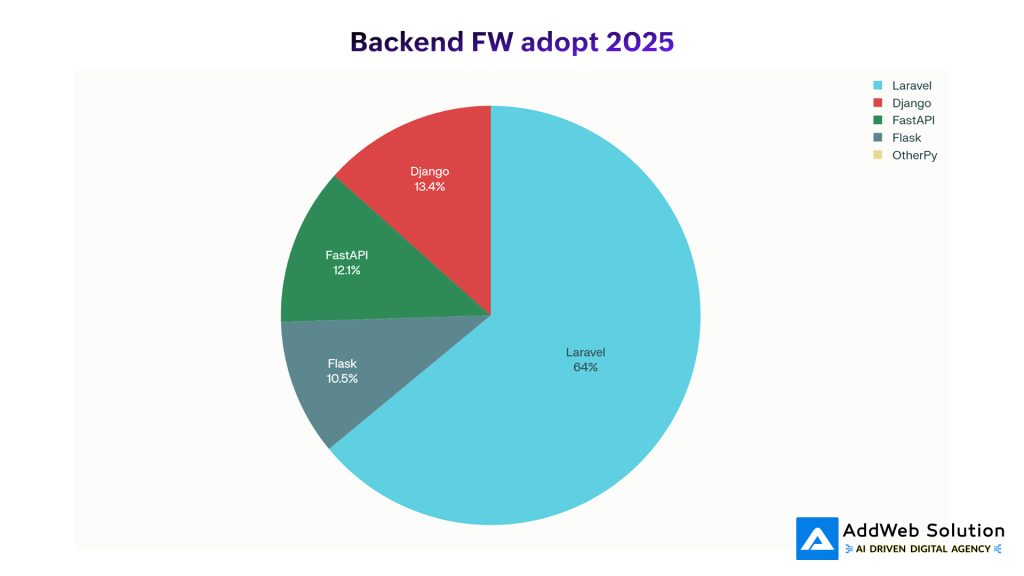
Backend Framework Adoption Trends 2025
Python Frameworks: The Specialist Solutions
Python frameworks don’t compete with Laravel on developer experience or rapid development velocity. They compete on solving specific, high-value problems that are architecturally central: building machine learning models, handling massive concurrent data streams, deploying to distributed container systems.
Django: The Enterprise Veteran
Django powers some of the internet’s most demanding applications: Spotify, Instagram, Pinterest, Dropbox, each handling billions of requests from global audiences daily. It’s mature, extensively documented, and beloved by organizations with data-heavy, security-critical applications.
Why enterprises choose Django?
- Built-in Admin Panel: Django automatically generates production-grade administrative interfaces from your data models. Non-technical stakeholders can manage data, run reports, make changes without writing queries or touching code
- Security by Default: Comprehensive security foundation is automatic. CSRF protection, SQL injection prevention, XSS filtering, secure session handling, all built-in. For healthcare, finance, government sectors where compliance is mandatory, Django’s defaults dramatically reduce security overhead
- ORM Maturity: Exceptionally sophisticated Object-Relational Mapping for complex relational databases. Healthcare platforms using Django streamline feature creation from electronic health records; clinicians can review model outputs without IT involvement
Tradeoff: Django’s all-in-one philosophy means adopting the Django way entirely. For traditional web applications, this is advantageous. For lightweight APIs or highly customized systems, it feels prescriptive.
FastAPI: The Modern Insurgent
FastAPI represents a fundamental rethinking of backend frameworks for 2025. Built from scratch for asynchronous request handling, automatic API documentation, and modern Python features like type hints, it’s optimized for high-concurrency, data-intensive applications where response time is architecturally critical.
Why FastAPI adoption is surging 30% annually:
- Native Speed: Delivers 10-15ms response times, often 5-10x faster than Django for concurrent I/O operations
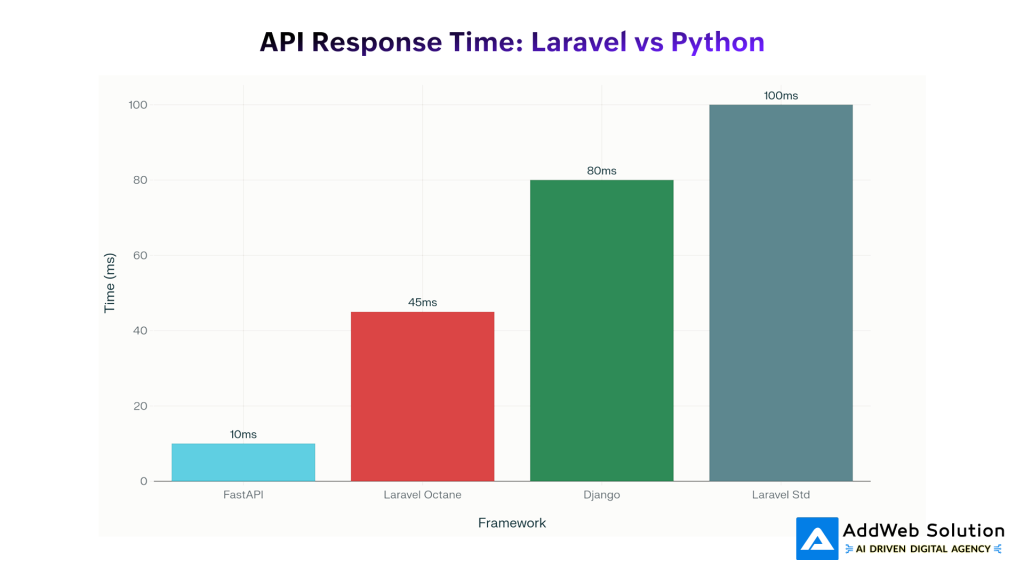
API Response Time Benchmark: Laravel vs Python Frameworks
- AI/ML Alignment: FastAPI sits naturally in machine learning pipelines. Data scientists train models in TensorFlow or PyTorch, then deploy inference APIs in FastAPI, no context switch, all Python
- Automatic Documentation: Generates interactive Swagger and ReDoc documentation automatically from code. Client developers can explore APIs, test endpoints, understand parameters without separate documentation work
- Containerization-Ready: Lightweight footprint and rapid startup times make it ideal for Kubernetes deployments. Horizontal scaling is built into the architecture
A fast-growing food delivery company built AI meal recommendations using FastAPI + vector databases + OpenAI, handling thousands of concurrent recommendation queries with 10ms latency, enabling real-time personalization at scale.
Performance & The Real-World Story
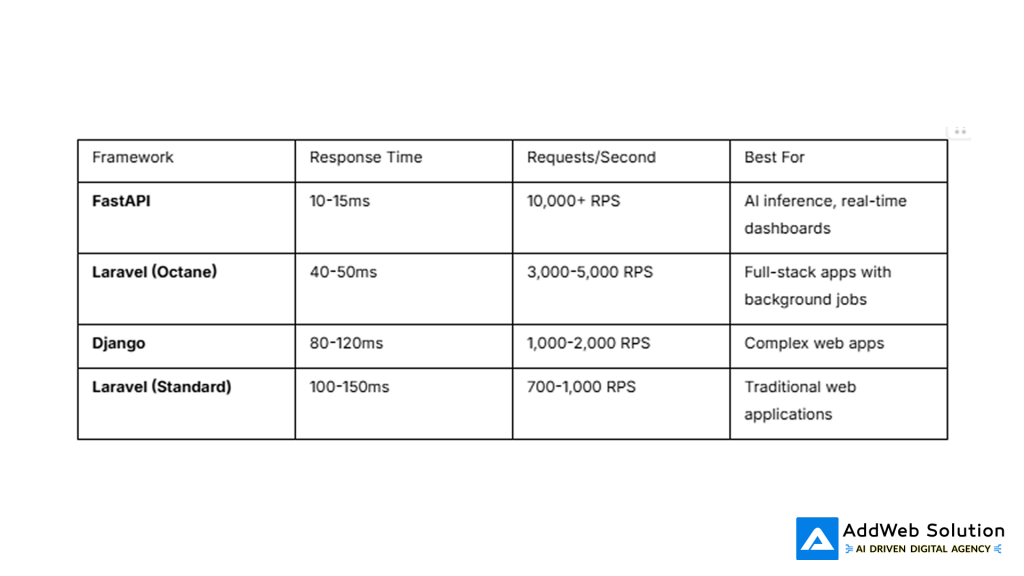
The business reality: Database queries often dominate total response time, not framework overhead itself. A Django or Laravel app calling a slow database query experiences the same latency whether the framework adds 10ms or 50ms of overhead.

API Response Time Benchmark: Laravel vs Python Frameworks
Performance matters most when handling thousands of simultaneous connections (FastAPI excels), building real-time features requiring sub-50ms latency, or deploying high-frequency trading systems and game backends. For most business applications, e-commerce platforms, SaaS dashboards, content platforms, the difference between 50ms and 100ms response time is imperceptible to end users.


Team Composition: Where It Gets Real
This often-overlooked factor determines success more than technology choices:
- PHP/Web experienced team → Laravel wins decisively. Larger talent pool, faster onboarding
- Data science backgrounds → Python frameworks are mandatory. Transition to FastAPI is natural within Python ecosystem
- Building AI/ML products → Python + FastAPI. Training, iteration, inference all happen in Python
- Building rapid MVP → Laravel dominates. Ship 2-3 weeks faster with smaller team
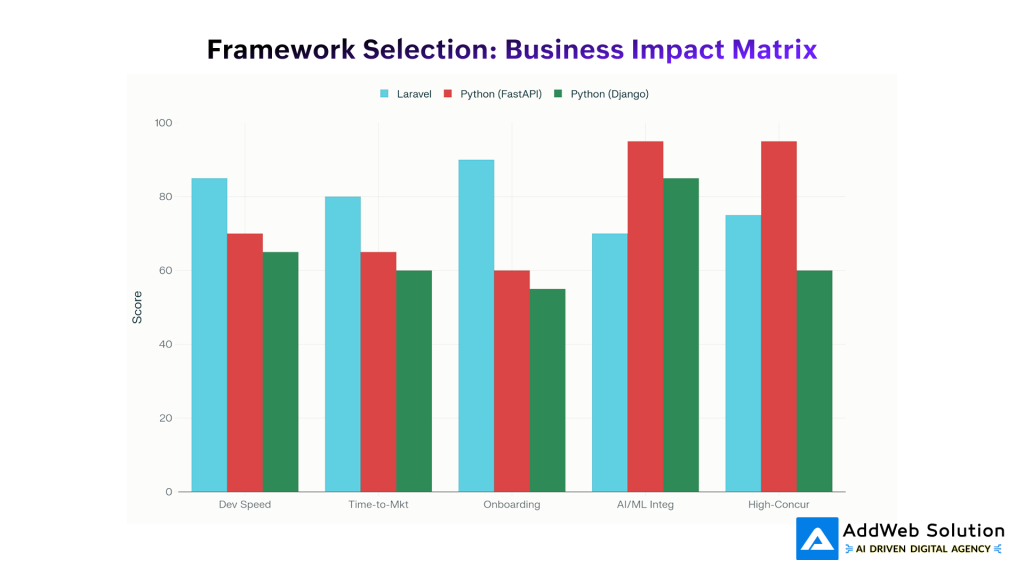
Framework Selection: Business Impact Comparison
AI Integration: The Real Differentiator in 2025
Laravel’s Strategy: Integrate third-party AI services (OpenAI, Anthropic, Google Vertex AI) and rely on Laravel Boost/MCP to guide implementation. Applications become AI-powered business applications.
Python’s Strategy: Build AI engine natively. If machine learning inference, model training, or data transformation is architecturally central, Python frameworks provide native integration.
ROI Numbers That Matter:
- Vodafone’s TOBi chatbot resolved 70% of inquiries independently, cutting cost-per-chat by 70%
- Klarna’s AI chatbot eliminated $40 million in annual support costs
- General ROI: Companies see returns of $3.50 for every $1 invested in AI customer service implementations
Decision Framework: Choose Deliberately
Ask these questions in order:
- Is AI/ML architecturally central? YES → Python | NO → Consider Laravel
- Need sub-50ms response times for thousands of requests? YES → FastAPI/Octane | NO → Laravel/Django fine
- Team’s strongest expertise? PHP/Laravel → Laravel | Python/data science → Python frameworks
- Launch timeline? 3-4 months → Laravel | 6+ months → Either | 12+ months → Any framework
- Long-term scalability? Predictable → Laravel | Unknown massive scale → FastAPI | Complex enterprise → Django
- Dedicated DevOps team? NO → Laravel (simpler) | YES → Python (flexible)
Real-World Scenarios
Scenario 1: SaaS MVP, $200K Budget, 3-Month Launch
Choose: Laravel , Ship feature-complete MVP in 8-12 weeks with 3-4 developers. Cost-effective, time-efficient.
Scenario 2: E-Commerce Platform, $2M Budget, 12-Month Build
Choose: Laravel Octane + Redis , Handle thousands of concurrent shoppers. Large team specializes in product features and performance optimization.
Scenario 3: Healthcare Analytics, AI Predictions, $3M Budget
Choose: Django + Python Microservices , Core value is predictive analytics. Django handles web app; Python microservices handle ML inference.
Scenario 4: Real-Time AI Recommendations, $1M Budget, 9 Months
Choose: FastAPI + Vector Databases + LLMs , Sub-50ms latency critical for user experience. Async architecture handles concurrent requests efficiently.
Looking Ahead: 2025 and Beyond
Laravel’s Trajectory: Laravel 12 shipped with enhanced async processing, improved caching, deeper AI integration via Boost and MCP. Repositioning as the framework for AI-powered business applications.
Python’s Consolidation: FastAPI leads for performance-critical systems; Django persists for complex applications. Market is bifurcating clearly.
Polyglot Reality: Sophisticated organizations adopt multi-framework architectures, Laravel for web logic, FastAPI for high-performance APIs, Python microservices for ML.
Power Your Next Big Idea With Python Experts by Your Side

Pooja Upadhyay
Director Of People Operations & Client Relations
Conclusion
The “backend framework war” isn’t about which technology is objectively superior. Each framework excels for specific problems. Competitive advantage accrues to teams that choose deliberately based on:
- Business requirements, not hype
- Team strengths, not tribal loyalty
- Time-to-market priorities
- Strategic AI integration from day one
Laravel dominates for rapid full-stack development with good scalability, when AI is a value-add feature, not your core moat.
Python frameworks (FastAPI) prevail when AI/ML and high-concurrency are architecturally central, when your team has data science strengths.
The backend war will be won by teams that choose deliberately.
- https://blog.jetbrains.com/phpstorm/2025/10/state-of-php-2025/
- https://kinsta.com/blog/php-benchmarks/
- https://laravel.com/blog/introducing-laravel-mcp-build-with-the-universal-ai-standard
- https://www.youtube.com/watch?v=TnfPXUU9wp0
- https://www.browserstack.com/guide/top-python-web-development-frameworks
- https://blog.jetbrains.com/pycharm/2025/02/django-flask-fastapi/
- https://blog.jetbrains.com/pycharm/2025/08/the-state-of-python-2025/
