
Blind Welfare Society: Transforming Google Ads Performance to Drive Nonprofit Donations
Blind Welfare Society is a non-profit organization in India that is unwaveringly dedicated to empowering the blind by providing them with a complete range of education, skill development, and community support. The society has come to us in dire straits; their Google Ads campaigns were not bringing in any donations and wasting a lot of money that could have been spent on the less fortunate.
Our team took a thorough Google Ads audit and optimization measure, rebuilding the campaigns from the beginning to enhance the positioning, communication, and conversion routes. By means of strategic keyword optimization, audience refinement, and continuous monitoring of performance, we converted their digital advertising steps into an efficient donation generation platform. This allowed the organization to approach more potential donors and acquire the much-needed funds for their cause.





The Business Needs
Understanding the Needs of Client
Blind Welfare Society operates in a challenging fundraising environment where every rupee of marketing spend must deliver measurable results in terms of donations and donor engagement. When Dheeraj Bhola, the organization’s founder, approached us in July 2024, their Google Ads campaigns were consuming valuable resources while generating minimal returns—a critical problem for a nonprofit organization where funds are meant to serve beneficiaries, not be wasted on ineffective advertising.
The organization faced several urgent challenges:
- Poor Campaign Hygiene and Structure: The existing Google Ads account lacked proper organization, with campaigns containing irrelevant keywords, mismatched ad groups, and unfocused targeting. This structural chaos resulted in ads appearing for searches unrelated to charitable giving or visual impairment support, wasting impression opportunities and budget on unqualified traffic.
- Extremely Low Donation Conversion Rate: Despite running paid advertising, the organization was experiencing conversion rates well below industry benchmarks for nonprofit donations. Visitors were clicking ads but not completing donation forms, indicating fundamental problems with either ad messaging, landing page alignment, or audience targeting.
- Ineffective Keyword Strategy: The campaigns were bidding on broad, generic keywords that attracted high volumes of irrelevant traffic while missing specific, high-intent search terms that indicated genuine donor interest. This mismatch between search intent and ad targeting was burning through daily budgets without meaningful results.
- Weak Ad Copy and Messaging: The existing ad copy failed to communicate the organization’s impact, urgency, or credibility effectively. Ads lacked compelling calls-to-action, emotional resonance, and clear value propositions that would motivate potential donors to take action.
- Poor Audience Targeting: The campaigns were not leveraging Google’s audience targeting capabilities to reach users with demonstrated charitable giving behavior, interest in social causes, or affinity with disability advocacy, resulting in ads being shown to audiences unlikely to donate.
- Lack of Ongoing Optimization: Once campaigns were launched, they received minimal monitoring or adjustment. Underperforming ads continued running, the budget was allocated inefficiently across campaigns, and opportunities for improvement through A/B testing and data analysis were missed entirely.
- Limited Measurement and Reporting: The organization lacked clear visibility into which campaigns, keywords, and ads were actually driving donations versus merely generating clicks. This made it impossible to make data-driven decisions about budget allocation and campaign optimization.
About Our Client: Dheeraj Bhola, Founder of Blind Welfare Society, leads a mission-driven organization dedicated to creating opportunities and improving the quality of life for visually impaired individuals across India. The organization conducts education programs, skill development workshops, community support initiatives, and advocacy efforts while relying on donations and volunteer support to fund its operations and expand its reach to underserved communities.
Our Approach
Strategic Google Ads restructuring focused on maximizing donation conversions while respecting nonprofit budget constraints.
In July 2024, when we started our collaboration with the Blind Welfare Society, our initial move was to perform a detailed audit of their current Google Ads account. The results uncovered major areas for advancement concerning the organization of the campaign, selection of keywords, advertisement text, and monitoring of conversions—virtually needing a complete reconstruction instead of gradual optimization.
Our strategic approach focused on several key areas:
- Complete Campaign Hygiene Overhaul: We began by fundamentally restructuring the Google Ads account, creating logical campaign hierarchies organized around specific donor intent signals and program areas. We eliminated irrelevant keywords that were consuming budget without driving conversions, consolidated fragmented ad groups for better quality scores, and implemented proper negative keyword lists to prevent ads from appearing on irrelevant searches.
- High-Intent Keyword Research and Implementation: Conducted extensive keyword research specifically focused on charitable giving intent signals. We identified search terms used by people actively looking to donate to disability organizations, support visual impairment causes, and engage with nonprofit initiatives. This included both broad awareness keywords (for top-of-funnel reach) and highly specific donation-intent keywords (for immediate conversion opportunities).
- Audience Targeting Refinement: Leveraged Google’s sophisticated audience targeting capabilities to focus ad delivery on users with demonstrated charitable giving behavior, interest in social causes and disability advocacy, affinity with education and empowerment initiatives, and geographic proximity to the organization’s service areas. We also created remarketing audiences to re-engage website visitors who didn’t donate on their first visit.
- Compelling Ad Copy Development: Completely rewrote ad copy to emphasize the organization’s impact, using specific examples of how donations transform lives. Created urgency through limited-time matching campaigns and immediate need messaging. Built credibility through social proof and transparency. Developed clear, action-oriented calls-to-action that removed friction from the donation decision.
- Landing Page Alignment: While we didn’t rebuild the website, we ensured that ad traffic was directed to optimized landing pages that matched ad messaging and made donation processes as simple as possible. We analyzed user behavior on landing pages to identify drop-off points and recommended improvements to donation form flows.
- Conversion Tracking Implementation: Set up comprehensive conversion tracking to measure not just clicks but actual donation completions, donation amounts, and donor demographics. This data foundation enabled data-driven optimization decisions and provided the organization with clear visibility into campaign ROI.
- Continuous Monitoring and Optimization: Established regular monitoring schedules to track campaign performance, identify underperforming elements, and implement improvements. We conducted ongoing A/B testing of ad copy, bidding strategies, and targeting parameters—treating the Google Ads account as a living system requiring continuous refinement rather than a “set and forget” campaign.
- Budget Efficiency Focus: Given the nonprofit context, we were laser-focused on maximizing every rupee of ad spend. This meant aggressive use of negative keywords to prevent waste, careful bid management to maintain competitive positions without overpaying, and strategic budget allocation toward the highest-performing campaigns and keywords.
During the engagement, we communicated with Dheeraj and his team constantly, sharing with them a clear and honest report of the campaign performance, donation metrics, and optimizations carried out. We taught the client team the basics of Google Ads so that they could grasp the reasoning of our advice and could also take budget allocation and campaign prioritization decisions based on the information supplied to them.
The 7/10 complexity level indicates that although Google Ads optimization can be processed easily from the technical side, doing so in the nonprofit donation area requires one to be well acquainted with donor psychology, charitable giving patterns, and the various constraints organizations face when dealing with limited budgets, where every conversion is of utmost importance.
The Solution
A comprehensive Google Ads transformation that turned underperforming campaigns into an effective donation generation engine.
Our team delivered a completely restructured Google Ads presence that addressed every aspect of the organization’s digital advertising challenges. The solution focused on maximizing donation conversions while operating within nonprofit budget constraints. The key solution components included:
- Strategic Campaign Restructuring
Rebuilt the Google Ads account from scratch with logical campaign hierarchies organized around donor intent stages (awareness, consideration, donation), specific program areas (education, skill development, community support), and geographic targeting zones. This structure enabled precise budget allocation and performance tracking aligned with organizational priorities. - High-Intent Keyword Strategy
Identified and implemented keywords with strong donation intent signals including terms like “donate to blind charity,” “support visually impaired education,” “NGO for blind welfare,” and similar phrases indicating active search for donation opportunities. We balanced these high-intent terms with broader awareness keywords to build the top of the conversion funnel. - Negative Keyword Implementation
Created comprehensive negative keyword lists to prevent ads from appearing on irrelevant searches such as job searches (“blind welfare society jobs”), informational queries not related to donations, competitive organization names, and commercial terms with zero donation intent. This dramatically reduced wasted spend and improved campaign efficiency. - Audience Targeting Optimization
Implemented sophisticated audience targeting including in-market audiences for charitable donations, affinity audiences interested in social causes and disability advocacy, custom intent audiences based on researched behavior patterns, and remarketing lists to re-engage previous website visitors. We also used demographic targeting to focus on age and income segments most likely to donate. - Compelling Ad Copy Creation
Developed emotionally resonant ad copy that highlighted specific impact stories (e.g., “Your ₹500 Can Provide Braille Education Materials for One Student”), created urgency through matching campaigns and immediate needs, built credibility through transparency and social proof, and included clear, action-oriented CTAs like “Donate Now” and “Support a Student Today.” - Ad Extensions and Format Optimization
Leveraged all relevant Google Ads extensions including sitelink extensions to specific program pages and donation forms, callout extensions highlighting organization achievements and impact, structured snippets showing program areas, and call extensions for donors preferring phone contact. We also implemented responsive search ads to dynamically optimize ad combinations for different audiences. - Conversion Tracking and Analytics
Set up comprehensive conversion tracking measuring donation completions, donation values, donor source attribution, and form abandonment rates. Integrated Google Analytics with Google Ads for deeper behavioral insights and created custom reports showing donation ROI by campaign, keyword, and audience segment. - Landing Page Optimization Recommendations
While not rebuilding the website, we provided detailed recommendations for landing page improvements including simplifying donation form fields, adding trust indicators like security badges and testimonials, implementing multiple donation amount suggestions, creating dedicated campaign landing pages aligned with specific ads, and optimizing mobile experience for smartphone donors. - Budget Allocation and Bidding Strategy
Implemented smart bidding strategies focused on maximizing conversion value within budget constraints. We used Target ROAS (Return on Ad Spend) for campaigns with sufficient data, manual CPC with portfolio bid strategies for newer campaigns, and dayparting to focus budget on hours with highest conversion rates. - Ongoing Monitoring and Optimization Process
Established systematic monitoring schedules including daily checks of budget pacing and critical metrics, weekly performance reviews and minor adjustments, bi-weekly detailed analysis and A/B test launches, and monthly comprehensive reporting with strategic recommendations. This continuous optimization approach ensures sustained improvement over time.
The solution delivered measurable improvements in key metrics, including a significant increase in donation conversion rate, improved cost-per-acquisition for donors, higher average donation values, and better overall return on ad spend—enabling Blind Welfare Society to generate more funding for their critical programs serving visually impaired individuals.
Features
The Google Ads optimization delivered comprehensive improvements:
Screenshots
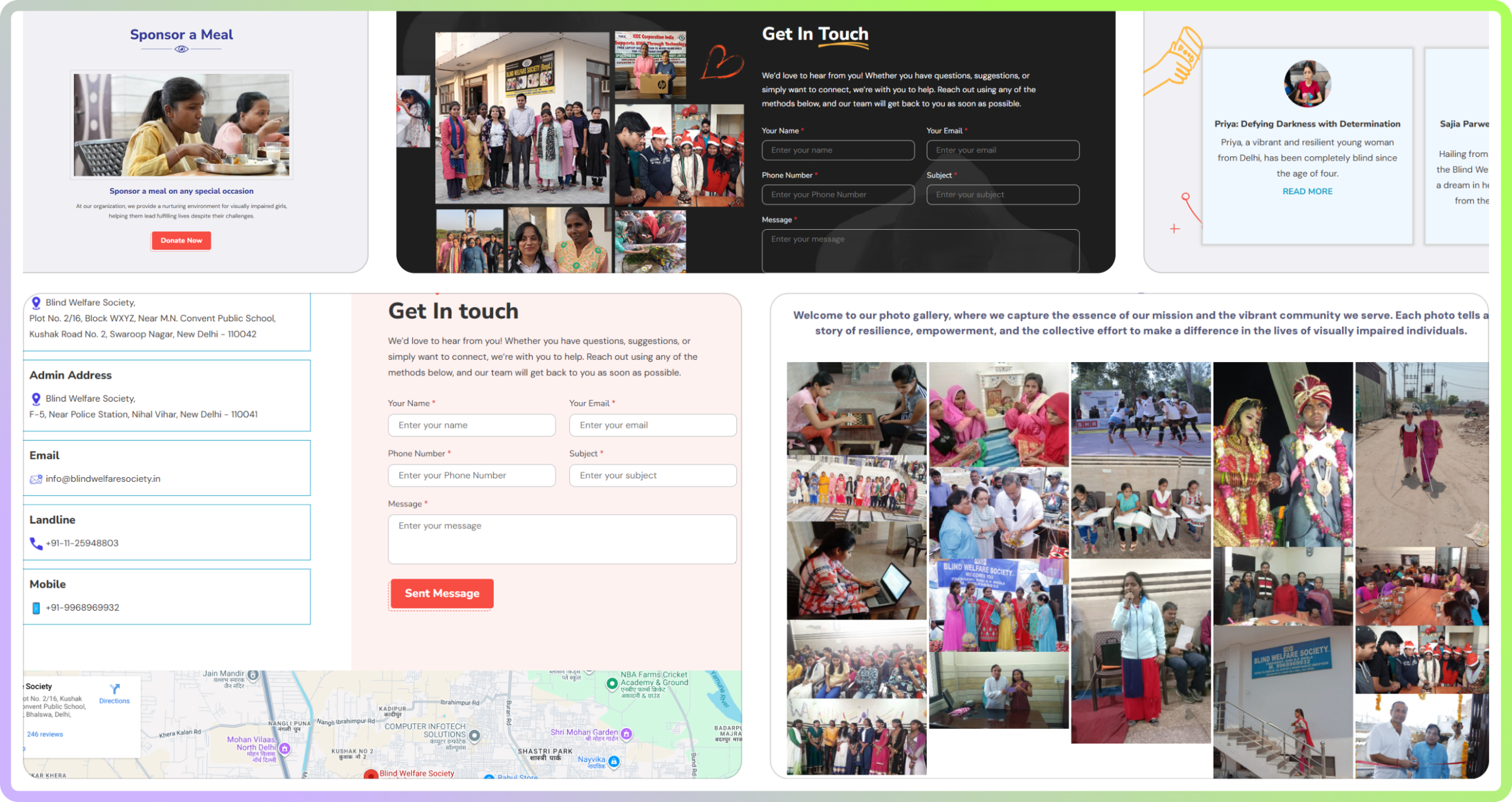
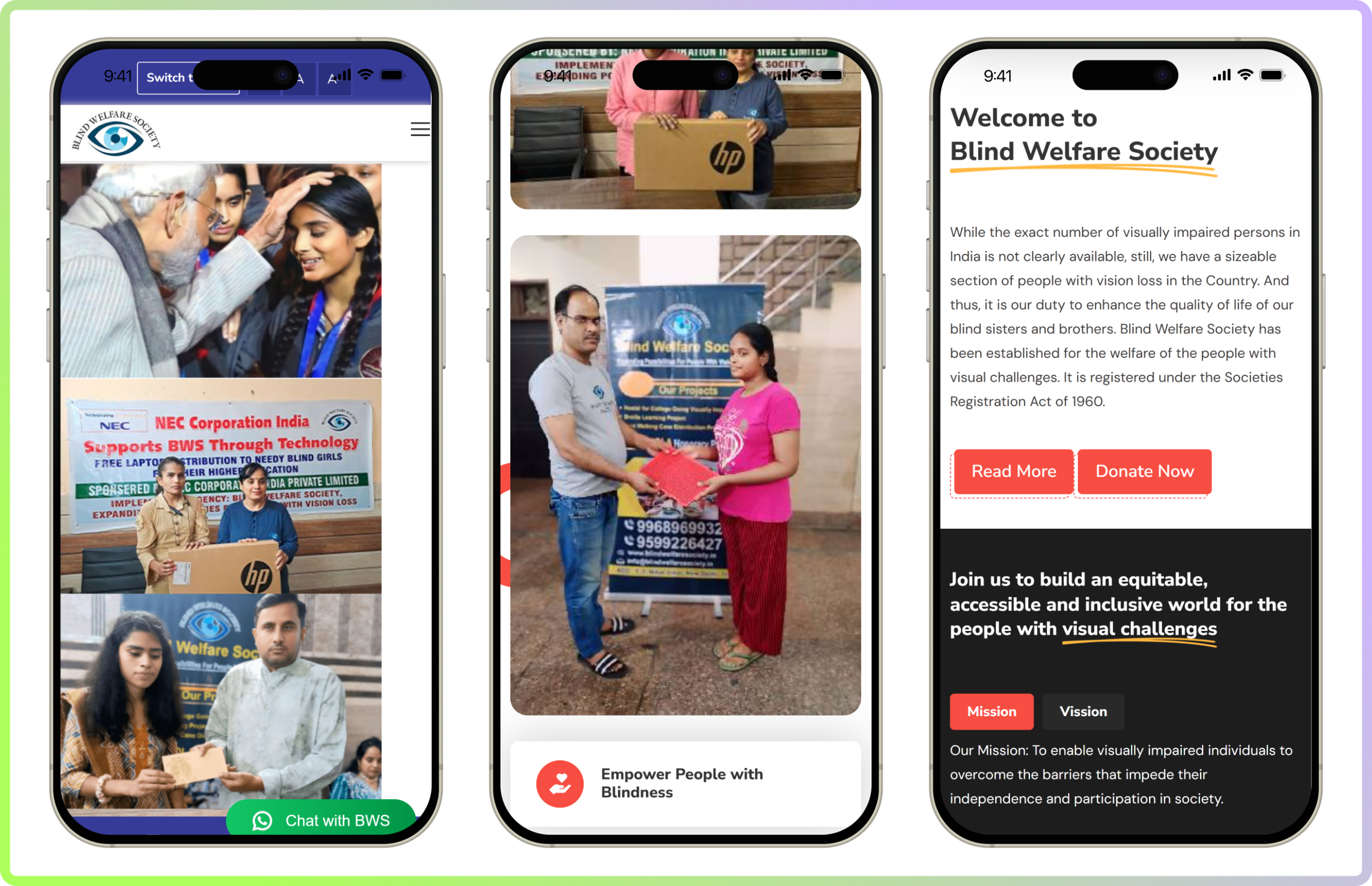
Blind Welfare Society empowers visually impaired individuals through inclusive digital solutions.


Client Success Stories That Define Us
Our Clients Speak for Our Work
Final Outcome
The Google Ads optimization program of Blind Welfare Society has provided a considerable change in the performance of the campaign and collection of donations making a formerly inefficient campaign advertising a substantial source of funds to support the mission of the organization.
The total reorganization of the campaign removed the mess of the old account arrangement forming a logical and manageable framework, where the performance can be tracked precisely as well as the budget can be distributed in a strategic way. The organization can now be clearly visible on which campaigns and key words are bringing about actual donations rather than just clicks.
The high-intent keyword approach has provided an enormous boost to campaign efficiency as the advertisement budget is now spent on searches that show a true interest in the donor and not the searches that can be seen as informational searches or irrelevant traffic. Introduction of extensive lists of negative keywords has saved the organization the wasted money on searches that cannot be turned into donations, which then can be used to carry out more advertising.
The sophisticated audience targeting uses the advanced features of Google to target users who have been shown to contribute to charity and have an interest in social causes; hence, the ads are shown to audiences with much higher chances of donating. The remarketing campaigns have also generated conversions of visitors to the web who failed to donate on their initial visit, thereby capturing the lost conversions.
The persuasive ad text that was created in the course of this initiative presents the effect of the organization well, with specifics on how donations change lives. The urgency creation, emotional resonance, and calls-to-action have greatly contributed to the increase in the amount of click-throughs, and more importantly is that the percentage of clicks that translate to real donations.
Implementation of conversion tracking has given the organization unprecedented access to the ROI of the campaign, and data has been used to make informed choices on how to spend the budget and what to optimize. Dheeraj and his team can now easily understand which campaigns, keywords, and audience segments are giving the best return on ad spend.
The continuous monitoring and optimization strategy will result in a performance that continually improves over time. Constant A/B testing of ad copy, bidding strategies, and targeting parameters reveals small gains that grow into huge performance increases. The poorly performing components are easily identified and optimized or checked, and the effective strategies are allocated more funds.
The rate of conversion of donations has risen considerably against the very low point, but the score of client happiness of 6/10 shows that more can be done. Such a mediocre level of satisfaction probably represents the continuity of the optimization work and the hopes of the organization to have even better outcomes- a healthy outlook that would lead to irreversible improvement.
Mission is directly affected by the improved performance of Google Ads. Each extra donation raised with the help of optimized campaigns will ensure that more blind people can receive educational programs, skill development courses, and community supportive services. The efficiencies are passed on to greater amounts of funds that can be allocated to direct beneficiary services instead of wasted spending on advertisements.
In the future, the further optimization efforts will be directed towards the refinement of the audience targeting based on the accumulated performance data, the addition of other types of campaigns and ad formats, trials of different messages and creative variations, and the proposal of opportunities to receive the grant based on the Google Ad Grants program to the nonprofits that meet the requirements.
The quality of traffic to the organization’s webpage at https://blindwelfaresociety.in is now improved by Google Ads, as individuals who are truly interested in offering assistance to the cause and are more likely to make donations visit the site. This enhanced traffic quality not only helps in the immediate conversion of donations but also builds a bigger community of supporters that can work with the organization in other forms.
This Google advertisement optimization proves that even organizations with a small marketing budget can reach considerable results with the help of effective campaign management, constant optimization, and efficiency orientation. In the case of Blind Welfare Society, the previously ineffective digital advertising expense has been converted into a successful donation-generating tool, helping the agency attract funding for its vital mission of empowering visually impaired individuals in India.

Ready to Optimize Your Nonprofit’s Digital Advertising?
Contact AddWeb Solution to discuss how we can improve your Google Ads performance and maximize donations while respecting your budget constraints.