


Partner-driven growth is no longer a secondary activity, but rather a rapidly emerging primary driver of SaaS revenue, with an increasingly large percentage of software revenue being driven through partner networks rather than direct relationships. Laravel-based platforms are uniquely positioned to help power this shift, providing a strong foundation for revenue sharing networks through the combination of multi-tenant SaaS, subscription billing, and extensibility.
What exactly is a revenue sharing network?
A revenue sharing network is a methodology for dividing the revenue that your platform generates with external partners, such as resellers, referral partners, agencies, and technology partners, based on a set of rules. Instead of a one-time commission, you provide a percentage of recurring revenue or transactional revenue, where they win when you win.
In a SaaS context, a typical partner ecosystem includes:
- Referral partners, who introduce or influence your business
- Reseller partners, who own the commercial relationship, often including billing.
- Agencies and service partners, who implement, customize, and deliver your software.
- Technology partners, who integrate your SaaS solution into their own product or marketplace.
Laravel platforms often host the entire stack, including your underlying software, the multi-tenant infrastructure for your customers, as well as portals and APIs for your partners.
Why partner ecosystems dominate modern SaaS revenue
The numbers are clear: partners are no longer a ‘nice to have’; they are where the SaaS revenue growth is happening.
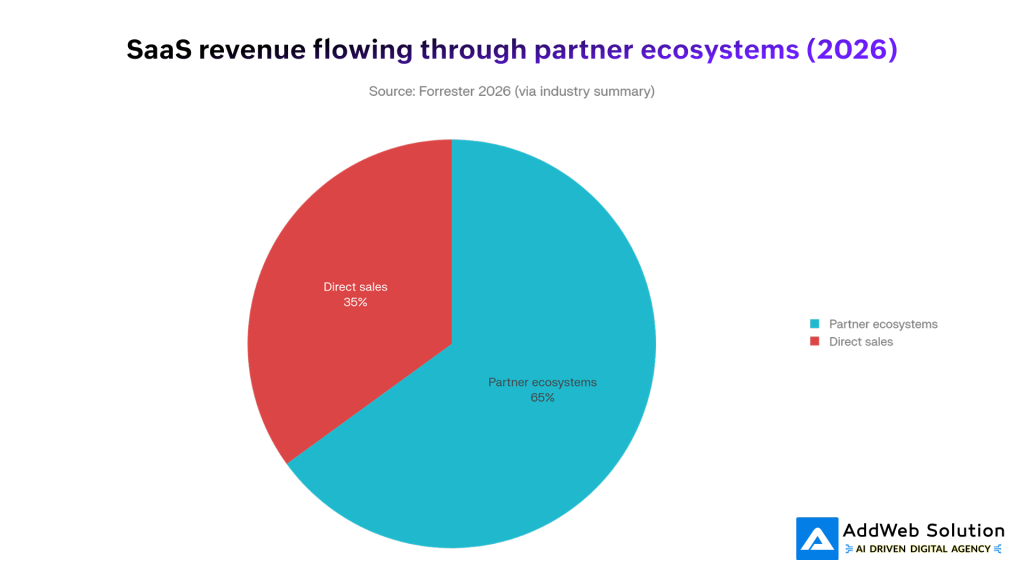
- According to Forrester’s 2026 projections, as referenced in other industry commentaries, approximately 65% of SaaS revenue is currently generated through SaaS partner ecosystems as opposed to direct sales.
- According to Canalys, currently, 38.2% of SaaS application revenue is generated through partners, a figure which will increase as programs mature and cloud marketplaces grow.
- Benchmark figures for B2B SaaS partner programs indicate that mature SaaS vendors are currently generating 20-40% of their total revenue through partners, though this can take 12-24 months to achieve.
The pie chart above illustrates the estimate of revenue generated through SaaS partner ecosystems as opposed to direct sales, as projected by Forrester.
In the early days of a partner program, you might see only 5-10% of revenue touched by partners, and this should be a steady growth progression, with a focus on a small number of high-quality partners.
Revenue sharing is a great sign for a Laravel-based product, as partners should be a first-class user type in your architecture, not an afterthought stapled on as a CRM add-on.
Why revenue sharing works (for both sides)
Revenue sharing, when done correctly, isn’t about splitting the pie; it’s about growing a much bigger pie together.
Benefits for SaaS platforms
- Lower upfront costs: Instead of paying for sales, integrations, or infrastructure, you let partners fund these efforts in return for a slice of future revenue.
- Faster innovation: Because partners get a bigger slice of the pie as you grow, they have a vested interest in suggesting features, co-building add-ons, and co-investing in go-to-market experiments.
- Better retention: Partners who get a slice of the pie from technology and service partners focus on experience, stability, and optimization, which should help drive higher customer retention.
- Shared risk: Because revenue sharing spreads risk, you can take a longer view in your business, focusing on long-term growth over short-term gains.
Benefits for partners
Revenue sharing provides the following benefits to partners:
- Long-term income potential rather than one-time payment for projects.
- Greater involvement in the direction of the product.
- More strategic relationship with the platform provider, where the relationship is about “we’re in this together.
It’s possible to put all of this into the product itself, using Laravel platforms, so the relationship is not just in the contract, but also in the code.


Typical SaaS partner revenue share models
Revenue share models for SaaS partner programs usually vary based on the extent of the sales and delivery work done by the partner. Benchmarks for revenue share models for B2B SaaS businesses are as follows:

If we take the average of these ranges, we can easily understand how revenue share increases with partner participation.
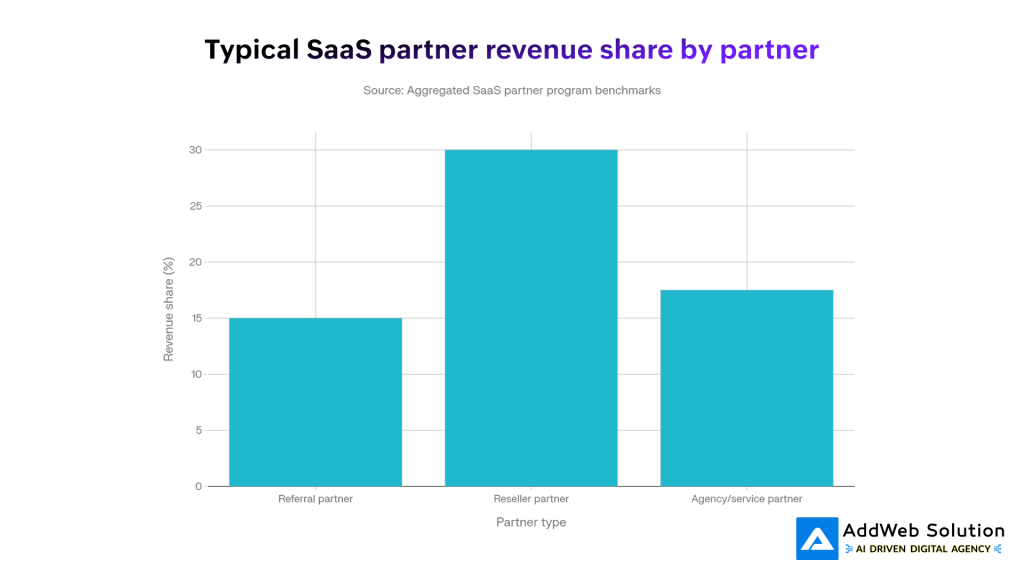
The design implication for a Laravel product is quite straightforward. The implication is, of course, that you should not hard-code these percentages within your application. You should, instead, store them as rules based on partner type, tier, product, or region, so that business can change these incentives easily without requiring a redeploy.
Measuring the impact of your partner ecosystem
You cannot manage what you do not measure. A useful starting point is the Partner Revenue Contribution metric, popularized in partner ecosystem analysis frameworks.
The core idea:
Partner Revenue Contribution (\%)=Revenue from PartnersTotal Revenue100
On top of that, strong SaaS programs watch a short list of ecosystem KPIs:
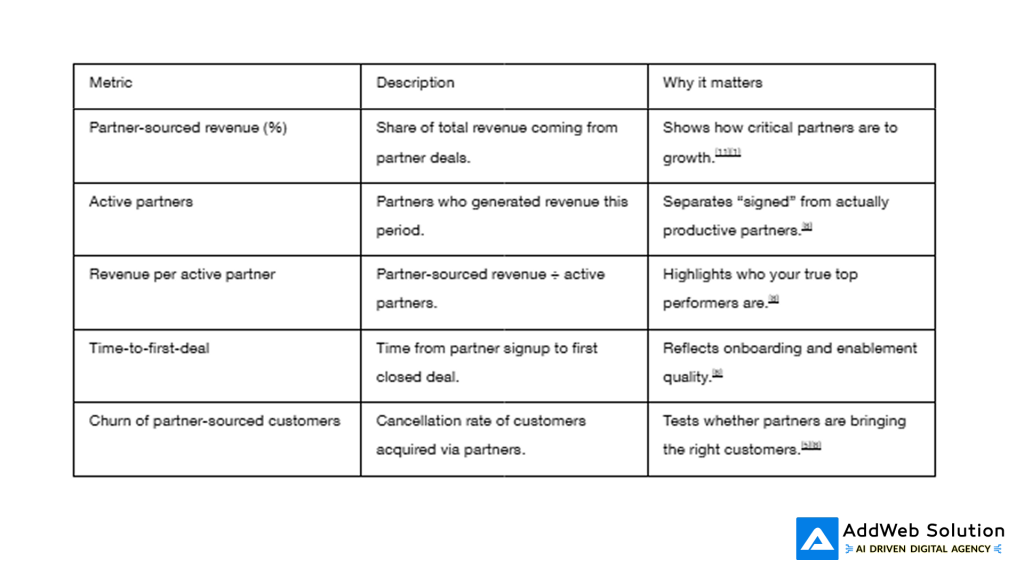
Laravel makes it fairly painless to expose these metrics through custom dashboards: events, queues, and Eloquent models give you a clean way to instrument the partner journey end-to-end.
Why Laravel is a strong foundation for revenue sharing networks
Revenue sharing networks are not only a matter of business model; they are a matter of architecture. The strengths of the Laravel ecosystem map almost one-to-one to the needs of revenue sharing networks.
1. Multi-tenant SaaS and marketplaces
Most revenue sharing networks are built on top of a multi-tenant system: one codebase for many customers, stores, or vendors. This is a popular use case for the Laravel ecosystem. Common patterns include:
- Subdomain routing for tenants and middleware for setting the context for the tenant.
- Shared database strategies, depending on the need for isolation between tenants.
- Per-tenant database strategies for maximum isolation for high-end applications.
There are examples of multi-tenant e-commerce applications running on the Laravel ecosystem, such as the multi-tenant SaaS applications offered by Bagisto. In this application, multiple tenants (brands/vendors) share the application core but have their own storefronts. This is the kind of application a revenue sharing network marketplace, e.g., a multi-vendor commerce application running on the Laravel ecosystem, needs.
2. First-class billing and subscription management
Revenue share management doesn’t hold up if you have bad billing management in the first place. Luckily for us, Laravel has already taken care of the hard parts with Cashier, a package that:
- Works with popular gateways like Stripe, Paddle, and Razorpay.
- Manages subscriptions, changes to plans, trials, renewals, etc.
- Handles webhooks and dunning notifications.
By using Cashier (or similar), you can then build revenue share management on top of consistent subscription events instead of trying to reinvent the wheel with your own billing system.
3. Event-driven architecture and extensibility
Revenue share is event-driven: a subscription is created, a payment is made, a refund occurs, a plan changes, etc. Laravel’s event system is a great way to manage these events.
Typical pattern:
- Raise domain events for things like SubscriptionCreated, InvoicePaid, RefundProcessed.
- Write event listeners that handle revenue share management.
- Queues for heavy computation so your customer-facing app remains fast.
Since Laravel is a framework that’s all about packages, it’s actually possible to create a package for revenue share management that can be used in many different products or microservices.
4. An ecosystem mindset baked into Laravel itself
The official Laravel Partnership Program offers partner companies visibility, credibility, and access to the core team and community. They are featured on the Laravel website and other promotional channels. This philosophy is a perfect fit for what you want to achieve as a SaaS platform builder: to become the center where agencies, integrators, and other tools can build their revenue streams on top of your Laravel-based product.
How a Laravel revenue sharing architecture typically looks
A real-world revenue sharing architecture on top of the Laravel stack would look like this:
- Core multi-tenant app
This handles the tenants (customers, vendors, accounts), roles, permissions, and the core application features. - Billing and subscription engine
This uses the Cashier system and payment gateways for plans, invoices, metered usage (if needed), taxes, and subscriptions. - Partner and commission engine
This holds the partners, agreements, rules, and computed commission records related to billable events. - Partner portal and APIs
This offers the partners a way to access their performance metrics, leads, and owed commissions through a portal and APIs to their systems.
Under the hood, this means Eloquent models (Partners, Agreements, Commissions, Payouts), policies and middleware (for permission management), events and listeners (for lifecycle management), and queues (for batch payouts and heavy calculations).
Example flow: from lead to commission
A simple end-to-end flow might be as follows:
- A lead converts, a subscription is created with Cashier, and the first invoice pays.
- An InvoicePaid event occurs; a listener calculates the commission based on the agreement and creates a PartnerCommission record.
- Commissions accrue for partners over a payout period; partners can see this in a portal, and you can export or process payouts with your finance system.
Everyone can see the same numbers, and the business arrangement is enforced by code, not spreadsheet lore.
Essential dashboards and tables inside your Laravel partner portal
To keep your partner ecosystem healthy, make the most important numbers painfully obvious. At minimum, your Laravel admin and partner portals should surface:
- Partner-sourced revenue and its percentage of total revenue.
- New and active partners in the current period.
- Revenue per active partner, with clear identification of the top 10–20%.
- Time-to-first-deal per partner.
- Churn and expansion metrics for partner-sourced accounts.
A simple configuration table that business teams can manage (via Nova, Filament, or a custom admin) should also exist for:
- Commission percentages per partner type and tier.
- Eligibility rules (minimum deal size, verticals, geographies).
- Payout schedules and thresholds.
All of this plays nicely with Laravel’s strengths in building internal tools and data-heavy admin UIs.
Best practices when designing revenue share on Laravel
Pulling together benchmarks and practical experience, a few patterns tend to work consistently well:
- Match share to effort: Give higher revenue shares to partners who take on more of the sales, implementation, and support workload—resellers typically earn more than simple referrers.
- Use recurring commissions where you want true commitment: For strategic partners, recurring revenue shares on renewals are more motivating than single up-front bounties.
- Start narrow, not wide: Data suggests that 80% of partner revenue often comes from the top 10–20% of partners, so focus on 5–10 strong relationships early on.
- Automate everything that must be auditable: Use events, listeners, and queues to ensure that every commission can be traced back to a billable event and a clear rule.
- Drive rules from data, not code: Keep commission rules in configuration tables or a simple rules engine, not scattered across controllers and services.
Laravel’s combination of expressive syntax, robust ORM, and rich ecosystem of SaaS-focused patterns makes these practices easy to implement without turning the codebase into an unmaintainable tangle.
How Laravel agencies and dev partners fit into these networks
Laravel-focused agencies and development firms can participate in these ecosystems from both sides:
- As builders, they architect and implement the revenue-sharing platforms themselves.
- As partners, they enter into revenue-sharing agreements for ongoing development, maintenance, or even joint ventures around a shared product.
Revenue-sharing with outsourced software development partners is increasingly used to align incentives, reduce up-front development costs, and spread risk across parties. Encoding those agreements directly into a Laravel platform’s billing and partner modules makes the economic relationship transparent and reportable for everyone involved.
A practical roadmap to building your Laravel partner ecosystem
If you are building or scaling a Laravel-based SaaS and want to move toward a partner-led model, a pragmatic sequence could look like this:
- Measure where you are now
Calculate partner revenue contribution and basic KPIs such as partner-sourced revenue, active partners, and revenue per partner. - Define partner types and economics
Decide which partner types you will support (referral, reseller, agency, technology partner) and map each to clear responsibilities and revenue-share ranges. - Model partners and commissions in Laravel
Design Eloquent models and relationships for partners, agreements, commissions, and payouts with a focus on auditability. - Wire billing events to commission logic
Use Cashier and domain events so that every relevant billing event can trigger commission calculations in a predictable way. - Ship a focused partner portal
Start with a lean portal: performance overview, owed commissions, documentation, and onboarding steps. - Iterate incentives using real data
Adjust commission percentages, tiers, and partner enablement based on what the numbers and qualitative feedback are telling you.
Done well, your Laravel platform stops being “just an app” and becomes the nucleus of a revenue-sharing ecosystem—one where partners are not simply reselling software, but co‑creating value with you over the long term.
Build Your Laravel Partner Ecosystem

Pooja Upadhyay
Director Of People Operations & Client Relations
⁂
- https://canalys-forum-apac.canalys.com/resources/saas-businesses-are-unlocking-growth-through-diversified-partner-ecosystems
- https://www.g2.com/articles/revenue-sharing
- https://strategeos.com/blog/f/revenue-sharing-models-when-and-how-to-use-them-in-tech-startups?blogcategory=Startup+Consulting
- https://umbrex.com/resources/industry-analyses/how-to-analyze-a-saas-company/partner-ecosystem-contribution/
- https://hubconnect.io/2024/10/25/the-benefits-of-revenue-sharing-with-outsourced-software-development-partners/
- https://apoorva.com/how-revenue-sharing-models-drive-saas-success-a-win-win-for-tech-companies-and-partners/
- https://www.youtube.com/watch?v=AGUfMDB_y7g
