


Hybrid work has reached a new equilibrium, with most companies being primarily on-site, while a significant percentage have moved to a hybrid model, and this has been stable rather than declining further. However, employees continue to want flexible working arrangements, and this has been shown to increase productivity in a hybrid setup.
The above has made the ‘hybrid workplace platform’ an ‘must-have’ rather than a ‘nice-to-have’ feature for companies, as it has to be able to integrate office and remote workers in real-time, as well as being able to display actionable insights into how, when, and where people are working. This is an area where Laravel excels in building this layer due to its maturity in API, real-time communication, scheduling, and queue systems.
The sections below will outline why this platform is important, what it needs to be able to do, and how this can be achieved with Laravel in a pragmatic way.
Hybrid work is now a durable reality
Where hybrid work stands today
Multiple data sets show that fully remote roles have declined from their pandemic peak, but hybrid work has remained resilient and is now a stable part of the workforce mix.
Illustrative snapshot (U.S., Q4 2025 – Robert Half workplace data):
| Work arrangement | Share of roles | Notes |
| Fully on‑site | 65%[5] | Still the dominant model, especially for roles needing physical presence |
| Hybrid | 24%[5] | Up from 21% in late 2023; growth has slowed but not reversed |
| Fully remote | 11%[5] | Down modestly as some employers move back toward office or hybrid |
Cisco’s 2025 Hybrid Work Study similarly reports that the share of respondents in hybrid arrangements fell from 62% in 2022 to 45% in 2025, while office‑presence mandates increased, indicating a rebalancing rather than a return to 2019 norms.[3]
Employee preferences and outcomes
As employers crack down on policies, employees’ need for flexibility is still high. In fact, research indicates that the majority of employees prefer some type of flexible or hybrid work. According to a report by Dialpad, citing statistics:
- 73% of employees prefer flexibility in terms of when they work and value hybrid work arrangements.
- McKinsey data, also included in this report, states:
- 87% of eligible employees choose to work flexibly if they can.
- The Cisco 2025 Global Hybrid Work Study found:
- 73% of employees reported being more productive in a hybrid work model, with an average self-reported 19% productivity boost.
- According to Gallup, employees’ perceived benefits of hybrid work include: Improvements in work-life balance, time efficiency, and control over time, location, and hours.
In terms of business, hybrid work is associated with improved employee retention, burnout reduction, and engagement, all of which contribute to business success.
Pie chart: current work models
The following simple pie chart represents the above Q4 2025 Robert Half snapshot as an index of work models.
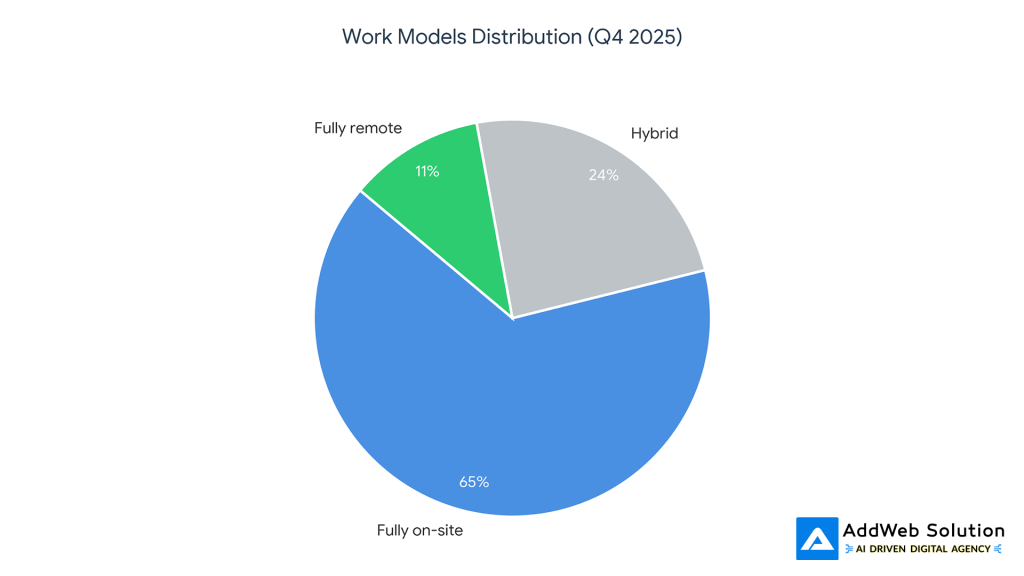
This distribution also helps to explain the need for a hybrid workplace platform to assume that a significant percentage of knowledge workers will be moving between contexts.
Why organizations need a hybrid workplace platform
From ad‑hoc tools to a cohesive layer
In the early days of the adoption of remote work, many organizations managed to thrive on a disparate set of tools, such as chat tools, video tools, and file-sharing tools. However, as the concept of hybrid work has evolved over time, it has become clear that the ad hoc approach to tools has a number of limitations:
- Inconsistent communication experiences
- Poor visibility of availability and work types
- Inadequate support for asynchronous work
- Inability to measure the effectiveness of hybrid work
A hybrid workplace platform helps to overcome the limitations of the ad hoc approach to tools. It does this by providing a cohesive layer on top of disparate tools.
Core jobs of a hybrid workplace platform
At a minimum, a credible platform for hybrid work should:
- Connect office and remote workers in real time via messaging, presence, and notifications.
- Support asynchronous collaboration so work is not blocked by time zones or meeting overload.
- Orchestrate hybrid presence (who is in the office when, which teams are co‑locating, how rooms and desks are used).
- Anchor rituals and workflows such as stand‑ups, incident response, approvals, and retrospectives.
- Provide analytics on policy adherence, engagement, collaboration patterns, and space utilization.[7][4]
Laravel is well suited to providing the backend for this platform layer, especially when paired with modern frontend frameworks for rich user experiences.
Why Laravel is a strong fit for hybrid workplace platforms
Relevant Laravel capabilities
Laravel offers several capabilities that map cleanly onto the needs of a hybrid workplace platform:
- Modern MVC + API‑first design: RESTful controllers, API resources, and middleware make it straightforward to expose consistent, versioned APIs to web and mobile clients.
- Authentication and authorization: Built‑in support for session auth, tokens (Sanctum/Passport), roles, and policies is critical for managing teams, roles (employee, manager, HR, facilities), and multi‑tenant organizations.
- Real‑time communication (Broadcasting & WebSockets): Laravel’s event broadcasting system integrates with drivers such as Pusher, Laravel WebSockets, and Redis to push events to clients in real time.
- Queues and background jobs: Queued jobs and workers are ideal for sending notifications, processing analytics, and integrating with external tools without blocking user requests.
- Scheduling: The task scheduler makes it easy to automate recurring jobs, such as daily digest emails or policy checks.
- Rich ecosystem: Packages for WebSockets, multi‑tenancy, auditing, SSO, and more reduce the amount of custom code needed for an enterprise‑grade platform.
These features combine into a pragmatic stack for building a platform that is both real‑time and robust.


Mapping hybrid needs to Laravel building blocks
The table below connects high‑level hybrid workplace needs to Laravel constructs.
| Hybrid need | Platform capability | Relevant Laravel features |
| Instant communication between office and remote staff | Team chat, channels, notifications | Events, broadcasting, WebSockets drivers, Laravel Echo integration[6][8][12][9] |
| Shared awareness of who is available and where they are working | Presence indicators, team status dashboards | Presence channels in broadcasting, real‑time updates via WebSockets, cache for status snapshots[6][8] |
| Coordinating office visits and desk/room usage | Reservations, check‑ins, occupancy dashboards | REST APIs, Eloquent models, queues for sync with calendars and access systems |
| Asynchronous collaboration across time zones | Threads, comments, task updates, notifications | Queues, notifications, mail, broadcast events, scheduled digests[6][8] |
| Policy and compliance monitoring | Guardrails (e.g., in‑office days, overtime) | Middleware, validation, scheduled audits, logging |
| Hybrid analytics and reporting | Dashboards for engagement and space usage | Eloquent + query builder, reporting endpoints feeding BI tools or custom charts |
Key capabilities of a Laravel‑powered hybrid workplace platform
1. Unified communication and presence
A hybrid platform must reduce the friction between “who is where” and “how do I reach them right now.”
Practical features include:
- Team and project channels with message threading and file sharing.
- Real‑time presence (online, in‑office, remote, in a meeting, focus mode) surfaced in people directories and team dashboards.
- Cross‑channel notifications (web, mobile, email, push) with user‑controlled preferences.
Laravel implementation considerations:
- Define domain events such as MessageSent, StatusUpdated, and MeetingStarted that implement ShouldBroadcast.
- Use broadcast channels (public, private, presence) to represent teams, projects, and organization‑wide streams.
- Use packages like laravel‑websockets or hosted services like Pusher as WebSocket backends.
- Expose an authenticated JavaScript/TypeScript client (via Laravel Echo) for web and native clients to subscribe to events.
2. Hybrid scheduling, space, and rituals
Hybrid work adds a layer of coordination complexity: teams need to know when to come in, which days are “anchor days,” which rooms are free, and how to avoid everyone choosing the same popular days by accident.
A Laravel‑backed platform can provide:
- Team scheduling: People set their in‑office and remote days; managers can nudge for alignment.
- Desk and room booking: Reservation flows, check‑ins, and no‑show handling.
- Hybrid rituals: Stand‑up, planning, and retro workflows that work regardless of location.
Implementation ideas:
- Represent work patterns (office, remote, travel) as Eloquent models tied to users and teams.
- Integrate with external calendars (Google, Microsoft) via API clients to avoid conflicts.
- Use queues to sync reservations and send reminders without slowing down the UI.
3. Asynchronous collaboration at the core
One of the strongest findings about successful hybrid organizations is that they lean heavily on asynchronous collaboration to reduce meeting load and enable focus time.
Features a Laravel platform can support include:
- Discussion threads tied to projects, documents, or tasks.
- Structured comments and decisions, so context is searchable later.
- Notification digests to summarize activity across teams.
Laravel implementation details:
- Model threads, comments, and reactions with Eloquent, exposing them via JSON APIs.
- Dispatch broadcast events for important updates (e.g., decision logged, task unblocked).
- Use the scheduler to send daily or weekly digests, built from recent activity queries.
4. Analytics: turning hybrid data into decisions
Leaders increasingly want to understand how hybrid policies affect productivity, engagement, and space usage, not just whether people badged into the office.
A Laravel backend can aggregate and expose data such as:
- Hybrid adoption: Distribution of office vs. remote vs. hybrid days per team.
- Meeting load: Time spent in meetings by role or org unit.
- Collaboration patterns: Cross‑team interactions, response times, and engagement in key channels.
- Space utilization: Peaks and troughs in desk and room occupancy.
These metrics can be fed into internal dashboards (e.g., via a frontend SPA) or exported to BI tools.
Graph: hybrid share over time (illustrative)
Using Robert Half’s reported U.S. work arrangements, the hybrid share of roles has edged up modestly and then plateaued.
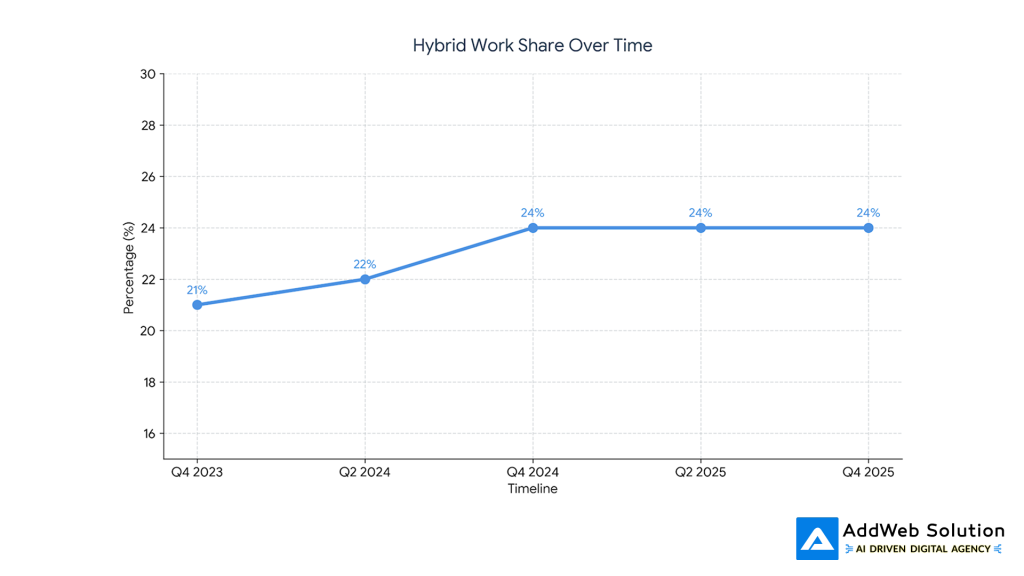
Even if the percentages are not skyrocketing, the stability of hybrid roles over multiple quarters justifies building robust, long‑lived platform capabilities rather than treating hybrid as a temporary exception.
Graph: self‑reported productivity index (Cisco study)
Cisco’s Global Hybrid Work Study reports an average self‑reported productivity increase of 19% under hybrid models among respondents who felt more productive, which can be represented as a simple index.

This visualization does not claim causation but highlights why many employees and leaders view investments in hybrid platforms as directly connected to performance.[2]
High‑level Laravel architecture for a hybrid workplace platform
Layered architecture overview
An effective Laravel‑based hybrid workplace platform typically follows a layered architecture:
- Client layer
- Web SPA (e.g., Vue, React, Inertia) used on desktops and office kiosks.
- Mobile apps (iOS/Android) for on‑the‑go check‑ins, status updates, and notifications.
- API & real‑time layer (Laravel)
- REST/JSON APIs secured with tokens or OAuth.
- Broadcast events for chat, presence, reservations, and workflow updates.
- WebSocket server (Laravel WebSockets or Pusher) handling subscribed channels.
- Domain & persistence layer
- Eloquent models for organizations, teams, users, spaces, schedules, and events.
- Policies and gates enforcing access rules (e.g., cross‑tenant data boundaries).
- Integration and automation layer
- Queue workers for sending notifications, pushing data into HRIS or identity providers, and syncing calendars.
- Scheduled jobs for generating daily metrics, running policy checks, and sending digests.
- Observability and governance
- Centralized logging and monitoring of events and WebSocket connections.
- Audit trails for key actions (policy changes, access grants, space rules).
Example request flows
A few practical flows illustrate how these layers work together.
Flow 1: A hybrid stand‑up update
- A developer working from home posts a stand‑up update in a team channel (web or mobile).
- The client calls a Laravel API endpoint, which validates and stores the update.
- Laravel dispatches a StandupUpdated event that is broadcast to the team channel.
- Teammates in the office see the update appear instantly on a wallboard or their laptops.
- A scheduled job compiles all stand‑up updates into a digest email or dashboard widget at the end of the day.
Flow 2: Booking an office day and desk
- A product manager selects an in‑office day, and the frontend calls a POST /office-days endpoint.
- Laravel records the planned office day, checks desk availability, and reserves a desk.
- A DeskReserved event is broadcast so space dashboards update in real time.
- A queued job sends a calendar invite and a reminder the day before.
Flow 3: Tracking engagement and collaboration health
- As chat messages, comments, and stand‑up updates are created, Laravel logs high‑level events and metadata.
- A nightly job aggregates these into metrics per team: participation rates, cross‑team interactions, meeting‑free days, and more.
- Dashboards visualize these trends for HR and leadership, allowing them to refine hybrid policies.
Design and implementation tips to keep the platform human‑centred
Design for psychological safety and focus
Hybrid platforms can easily become “yet another tool” that adds noise. Human‑centred design choices help avoid that:
- Status that respects focus: Allow users to mark deep‑work blocks; integrate with calendar events to auto‑set focus modes.
- Gentle nudges, not surveillance: Aggregate metrics at team or org level and avoid exposing individual‑level activity dashboards to managers.
- Inclusive defaults: Make sure features work equally well for fully remote team members and in‑office staff.
Laravel supports these patterns by making it straightforward to embed status rules in middleware and policies and to aggregate data at the right level of abstraction.
Prioritize asynchronous over synchronous
To reduce burnout and meeting overload, hybrid platforms should encourage asynchronous workflows first and synchronous ones second.
Practical ideas:
- Make it easy to turn a discussion thread into a decision log without a meeting.
- Provide templates for written status updates, project briefs, and retrospectives.
- Offer light‑weight audio or video clips embedded in threads as an alternative to live calls.
Laravel’s queues, schedulers, and notification system align well with these async‑first patterns.
Start small, iterate, and integrate
From an implementation standpoint, teams often succeed by:
- Starting with one or two critical flows (e.g., team communication and hybrid scheduling), then expanding.
- Integrating the Laravel backend with existing identity providers and HR systems rather than trying to replace them.
- Instrumenting the platform early so usage data informs the roadmap.
Because Laravel is highly modular, adding new capabilities—like advanced analytics, richer workflows, or AI‑assisted summarization—can be done iteratively without a full rewrite.
Practical checklist for building your Laravel hybrid workplace platform
Below is a practical, implementation‑oriented checklist to guide a Laravel‑based build.
Foundation
- Clarify primary users and jobs‑to‑be‑done (e.g., team leads coordinating office days, employees needing a simple visibility layer).
- Define your data model for organizations, teams, users, spaces, schedules, and activities.
- Choose your authentication approach (SSO, SAML/OIDC, or application‑level auth).
Real‑time and communication
- Select a WebSocket solution (Pusher, Laravel WebSockets, or equivalent).
- Implement broadcast events for core actions (messages, status updates, reservations).
- Set up presence channels where appropriate to show who is online/in‑office.
Collaboration and workflows
- Design threads, comments, reactions, and decision logs as first‑class entities.
- Implement notification preferences per user (channel and frequency).
- Create templates for recurring rituals (stand‑ups, check‑ins, retrospectives).
Scheduling and space
- Model in‑office/remote days and link them to teams and locations.
- Provide desk/room booking with conflict resolution.
- Integrate with calendars for invites and room availability.
Analytics and governance
- Define key metrics: hybrid adoption, engagement, space utilization, and meeting load.
- Implement nightly or near‑real‑time aggregation jobs.
- Build role‑appropriate dashboards and ensure privacy‑preserving aggregation.
UX and change management
- Partner with HR/people teams to align platform design with policy.
- Provide onboarding, training, and in‑product guidance.
- Iterate based on feedback and usage data, not only leadership opinions.
Conclusion
Hybrid work has moved past the experimental phase into a durable, if evolving, part of modern work. Employees continue to value flexibility and report productivity gains, while organizations wrestle with the right mix of remote, hybrid, and in‑office policies. A dedicated hybrid workplace platform provides the connective tissue that turns these policies into day‑to‑day reality, ensuring that office and remote team members stay in sync, can collaborate effectively, and feel part of the same culture.
Laravel offers a pragmatic, well‑supported foundation for building this platform layer, combining real‑time capabilities, strong security primitives, rich ecosystem support, and a developer‑friendly experience. With thoughtful design and a focus on human‑centred workflows, organizations can use a Laravel‑powered hybrid workplace platform not just to manage attendance, but to genuinely connect their distributed teams and improve how work gets done.
Empower Your Digital Transformation With Our Laravel Development Services!

Pooja Upadhyay
Director Of People Operations & Client Relations
References
- https://www.gallup.com/workplace/398135/advantages-challenges-hybrid-work.aspx
- https://www.cisco.com/c/en/us/solutions/collateral/enterprise-networks/hybrid-work/global-hybrid-work-study.html
- https://www.roberthalf.com/us/en/insights/research/remote-work-statistics-and-trends
- https://www.codemag.com/Article/2401061/Real-Time-Communication-in-PHP-Laravel-Part-2
- https://owllabs.com/state-of-hybrid-work/2024
- https://dev.to/prateekshaweb/implementing-real-time-notifications-using-laravel-websockets-and-nextjs-a-complete-guide-1a2l
- https://stackoverflow.com/questions/78022314/implementing-websocket-broadcasting-in-laravel-for-real-time-updates-when-creati
- https://www.uscareerinstitute.edu/blog/50-eye-opening-remote-work-statistics-for-2024
