


Choosing the right CMS isn’t just an IT call – it’s a business move that shapes revenue, growth, security, and your edge over competitors. If you’re leading a team or making big decisions, understanding Drupal and its impact could redefine your digital strategy.
Why Non-Tech Leaders Need to Care About CMS Selection
Here’s what many overlook: every time marketing waits on IT to publish, it costs money. When your site lags during traffic spikes, you lose conversions. And when weak security leads to a breach, it costs more than money — it costs trust.
Your CMS isn’t just background tech; it’s the engine driving your digital presence, team speed, and ability to scale.
You don’t need to know how to code Drupal — but you do need to know why some organizations choose it over simpler tools, and how that choice shapes business outcomes.
Think of it like this: you don’t need to be an engineer to see why some build skyscrapers and others build strip malls — the architecture decides what’s possible.
Why This Conversation Matters Right Now
Digital transformation spending is projected to reach $3.9 trillion by 2027. At the same time, 68% of enterprises migrated to new or modernized CMS platforms in 2024. If your organization hasn’t made this move yet, the question isn’t whether to modernize – it’s which platform will support your ambitions without becoming a technical burden.
The Enterprise Reality: Who’s Actually Using Drupal
Let’s start with what the data shows. When you look at global CMS market share, WordPress platform dominates with 43.6% of all websites. Drupal claims 1.2% of the overall market. On the surface, that sounds like Drupal is losing.

Global CMS Market Share Distribution (2025)
WordPress may dominate in numbers, but Drupal leads where it matters — high-value, high-reliability use cases. Over half of Fortune 500 companies use it, 41% of U.S. government sites run on it, and 150+ countries trust it for official platforms.
These aren’t just stats – they show that when security, scale, and reliability are non-negotiable, Drupal is the choice.
Where Drupal Dominates
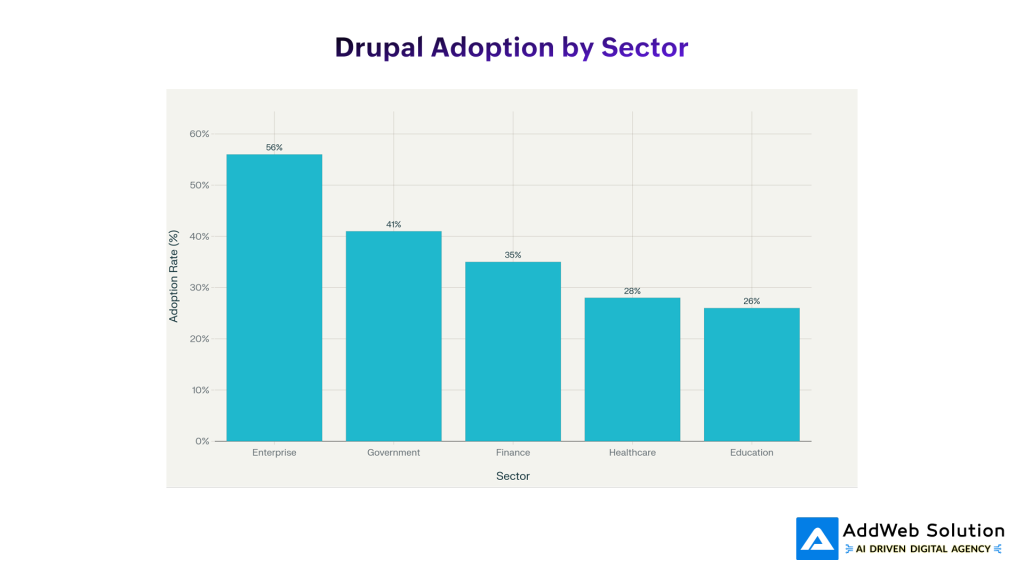
Drupal Adoption Rates by Sector (2024-2025)
The pattern is clear: Drupal thrives in industries where complexity and risk are highest — the spaces where tech decisions drive strategy.
Companies like Tesla, Pfizer, and NBCUniversal don’t pick Drupal because they can’t afford WordPress; they pick it because it meets enterprise demands. NASA runs Drupal on AWS to handle 250K+ pages, 3TB of assets, and a million daily visits — even during massive events like the Solar Eclipse — with zero downtime.
That’s not just good tech. That’s business continuity.
Drupal vs. the CMS Market: Where It Wins
If WordPress is the sedan in the CMS parking lot—reliable, affordable, good for most drivers – Drupal is the specialized vehicle engineered for specific high-demand scenarios. Understanding the distinction helps leaders make smarter choices.
The Market Landscape
Drupal’s current installed base includes over 1.68 million active installations worldwide. While that’s smaller than WordPress’s 835 million sites, Drupal’s version distribution tells a story about adoption patterns.
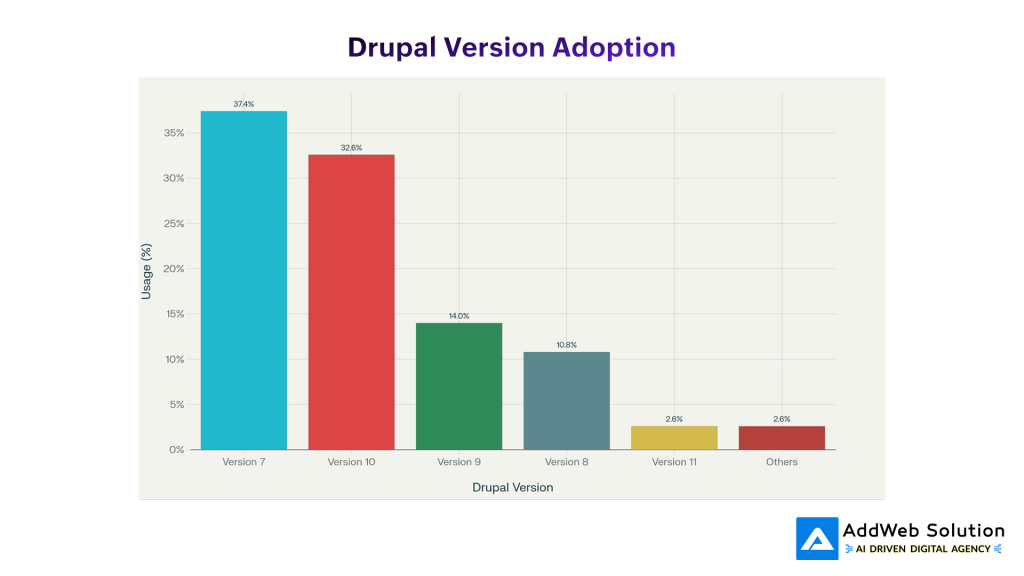
Drupal Version Distribution (2025)
Drupal 7 still powers 37.4% of sites thanks to its reliability and long track record. Drupal 10 now runs 32.6% of deployments – clear momentum toward modern architectures.
This shift shows a healthy, evolving ecosystem that balances modernization with stability – exactly what enterprises need.
When Drupal Makes Sense (And When It Doesn’t)
Drupal wins when you need:
- Enterprise-scale content: Complex workflows, multiple roles, and detailed permissions — all managed without chaos.
- Seamless integrations: CRM, ERP, marketing tools — Drupal’s API-first design makes it easy to connect your stack.
- Headless flexibility: Power websites, apps, and even IoT devices from one source — headless Drupal grew 32% YoY.
- Security & compliance: Trusted by governments, finance, and healthcare for its granular controls and audit trails.
- Multi-site governance: Manage multiple brands or regions from one hub with consistency and control.
WordPress (and simpler tools) win when you need:
- Fast launch and minimal custom work
- Ease of use for non-technical teams
- Lower cost for simple sites
- Huge plugin ecosystem for quick fixes
The truth: Most sites don’t need Drupal — but most enterprises do.
Additional
Read

The Real Business Impact: Scalability, Security, and ROI
Non-technical leaders ultimately care about three things: Does it work? Can we scale it? Will it pay for itself?
Scalability That Actually Holds Up
When the U.S. Department of Justice released the Mueller Report, traffic spiked 7,000% in one day — and the Drupal site didn’t crash. That’s not luck — that’s architecture.
Why Drupal scales:
- Multi-layer caching: Handles 10x traffic without 10x cost.
- CDN integration: Faster load times worldwide, no extra data centers.
- Horizontal scaling: Add servers easily — no downtime or reconfig.
- Database optimization: Grows from thousands to millions of items without slowing down.
What it means for business: Your site stays fast, your campaigns don’t break things, and you scale without firefighting.
Security: Built-In, Not Bolted-On
Drupal’s security model is built for enterprise-level threats, not casual attacks — and its defenses match that scale.
- Granular permissions: Control access down to specific fields. Marketing sees what it needs; Finance doesn’t see campaigns.
- Moderation workflows: Every post goes through approval — no accidental leaks.
- Audit trails: Track who changed what, when, and why — essential for compliance.
- Proactive security team: Patches and updates roll out before issues become risks.
For healthcare, finance, or government, a breach isn’t just a fine — it’s lost trust. That’s why security-first architecture matters.
The Financial Reality of CMS Ownership
Let’s talk costs. Both Drupal and WordPress are free, but your total cost of ownership depends on traffic, complexity, and customization.
WordPress:
- Domain: ~$12/year
- Hosting: $4–$50+/month
- Plugins: $0–$1,000+
- Dev fees: $50+/hr
👉 Total: ~$50–$1,000+/year
Drupal:
- Domain: ~$10/year
- Hosting: $4–$100+/month
- Modules/themes: $0–$500+
- Dev fees: $40–$80+/hr
👉 Total: ~$100–$2,000+/year
The catch: Drupal projects cost more upfront because they’re built for scale. A WordPress site that handles 1,000 visitors might need a rebuild at 10M — but a well-architected Drupal site simply grows with you.
Drupal for Different Industries: Government, Enterprise, and Education
Different sectors prioritize different CMS qualities. Here’s what Drupal brings to each.
Government and Public Sector
88% of U.S. citizens now expect digital interaction with government. When a website fails during open enrollment or tax filing season, constituent frustration turns into political pressure turns into budget discussions.
Drupal powers 41% of U.S. government websites and is used across 150+ countries for government and intergovernmental operations. Why? Because government’s requirements are unforgiving:
- Scale without warning: A news story breaks, citizens flood the website. Your infrastructure needs to handle the spike without degrading.
- Accessibility compliance: WCAG and WAI-ARIA standards aren’t optional. Drupal builds these into the core platform, not as afterthoughts.
- Multi-language support: Government websites serve diverse populations. Drupal’s native multilingual capabilities mean one content source feeds multiple language experiences.
- Long-term stability: Governments plan in 10-year cycles. They need platforms that will be supported and relevant a decade from now.
Enterprise and Fortune 500
Fortune 500 companies use Drupal for different reasons than government. When you’re Tesla managing a global e-commerce experience or Pfizer coordinating compliance across pharmaceutical markets, the problems are about orchestration at scale.
Drupal’s strength in enterprise is composable architecture. Content created in one place flows to websites, mobile apps, IoT experiences, and partner channels simultaneously. Update your product information once—it updates everywhere.
This dramatically reduces the cost of managing multiple digital touchpoints. Instead of separate systems for web, mobile, and partner networks, one content hub orchestrates all of them.
Education
Universities and educational publishers—26% adoption rate—use Drupal for different reasons still. Educational content is structured differently. Interactive learning requires different workflows. Student access control is granular.
Drupal’s flexible entity system means you’re not fighting the platform to model how education actually works. Courses, learners, assessments, outcomes—these can all be native content types with native relationships instead of workarounds.
“Drupal’s ability to integrate seamlessly with enterprise systems—CRM tools like Salesforce, marketing automation like HubSpot, or ERP systems like SAP—is what sets it apart for organizations managing complex digital ecosystems.”

Curious how Drupal can unlock growth for your business? Schedule a quick 15-minute discovery call with our experts today.

Pooja Upadhyay
Director Of People Operations & Client Relations
Making the CMS Decision: A Practical Guide for Leaders
Step: 1. Identify what’s broken
Before comparing tools, ask:
- Can marketing publish without IT?
- What fails when traffic spikes?
- How smooth are your integrations?
- Can content easily reach new channels (apps, email, voice)?
These answers ground the choice in business reality, not tech specs.
Step: 2. Involve the right people
Form a small, cross-functional team:
- Marketing – ease of use
- IT – stability & security
- Finance – total cost
- Strategy – long-term vision
Each brings a vital lens — and the CMS must balance them all.
Step: 3. Define success
Decide what “good” looks like:
- Adoption: % using it without training
- Speed: time from draft to publish
- Uptime: acceptable downtime
- Budget & ROI: clear cost vs. value
Step: 4. Test before committing
Run a small pilot: move real content, involve real users, and track real results.
Pilots expose what demos never do — and save costly surprises later.
Conclusion
Understanding Drupal isn’t about coding — it’s about knowing why organizations choose it and what that means for your business.
The best digital transformations happen when leaders ask smart tech questions and technical teams can answer with clarity.
That’s the kind of conversation that drives real growth.
Source URLs
- https://www.acquia.com/blog/what-is-drupal
- https://www.globalmediainsight.com/blog/drupal-statistics/
- https://electroiq.com/stats/drupal-statistics/
- https://www.ibm.com/think/topics/content-management-system
- https://www.theedigital.com/blog/top-reasons-to-use-a-content-management-system
- https://drupalize.me/course/performance-and-scalability-drupal-sites
- https://www.mckinsey.com/featured-insights/mckinsey-explainers/what-is-digital-transformation
