


“For NGOs, a website redesign is not just a design project; it’s a governance and culture project. To really build trust, you have to align leadership, finance, programmes, and communications around what you’re willing to show the world.”
Introduction: Your Website Is Now Your Strongest Donor Conversation
If you run or support an NGO, you’ve probably felt the shift: donors don’t just “hear about you” anymore-they research you, compare you, and decide whether to trust you based on a few clicks and scrolls.
At a time when global charitable giving is near record highs but donor numbers and retention are under pressure, the NGOs that win attention (and sustained support) are the ones whose websites feel transparent, usable, and genuinely human.
Online giving is no longer a side channel. Over half of donors worldwide now prefer to give online by card, and roughly two‑thirds of nonprofits are already set up to accept digital donations. That means your website is not just a brochure-it’s your primary trust engine and your most important fundraising product.
1. What Makes a Modern NGO Website Actually Trustworthy?
Public trust in charities is recovering, but it’s fragile.
Recent UK research shows trust in charities is at a ten‑year high, scoring 6.5 out of 10, with 58% of people expressing “high” trust-yet fewer people are donating than in 2020. At the same time, a Wise Giving Alliance survey found 70% of people say trust is essential when giving to charities, but only 20% say they “highly trust” charities in practice.
So donors want to trust you, but your website has to earn it quickly.
Three pillars of a trust‑worthy NGO site
- Radical clarity about money and impact
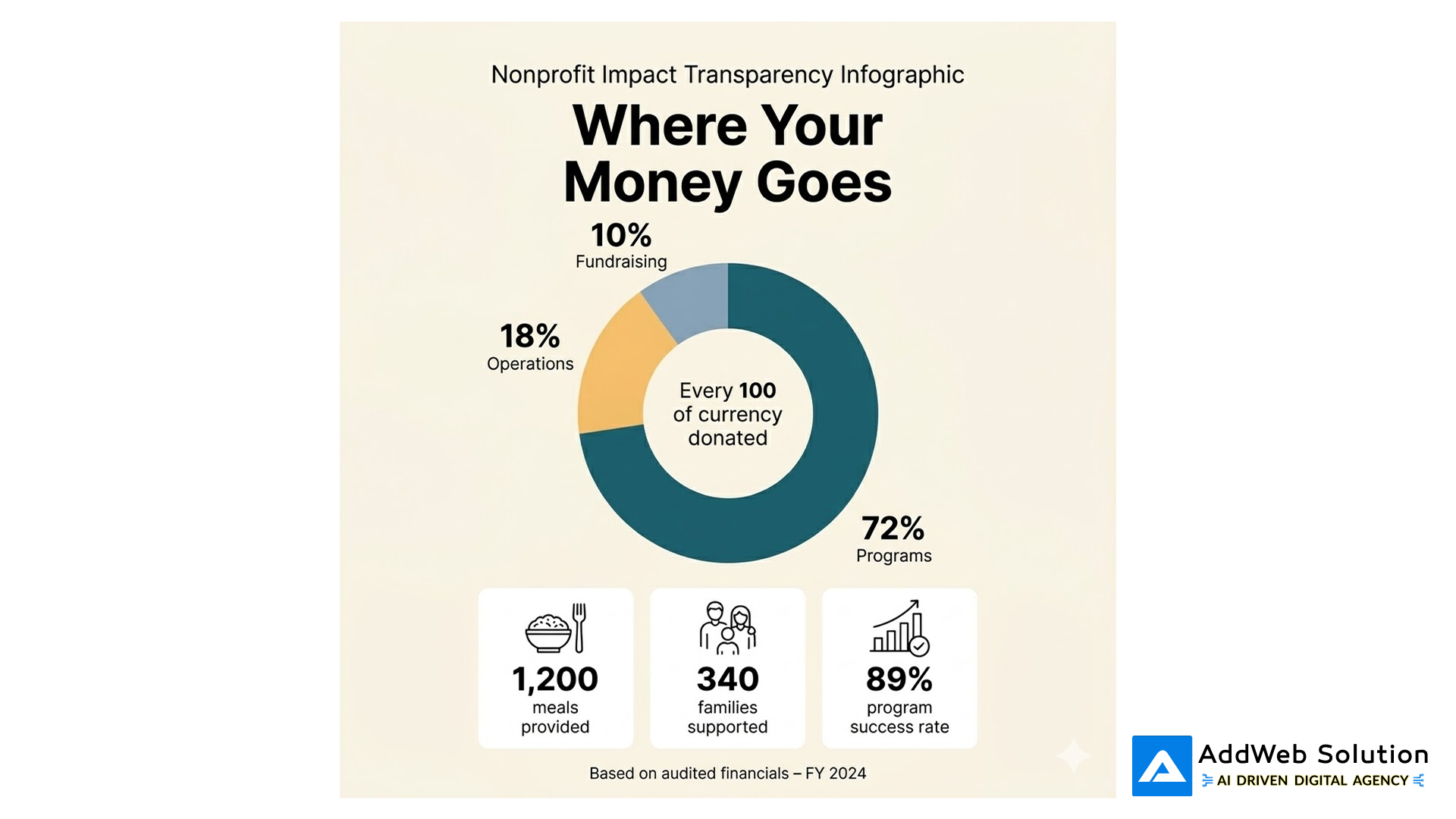
Research consistently shows that how you spend money and whether you achieve your mission are the top drivers of public trust in charities. Donors look for clear breakdowns of where funds go, evidence of outcomes, and honest discussion of overhead and challenges. - Frictionless, credible donation experience
Globally, 54% of donors prefer giving online with a credit or debit card, while only 11% prefer direct mail and 11% prefer cash. Yet overall, nonprofits still see just a tiny fraction of site visitors convert; one 2025 analysis suggests only around 1% of nonprofit website visitors become donors or subscribers. - Human, accessible digital storytelling
Many charities report that digital progress is “static” because of budget and skills gaps-64% of small charities say they are still at an early stage with digital, and 47% cite staff digital skills as a barrier. That gap shows up in clunky menus, hard‑to‑read pages, non‑mobile layouts, and outdated content that undermines otherwise good work.
In other words, design, UX, content, and technology are no longer “nice to have”. They are governance tools-because they directly affect whether people believe you are who you say you are.
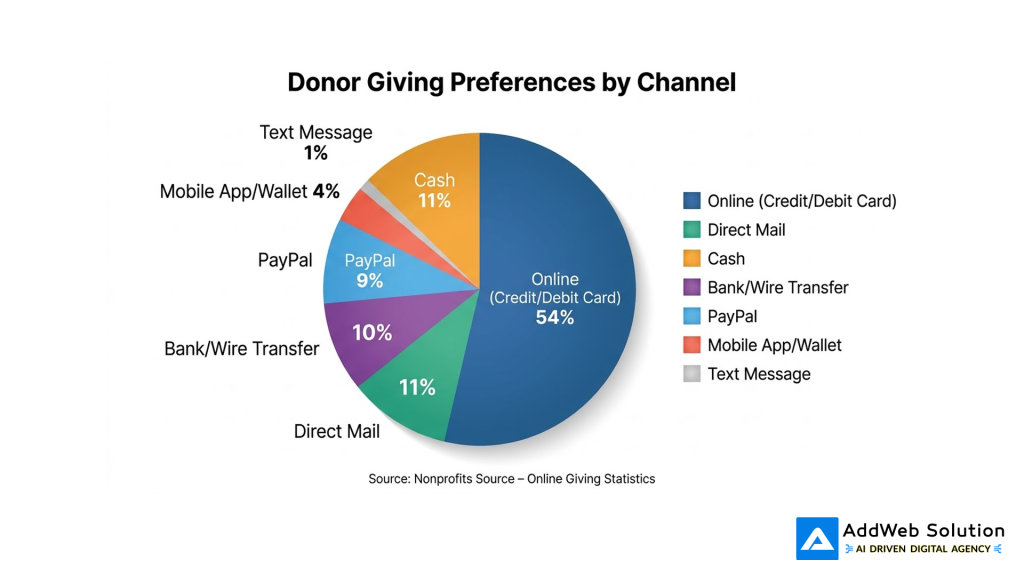
This kind of simple visual is powerful on an NGO website-used in an “Why online giving matters” or “How people support us” section, it quickly shows donors that you understand how they actually give today.
2. The Building Blocks: Old-School vs Modern NGO Websites
Let’s get concrete. Below is a practical comparison you can use with your team or board when discussing a redesign.
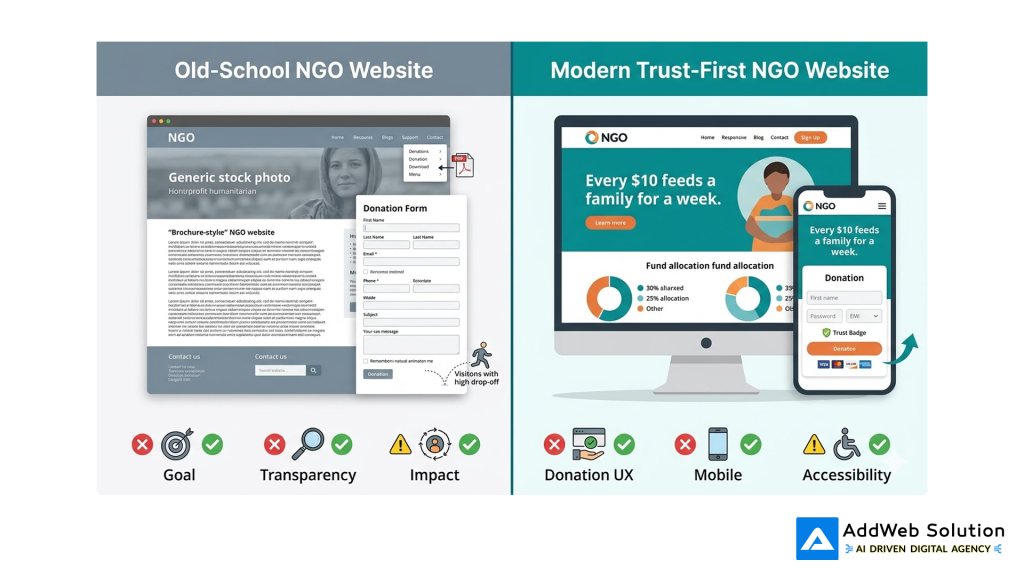
Modern sites are not just prettier. They are deliberately engineered to reduce doubt, answer unspoken questions, and make the decision to feel safe and straightforward.
3. What Happens When You Get It Right? The Numbers Behind Digital Giving
Charitable giving is changing shape, not disappearing.
In the US, total giving reached about 592.5 billion in 2024, one of the strongest years on record, even though the number of donors fell and overall retention dropped to around 42%. Meanwhile, online giving has grown steadily: online revenue represented just over 12% of total revenue for the average nonprofit in 2023, up from roughly 8% in 2022, and continued to grow into 2024.
That growth is mirrored in donation form performance.
Benchmarks from M+R show average donation page conversion rates of about 11% on desktop and 8% on mobile, with many campaigns aiming for a 10–20% range for well‑optimized forms. Yet one analysis suggests that when you look at the whole website (not just the donation form), only around 1% of visitors convert, highlighting how much potential is being lost before people ever reach the form.
For NGOs, this gap is both a warning sign and an opportunity: small improvements in trust signals and user journeys can unlock outsized gains.


How NGOs Translate These Numbers into Design Decisions
Here’s how organizations are using such data when rebuilding sites:
- Shorter, more focused donation flows
If you know typical donation page conversion is 10–20%, while your own is at 6%, you have a clear argument for simplifying forms, reducing steps, and testing different layouts. - More visible impact metrics on key pages
Since public trust hinges on seeing how money is spent and whether you make a difference, NGOs are putting topline impact metrics (e.g., “families reached this year”) directly on the home and donation pages. - Investing in digital skills and governance
With 64% of small charities saying they are at an early stage with digital and 68% citing squeezed finances as a major barrier, leaders are using hard numbers to make the case for investing in digital capacity-not just campaigns.
At AddWeb, this is typically where we sit down with clients to align analytics, stakeholder expectations, and technical possibilities into a realistic roadmap.
How to Start Modernizing Your NGO Website (Without Overwhelm)
If this all feels a bit daunting, break it down into manageable steps that match where your organization is today.
- Audit what’s already live
- Can a first‑time visitor answer, in under 30 seconds, who you help, where you work, and how they can contribute?
- Is your most recent impact story or report more than 18–24 months old?
- Fix the “trust basics” first
- Create or surface a “Where your money goes” page with a simple spending breakdown and outcomes.
- Make sure your donation form is secure (HTTPS, trusted payment provider) and shows clear reassurance messages.
- Prioritize mobile experience
Over half of nonprofit website visitors now come via mobile; one compilation found 51% of visits to nonprofit sites occur on mobile devices. Check your forms, navigation, and storytelling on a mid‑range Android device, not just a designer’s MacBook. - Set one conversion goal and measure it
Decide whether your main priority is donations, email signups, or volunteer applications, and track that metric before and after changes. If your site‑wide conversion is under 1%, getting to 1.5–2% can dramatically improve your fundraising efficiency. - Build a realistic digital skills plan
Given that 43% of charities say they most need funding for digital and data training, it’s smart to include training and coaching in any web project budget. This is often the difference between a site that looks good on launch day and a site that keeps working year after year.
At AddWeb Solution, we usually frame NGO website projects as 60% strategy and governance, 20% UX and content, and 20% engineering-because the technology only shines when the first 80% is honest and aligned.
Empower your NGO with digital transformation strategies for 2026 success

Pooja Upadhyay
Director Of People Operations & Client Relations
Closing Thoughts: Your Website as a Living Trust Contract
A modern NGO website is not a one‑off campaign asset-it’s an ongoing public record of how seriously you take trust, transparency, and digital accessibility.
When you combine clear money and impact storytelling, a frictionless donation journey, and the right analytics, you are no longer guessing whether your website is “working”. You can see how many people feel confident enough to give, and you have the levers to improve that over time.
If you’re planning a redesign or even just a focused optimization sprint, the AddWeb team can help you turn abstract trust goals into concrete UX changes, content structures, and technical foundations that actually move your donation and engagement metrics in the right direction.
Source URLs
- https://nonprofitssource.com/online-giving-statistics/
- https://www.gov.uk/government/news/public-trust-in-charities-at-ten-year-high-new-research-shows
- https://give.org/donor-trust-report
- https://fundraisingreportcard.com/trust-in-charities-nonprofits-survey-data/
- https://charitydigitalskills.co.uk/wp-content/uploads/2024/07/Charity-Digital-Skills-Report-2024.pdf
- https://www.blackbaud.com/newsroom/article/latest-blackbaud-institute-data-reveals-2024-charitable-giving-neared-all-time-high
- https://www.nonprofitpro.com/article/data-reveals-2024-charitable-giving-neared-all-time-high/
