


Nonprofits must use technology strategically because donors are already online. By integrating websites, social media, email, CRM, and AI, nonprofits can create seamless donor journeys that improve conversions, retention, and recurring giving. Mobile-first design, accessibility, personalization, and data-driven decisions – not more traffic – are what turn visitors into long-term supporters and maximize impact.
The Digital Opportunity: Why Nonprofits Can’t Ignore Online Growth
Let’s cut through the noise first. Yes, nonprofits should embrace technology—but not because it’s trendy or because every consultant recommends it. The reason is simpler and more compelling: your supporters are already online, and they’re making giving decisions based on digital experiences.
Consider these numbers: In 2024, 45% of all online donations came from mobile devices, yet most nonprofit websites aren’t optimized for mobile users.
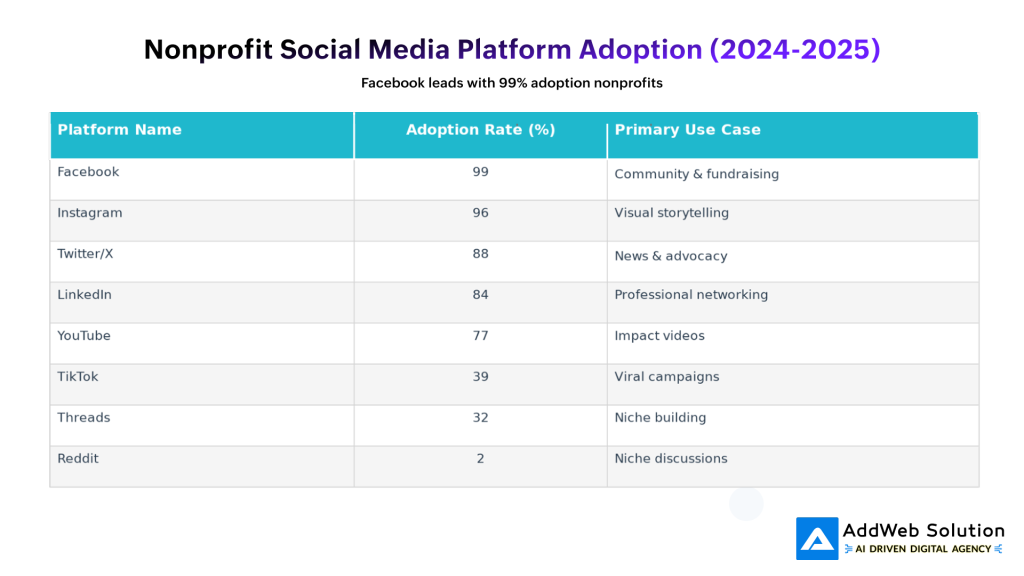
Meanwhile, 99% of nonprofits have a Facebook presence, but only 22% of nonprofit websites meet accessibility standards for people with disabilities. This gap represents both a risk and an extraordinary opportunity.
The average nonprofit raises just $1.29 per website visitor. That conversion rate tells us something crucial: most organizations are driving traffic but failing to convert it. Compare this to organizations that implement integrated digital strategies—they see engagement climb, donor retention rates improve by 29% when they capture email addresses, and recurring giving programs grow by 3.6% annually on average.
The transformation doesn’t happen overnight, and it doesn’t require a massive budget. What it requires is clarity about how technology serves your mission, not the other way around.

Building an Integrated Donor Journey Across Digital Channels
Think of your donor journey like a story with chapters. The first chapter is awareness—when someone discovers your organization. The second is consideration—they’re evaluating whether to support you. The third is action—they donate, volunteer, or advocate. Too many nonprofits treat these chapters as separate stories instead of one continuous narrative.
An integrated donor journey means every touchpoint reinforces your message. A potential supporter might first encounter your organization through a social media post (awareness). They click through to your website for more information (consideration). An email invitation invites them to learn more or make a first gift (action). Each step should feel connected, not disjointed.
Here’s what this looks like in practice:
Stage 1: Awareness Through Social Discovery
You’re sharing impact stories on Instagram. A carousel post about a family your organization helped receives shares and comments. That engagement signals to the platform algorithm that the content resonates. Your organic reach grows.
Stage 2: Website as Your Headquarters
They click your profile link and land on a mobile-optimized website. The design clearly explains your mission, showcases recent impact, and has a prominent (but not aggressive) call-to-action. They sign up for your email list.
Stage 3: Email Nurture with Purpose
They receive a welcome email series. Not a hard sell—instead, education about your work, a volunteer opportunity, or an invitation to an upcoming event. Studies show personalized subject lines increase open rates by 26%. When done right, email drives 11% of nonprofit online revenue.
Stage 4: The Second Gift (The Critical Conversion)
Here’s a statistic that changed how many nonprofits approach retention: only 31% of first-time donors make a second gift, but of those who do, 59% continue giving long-term. This means your post-first-gift stewardship is everything. A thoughtful thank-you video, a personal email from your executive director, or an impact update that shows their gift in action—these moments transform one-time supporters into recurring donors.
The technology that powers this? A nonprofit CRM (Constituent Relationship Management) system. Platforms like Bloomerang, Donorbox, Salesforce Nonprofit Cloud, or Keela integrate donor data, automate communications, and create a 360-degree view of each supporter. When your email platform, donation system, and event management all speak to each other, you can track where donors came from, what engages them, and the optimal timing for outreach.


Data, AI, and Personalization: The Technology Stack That Works
AI isn’t replacing fundraisers—it’s making them superhuman. In 2025, the organizations pulling ahead are using artificial intelligence to work smarter, not just harder.
Here’s what AI can actually do (and it’s remarkable):
Predictive Donor Analytics: AI analyzes giving history, engagement patterns, and demographic data to identify major gift prospects you might otherwise overlook. One predictive AI tool helped nonprofits achieve a 10% recapture rate of lapsed donors, compared to the industry average of just 4%.
Smart Donation Amount Suggestions: Rather than asking “How much would you like to give?” with a blank box, AI-powered donation forms suggest amounts optimized for each donor’s giving history. Result? A 12% increase in per-transaction revenue for nonprofits using this feature.
Automated But Personal Communications: AI can draft donor emails, thank-you messages, and social media posts in minutes, reducing admin time so your team focuses on relationship-building. One AI use case that’s showing real results: sentiment analysis—software that scans donor emails and interactions to identify how engaged (or at-risk) they are, allowing you to adjust outreach strategy accordingly.
The catch? AI works best when you have clean data. That’s why data quality is nonprofits’ second-biggest digital priority in 2025, surpassing technology adoption itself. Garbage in, garbage out applies here.
Practical first steps:
- Audit your current data. Are donor records consistent? Do emails match phone numbers? Clean data first.
- Choose one AI tool and test it. Don’t boil the ocean. Maybe start with AI-powered email subject line optimization.
- Track the ROI. If a tool saves your team 5 hours per week, quantify that value. It matters for future budget conversations.
Social Media Strategy: From Broadcasting to Building Community
Here’s the uncomfortable truth: nonprofit social media engagement is declining—not because you’re posting less, but because the era of broadcasting is over. Facebook’s organic reach for nonprofits has plummeted. Instagram’s algorithm now prioritizes meaningful interactions (comments, shares, video views) over passive likes.
The organizations winning on social media aren’t just posting; they’re creating conversations.
What This Means Practically:
1. Content That Stops the Scroll
You have three seconds. Visual content—high-quality photos, short-form videos, infographics—is non-negotiable. Videos on social media generate 1200% more shares than text and images combined. Keep them under two minutes. Show real people, real impact, authentic moments.
2. Stories Over Statistics
Yes, your impact metrics matter. But donors are 22 times more likely to remember facts when they’re presented as stories. Instead of “We served 500 families last year,” tell the story of one family—the challenge they faced, how you helped, and where they are now. That narrative sticks.
3. Interactive Content That Builds Community
Ask questions in your captions. Run polls. Respond to every comment within 24 hours. Spotlight volunteers and thank donors publicly. One LinkedIn study found that nonprofits using multiple platforms to share stories raise up to three times more donations than those relying on a single channel.
4. Platform-Specific Thinking
Facebook (99% nonprofit adoption rate) is still the workhorse for community building and fundraising. Instagram (96% adoption) excels at visual storytelling. LinkedIn (84% adoption) works for recruitment and thought leadership. TikTok (39% adoption) is cracking through for viral campaigns that reach Gen Z. Don’t post the same content everywhere—adapt it.
The metric that matters: engagement rate, not followers. A nonprofit with 5,000 highly engaged followers will outperform one with 50,000 ghost followers every single time.
Mobile-First Design: Meeting Donors Where They Are
Here’s a staggering stat: 57% of nonprofit website traffic comes from mobile devices, yet 75% of donation revenue comes from desktop. That gap isn’t an accident—it’s a design problem.
Your website has to work flawlessly on a phone. Period. Here’s why and how:
The Mobile Reality:
People browse nonprofits on their phones during lunch breaks, on their commute, while scrolling between other activities. They’re checking you out because someone shared a post or sent an email. They’re not in “desktop research mode”—they’re making quick, gut-level decisions about whether to engage.
A mobile visitor on your site for 30 seconds is either intrigued enough to stay or gone forever. If your donation form has tiny buttons, confusing navigation, or slow loading, they’re gone.
What Mobile-Optimized Really Means:
- Your website loads in under 3 seconds on a 4G connection
- Text is readable without zooming
- Donation buttons are large and easy to tap
- Forms ask for only essential information (name, email, amount—nothing more on first pass)
- Videos auto-play muted (or don’t auto-play at all)
- Your navigation is clear and simplified
Organizations testing AI-powered donation suggestions saw another benefit: a 2.3% increase in recurring donors because donors on mobile found it easy to toggle the “give monthly” option.
Accessibility Matters More Than You Think:
One in four U.S. adults lives with a disability. If your site isn’t accessible, you’re excluding 25% of your potential audience and performing worse in Google search rankings. Simple fixes include:
- Alt text on all images
- Closed captions on videos
- High-contrast colors
- Clear, descriptive link text (not “click here”)
Test your site quarterly using free tools like WAVE or WebAIM.

Measuring Impact: The Metrics That Actually Matter
“What gets measured gets managed.” But nonprofits often measure the wrong things.
Stop measuring:
- Total followers (vanity metric)
- Email list size alone (without engagement data)
- Website visits without conversion data
- Time spent posting versus impact generated
Start measuring:
- Donor Retention Rate: Are you keeping supporters year-over-year? The nonprofit sector average is 35%. If you’re below that, fixing retention matters more than acquiring new donors.
- Cost Per Conversion: How much are you spending (in time, ads, tools) to acquire each donor? Email is incredibly efficient—nonprofits raise $58 for every 1,000 fundraising emails sent.
- Lifetime Donor Value: A first-time donor gives once. A second-time donor is far more likely to keep giving. Where are you losing people?
- Engagement Rate: Comments, shares, and click-throughs. Not followers.
- Recurring Giving Growth: Monthly giving grew 11% in 2024 and now represents 31% of online fundraising revenue. This metric directly correlates with stable, predictable revenue.
The Dashboard Approach:
Create a simple monthly dashboard tracking 5–7 key metrics that directly connect to your fundraising goals. Share it with your board. Let data drive decisions.
Real-World Success: Learning from Organizations That Got It Right
Shatterproof’s Digital Transformation
Shatterproof, a national nonprofit fighting the addiction crisis, faced a classic problem: outdated technology limiting growth. Their ATLAS platform—a treatment locator—had tremendous potential but was buried under technical debt and siloed data.
By partnering with SC&H Group, they modernized their cloud infrastructure, implemented data analytics pipelines, and created accessible dashboards. The result? ATLAS traffic exploded from minimal usage to over 130,000 visits in the first year. More importantly, they tripled the number of people finding treatment through their resources.
The lesson here isn’t “hire an expensive IT firm.” It’s: invest in your technology infrastructure, not as a cost center, but as a revenue and impact amplifier.
Charity: Water’s Transparency Play
Charity: Water revolutionized donor trust by implementing radical transparency. Every donor can track exactly which well their contribution funded, see GPS coordinates, and monitor water quality updates. This single feature—enabled by technology—transformed how donors feel about their giving.
Result: extraordinary donor loyalty and willingness to give again.
American Cancer Society’s AI Breakthrough
The American Cancer Society used machine learning to analyze which communication channels and messages resonated with different donor segments. They tested, learned, and optimized. Their conversion rate for donations skyrocketed by 400%.
What they did wasn’t magic—it was disciplined testing using available tools.

Interesting Facts: Quick Stats to Bookmark
1. The Second Gift Rule
Only 31% of first-time donors make a second gift, but 59% of those who do continue giving. This means your post-donation stewardship strategy is worth 10x more than your acquisition strategy.
2. GivingTuesday’s Explosive Growth
In 2024, GivingTuesday raised $3.6 billion—a 16% jump from 2023’s $3.1 billion. Since 2012, the giving day has generated over $18.5 billion. What started as a hashtag is now a cultural moment.
3. Email’s Surprising Power
For every 1,000 nonprofit fundraising emails sent, organizations raise $58. Email drives 11% of all online fundraising revenue. Not flashy, but reliable.

Expert Insight: Why Technology Matters More Than You Think
Technology is not replacing nonprofit professionals—it’s enhancing their ability to create impact. The organizations pulling ahead in 2025 aren’t the ones with the fanciest tools. They’re the ones using technology intentionally to:
- Automate repetitive tasks so humans can focus on relationships
- Understand donors deeply through data
- Communicate personally at scale
- Measure what matters and adjust course accordingly
As one nonprofit CIO put it after modernizing their tech stack: “We went from a mom-and-pop operation to an enterprise-level data schema—and it’s saving lives.”
Your Digital Transformation Roadmap
Phase 1: Foundation (Months 1–3)
- Audit your current tech stack. What’s working? What’s broken?
- Choose a nonprofit CRM (or upgrade your existing one)
- Clean your donor data
- Map your donor journey on paper
Phase 2: Integration (Months 4–6)
- Connect your email platform to your CRM
- Set up Google Analytics and track website conversion
- Create a social media content calendar
- Establish baseline metrics for your 5–7 key KPIs
Phase 3: Optimization (Months 7–12)
- A/B test email subject lines
- Experiment with one AI tool (donation amount suggestions or email copy)
- Refine your social media strategy based on engagement data
- Run a mobile accessibility audit
Phase 4: Scale (Year 2+)
- Expand AI adoption
- Build predictive models for donor behavior
- Invest in video content
- Develop recurring giving campaigns with specific targets
Empower your NGO with digital transformation strategies for 2026 success

Pooja Upadhyay
Director Of People Operations & Client Relations
The AddWeb Difference: Supporting Your Digital Transformation
At AddWeb Solution, we’ve spent over a decade helping nonprofits and social enterprises harness technology to amplify impact. We understand the challenges you face—tight budgets, lean teams, competing priorities. We also understand that technology done well isn’t a distraction from your mission; it’s a force multiplier.
Whether you’re building a website that converts visitors into donors, implementing a CRM system that connects your entire organization, or exploring AI tools that personalize your outreach at scale, the right technology partner makes all the difference. We’ve worked with organizations across sectors—healthcare nonprofits, education initiatives, environmental groups, and more—to solve the specific digital challenges they face.
Our approach is straightforward:
- Understand your mission and goals first
- Design technology solutions that serve those goals
- Implement with your team (not for your team)
- Measure results and iterate
You didn’t start your nonprofit to become a tech expert. That’s where we come in.
Conclusion
Nonprofits don’t need more tools or traffic—they need intentional digital experiences that build trust, remove friction, and strengthen relationships. When websites, social media, email, CRM, and AI work together, supporters move naturally from discovery to donation to long-term advocacy. Mobile-first design, accessibility, personalization, and clean data are no longer optional; they are essential to converting interest into impact.
The organizations that will thrive are not the most tech-heavy, but the most mission-focused in how they use technology. Start small, measure what matters, and scale what works. When technology is aligned with purpose, it becomes a force multiplier—turning everyday visitors into committed changemakers and helping nonprofits deliver greater impact, consistently and sustainably.
Source URLs
- https://www.nptechforgood.com/101-best-practices/online-fundraising-statistics-for-nonprofits/
- https://www.givingtuesday.org/blog/givingtuesday-2024-record-breaking-results/
- https://www.forbes.com/councils/forbesnonprofitcouncil/2024/08/14/11-ways-nonprofits-can-maximize-tech-to-reach-more-donors/
- https://charitydigital.org.uk/topics/fundraising-facts-you-need-to-know-in-2025-11052
- https://www.nextafter.com/blog/donor-retention/
- https://48in48.org/nonprofit-web-design-best-practices-for-accessibility/
- https://www.501c3.org/wcag-compliant-nonprofit-website/
