


Today’s nonprofits need more than a donation button and a good cause. Donor retention is falling – just 57.1% globally and only 46.6% in North America in 2023. But there’s good news: organizations that refine their donor journey see far better results. The real question isn’t if you should optimize your fundraising website – it’s how to do it in a way that feels human and drives real engagement. This guide shares proven strategies and insights to help you turn visitors into long-term supporters.
Understanding the Modern Donor Journey: From Awareness to Advocacy
The donor journey isn’t a straight path—it never was. Today’s supporters move through a mix of social media, email, websites, peer reviews, and events before giving. Fundraising expert Cherian Koshy captures this through the Five A’s Framework: Awareness, Assessment, Action, Affiliation, and Advocacy.
Here’s how it shapes your fundraising website:
- Awareness: Donors find you through social media, search, or word-of-mouth. Make it easy with good SEO, clear messaging, and active social presence. (Fun fact: 25% of donors say social media inspired their gift.)
- Assessment: Once on your site, visitors check if you’re trustworthy. Show impact, transparency, and real stories—avoid clutter that hides what matters.
- Action: This is the donation moment, but 92% of mobile visitors still
drop off. Simplify your donation form and design for speed and trust.
- Affiliation & Advocacy: After giving, donors want to belong. Keep them close with updates, impact stories, and ways to share your cause. That’s how one-time donors become lifelong supporters.

Nonprofit Donor Conversion Rates by Channel (2024-2025)
Building Mobile-First Donation Experiences: Where Phones Rule
Here’s the hard truth: in 2024, 57% of nonprofit website traffic came from mobile, but 75% of donations still came from desktops. That’s money left on the table.
Mobile users aren’t less generous—the experience just fails them. Desktop donors give about $145, tablet users $96, and mobile users only $76. The problem isn’t generosity; it’s a broken mobile journey.
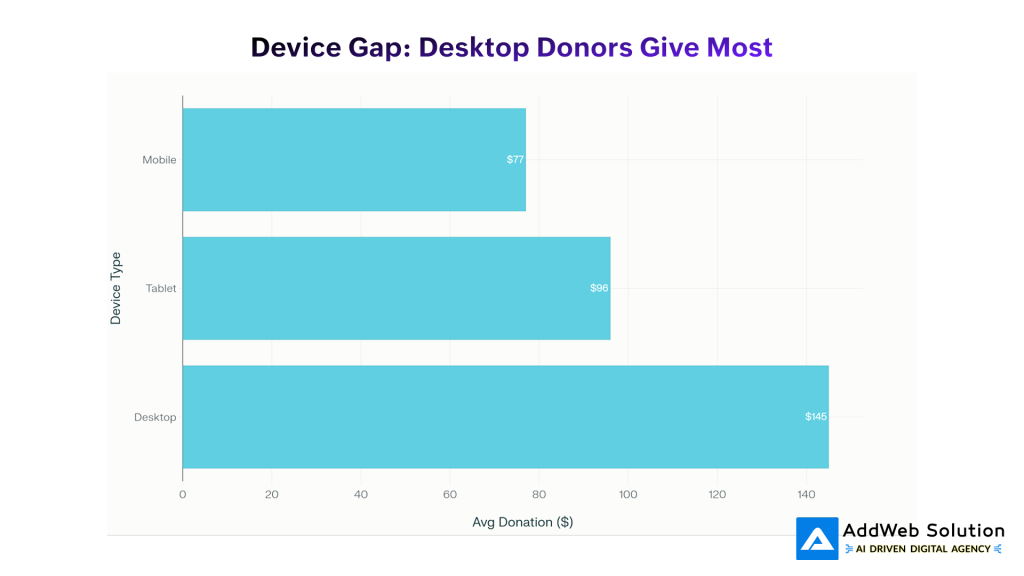
Average Nonprofit Donation Amount by Device Type
Here’s what separates high-converting nonprofits from the rest on mobile:
Speed matters. Mobile users won’t wait – just a one-second delay can hurt conversions. Compress images, cut redirects, and test with Google PageSpeed Insights.
Keep it simple. Long forms kill donations. Ask only for name, email, and payment info—nothing more. One nonprofit saw mobile conversions soar after trimming their form.
Make your Donate button impossible to miss: bold color, large tap area, and always visible as users scroll.
Offer multiple payment options – Google Pay, Apple Pay, PayPal, digital wallets. The easier it is to give, the more people will.
Use responsive design that adapts to every screen. Short, multi-step forms often beat single-page ones by reducing overwhelm.
Bottom line: 63% of donors give via card – make it effortless.

Additional
Read

- 10 Essential Steps for NGO Digital Transformation in 2025
- Laravel for NGOs & Social Impact Platforms
Crafting Compelling Donation Pages That Convert: The Psychology Behind the Ask
Your donation page isn’t just a form—it’s a conversation with a potential supporter. Every detail—from the headline to the button color—speaks volumes.
Cut distractions. Removing navigation links can actually double donations (NextAfter found a 195% lift). Keep donors focused on giving, not browsing.
Make giving easy to find. Place your donation button front and center—on the header, sidebar, or even mid-content. The Coral Reef Alliance nails this with clean, on-brand, distraction-free pages.
Use smart ask amounts. Offer clear tiers like $50, $100, $250, $500 with a “custom” option. Seed Savers Exchange raised their average gift from $112 to $181 just by refining this.
Lead with emotion. Pair data with heart—real photos, short testimonials, impact stories. People give to people, not forms.
Build trust. Show security badges, use HTTPS, and add a short reassurance like, “Your data is protected with industry-standard encryption.” It boosts confidence and completion rates.
Promote recurring giving. Monthly donors are the backbone of sustainability—they’re 3x more likely to increase their gifts. Make that option just as visible as one-time donations.
Multichannel Engagement Strategies: Meeting Donors Where They Are
What’s working in 2025: nonprofits using multiple channels—email, social, and peer-to-peer—are outperforming everyone else.
Email still leads. 33% of donors say it inspires them most to give (vs. 29% for social). Why? It’s personal and direct. Small nonprofits raise up to $6.15 per contact. Segment your donors, A/B test everything, and focus on meaningful—not constant—communication.
Social media builds awareness. With 4.9B users spending 145 minutes daily, it’s where relationships start. Post unique content per platform and meet your audience where they are—don’t chase trends.
Peer-to-peer fundraising rocks. Walks, runs, rides—these events drive $568 per fundraiser (vs. $128 traditionally) and retain 50% of donors.
GivingTuesday = loyalty. It raised $3.6B in 2024 (up 16%), and 65% of those donors gave again in 2025. That’s long-term impact, not just a one-day splash.
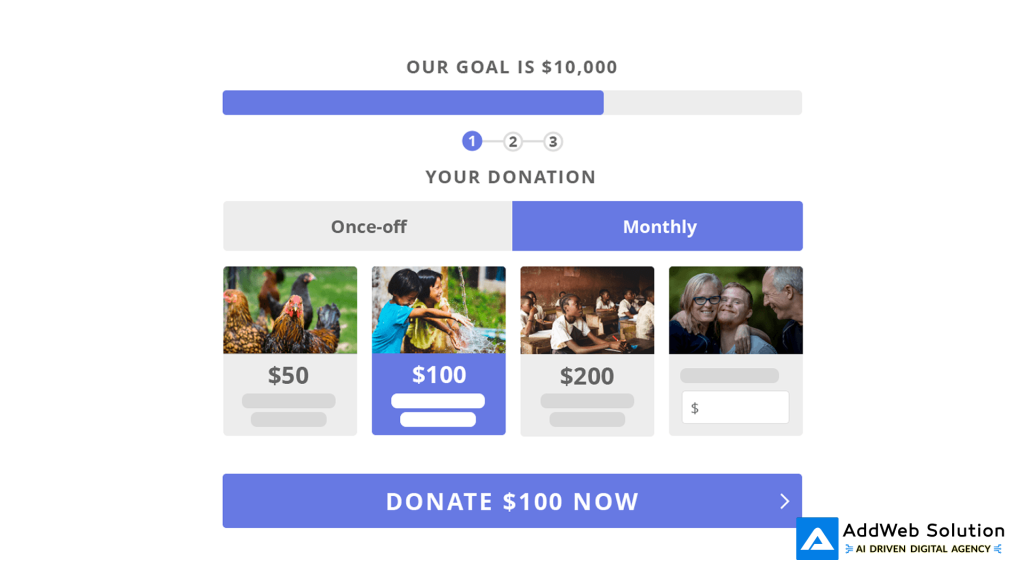
Donation interface with goal progress, monthly donation options, and emotional imagery to optimize donor engagement on NGO websites
Seasonal Giving: Capturing Year-End Momentum
If you only optimize your fundraising website once a year, do it before December. The numbers are brutal:
- 30% of annual charitable giving occurs in December
- 25% of annual online revenue happens in December
- 10% of annual revenue comes in the final three days of the year

- Year-End Giving Patterns: Peak Donation Times (September-December)
Year-end giving isn’t random—it’s driven by holiday spirit, tax deadlines, matching gifts, and reflection. Nearly 97% of donors give because they want impact, though 56% still think about tax perks.
Here’s how to capture that momentum:
- Start early (September!) Most wait until November. Early planners test, refine, and win.
- Tell a story, not a series of asks. Build momentum month by month—impact → emotion → urgency → gratitude.
- Use matching gifts. A dollar-for-dollar match can double conversions.
- Segment messages. First-timers, loyal donors, and lapsed supporters all need different tones.
- Own the final 3 days. Dec 29–31 brings 27% of annual online giving. Keep your site fast, forms ready, and thank-you emails prepped.
Retention Through Personalization and Storytelling: Turning Donors Into Advocates
Retention isn’t flashy—but it’s powerful. Getting a new donor costs 5–7x more than keeping one. Yet global retention sits at just 26.3% in 2025—steady, but still too low.
Personalization changes everything.
- Speak directly. Send youth donors youth updates—not generic emails.
- Remember their story. “Your gift last spring funded 500 meals—this year, we’re feeding 1,000.”
- Guide their next step. If they give regularly, suggest small upgrades or timely engagement.
Storytelling keeps hearts connected. Donors give to people, not spreadsheets. Show real lives changed—like Charity: Water, which turns impact into emotion.
Communicate with rhythm.
- Build relationships: newsletters or updates monthly or quarterly.
- Ask smartly: around GivingTuesday, campaigns, and year-end.
- Say thanks fast: within 48 hours, and again when impact happens.
Measure and adapt. If open rates or conversions drop, test new headlines or designs. Track behavior, tweak often, and keep it human.
Security and Trust: The Non-Negotiable Foundation
Trust drives giving. Donors give more—and more often—when they feel safe. Cybersecurity isn’t a tech chore; it’s a fundraising essential.
Here’s what matters most:
- Use HTTPS. That little lock icon means donor data is protected. No excuses—secure it today.
- Rely on PCI-compliant processors like PayPal or Stripe, and display their trust badges.
- Be transparent. Clearly explain how you use and protect donor info—no surprises.
- Show credibility. Add badges from Charity Navigator, BBB, or Candid to build confidence.
- Train your team. Teach everyone how to spot phishing and handle data safely – people are your first defense.
Transform your donor experience today: simplify giving, boost conversions, and deepen engagement.

Pooja Upadhyay
Director Of People Operations & Client Relations
Conclusion: Your Donor Journey Starts Now
Optimizing your fundraising site isn’t about fancy design—it’s about respecting donors’ time, earning trust, and making giving effortless.
The top nonprofits in 2025 focus on mobile ease, simple forms, strong stories, multichannel outreach, and rock-solid security.
Start small: fix your mobile form, segment your emails, or prep your year-end campaign early.
The data’s clear—when you optimize the donor journey, you raise more, retain longer, and build lasting communities. Your donors are ready. You just need to make giving easy.
Source URLs
- https://www.nptechforgood.com/101-best-practices/online-fundraising-statistics-for-nonprofits/
- https://www.nptechforgood.com/101-best-practices/10-donation-page-best-practices-for-nonprofits/
- https://doublethedonation.com/nonprofit-fundraising-statistics/
- https://www.campaignmonitor.com/resources/guides/ultimate-guide-email-marketing-nonprofits/
- https://rallyup.com/blog/fundraising-metrics-conversion-rate/
- https://www.galabid.com/fundraising/online-nonprofit-fundraising-2025
- https://www.peertopeerforum.com/us-top-thirty-peer-to-peer-fundraising-programs/
