


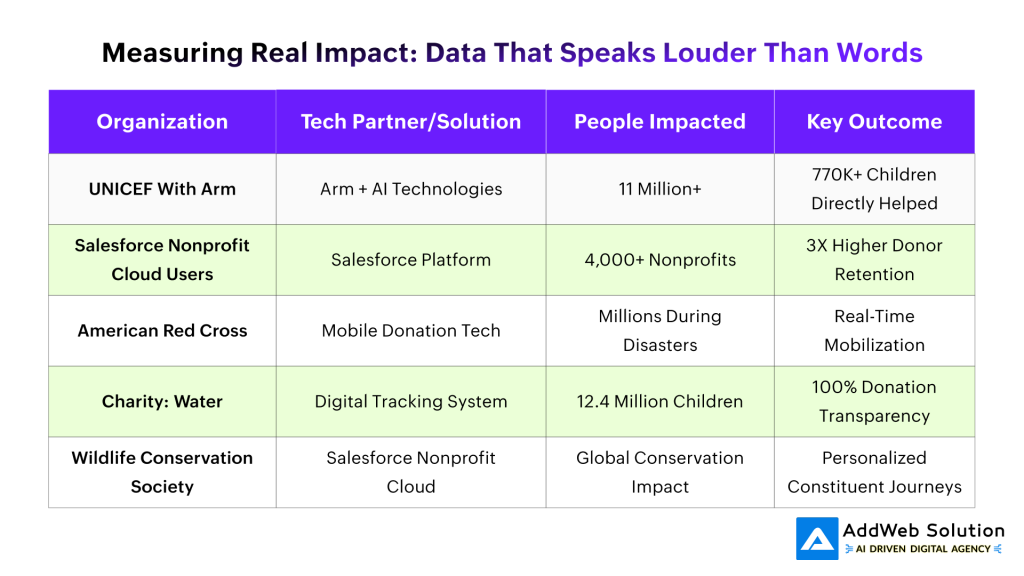
Arm and UNICEF’s decade-long partnership shows the power of true collaboration helping over 11 million people with AI flood alerts, literacy apps, and clean-air monitoring not just through funding but by combining technology and expertise. With 83% of tech companies now investing more heavily in social responsibility than other sectors, the shift is clear: it’s no longer about writing checks, but about working together to create impact neither side could achieve alone.
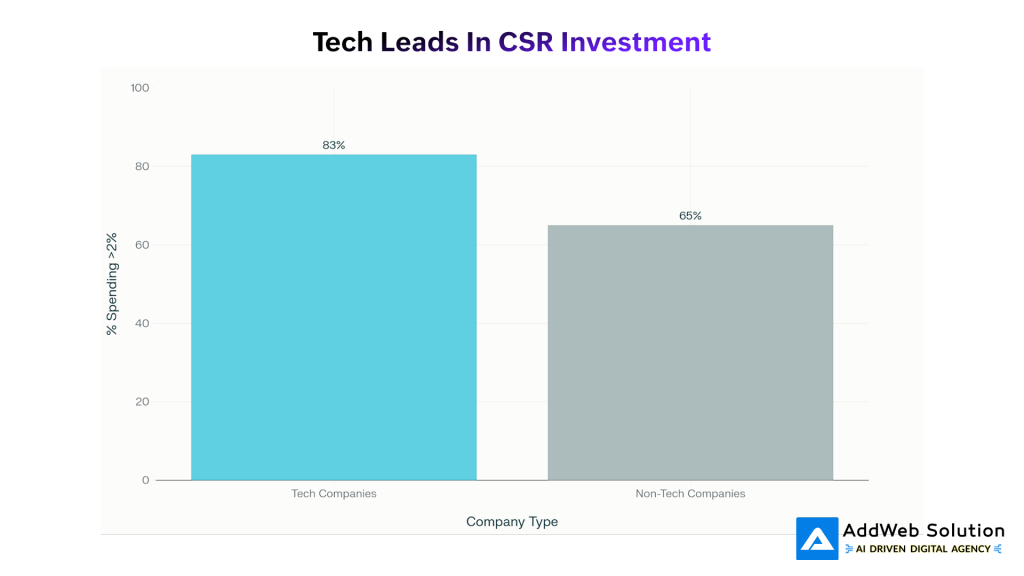
Tech companies demonstrate 1.27x higher commitment to CSR spending compared to non-tech companies, with 83% allocating more than 2% of profits to social impact initiatives
The New Era of Strategic Tech-NGO Collaboration
Walk into a nonprofit office today and you’ll instantly feel how much things have changed. Just a few years ago, digital tools were optional—now they’re essential. Over 80% of NGOs worldwide use tech to run their operations, but many are still trying to make outdated systems work or struggling with limited technical support.
That’s why tech, NGO partnerships matter so much. Take World Pulse and Okta. Their collaboration wasn’t just about software, it was about sharing strengths. World Pulse learned how to turn their powerful stories into data dashboards that speak to tech audiences, while Okta gained a deeper understanding of real community issues and ethical inclusion.
This shift is huge. Partnerships are no longer one-way donations. They’re two-way learning relationships. Tech companies get real-world insight they can’t find in surveys, and nonprofits get the tools and talent to scale their mission.
And the numbers back it up: companies with strong partnerships are 33% more innovative, and partner-supported deals close 53% more often—and nearly 50% faster. But beyond the stats, the real impact shows up in clean water reaching villages, kids learning to code, or families getting flood alerts days before disaster.
Why Technology Companies Are Uniquely Positioned to Amplify NGO Impact
Tech companies offer more than software, they offer the power to solve big problems at scale. Look at Salesforce Nonprofit Cloud, used by 4,000+ nonprofits worldwide. Teams using it see donor retention triple, grants approved 41% faster, and campaigns reach nearly triple. These aren’t small wins. They’re game-changing improvements that free up staff time, boost funding, and help nonprofits support more people with the same resources.
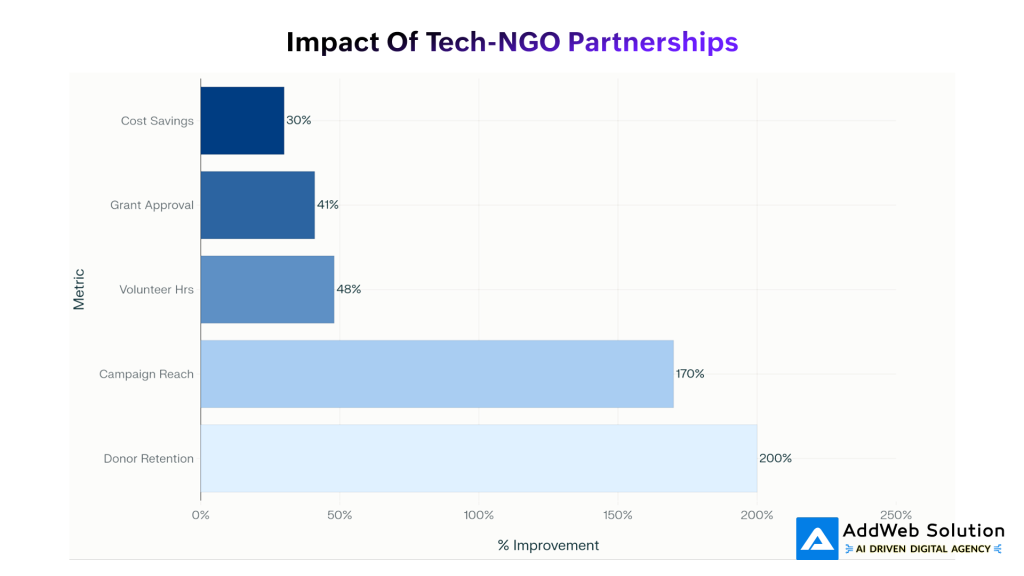
Strategic tech-NGO partnerships deliver transformative results, with donor retention improving by 200% and campaign reach expanding by 2.7x when nonprofits leverage modern technology platforms
The tech world’s commitment to social impact is growing fast. In 2023, 75 major tech companies led more than 2,600 CSR projects across education, healthcare, sustainability, and skilling. CSR spending rose 13%, and by 2024 nearly 65% of all projects were tech-led—90% of which delivered better scale, efficiency, and real results than traditional efforts.
What makes these partnerships so powerful is the tech itself. AI monitoring, digital finance, real-time data, and cloud collaboration are becoming standard tools for nonprofits. Companies like AddWeb Solution, with 13+ years in digital transformation, know it’s not about using tech for the sake of it—it’s about aligning digital tools with mission goals to create real, lasting impact.
Microsoft’s partner ecosystem shows this in action. With 95% of its revenue flowing through partners, Microsoft relies on certified nonprofit partners to deliver tailored cloud solutions and community training. It’s not just goodwill—it’s proof that solving big social challenges requires shared expertise, diverse perspectives, and long-term commitment.
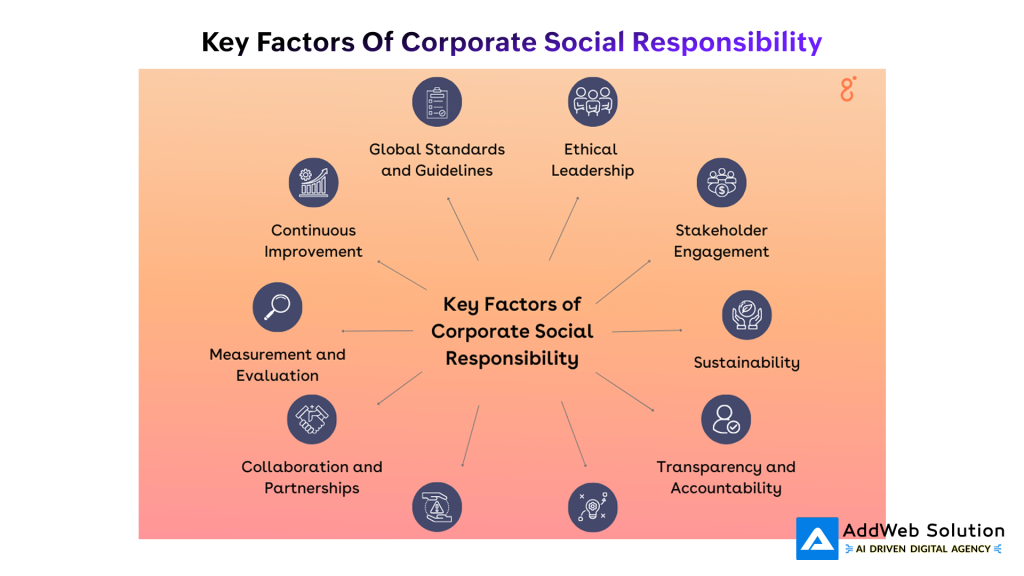
Key factors of corporate social responsibility including ethical leadership, stakeholder engagement, and collaboration


Five Partnership Models That Actually Work
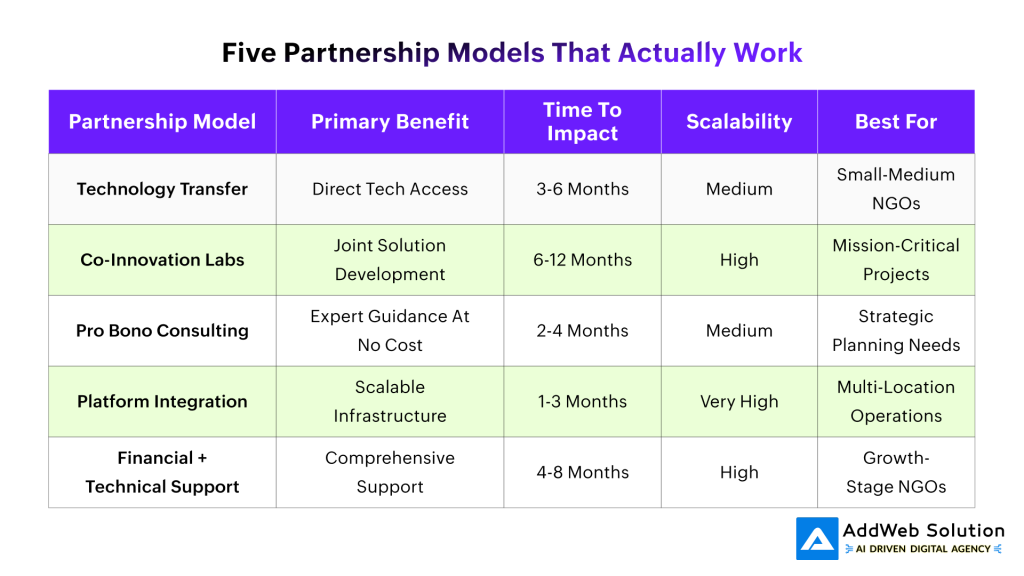
Not all tech–nonprofit partnerships work the same way. Five models consistently deliver real results:
1. Technology Transfer
Simple and cost-friendly. Programs like Salesforce’s Power of Us give nonprofits free or discounted tools, helping small and mid-sized NGOs upgrade quickly. Impact shows up in 3–6 months.
2. Co-Innovation Labs
Deep, strategic collaboration. Think Accenture + UNICEF building ethical AI frameworks together. These take 6–12 months but are highly scalable and ideal for big, mission-critical challenges.
3. Pro Bono Consulting
Tech experts volunteer their skills for strategy, planning, and digital transformation. Great when an NGO knows what it wants but needs technical leadership. Usually 2–4 months.
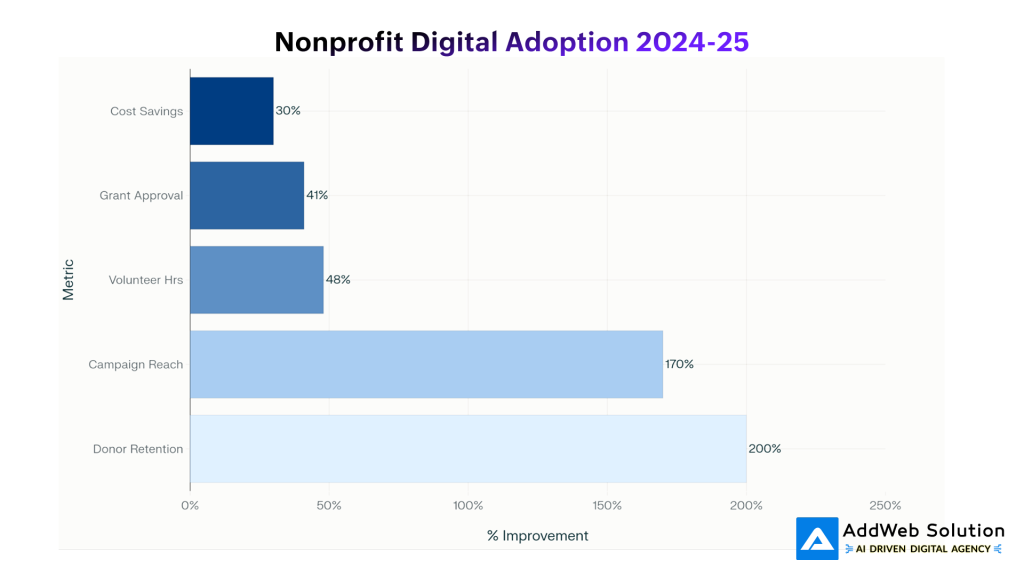
Nonprofit digital transformation accelerates with cloud platforms leading at 80% adoption, while AI usage among NGOs is projected to jump from 54% to 65% by 2025
4. Platform Integration Partnerships
High scalability. By integrating with platforms like Salesforce or Stripe, nonprofits tap into full ecosystems of tools and best practices. Impact can appear in 1–3 months.
5. Financial + Technical Support
The most comprehensive model. Programs like the HCLTech Grant offer funding, mentorship, and expert support—helping growth-stage NGOs scale fast, often within 4–8 months.
Measuring Real Impact: Data That Speaks Louder Than Words
Here’s the simple truth: if you’re not measuring impact, you’re just staying busy. The best tech–NGO partnerships stand out because they track results, report honestly, and keep improving based on data.
Take Urban Alchemy. By using Salesforce Nonprofit Cloud, they started tracking client journeys in real time and automated a lot of their workflows. That freed their team to focus on people, not paperwork, and improved decision-making across the board.
The Partnership on AI takes this even further. With members like Amazon, Google, IBM, and Microsoft—and guidance from UNDP—their projects aren’t just tech demos. They’re tied directly to real development outcomes, from drone mapping in Uganda to AI-powered policy tools.
Quick Impact Facts
- 83% of tech companies now invest more than 2% of profits in CSR
- 90% of tech-led CSR projects scale better than traditional ones
- Partnered deals close 46% faster and 53% more often
- Salesforce-powered nonprofits see 200% better donor retention
- NGO AI adoption jumped from 54% to 65% in one year
- Long-term partnerships deliver 40% higher ROI
- Integrated tech systems reduce donor churn by 58%
Another great example: the Africa Drone and Data Academy in Malawi, supported by Arm and UNICEF. More than 1,400 students have graduated, but the real impact is bigger—faster disaster response, better climate monitoring, and stronger community resilience, all tracked through clear, measurable outcomes.
Overcoming the Barriers: Common Challenges and Smart Solutions
Let’s be honest – these partnerships don’t always go smoothly. Fewer than 30% of nonprofit digital transformation efforts actually hit their goals. Knowing why things fail is just as important as celebrating success.
The Digital Skills Gap
Many nonprofits simply don’t have the people power. With 58% struggling more with staffing than funding, it’s clear that tech only works when people can use it. That’s why organizations need “tech-social translators” – people who can bridge the gap between mission-driven work and tech implementation.
Misaligned Expectations
Sometimes tech companies focus on metrics like app usage, while nonprofits care about real-world impact. As World Pulse shared with Okta, time spent online doesn’t always equal meaningful benefit. Both sides need shared, realistic KPIs rooted in nonprofit MEL frameworks.
Resource Constraints
Only 9% of nonprofits feel truly data-driven, even though most know metrics matter. Leaders often avoid new tech because they fear the cost and complexity. The fix? Start small. Pilot projects and MVPs—like the ones AddWeb builds—prove value before bigger investments.
Data Privacy Concerns
Nonprofits work with vulnerable communities, so data protection is non-negotiable. With regulations tightening, many organizations are turning to secure, on-premise solutions. Good partnerships bake in governance and privacy from day one—not after something goes wrong.
Resistance to Change
Adoption takes time. When Pacific Clinics rolled out Nonprofit Cloud, leadership emphasized that true success came from a strong partnership and patient change management. Clear communication, support, and trust make or break any transformation.
“Digital transformation in nonprofits isn’t about adopting the latest technologies – it’s about solving real problems for real people in sustainable, scalable ways. When tech partners truly understand nonprofit missions and nonprofits embrace data-driven decision-making, that’s when multiplication of impact becomes possible.”
— AddWeb Solution Leadership Team
What’s Next: Future Trends in Tech-NGO Partnerships
In the coming years, tech–nonprofit partnerships will become smarter, more connected, and deeply focused on real impact. AI will move from optional to essential, but responsible use – fair, transparent, and ethical – will be just as important. Innovation will increasingly target underserved regions, proving that solutions built for tough environments often scale best. Blockchain will strengthen trust, and multi-stakeholder platforms will replace isolated partnerships. Above all, investing in digital skills and local capacity will be what keeps these solutions sustainable for the long run.
The most meaningful progress will come from partnerships that rethink how problems are solved. When tech innovation meets nonprofit field knowledge and government-scale support, breakthroughs become possible. The winners won’t be the organizations with the biggest budgets – they’ll be the ones that build genuine, transparent, long-term relationships rooted in trust and shared purpose.
Conclusion: Your Next Step Toward Amplified Impact
The message is clear: when tech companies and nonprofits work together, the impact multiplies. From Arm and UNICEF reaching 11 million people to HCLFoundation transforming 2 million lives, to Salesforce helping nonprofits double donor retention—the results show what’s possible when both sectors join forces.
And the most exciting part? We’re still just getting started. Even though most nonprofits use digital tools, only a small fraction feel truly data-ready. Meanwhile, tech companies are realizing that solving real-world problems fuels better innovation. The potential for meaningful impact has never been bigger.
Tech–NGO partnerships are already shaping the future of social good—the real question is whether you’ll help shape it too. At AddWeb Solution, we’re not just a tech provider; we’re a committed partner focused on building scalable, ethical, measurable solutions. Whether you’re a nonprofit ready to grow or a tech company looking to make a difference, we’re here to help you create an impact that lasts.
Want a scalable, accessible website that amplifies impact? Schedule a technical briefing to review architecture, accessibility, and performance.

Pooja Upadhyay
Director Of People Operations & Client Relations
Source URLs
- https://newsroom.arm.com/blog/arm-unicef-partnership
- https://thecsruniverse.com/articles/83-tech-companies-reported-spending-over-2-of-their-total-spends-on-csr-report
- https://www.undp.org/press-releases/undp-joins-tech-giants-partnership-ai
- https://www.unicefventurefund.org/story/unicef-innovation-fund-opportunity-tech-startups
- https://www.forbes.com/councils/forbestechcouncil/2023/04/25/how-tech-companies-can-collaborate-with-nonprofits-for-social-impact/
- https://www.microsoft.com/en-us/nonprofits/partners
- https://aimagazine.com/ai-strategy/microsoft-google-and-others-join-us-ai-research-programme
