


You know that moment? It’s 11 PM, you’ve closed the store, you’re finally about to relax, and your phone buzzes. Another customer asking, “Where’s my order?” You haven’t even looked at today’s emails yet. Tomorrow you’ll probably have 15 more messages waiting. Most of them are asking the same three questions you answered last week.
That’s the small store reality nobody talks about.
Most online retailers we speak with are drowning in repetitive questions. Not because customers are difficult. Because every customer asks the same things: “Do you have this in stock?” “How long is shipping?” “What’s your return policy?” “Can I track my order?” The questions themselves aren’t hard. But answering them 50 times daily? That’s brutal.
Here’s what changed everything: AI chatbots are handling 60% of purely routine tickets.
The Numbers That Got Our Attention
When we looked at real implementations across Shopify and WooCommerce stores in 2025, the data was honestly surprising. We expected cost savings. We didn’t expect the customer satisfaction to actually go up.
The typical breakdown: In any small store, about 92% of support tickets are routine inquiries. That’s order tracking (35%), product questions (25%), returns (20%), and shipping (12%). The remaining 8%? Those need actual human thinking—angry customers, custom requests, edge cases.

Distribution of customer support tickets in small online stores: 92% are AI-handleable routine inquiries
A chatbot handling that 60% of routine work means your human team suddenly has time to do what humans are actually good at: helping genuinely frustrated customers, solving real problems, building relationships.
What we saw in the field:
- Response times dropped from 8+ hours to 2 minutes
- First-contact resolution jumped from 54% to 84%
- Customer satisfaction went up 12-24%
- Most stores saw 40-50% fewer tickets reaching humans
But here’s the part that surprised us: customers actually prefer this. Sixty-two percent of customers prefer chatbots for routine questions. They don’t want to wait for a human to answer “Where’s my package?” They want an instant answer.
The Real Money Conversation
Let’s get practical. A support agent costs you $40,000-$60,000 annually, fully loaded. A chatbot? $99-$299 monthly.

Monthly support cost comparison: traditional human-only support vs. hybrid AI + human model for a small business
For a store handling 500 support tickets monthly:
- Pure human support: ~$2,500/month in costs
- Chatbot + reduced humans: ~$1,225/month
- Monthly savings: $1,275 (or $15,300 annually)
But that’s just the direct cost. The revenue play is bigger.
Abandoned carts. That’s where chatbots make serious money. When a chatbot proactively engages customers before they leave, recovered cart rates jump from nothing to 15-25%. For a store with 1,000 monthly interactions, that’s potentially $2,400-$4,500 in extra monthly revenue.
Real examples:
Snow Teeth Whitening (Shopify store): Deployed a chatbot. Within 60 days, it recovered over $220,000 in abandoned carts.
Wonolo: Implemented AI chat responses. Reduced handle time by 20%, saving five hours weekly with 11 agents.
These aren’t anomalies. These are repeatable results.
The ROI Timeline (It’s Fast)
Here’s what actually matters: when do you make your money back?
Most implementations break even in 10-14 days.
Real timeline:
Month 0: You invest $99-$299. You spend 4 hours setting up FAQs and chat flows.
Week 1: Chatbot handles 50-100 routine conversations. You recover 3-5 abandoned carts. Cost savings: $400-$600. Revenue recovered: $1,200-$2,000.
Month 1: You’ve processed 200-300 routine tickets that never hit your inbox. You’ve recovered $1,500-$3,000 in revenue that would’ve been lost. Your support team has freed up 15+ hours. That’s 770-4,200% ROI in month one.

ROI timeline for AI chatbot implementation: payback period achieved within first month, scaling to 500%+ by month 3
By month three, most stores are running at 400%+ ROI. By month six, it stabilizes around 500%+.
The people who see ROI fastest? They start narrow. They automate the one question they answer 20 times daily. They expand from there. Not “automate everything.” Just automate the obvious pain.
Real Store Examples (Not Marketing Copy)
Sarah’s clothing store (Shopify): She was solo answering 60-80 daily questions. Installed a $99/month chatbot. The bot handled size/color/shipping questions. Result: Support tickets dropped 40% immediately. She got 8+ hours weekly back. Within 60 days, she’d recovered $8,400 in abandoned carts just by having someone (something?) responding to customers at night.
Marcus’s multi-channel store (Shopify + Amazon + own site): He was managing four separate inboxes. A customer would ask via Shopify, he’d answer, then they’d email the same question, not realizing they’d already gotten a response. Unified chatbot platform fixed that. Result: 52% faster resolution, $1,300/month in cost savings.
Jennifer’s timezone problem (WooCommerce): Her store gets after-hours traffic from Asia and Europe. She sleeps. Those questions just… disappeared. Revenue lost. A 24/7 chatbot changed that. Now, after-hours inquiries get instant responses. She’s capturing $2,100-$3,500 monthly which used to evaporate.

How AI Chatbots Can Transform Customer Service
The Customer Experience Actually Improves
This is the counterintuitive part. You’d think replacing humans with bots would hurt satisfaction. Doesn’t happen if you do it right.
Here’s why: customers don’t want to talk to a human about order tracking. They want their answer in 10 seconds. They want to know if you have their size in stock without waiting for an email response. They want to know your return policy without digging through your site.
When chatbots handle that? Satisfaction goes up.
The key: make escalation automatic. If a customer gets frustrated, escalate to a human immediately. If the bot tries twice and can’t help, escalate. Don’t torture customers with a bot pretending to understand their anger.
When stores do this right, customer retention increases 17-30%. Not because the chatbot is so great. Because customers feel heard faster, and humans have time to actually help with real issues.

The User Experience of Customer-Service Chat: 20 Guidelines …
What Actually Works (Don’t Waste Time on the Rest)
Metric 1: Ticket Deflection Rate
What percentage of tickets does your chatbot handle without human involvement? Aim for 65%+. Anything less and it’s not saving you time.
Metric 2: First Contact Resolution (FCR)
On the tickets the bot handles, does it actually solve them? Shoot for 70%+ on handled conversations. If your bot only resolves 40% and escalates everything, that’s just friction.
Metric 3: Response Time
This one’s objective. Chatbots should respond in under 5 seconds for text. That’s the whole point.
Metric 4: CSAT
Ask customers if they were satisfied. Post-implementation, target 80%+. Dropping satisfaction means something’s wrong (usually the bot handling stuff it shouldn’t).
Metric 5: Revenue Impact
Track it directly: abandoned carts recovered, repeat purchase rate, and average order value. You should see 15-25% improvement in cart recovery and 19% increase in repeat purchases within six months.
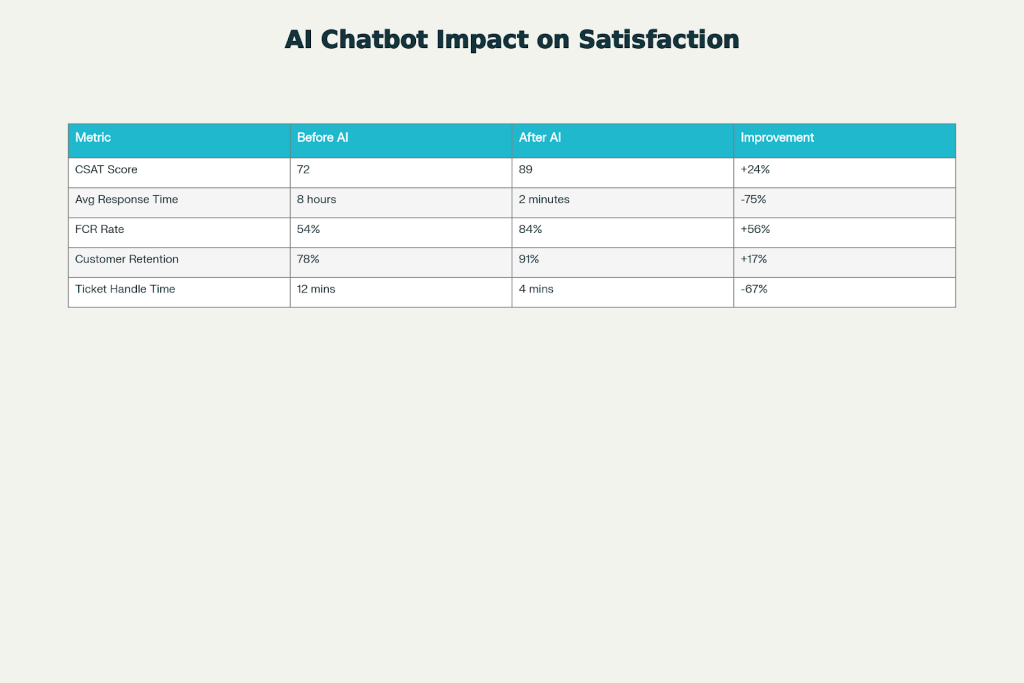
Key performance metrics before and after AI chatbot implementation for small online stores
Implementation (The Honest Version)
You’re probably thinking, “Okay, but how hard is this actually?”
Harder than marketing makes it sound. Easier than you’d think.
Week 1: Figure out which questions you answer repeatedly. Review your last 50 support conversations. What comes up 5+ times? That’s your automation target.
Week 2-3: Pick a platform. For small stores: Tidio (simple, free tier) or UChat (multichannel). Set up basic Q&A flows. Plug in your FAQ, return policy, and shipping info. Time investment: 4-8 hours. Cost: $0 (try free tier first).
Week 4: Go live. Start with just your website chat first, not everywhere.
The real work? Make sure your information is correct. This is boring and tedious and absolutely critical. If your chatbot says shipping is 5-7 days, but you changed it to 3-5 last month, now customers are confused. Audit everything first.
The mistakes we see:
- Launching with outdated info → chatbot gives wrong answers → customers mad
- Never escalating to humans → bot fights with angry customers → backfires
- Setting it live and ignoring it → becomes stale within weeks
- Trying to automate everything → bot handles stuff it shouldn’t
Don’t do those things.


Platform Reality Check for Small Stores
| Platform | Start | Why | Downside |
| Tidio | Free | Dead simple, ChatGPT built-in, works on Shopify | Limited if you need complex flows |
| UChat | $15/mo | 10+ channels, good AI, integrations | Steeper setup |
| Manychat | $10/mo | Great for Instagram/WhatsApp selling | Website chat not the focus |
| Botpress | Free | Most powerful, best AI | Harder for non-technical users |
Most small stores start with Tidio (free tier) or UChat ($15/month). Both have Shopify integrations. Both let you see results before spending real money.
The Honest Hard Part
This doesn’t work if your knowledge base is garbage.
Seriously. Your chatbot will confidently tell customers wrong things if your internal documentation is wrong. Product pages say the wrong dimensions? Chatbot reads that. Is the FAQ outdated? Chatbot spreads it.
Before you launch, have someone (not you) verify every single fact the chatbot will reference.
Also, don’t expect perfection immediately. The first month is learning. Customers ask things you didn’t anticipate. The bot misunderstands some situations. Update your knowledge base weekly, not quarterly. The best chatbots are actively managed.
See how AI chatbots can transform your small store’s support.

Pooja Upadhyay
Director Of People Operations & Client Relations
Why This Actually Matters for Small Stores
Amazon can hire 50 support people. You can’t.
But you can respond in 2 minutes instead of 8 hours. You can handle customer questions 24/7. You can recover revenue that used to be lost to late-night browsing.
That’s a competitive advantage.
Stores doing this now are gaining ground on competitors who are still answering every question manually or not answering at all.
The ROI is too fast to ignore. The implementation is too simple. The payback period is too short.
Your store can start with $99 and 4 hours of setup work.
The only question is: are you doing it, or are you leaving that money on the table?
Sources:Sentisight.ai – AI Customer Service Automation Guide for Small Business (2025)
FullView.io – 100+ AI Chatbot Statistics and Trends (2025)
QuickChat.ai – Chatbot Cart Abandonment Recovery (2025)
Sobot.io – AI Customer Service Case Studies (2025)
LiveChat.ai – AI Revolution in Customer Support Statistics (2025)
