


In just over three decades, Python has evolved from a side project into the backbone of artificial intelligence and data science. The more the number of rivals that cropped up, the stronger Python seemed to get. Today, Python leads with a commanding 23.88% rating on the TIOBE Index, with an 8.72% increase in just one year. This amazing momentum comes from a mix of accessibility, powerful libraries, enterprise adoption, and community support that have ultimately made Python indispensable in building transformative technologies.
The Python Story: From Hobby to Global Standard
The Origin of Revolution
The Python story starts in December 1989, when Dutch programmer Guido van Rossum created a language that combined ease of use with system-level power. A holiday hobby became revolutionary. The Python 0.9.0 was released in February of 1991, followed by Python 1.0 in January 1994. Naming it after the British comedy “Monty Python’s Flying Circus,” the guiding principles embedded therein proved to be prescient: explicit is better than implicit, readability counts, and programmer time counts more than CPU time.
Python’s architectural philosophy positioned it as a generalist tool-adaptable to any domain while maintaining consistent syntax. This turned out to be prophetic when AI exploded. When TensorFlow, PyTorch, and scikit-learn emerged, they made Python their primary interface. Once these frameworks standardized on Python, network effects started to take hold. Every AI researcher learned Python. Every company building AI adopted Python.
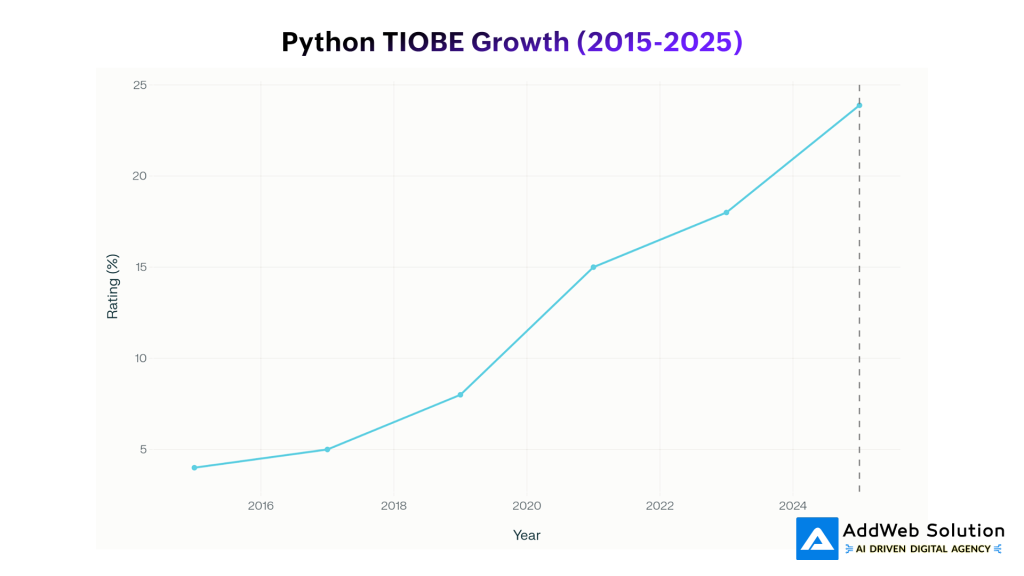
Python’s TIOBE Index Growth (2015-2025): A Decade of Dominance
Python’s Dominance: The Data Tells the Story
Market Presence and Adoption
The evidence of Python’s leading position is convincing. In the 2025 Stack Overflow Developer Survey, Python had a 7 percentage point increase in adoption from 2024 to 2025-the largest single-year jump of any major language. Over 1.19 million job listings on LinkedIn require Python skills. The global Python IDE market reached US$559 million in 2025, with an expected 8.1% CAGR through 2033.
For professionals, this means there is exceptional demand: 25% growth in software development jobs, with Python commanding premium salaries across all industries. McKinsey research cites companies using Python for AI report 30% greater productivity compared to teams using slower languages.
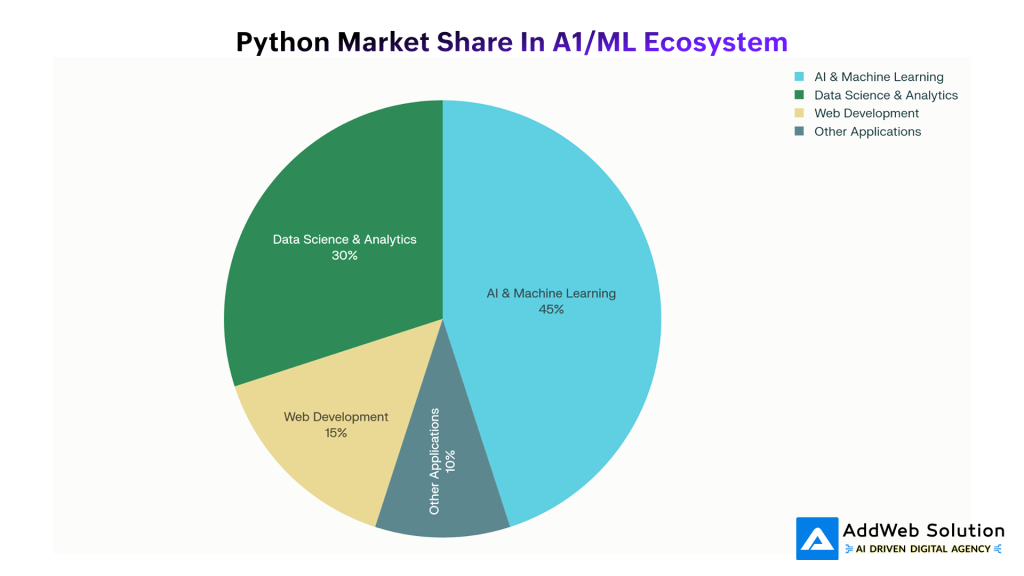
Python’s Market Share Across Key Applications (2025)
Why AI Changed Everything
The AI revolution accelerated the dominance of Python. When ChatGPT crossed 1 million users in 5 days, it was built with Python-first tools. OpenAI, Google Bard, and Meta’s LLaMA rely on the rich Python ecosystem as their base.
It is favored by 70% of the researchers in AI, mostly because of its tight integration with Python. TensorFlow, in turn, powers most enterprise AI systems. Be it building transformer models, fine-tuning LLMs, or even deploying a computer vision system, Python does the orchestration, data processing, and integration that comes along with all these things.
The adoption numbers are staggering-78% of the organizations now use AI, up from 55% the year before. By mid-2025, 82% of enterprise leaders use generative AI at least weekly, and 46% use it daily. This explosive adoption is directly related to growing market presence for Python.


The AI Ecosystem: Python’s Unmatched Landscape
The Three Pillars of Dominance
Python’s success in AI is due to three critical interconnected pillars: frameworks, libraries, and community.
Deep Learning Frameworks: PyTorch by Meta highlights research flexibility, thanks to its dynamic computation graphs. On the other hand, TensorFlow from Google focuses on production deployment through static graphs and integrated Keras. They coexist in Python’s ecosystem-a thing no competitor can match. Dozens of specialized libraries lay beyond these giants: the Hugging Face Transformers for language models, Scikit-learn for machine learning, Keras for rapid prototyping, and spaCy for NLP.
Data Processing: Python’s Data Science stack is leading data analysis almost in a monopoly manner, with NumPy, Pandas, SciPy, and Polars. 51% of Python developers working on data use Pandas and NumPy. These libraries give the ability to process billions of records in record time by writing minimal code.
ML-specific solutions: XGBoost and LightGBM dominate competitive machine learning. Ray MLlib allows distributed ML, while OpenCV and YOLO allow real-time object detection. Core text processing is enabled via NLTK, TextBlob, and Gensim.
The Web Framework Renaissance
While AI dominated the headlines, Python’s web development had a renaissance of sorts. FastAPI jumped from 29% adoption in 2023 to 38% in 2024-a 30% year-over-year increase. This reflects Python’s versatility-the same developer can build AI backends, APIs, and web applications without switching languages.
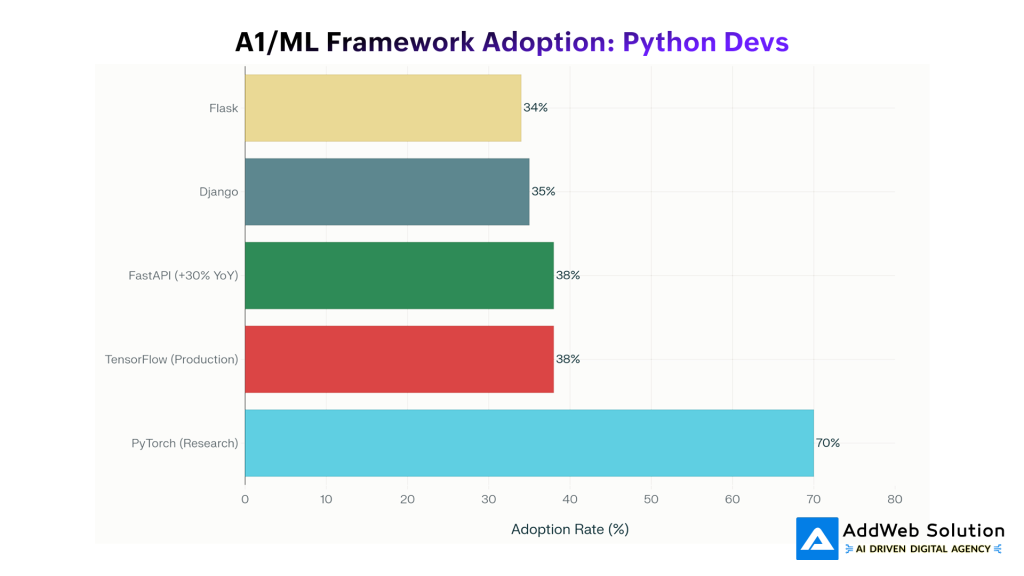
Top Python Frameworks Adoption Rates (2024-2025)
Python in Production: Enterprise at Scale
Critical Mass Achievement
The period of 2025-2026 will be very pivotal for Python. Wharton’s AI Adoption Research illustrates that 82% of leaders use Gen AI at least weekly. Critically, 72% of companies formally measure the ROI of Gen AI-meaning Python-based AI isn’t experimental, it’s strategic.
By 2026, more than 80% of enterprises will have deployed generative AI applications by 2026, which compares with 5% in 2023. This explosion is fundamentally a Python story. Financial institutions use Python for algorithmic trading and fraud detection. Healthcare organizations deploy Python computer vision for diagnostic imaging. E-commerce platforms use Python recommendation engines. Manufacturing implements Python predictive maintenance systems.
The Productivity Advantage
A NASA study showed that Python development was “staggeringly faster” than C++ or Java; teams could start coding in minutes instead of days. This compounds at scale: when financial services need 50 different ML models, Python’s velocity generates massive savings.
Development speed operates on many levels: prototyping through Jupyter Notebooks, production deployment via FastAPI and Django, and maintenance by way of readable code that enables fast team onboarding.
Python 3.14: The Next Frontier
Breaking the GIL: Free-Threaded Python
Python 3.13 had GIL-free experimental builds, and Python 3.14 officially supports this feature. This removes the Global Interpreter Lock entirely, allowing true parallel execution across multiple CPU cores within a single process.
The implications are transformational:
- Matrix multiplication: 10x speedup (4.56 seconds vs. 43.95 seconds)
- Finding prime numbers: 10x performance increases (70 seconds to 3.5 seconds)
- File reading: 3x performance improvement
That means data scientists training large models, financial firms running quantitative analysis, and cloud platforms serving concurrent requests can finally unlock Python’s full potential in 2026.
Performance Across the Board
Python 3.13 and 3.14 bring generalized improvements: upgrading from Python 3.11 to Python 3.13 yields 11% faster execution, with 10-15% less memory usage with zero code changes. For organizations still running Python 3.10—27% of developers—upgrading delivers ~42% speed increase and 20-30% memory reduction.
As of Python 3.14, experimental JIT compilation is available which, when combined with tail-call optimization, can speed your program between 3-30% (up to 45% in some cases).
Why Alternatives Haven’t Displaced Python
Rust and C++ deliver superior performance at different development models. Rust enforces memory safety and prevents errors but creates steep learning curves. C++ insists on manual memory management and verbose syntax. The trend is converging, with 25-33% of new Python extensions using Rust today. Python handles the orchestration; Rust provides the performance-critical components.
Java leads in enterprise application servers, but Python’s simplicity and verbosity advantages make AI development painful in Java. Python microservices have gained more popularity within enterprises compared to traditional servers.
JavaScript remains frontend-focused: While Node.js provides server-side JavaScript, the missing ML library ecosystem keeps JavaScript a frontend language. Web frameworks for Python create a new dynamic: Python backends with JavaScript frontends.
Python’s AI Domain Dominance
Large Language Models and Generative AI
Every significant LLM in training and deployment utilizes Python for training and deployment: GPT, Claude, Gemini, and LLaMA. Python is also used by Hugging Face Transformers, the de facto standard for working with pre-trained models. Similarly, LangChain, Ollama, and orchestration frameworks finally empower Python developers to implement value-added applications with LLMs. Enterprise deployment increasingly relies on Python backends for generative AI.
Computer Vision and Autonomous Systems
With OpenCV, YOLO, and Detectron2, Python has real-time object detection and classification of images. The open-source core of Tesla’s autonomous driving software is Python-based computer vision pipelines. Medical imaging in Python assists diagnostics. Retail deploys Python inventory management via shelf monitoring.
Natural Language Processing
From sentiment analysis to automated document processing, Python’s NLP tools are enterprise standard. spaCy for production, NLTK for research, Transformers for SOTA models, TextBlob for rapid prototyping create complete coverage. Python is used in financial firms for contract analysis. Customer service organizations deploy chatbots built on Python. Content platforms use Python to provide recommendations, detect abuse, and so on.
The Dynamics of Talent and Skills
Unprecedented Demand
Demand for Python grows at 23% YoY, with specialized AI/ML skills commanding premium compensation. According to the Indian skills report, growth in demand for Python is 22% annually. Hiring intensity across industry: AI/ML-6.7-7.0 LPA, Finance-6.6 LPA, and IT Services-6.3 LPA.
Interestingly, it ranges from healthcare to finance, manufacturing to retail, and governmental sectors, all of which are highly in need of Python developers for digital transformation
The Training Ecosystem
Python-first curricula is being given by universities. Online platforms offer specializations in Python. Corporate training standardizes on Python. By 2027, the online Python learning market reaches $151.32 billion, growing at 15.7% annually.
Outlook 2026: Undisputed Supremacy
Every major technology company has strategic bets on Python: Google develops TensorFlow, Meta develops PyTorch, Microsoft integrates Python deeply into Azure, and Amazon web Services offers comprehensive Python support.
As the AI systems integrate vision, language, and audio-multimodal AI-the Python ecosystem comes in very handy. Combining computer vision, NLP, and audio processing leverages Python’s seamless interoperability of libraries.
Cloud-native and serverless architectures are standardizing on Python. With Python’s quick start-up times and small deployment packages, Python is ideal for function-as-a-service. As more enterprises move to serverless, Python adoption accelerates.
Power Your Next Big Idea With Python Experts by Your Side

Pooja Upadhyay
Director Of People Operations & Client Relations
Conclusion: Python’s unstoppable ascent
Thirty-five years since its inception, Python stands at its zenith. What was once written off as “too slow” is now the basis of artificial intelligence, data science, cloud infrastructure, and even modern web development.
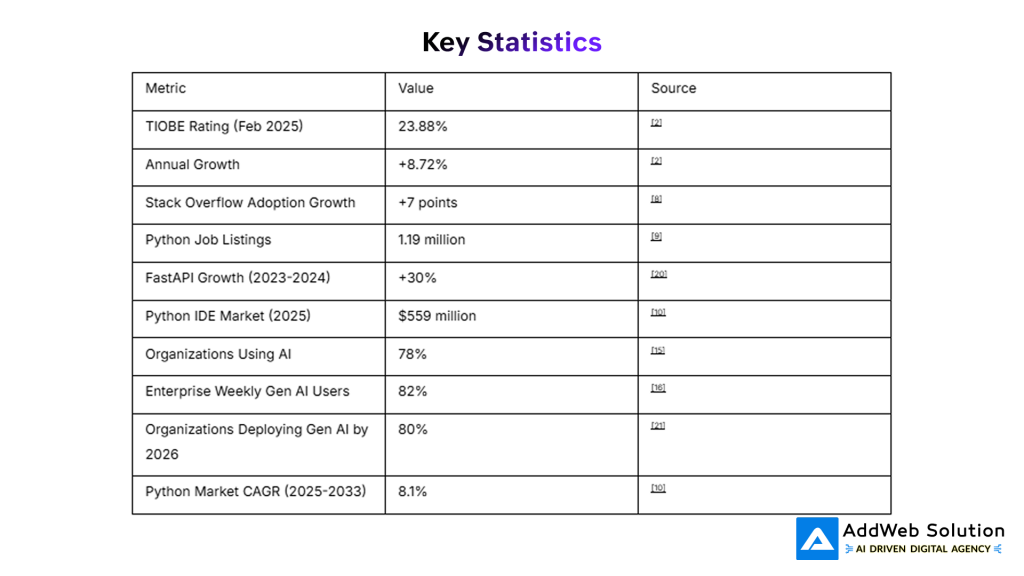
The numbers tell the story: 23.88% TIOBE rating, 8.72% growth in one year. More than 1.19 million job openings requiring Python. 78% of the organizations are deploying AI, and Python is the primary language. 82% of the enterprise leaders use generative AI every week.
Python succeeded because it enshrined a philosophy: programmer time is far more important than computer time, readability counts, and simplicity should never mean weakness. These are valid principles for 2026 and will power the AI revolution for the remainder of the 2030s.
For anyone building AI, analyzing data, automating workflows, or deploying applications, Python isn’t a choice among many options; it’s the pragmatic standard. And with free-threaded Python removing the GIL, with performance improvements accelerating, and with the ecosystem strengthening, Python is positioned to lead through the next decade.
The 35-year-old language hasn’t faded. It’s only getting stronger.
Key Statistics
Resources:
- https://blog.jetbrains.com/pycharm/2025/08/the-state-of-python-2025/
- https://www.britannica.com/technology/Python-computer-language
- https://survey.stackoverflow.co/2025/technology
- https://hai-production.s3.amazonaws.com/files/hai_ai_index_report_2025.pdf
- https://knowledge.wharton.upenn.edu/special-report/2025-ai-adoption-report/
- https://towardsdatascience.com/python-3-14-and-the-end-of-the-gil/
- https://realpython.com/python-news-july-2025/
