


You know that feeling when you walk into a store and the staff seems to know exactly what you’re looking for? They’ve got your size ready, they recommend products that actually fit your style, and by the time you leave, you’ve spent more than you planned—but you’re happy about it.
That’s what personalization does online. Except instead of one person behind the counter, you’ve got algorithms working 24/7 to make every single visitor feel like the experience was built specifically for them.
Here’s the thing: 71% of customers expect this level of personalization. But do most websites use WordPress? They’re still serving everyone the same generic homepage. Same product listings. Same call-to-action button. It’s like opening that fancy store and making every customer take the exact same route through the aisles.
This gap costs real money. We’re talking 10-15% revenue gains for sites that get personalization right. Amazon makes over 35% of its e-commerce revenue from recommendations alone. Netflix has built an empire on showing each person exactly what they want to watch next.
The good news: Sites that use WordPress can now do this. Not in some complicated, expensive way. Through plugins that work with your existing setup and AI systems that learn about your visitors in real-time.
What’s Actually Happening When Your Site Gets “Personal”
Let’s talk mechanics for a second. When someone lands on your Site built on the WordPress platform, a few things happen simultaneously.
First, the system starts paying attention. It notices they’re on mobile. It sees they came from Instagram. It tracks that they spent two minutes on your pricing page, then jumped to your testimonials. If they’re returning, it knows exactly what they looked at last time.
This isn’t spooky surveillance—it’s first-party data collection. You’re tracking behavior on your own domain, which means you control it completely and it complies with privacy laws. Unlike third-party cookies that browsers are actively blocking, first-party tracking is the future.
Second, machine learning patterns emerge. The system doesn’t just record data—it looks for relationships. “People who view this product also click here.” “Visitors from London have different engagement patterns than visitors from New York.” “Mobile visitors abandon carts 23% more often unless they see a trust badge first.”
Third, the experience shifts. When that visitor lands on your homepage tomorrow, they don’t see what you see when you preview the site. They see something tailored. Different hero image. Different product recommendations. Different CTA. All because the system learned from their first visit.
The acceleration happens fast. After 10 visits, personalization gets better. After 50 visits, it gets significantly better. After hundreds of visits, you’ve essentially built a prediction engine for that specific customer.
Here’s what makes this different from manually segmenting audiences: it’s real-time and continuous. You’re not guessing what visitors want—you’re responding to what they’re actually doing.
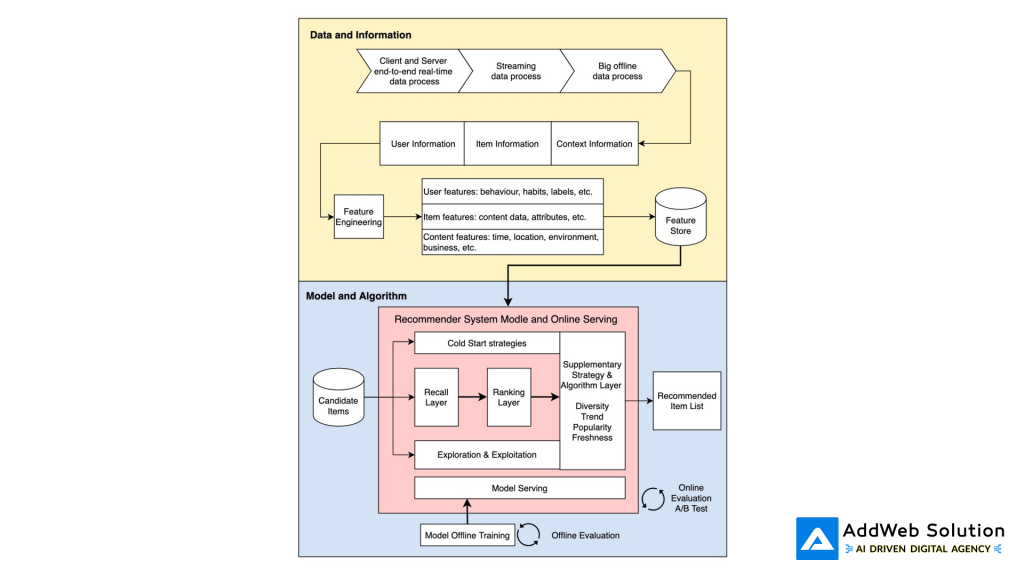
Flowchart of a machine learning recommender system showing data inputs, feature engineering, model architecture, and evaluation processes
The Data That Actually Powers This
Personalization lives and dies by data quality. You need the right signals feeding the system.
Behavioral data is the foundation. Page views. Clicks. Time spent. Scroll depth. What product did they look at? How long? Did they add it to cart? This tells you intent.
Then there’s context. Where are they? What device? Is it their first visit or their hundredth? What time of day? What day of week matters too—weekend shoppers behave differently than weekday browsers.
Demographic and engagement data layered on top. Location matters for localized offers. Device type matters for experience optimization. New vs. returning visitors get different treatments. Email engagement history influences what you show them.
Here’s what works:
- Behavioral tracking: Page views, product views, cart behavior, click patterns
- Demographic signals: Location, device type, browser, new/returning status
- Engagement history: Email opens, link clicks, form submissions, video plays
- Predictive scoring: Lead score, purchase likelihood, risk of churn
- Traffic source context: Did they come from organic search? Social? Paid ads? Direct?
- Time-based signals: Time of day, day of week, seasonal patterns
The secret sauce? Combining multiple data types. One signal is useful. Five signals cross-referenced? That’s predictive power.
Now, the elephant in the room: third-party cookies are dying. Safari already blocks them. Firefox defaults to blocking them. Regulations like GDPR have made them legally risky. So what works now?
First-party data. You collect it. You store it. You own it. This is actually better for personalization anyway—the data is more accurate and you’re not competing with fifty other companies trying to track the same person across the internet.
WordPress plugins like MonsterInsights make this straightforward. You’re not building custom tracking—you’re implementing a system that captures eCommerce behavior directly.
Additional
Read

What the Numbers Actually Show
Numbers are the litmus test. Talk is cheap. Revenue is real.
Conversion rates jump dramatically when personalization enters the picture.
We’re not talking 10% improvement. A furniture e-commerce store implemented personalization and watched conversion rates climb from 3.2% to 7.8%. That’s more than double. Fashion retailers? From 4.1% to 8.9%. SaaS companies? From 2.8% to 7.2%.
Those numbers aren’t anomalies. They’re consistent across industries because the mechanism is straightforward: show people what they actually want instead of what you think they might want.

Conversion Rate Lift: Before vs. After AI Personalization Implementation
Product recommendations become a revenue driver all their own.
Amazon generates over 35% of its total e-commerce revenue from recommendations. Not sales—revenue. That’s not a side feature; that’s a core business function. When customers see genuinely relevant suggestions, they buy more.
The data backs this up consistently. Personalized recommendations drive a 288% increase in conversion rates. They account for 31% of total e-commerce revenue across industries. This isn’t marginal improvement territory.
Customer loyalty flips from aspirational to measurable.
Here’s something most businesses get wrong: personalization isn’t just about winning the immediate sale. It’s about building repeat customers.
Research from Twilio showed that 56% of people will become repeat buyers after receiving a personalized experience. That’s a behavioral shift. Nike uses this relentlessly. Aesop uses this. Luxury brands understand that showing each customer only what matches their taste builds loyalty.
Session engagement extends in measurable ways.
When visitors encounter genuinely personalized experiences, they behave differently. They stay longer. They click more. They explore deeper.
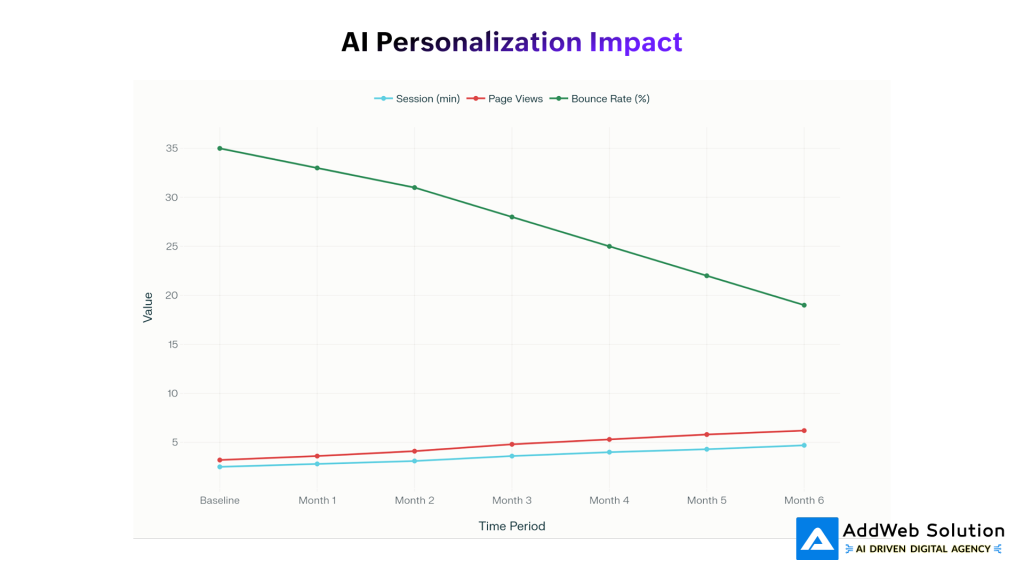
Customer Engagement Metrics Improvement Over 6 Months Post-Implementation
How This Actually Works on WordPress (No Coding Required)
Here’s where theory meets practice. WordPress has matured enough that setting up personalization doesn’t require hiring a developer or spending six months on implementation.
The basic workflow:
You install a plugin. If-So, Logic Hop, or similar tools plug directly into WordPress without touching code. They work with page builders like Elementor and Divi. They work with WooCommerce. They understand Gutenberg blocks.
You set conditions. “If the visitor is from the UK, show GBP pricing instead of USD.” “If they’ve viewed our pricing page twice, show them a 15% discount.” “If they came through Instagram, show our social-focused hero image instead of the corporate one.”
You deploy dynamic content blocks. Any element on your site can swap based on conditions. Headlines. Call-to-action buttons. Entire product recommendation sections. Pop-ups triggered by behavior. Form fields that auto-populate based on what you know about them.
You watch analytics to see what works. MonsterInsights tracks personalized experiences and drives conversions. You optimize from there.
Real example: An e-commerce client ran WooCommerce and implemented AI recommendations through Clerk.io. Within 90 days, the average order value jumped 31%. Conversion rate increased 33%. The system watched what customers browsed and recommended complementary products at checkout.
That’s not magic. That’s applied data science.
Privacy actually gets stronger, not weaker.
There’s a misconception that personalization requires surveillance. Modern systems work differently. First-party tracking means you control the data. GDPR compliance means transparent consent. You’re not secretly tracking; you’re building customer profiles with their knowledge.
This is actually a competitive advantage. You own the relationship. You’re not dependent on third-party cookies that browsers are actively killing.
(see the generated image above)
The Tools That Actually Deliver Results
Not every personalization tool is created equal. Some are overhyped. Some are overpriced. Some overcomplicate what should be straightforward.
Here’s what actually works for WordPress:
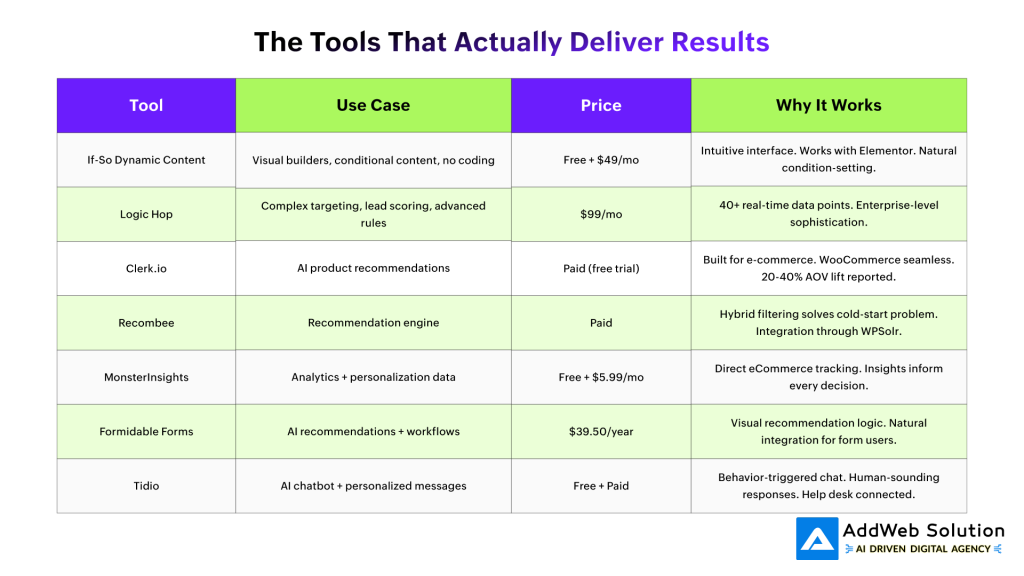
Pick based on what you need right now. If you’re just starting, If-So handles 90% of use cases. If you need product recommendations, Clerk.io is worth every penny. If you’re running a complex membership site, Logic Hop becomes necessary.
Three Quick Facts That Surprised Us
🔹 Netflix’s entire dominance rests on recommendations: 80% of Netflix viewing comes from personalized recommendations. The company estimates this saves them $1 billion annually in retention cost. They’re not a streaming service that happens to personalize. They’re a personalization engine that streams video.
🔹 Personalization cuts marketing costs while boosting profit: AI personalization can increase retail profits by 15% while cutting marketing spend by 20%. You’re not spending more to win customers—you’re spending less while converting higher. The math is magical.
🔹 The “cold start” problem is solved: Modern recommendation engines use hybrid filtering, combining content-based and collaborative filtering. Even completely new visitors get smart recommendations. You’re not stuck waiting for data to accumulate.
What People Actually Building This Say
“The WordPress world moved past treating personalization as a nice-to-have three years ago. Now it’s baseline expectation. Sites competing on speed, SEO, and design are losing to sites that understand their visitor intent and respond to it.”
“We’ve seen personalization transform how clients think about their website. It’s not a broadcast channel anymore. It’s a two-way conversation where the site adapts to each person. Revenue follows that mindset shift.”
Moving Forward: Your Next Steps
The personalization landscape has shifted dramatically. Tools that cost $50K two years ago now cost $50/month. Implementation takes weeks instead of months. Browser changes have made first-party data the only option—which coincidentally gives you better data than third-party tracking ever did.
Your competition is moving on this. Your customers expect it. The time to “eventually consider” personalization is over.
Start with one of these approaches:
Approach 1: Product Recommendations First
Deploy Clerk.io or Recombee on your WooCommerce store. Most see 15-30% AOV lift within 60 days. This is the quickest path to measurable revenue.
Approach 2: Dynamic Offers for Your Audience
Use If-So or Logic Hop to show different CTAs, discounts, or offers based on visitor segment. Takes a few hours to set up. Conversion improvement follows quickly.
Approach 3: Behavioral Triggers
Exit-intent pop-ups. Scroll-based offers. Time-based messaging. These convert abandoning visitors into leads. Quick implementation, visible results.
Approach 4: Data Foundation First
Start with MonsterInsights if you don’t have clear visibility into audience behavior. Better data informs every personalization decision downstream.
The best approach? Start with one. See results. Build from there.
AddWeb Solution has spent the last decade building these systems for e-commerce brands, SaaS companies, and publishers. We’ve seen what works and what doesn’t. We’ve deployed personalization systems that consistently deliver 20-40% revenue improvements across WooCommerce stores, membership sites, and multi-location businesses.
If you’re ready to move beyond generic WordPress experiences—if you want your site adapting to each visitor instead of treating them all the same—we’re here to guide that transformation.

Get started with AI-powered personalization on WordPress today and turn every visit into a tailored experience.

Pooja Upadhyay
Director Of People Operations & Client Relations
Source URLs:
https://www.expertise.ai/blog/ai-personalization-examples
https://wordpress.org/plugins/if-so/
https://wordpress.org/plugins/logic-hop/
https://visser.com.au/ai-plugins-for-wordpress/
https://aws.amazon.com/blogs/industries/revenue-management-and-the-role-of-personalization/
https://www.reddit.com/r/Wordpress/comments/1lilaw7/any_good_ai_product_recommendation_plugins/
