


This blog was originally published on October 3, 2025, and has been fully updated on Jun 26, 2026. All statistics, trends, technology references, and best practices have been revised to reflect the current landscape of custom software development.
The nonprofit sector is facing unprecedented stress to digitize operations while maximizing impact with shrinking resources. With just 35% of digital transformation efforts succeeding and 94% of organizations now conducting digital efforts, NGOs no longer have an option but to accelerate their digital evolution. The future demands a strategic, people-first approach that not only changes technology but also organizational culture at scale.

Nonprofit dashboard displaying key metrics and visual data on budget, revenue, and donations over time
The Digital Imperative for NGOs
Digital transformation for nonprofits isn’t just about adopting new technology—it’s about fundamentally changing the manner in which organizations serve their communities, engage with donors, and achieve their missions. Digitally sophisticated nonprofits are 4 times more apt to achieve their mission goals and 2 times more likely to find operational efficiency improving. Still, 58% of nonprofit organizations report increasing disparity between where they are today and where they need to be in order to remain competitive.
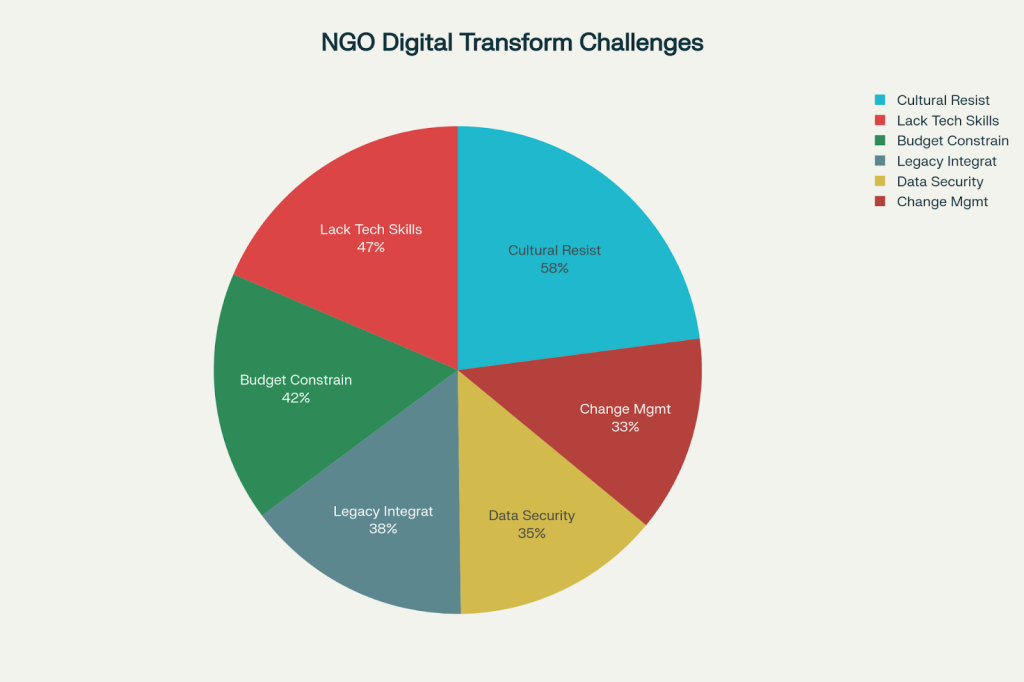
Major Digital Transformation Challenges Faced by NGOs in 2026
The stakes couldn’t be higher. Modern donors expect seamless digital experiences, volunteers demand flexible engagement options, and traditional paper processes no longer meet stakeholder expectations. Organizations that delay transformation risk losing support and failing to achieve their vision.


Understanding the Challenges
Before diving into solutions, it’s crucial to acknowledge the barriers NGOs face. Our analysis reveals that cultural resistance tops the list at 58%, followed by lack of technical skills at 47% and budget constraints at 42%. These challenges aren’t merely technical—they’re deeply human and organizational.
The complexity increases when considering that 70% of business solution failures stem from non-technical issues like low user adoption rather than technology problems. This reality underscores why successful digital transformation requires equal attention to people, processes, and technology.
The 10 Essential Steps
Step 1: Build Your Digital Transformation Team
Success begins with assembling the right people. Your transformation team should include representatives from various departments, fundraising, operations, finance, marketing, and IT personnel. This cross-functional approach prevents the siloed strategies that plague many transformation efforts.
Key actions:
- Designate transformation champions from each department
- Include front-line staff who will use new technologies daily
- Establish clear roles and decision-making authority
- Create a governance structure with executive sponsorship
The team composition is critical because 70% of transformation priorities focus on leveraging technology to simplify workflows and manual processes, requiring insights from those who understand current operations intimately.
Step 2: Assess Your Current Digital Landscape
Conduct a comprehensive IT audit to understand your starting point. This baseline assessment should evaluate existing hardware, software, network capabilities, and most importantly, staff digital literacy levels.
Assessment areas:
- Current technology inventory and performance gaps
- Staff digital skills and comfort levels
- Data management and security protocols
- Process efficiency and workflow bottlenecks
- Financial resources available for transformation
Research shows that 77% of organizations rate their data quality as average or worse, making this assessment crucial for identifying improvement opportunities. Document all findings in a comprehensive report that will guide your transformation roadmap.
Step 3: Define Clear Objectives and Success Metrics
Transformation without clear goals is merely expensive experimentation. Define specific, measurable objectives aligned with your mission. Whether improving donor retention, reducing administrative overhead, or expanding program reach, each goal needs corresponding KPIs.
Essential metrics to track:
- Revenue growth: Measure increases directly attributable to digital initiatives
- Cost reductions: Track savings from automation and process improvements
- Operational efficiency: Monitor productivity gains and reduced cycle times
- Stakeholder satisfaction: Use surveys and engagement scores
- Data accuracy: Measure improvements in information quality
Organizations with strong measurement frameworks achieve 10.3x ROI versus 3.7x for those with poor integration. Establish baseline measurements before implementing changes to accurately quantify improvements.
Step 4: Prioritize Cloud Adoption for Flexibility and Scale
Cloud computing offers nonprofits unprecedented flexibility and cost savings. 90% of nonprofits have adopted cloud computing to some extent, with file sharing and storage leading at 90% adoption. The benefits extend far beyond simple cost reduction.
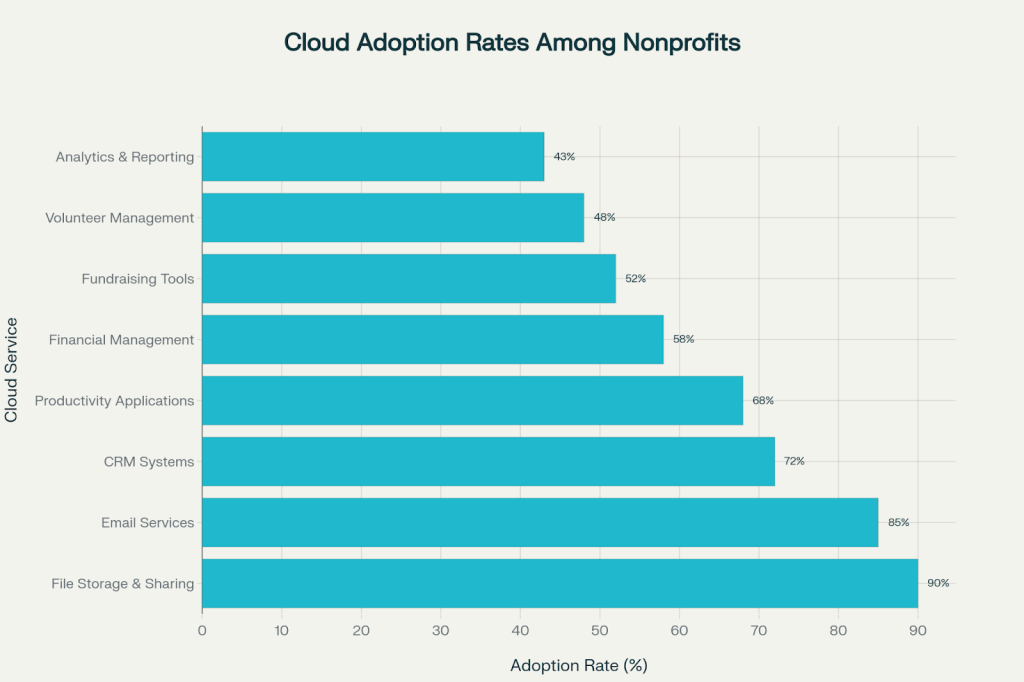
Cloud Service Adoption Rates Among Nonprofit Organizations
Core cloud benefits for NGOs:
- Cost savings: 30-50% reduction in storage costs and 25-40% in email services
- Remote accessibility: Enable global teams to collaborate seamlessly
- Scalability: Adjust resources based on seasonal demands or crisis response needs
- Enhanced security: Access enterprise-grade protection without massive IT investments
- Carbon footprint reduction: Cloud data centers are 68-87% more energy efficient
Start with basic services like email and file storage, then gradually migrate more complex applications as your team’s comfort level increases.
Step 5: Implement Robust Data Security and Privacy Measures
With NGOs handling sensitive donor information, beneficiary data, and financial records, security cannot be an afterthought. 35% of organizations cite data security concerns as a major transformation barrier, yet proper implementation actually enhances security.
Essential security practices:
- Data minimization: Collect only necessary information
- Encryption: Protect data both in transit and at rest
- Access controls: Implement role-based permissions
- Regular audits: Conduct quarterly security assessments
- Staff training: Ensure all team members understand security protocols
- Incident response planning: Prepare for potential breaches
Multi-factor authentication and employee training are particularly crucial, as human error remains the leading cause of data breaches. Consider partnering with specialized security providers if internal expertise is limited.
Step 6: Modernize Donor Management and Fundraising
Digital transformation revolutionizes how NGOs build relationships with supporters. Modern donor management systems integrate giving history, communication preferences, and engagement tracking to create comprehensive supporter profiles.
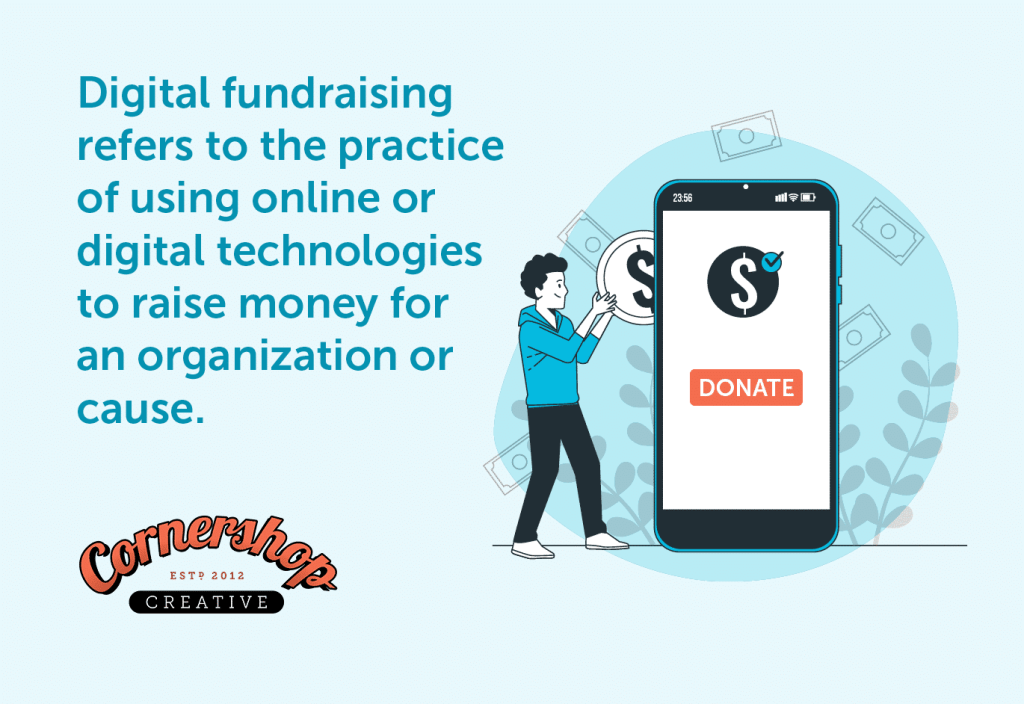
Key fundraising technology components:
- Integrated CRM systems: Centralize all donor interactions and history
- Online giving platforms: Enable seamless donation experiences
- Peer-to-peer fundraising tools: Empower supporters to fundraise on your behalf
- Text-to-give capabilities: Capitalize on mobile giving trends (14% revenue increase from 2022-2023)
- AI-powered analytics: Predict donor behavior and optimize outreach timing
Organizations using advanced donor management see 64% donor retention rates versus the 42% industry average. The investment in proper tools pays dividends through stronger, more sustainable fundraising.
Step 7: Automate Administrative Processes
Administrative tasks consume valuable time that could be spent on mission-critical work. Automation transforms routine operations while reducing errors and costs.
High-impact automation opportunities:
- Financial management: Automate expense reporting, budget tracking, and compliance
- Volunteer coordination: Streamline scheduling, communications, and recognition
- Grant tracking: Monitor deadlines, requirements, and reporting obligations
- Email communications: Personalize donor journeys and acknowledgments
- Data entry: Eliminate manual processes through system integrations
Cost savings from automation can reach $100,000 annually for mid-sized organizations, freeing resources for program expansion or emergency reserves.
Step 8: Enhance Communication and Collaboration Tools
Modern NGOs operate across multiple locations with diverse teams of staff, volunteers, and partners. Digital collaboration tools enable seamless coordination regardless of geographic boundaries.
Essential collaboration features:
- Cloud-based document sharing: Enable real-time editing and version control
- Video conferencing: Connect teams and serve beneficiaries remotely
- Project management platforms: Track initiatives and maintain accountability
- Mobile accessibility: Ensure tools work across all devices
- Integration capabilities: Connect different systems for seamless workflows
42% of nonprofits cite remote access as the most useful cloud benefit, highlighting how proper collaboration tools directly impact productivity and stakeholder engagement.
Step 9: Develop Digital Skills Through Training
Technology is only as effective as the people using it. Up to 90% of organizations face IT talent shortages, with projected $5.5 trillion in losses by 2026 from skills gaps. Investing in staff development isn’t optional—it’s essential for transformation success.
Comprehensive training approach:
- Role-specific training: Tailor education to actual job functions
- Gradual implementation: Introduce new systems incrementally
- Peer mentoring: Pair tech-comfortable staff with those needing support
- External resources: Leverage vendor training and nonprofit technology organizations
- Ongoing education: Technology evolves rapidly; training must be continuous
95% of employees completing digital skills training within the first month correlates with successful system adoption. Make training investment a priority, not an afterthought.
Step 10: Measure Impact and Iterate Continuously
Digital transformation isn’t a destination—it’s an ongoing journey requiring continuous evaluation and adjustment. Organizations that treat transformation as a one-time project rather than an iterative process significantly increase their failure risk.
Sustainable measurement framework:
- Monthly dashboard reviews: Track key metrics consistently
- Quarterly stakeholder feedback: Gather input from staff, volunteers, and beneficiaries
- Annual strategy assessment: Evaluate progress against long-term goals
- Technology audits: Ensure systems remain current and secure
- ROI calculation: Demonstrate value to board and funders
Organizations addressing data quality first show 2.5x higher transformation success rates, emphasizing why measurement and continuous improvement are essential components of digital maturity.
| Implementation Phase | Timeline | Key Focus Areas | Success Indicators |
| Foundation Building | Months 1-3 | Team formation, assessment, planning | Clear roadmap, engaged stakeholders |
| Core Systems | Months 4-9 | Cloud migration, security, basic automation | Operational tools deployed, staff trained |
| Advanced Capabilities | Months 10-15 | Analytics, AI integration, process optimization | Measurable efficiency gains, ROI positive |
| Continuous Evolution | Ongoing | Innovation, scaling, refinement | Sustained improvement, competitive advantage |
Empower your NGO with digital transformation strategies for 2026 success

Pooja Upadhyay
Director Of People Operations & Client Relations
Overcoming Common Barriers
Even with a solid plan, NGOs encounter predictable obstacles. Cultural resistance affects 58% of organizations, making change management as important as technical implementation. Address resistance through:
- Transparent communication about transformation benefits
- Early involvement of skeptical staff in planning processes
- Quick wins that demonstrate immediate value
- Recognition programs for transformation champions
- Patience and persistence as cultures evolve gradually
Budget constraints impact 42% of organizations, but transformation doesn’t require massive upfront investment. Start with high-impact, low-cost initiatives like cloud migration for email and storage, then reinvest savings into more ambitious projects.
Conclusion
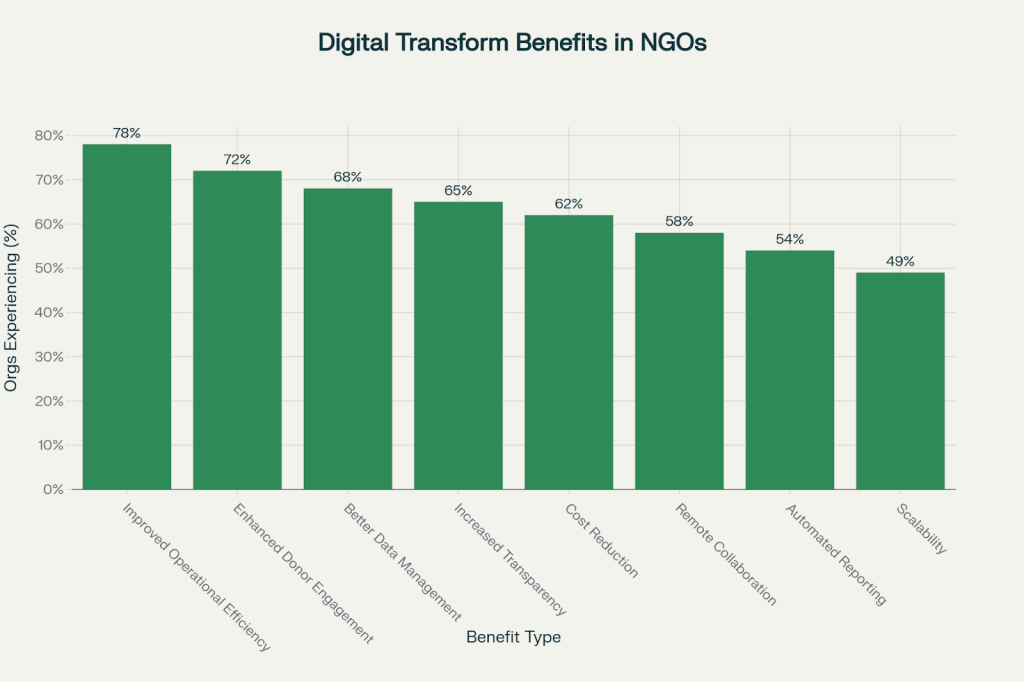
When executed thoughtfully, digital transformation delivers profound benefits. 78% of organizations experience improved operational efficiency, while 72% see enhanced donor engagement[Benefits data]. These improvements compound over time, creating sustainable competitive advantages that amplify mission impact.
The transformation journey requires commitment, resources, and patience, but the alternative, organizational stagnation and declining relevance—poses far greater risks. NGOs that embrace digital evolution position themselves to thrive in an increasingly connected world while serving their communities more effectively than ever before.
The question isn’t whether to pursue digital transformation, but how quickly and strategically you can implement it. The 10 steps outlined here provide a roadmap for NGOs ready to unlock their digital potential and maximize their mission impact in 2026 and beyond.
Source URLs
- https://www.veritis.com/blog/top-10-digital-transformation-trends/
- https://www.integrate.io/blog/data-transformation-challenge-statistics/
- https://tealtech.com/blog/nonprofit-digital-transformation/
- https://whatfix.com/blog/digital-transformation-in-nonprofits/
- https://www.o8.agency/blog/digital-transformation/breaking-down-barriers-digital-transformation-overcome-challehttps://backlinko.com/digital-transformation-stats
- https://quixy.com/blog/top-digital-transformation-statistics-trends/
- https://moveworks.com/us/en/resources/blog/how-to-measure-success-of-your-digital-transformation
- https://rsmcanada.com/insights/industries/nonprofit/5-steps-for-ngos-to-successfully-implement-technology-globally.html
- https://cmitsolutions.com/mesa-az-1086/managed-cloud-services/benefits-non-profit-organizations/
- https://nasscomfoundation.org/blog/ngo-empowerment/exploring-the-power-of-techforgood-for-the-non-profits/
- https://digitalsocialinnovation.org/benefits-of-nonprofit-digital-transformation/
