


When Google quietly repositioned Flutter under its Cloud division in early 2024—rather than its traditional platforms organization—few outside the developer community noticed. But that single organizational move speaks volumes. Flutter isn’t just another framework in Google’s sprawling portfolio. It’s evolved into a mission-critical strategic asset that’s reshaping how enterprises build, deploy, and scale software across every conceivable platform. As of 2025, with 42% market share against React Native’s 38%, Flutter has already surpassed its closest competitor. Yet the real story isn’t about market dominance—it’s about why Google is betting the farm on Dart and Flutter as the foundation for a post-fragmented app development future.
The Quiet Organizational Shift: What It Really Means
Here’s what most tech blogs got wrong: when Google moved Flutter from the “Platforms” division to “Cloud,” it wasn’t a demotion. It was a strategic repositioning. Let me explain why that matters.
For years, Flutter lived in the world of consumer mobile apps—the realm of flashy UI frameworks and startup MVPs. But Google’s organizational change signals a fundamental shift in how the company views the framework’s purpose. Flutter is no longer primarily a tool for consumer-facing applications. It’s become a foundational platform for enterprise development, cloud-native computing, and large-scale digital transformation.
This distinction matters more than you might think. When a framework moves into the Cloud division—alongside services like Google Cloud Functions, Cloud Run, and Vertex AI—it gains a completely different set of priorities. Security updates become non-negotiable. Compliance certifications get fast-tracked. Integration with AI and machine learning services becomes a primary focus rather than an afterthought.
And indeed, Google’s own actions confirm this. The company introduced Flutter Enterprise, a subscription-based model launched in late 2024, offering extended support guarantees, priority issue resolution, and comprehensive compliance certifications. This is the behavior of a company building a sustainable, defensible business model—not experimenting with a side project.
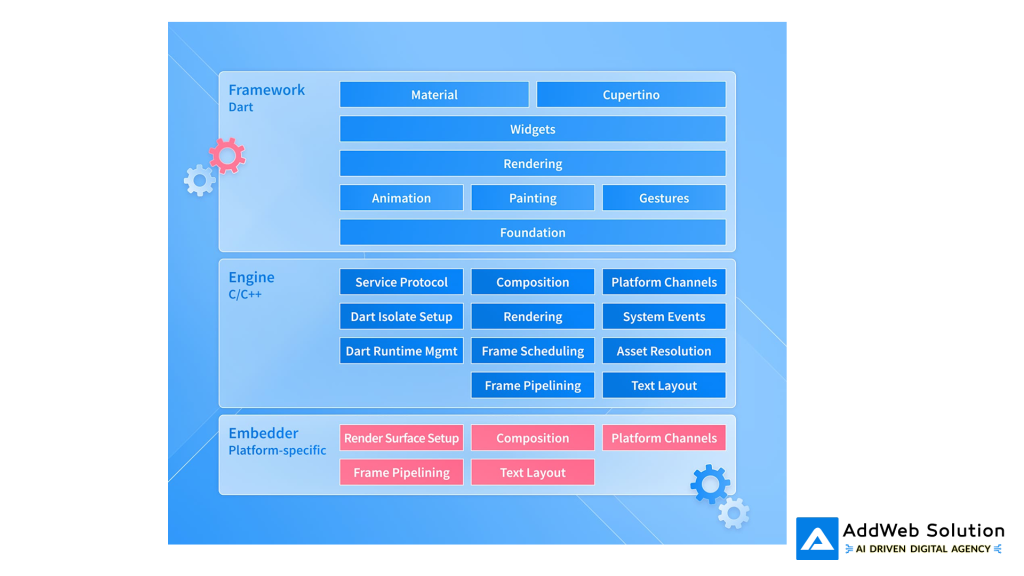
What Is Flutter? Pros & Cons for Mobile App Development
The Numbers Tell a Compelling Story
Let’s talk data, because Flutter’s growth trajectory is genuinely remarkable.

Flutter App Ecosystem Growth: A 5-Year Trajectory (2019-2024)
The ecosystem numbers paint an undeniable picture. Flutter went from 30,000 published apps in 2019 to 760,000 apps by 2024, with the most explosive growth happening in 2022 when Flutter 3 introduced web and desktop support. That’s not linear growth—that’s exponential adoption driven by real business value.
But here’s where it gets really interesting: while new project initiations have plateaued compared to the explosive 2021-2023 boom, existing Flutter applications are continuing through multiple update cycles with decreasing maintenance costs. This suggests a maturing ecosystem where developers aren’t just experimenting—they’re building long-term, mission-critical systems.
The developer community has grown to 2 million active developers using Flutter, with a consistent 10% month-over-month growth rate post-March 2024. And on GitHub, Flutter boasts over 145,000 stars with 170,000+ stars by mid-2025, significantly outpacing React Native’s 121,000 stars. When developers vote with their attention and contributions, they’re signaling confidence.
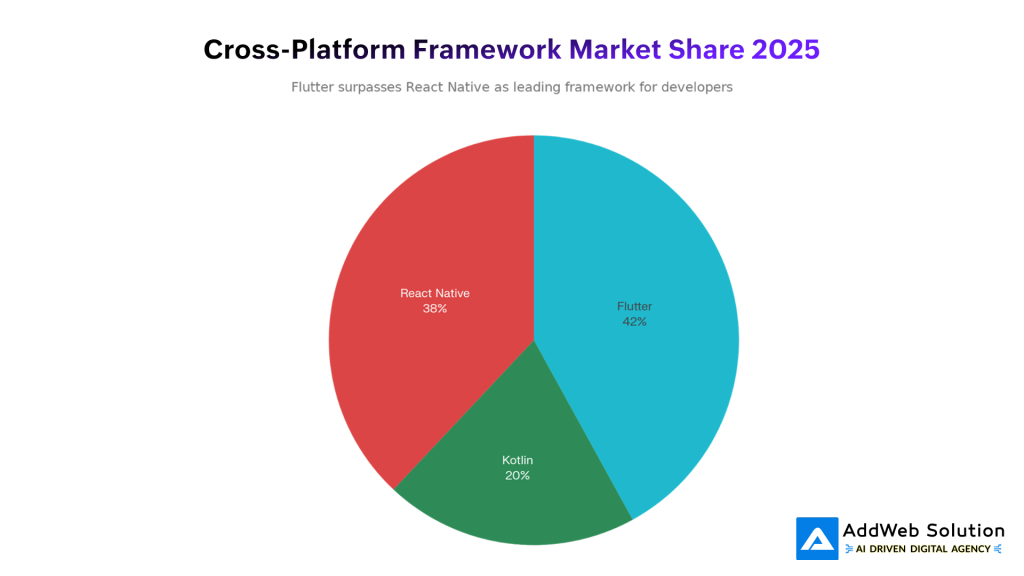
Cross-Platform Framework Market Share 2025
Why Finance & Enterprise Are the Real Winners
If you want to understand Google’s strategic thinking, follow the money. Financial services has become the flagship industry for Flutter adoption, growing an astounding 217% since 2021—the fastest-growing sector by a massive margin.
Think about that number for a moment. 217% growth. In an industry as conservative as banking and fintech, that’s not hype. That’s a fundamental shift in how institutions build technology.
Nubank, Latin America’s largest digital bank with over 100 million customers, is the poster child for this transition. After switching to Flutter, Nubank reported:
- 30% higher merge success rate compared to native platforms
- 600% faster pull request processing
- Insurance feature launched in just three months—their fastest product rollout ever
These aren’t marketing numbers. These are operational metrics that directly impact bottom-line efficiency and competitive velocity. For a fintech company, the ability to ship features in weeks instead of months is the difference between market leadership and obsolescence.
The reasons are straightforward. Traditional fintech development required separate iOS and Android teams working in parallel—consuming overhead, creating delays, and multiplying testing costs. With Flutter, one codebase serves both platforms, cutting development time by 30-40% and reducing testing burden by 40%. Code duplication drops by 90%.
And then there’s security—the elephant in every fintech room. Flutter provides native encryption, PCI compliance support, and biometric authentication without requiring additional development overhead. For industries handling sensitive user data, this built-in security posture is a game-changer.


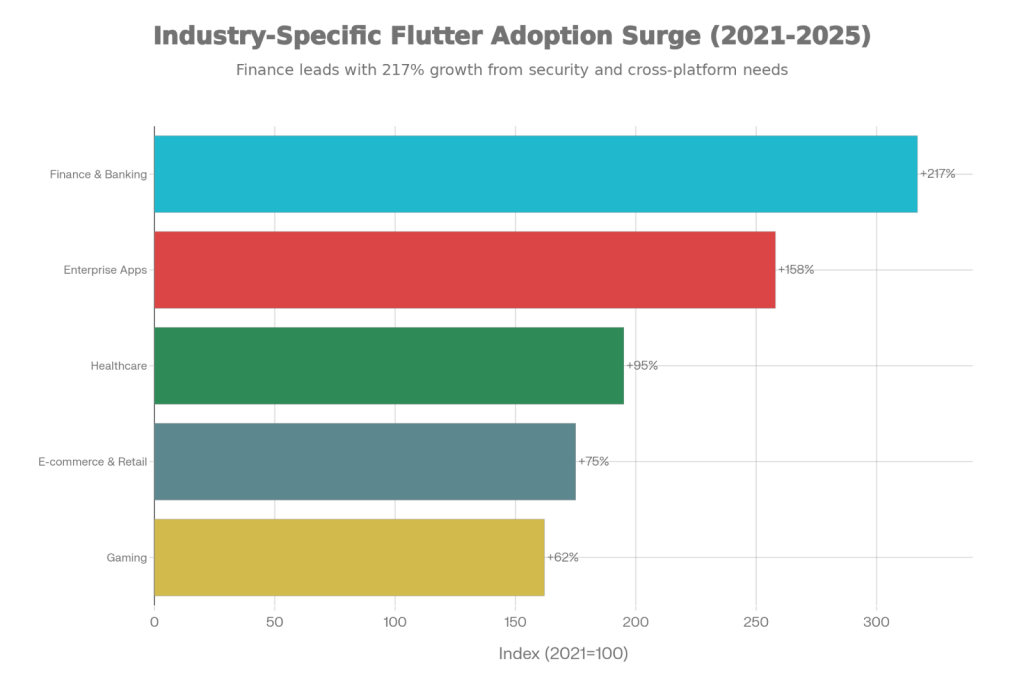
Industry-Specific Flutter Adoption Surge (2021-2025)
Flutter’s AI Integration: The Gemini Partnership
Now here’s where Google’s strategic vision becomes crystal clear.
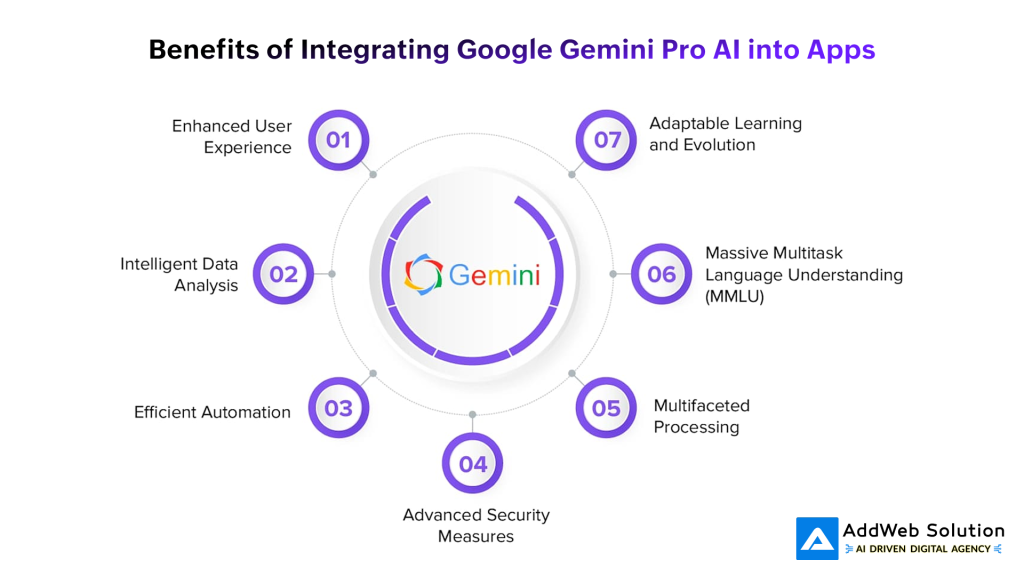
At Google I/O 2025, the company announced Flutter 3.32 with new features designed to accelerate development and enhance apps, alongside deepened integration with Google’s Gemini AI models. This isn’t a coincidence. It’s a deliberate two-pronged strategy: make Flutter the go-to framework for building AI-powered applications at scale.
Google released comprehensive codelabs and documentation showing developers exactly how to integrate Gemini directly into Flutter apps. The process is remarkably clean—Firebase AI Logic handles authentication and configuration, while Riverpod providers manage asynchronous services. Within hours, developers can build intelligent chatbots, image recognition features, and predictive analytics directly into their applications.
Cost to Integrate Google Gemini Pro AI into Mobile Apps
The strategic brilliance here is that Google is creating path dependency. Developers who build with Flutter + Gemini create applications so deeply integrated with Google’s AI services that switching to competing frameworks becomes economically irrational. When your financial app’s fraud detection relies on Gemini’s latest models, or your e-commerce app’s recommendations depend on Google’s AI infrastructure—you’re not just choosing Flutter anymore. You’re choosing to remain deeply embedded in Google’s ecosystem.
And for enterprises, this integration is transformative. Imagine fraud detection powered by Gemini’s latest large language models. Personalized investment advice from AI assistants. Predictive analytics for risk management. All built natively into Flutter apps running seamlessly across iOS, Android, and web.
Real-World Winners: Companies Building the Future
BMW’s Transformation
The automotive manufacturer used Flutter to build connected car experiences, reducing release cycles by 33% while maintaining high engineering standards. For an industry where software updates are critical to competitive differentiation, this speedup is game-changing.
Google Ads App
Google redesigned its own flagship Ads app using Flutter, resulting in a 33% increase in customer satisfaction. When Google uses its own frameworks for customer-facing products, that’s validation.
Alibaba’s Xianyu
Supporting over 50 million users, Alibaba’s Xianyu app (a community-driven shopping app) demonstrates that Flutter scales to enterprise magnitude without performance degradation.
Nubank’s Mobile Banking Platform
Serving 100+ million users with complex financial workflows, Nubank’s migration to Flutter yielded:
- 30% better merge success rates
- Fastest feature deployment cycles in company history
- Ability to scale across Latin America without proportional team growth
These aren’t isolated success stories. They represent a pattern: when enterprises choose Flutter deliberately, they achieve outsized competitive advantages.

6 Cross Platform App Development Tools of 2023
Looking Ahead: What Comes Next
Google’s roadmap for Flutter in 2025 and beyond points toward several exciting directions:
- Flutter Cloud Native: Serverless backend development with Dart and Firebase integration
- Game Engine Capabilities: Internal projects suggest Google is exploring Unity-like game support for Flutter
- Full-Stack Dart Adoption: More developers using Dart on both frontend and backend, creating unified technology stacks
- AI-Native App Templates: Prebuilt components and UI kits with AI baked directly into Flutter’s ecosystem
The vision is clear: Flutter isn’t just a mobile framework anymore. It’s Google’s comprehensive platform for building intelligent, scalable, cloud-native applications that work everywhere.
The Bottom Line
Flutter is quietly becoming Google’s most strategic bet because it solves a problem that affects every technology organization on Earth: how to build and maintain software across multiple platforms without exponentially increasing cost and complexity.
For enterprises, this is a competitive advantage waiting to be captured. For developers, it’s a strategic bet on a technology that Google has clearly committed to defending and evolving for the next decade. And for the future of software architecture, Flutter represents a move toward unified development stacks that prioritize developer productivity and business velocity.
The companies that recognize this now—and build their technology roadmaps around Flutter—will be the ones setting the pace for their industries.
Stay Connected with AddWeb Solution
At AddWeb Solution, we’re building the next generation of cross-platform applications for global enterprises. If you’re evaluating Flutter for your digital transformation initiative, or you want to explore how AI-powered development can accelerate your time-to-market, our team of Google-certified Flutter experts is here to guide your strategy.
From fintech platforms serving millions of users to enterprise dashboards powering multinational corporations, we’ve seen firsthand how Flutter transforms engineering organizations and unlocks competitive advantage.
Ready to explore what’s possible? Let’s talk about your next-generation app architecture.
Start today with a tailored plan, starter folder structure, and tooling setup to unlock scalable, enterprise-grade Flutter apps.

Pooja Upadhyay
Director Of People Operations & Client Relations
Key Takeaways
✓ Flutter has surpassed React Native with 42% market share, becoming the dominant cross-platform framework
✓ Financial services leads Flutter adoption at 217% growth since 2021, driven by speed and security advantages
✓ Google’s organizational restructuring positions Flutter as enterprise-critical infrastructure, not experimental technology
✓ Enterprise subscription models and deepened Gemini AI integration show Google’s decade-long commitment
✓ Companies like Nubank achieve 30% better merge rates and 3-month feature cycles with Flutter
✓ One codebase delivering across iOS, Android, web, and desktop reduces development costs by 30-40%
