



The Flutter ecosystem has evolved dramatically since its inception. What started as a framework for building beautiful cross-platform apps has matured into an enterprise-grade solution trusted by millions of developers worldwide. However, as your Flutter application grows—especially in complex enterprise environments—the architectural decisions you make early become critical to long-term success.
The challenge isn’t just building a Flutter app anymore; it’s about building a scalable, maintainable system that multiple teams can work on without stepping on each other’s toes. This is where modular architecture and monorepos come into play.
Picture this: A fintech company with separate teams for payments, authentication, and analytics. Traditionally, they’d maintain three separate repositories, coordinate version updates manually, and struggle with platform parity. With Flutter’s modular architecture and a properly configured monorepo, they deployed consistently across all teams in just a few hours instead of five days.
This article dives deep into how to structure your Flutter projects for scale, why modular architecture matters, and how monorepos can be your secret weapon for enterprise development.
What is Flutter Modular Architecture? {#modular-architecture}
Flutter’s modular architecture is an organizational pattern that divides your application into independent, self-contained modules. Each module typically handles a specific feature or business domain.
Think of it like building a city. Instead of one massive building doing everything, you have specialized districts: a financial district (payments), a residential zone (user profiles), a commercial area (shopping), each with their own infrastructure but connected through well-defined roads (APIs).
Core Benefits of Modularity:
- Independence: Teams can work on their authentication module without touching the payment module
- Reusability: The login module from one app can be dropped directly into another app with minimal changes
- Ease of Change: Swap Firebase for a different backend without major refactoring across your entire codebase
- SOLID Compliance: Loosely coupled, highly testable code that follows software engineering principles
The Three-Layer Architecture Pattern
Most enterprise Flutter applications follow a clean architecture with three distinct layers:
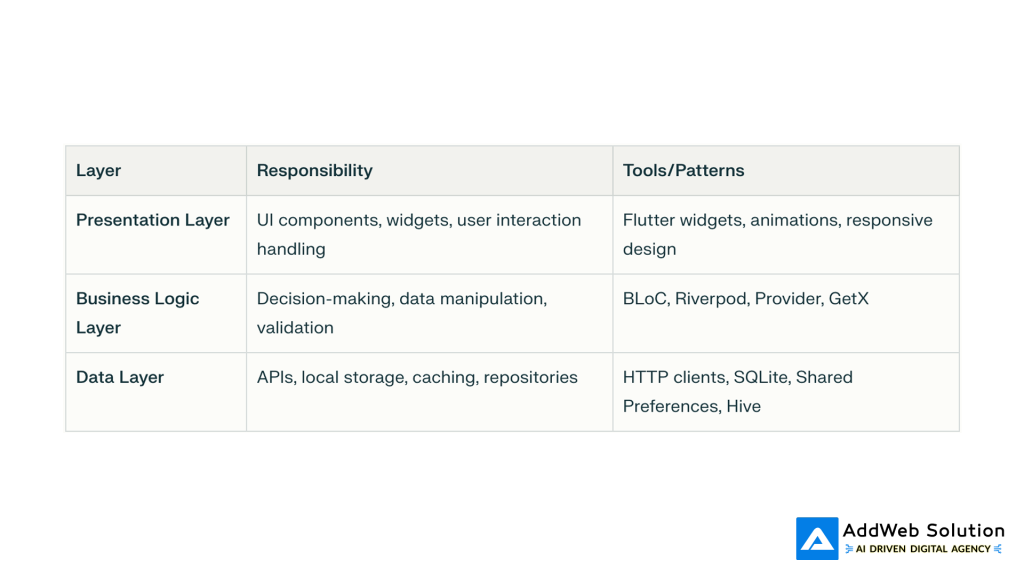

Flutter architectural overview
Each layer is isolated, making testing straightforward and changes manageable. When you need to modify how data flows, you update the data layer without touching the UI. Business logic changes don’t require database restructuring.
Understanding Monorepos in Flutter {#monorepos}
A monorepo (monolithic repository) is a single Git repository that contains multiple projects or packages. For Flutter development, this typically means housing multiple Flutter apps and shared Dart packages in one repository structure.
Traditional Structure (Polyrepo):
All connected, managed, and deployed from a single source of truth.
Why Monorepos Matter for Flutter:
According to a 2025 analysis, enterprises using monorepos report build time reductions of 55-85% and improved DORA metrics for deployment frequency and lead time. For Flutter teams, this translates to faster development cycles, more frequent releases, and reduced infrastructure costs.
The key to managing this complexity is Melos, a CLI tool specifically designed for Dart and Flutter monorepos. Melos handles dependency management, runs scripts across multiple packages, and ensures consistency across your entire workspace.

Performance Impact of Monorepo Architecture – Key metrics improvement with modular structure
Monorepo vs. Polyrepo: Making the Right Choice {#comparison}

When to Choose Monorepo:
- Multiple Flutter apps sharing common code
- 5+ developers collaborating on related features
- Enterprise projects requiring consistent versioning
- Products with tight platform parity requirements
When Polyrepo Might Work:
- Completely independent projects
- External packages intended for pub.dev publication
- Teams operating with full autonomy


Key Statistics & Market Adoption {#statistics}
Flutter’s Explosive Growth:
- 2 million developers actively use Flutter globally, with steady 10% month-over-month growth since March 2024
- 500,000+ Flutter apps published on Google Play Store, with 50% year-over-year growth
- 46% of developers chose Flutter as their preferred cross-platform framework in 2023, making it the most favorable option
- Flutter ranks as the 3rd most loved framework among developers, with 68.8% expressing interest in continuing development
Enterprise Impact:
- Google Ads app saw a 33% increase in customer satisfaction after Flutter redesign
- Alibaba’s Xianyu app (built with Flutter) supports 50+ million users seamlessly
- Tencent’s Now Live app reaches 10 million daily active users using Flutter
Development Efficiency Gains:
- Flutter development is 1.5x faster than native development across iOS and Android
- 20-50% reduction in MVP development time compared to native approaches
- 30% reduction in total development time from single codebase approach
- 33% increase in development speed achieved by Whirlpool after switching to Flutter
Monorepo & Modular Architecture Impact:
- Build time reduced by 55-85% with proper monorepo configuration
- CI pipeline costs reduced by 20-40%
- 40% reduction in build times achieved through modular architecture with BLoC state management
- 60% reduction in bug reports after implementing modular CI/CD pipelines
Start today with a tailored plan, starter folder structure, and tooling setup to unlock scalable, enterprise-grade Flutter apps.

Pooja Upadhyay
Director Of People Operations & Client Relations
Interesting Facts About Flutter at Scale {#facts}
1. Hot Reload Productivity Multiplier
Flutter’s hot reload feature accelerates development significantly. Developers can make changes and see results in under a second. For a team of 10 developers working 8 hours daily, this saves approximately 10-15 hours per week in rebuild time alone. Across a year, that’s roughly 520-780 hours saved per developer—equivalent to 2-3 additional developers’ worth of productivity.
2. The Alibaba Effect
When Alibaba’s Xianyu app was developed using Flutter, it demonstrated that complex, high-scale applications could run smoothly on the framework. The app managing 50+ million users proved that modularity and proper architecture could handle extreme scale.
3. Google’s Billion-Line Monorepo Inspiration
Google’s internal monorepo contains billions of lines of code across all products. While not Flutter-specific, the principles Google uses for managing scale directly influenced how Melos was designed. This is why Melos is so effective—it’s built on decades of Google’s repository management expertise.
4. Platform Parity Paradox
With traditional native development, achieving feature parity across iOS and Android typically takes 20-30% longer. Flutter eliminates this overhead entirely. One team can maintain one codebase and deploy simultaneously across all platforms. For an enterprise releasing fortnightly, this means 2-4 extra feature releases per year—purely from eliminating platform parity work.
5. The Fintech Reliability Test
A fintech company initially deployed manually, but when 80,000 simultaneous users registered on launch day, the app crashed within minutes. After implementing automated CI/CD with modular architecture, the same infrastructure now scales to 1+ million users with zero manual checks.
6. Development Cost Savings
Google Pay saved approximately 60-70% of its engineering time by consolidating from separate native teams to Flutter. For a company with 50 engineers, this equates to approximately 30-35 engineers’ worth of productivity—or roughly $3-5 million annually in saved costs (at average tech salaries).
7. The Standardization Effect
Enterprises adopting Flutter with modular architecture report 2x productivity gains across teams. Part of this comes from standardized tooling, shared widgets, and unified state management patterns. New developers onboard 40-50% faster because standards are enforced organization-wide.
FAQ: Common Questions Answered {#faq}
Q1: Should we start with a monorepo or grow into one?
A: Start with a monorepo if you have multiple related apps or anticipate code sharing. If you’re building a single app, start simple and migrate to monorepo structure later. The Melos bootstrap process makes migration relatively painless. AddWeb Solution recommends evaluating this decision during architectural planning—it’s easier to implement upfront than retrofit later.
Q2: What’s the best tool for managing Flutter monorepos?
A: Melos is the de facto standard and most widely adopted tool in the Flutter community. It’s specifically designed for Dart and Flutter, integrates seamlessly with CI/CD platforms, and handles dependency management, script execution, versioning, and changelog generation. Dart Workspaces (pub workspaces) is newer but lacks some features Melos provides.
Q3: How do I handle dependencies in a Flutter monorepo?
A: Use local path dependencies in your pubspec files:
Melos bootstrap automatically resolves these and creates a unified lockfile, ensuring version consistency across your entire monorepo.
Q4: Can we use monorepo with separate teams?
A: Absolutely. This is one of the primary advantages. Each team can own specific modules or apps while sharing core packages. Clear pubspec dependencies and code review processes maintain boundaries. Melos scripts ensure all teams follow the same build, test, and deployment processes.
Q5: How does monorepo affect build times?
A: Properly configured monorepos with incremental builds can be significantly faster. Melos only rebuilds packages with changes, not the entire monorepo. Additionally, unified CI pipelines can cache dependencies once, reducing redundant downloads. Industry data shows 55-85% improvements in build time for enterprises that implement monorepos with proper automation.
Q6: What about CI/CD pipeline complexity?
A: Monorepos actually simplify CI/CD. Instead of configuring separate pipelines for each repository, you have one unified pipeline that orchestrates all packages. Melos scripts handle running tests, analysis, and builds across all packages uniformly. A single GitHub Actions or GitLab CI workflow can manage your entire monorepo.
Q7: Is monorepo suitable for open-source packages?
A: Yes, but with caveats. If you’re publishing packages to pub.dev intended for external use, monorepo works well. However, for open-source projects with many external contributors, separate repositories might be clearer for governance and community contribution workflows.
Q8: How do we maintain code quality in a monorepo?
A: Enforce standards through CI/CD gates. Run melos analyze, melos test, and melos format on every PR. Use shared analysis options (analysis_options.yaml), shared linting rules, and standardized folder structures. AddWeb Solution’s approach includes automated code quality checks that prevent merging until quality thresholds are met.
Q9: Can existing Flutter apps migrate to monorepo structure?
A: Yes. The migration process typically involves: (1) Creating the monorepo directory structure, (2) Moving existing app into apps/, (3) Extracting shared code into packages/, (4) Updating pubspec dependencies to local paths, (5) Running melos bootstrap. Most teams complete this in 1-2 sprints depending on code complexity.
Q10: What’s the learning curve for teams new to monorepos?
A: Moderate. Developers familiar with Dart/Flutter typically need 1-2 weeks to become comfortable with monorepo workflows. The key concepts are: local path dependencies, Melos scripts, and shared package structure. Clear documentation and team training sessions accelerate adoption significantly.
Source URLs:
- Statista Flutter Developer Survey:
- https://www.goodfirms.co/blog/flutter-2025-definition-key-trends-statistics
- Stack Overflow Developer Survey 2024:
- https://www.nomtek.com/blog/flutter-vs-react-native
- Enterprise Flutter Case Study:
- https://nanobytetechnologies.com/Blog/How-to-Build-Scalable-Enterprise-Apps-Using-Flutter-Architecture-CICD
- Flutter Adoption Growth:
- https://ahex.co/future-of-flutter-trends-predictions/
