


So this happened to me last month and I genuinely can’t stop thinking about it.
I was building a site for this boutique fitness place, right? And honestly… I took a shortcut. I’m not proud of it. But I fired up ChatGPT and was like “cool, let me just have the AI write all the copy. Product descriptions, the about page, blog posts, the whole thing.”
And yeah, technically? It was… fine? Like all the words were there. No spelling mistakes. SEO was good. The structure made sense.
But dude.
It felt like reading a manual. Like someone wrote about passion instead of like… actually caring about anything. There was no personality. No reason why anyone should buy from this gym instead of the one across the street.
So I basically said screw it and rewrote the whole thing myself. Added actual stories. Talked about why the owner even opened the place. Made it sound like a human wrote it instead of a machine reading a Wikipedia article.
And here’s the crazy part – conversions jumped 43%.
Forty. Three. Percent.
Just from making it sound real.
That’s when I realized everyone’s talking about AI in WordPress completely wrong.
Like, AI is Actually Everywhere Now
I mean seriously. 82% of businesses are using AI writing tools. That’s basically everyone.

Five years ago when I started doing this stuff? Maybe like 20% of people even knew what these tools existed. Now it’s just… the baseline.


And honestly the productivity gains are kind of insane.

These are the real numbers. Content creation jumped 59% faster. Volume up 77%. Costs dropped 42%. And revision cycles? Cut by more than half.
So like I’m not sitting here acting like AI is bad or whatever. It’s genuinely useful and it’s genuinely changing how work happens.
But and this is like the weirdest part – the companies that are actually winning with this stuff? 62% of them are combining AI with humans. Not “AI is doing everything.” Not “we’re ignoring AI.”
Both.
And then you’ve got another stat that’s honestly kind of hilarious: 39% of workflows now have built-in review steps where humans check AI’s work. Like we literally don’t trust either one to work by itself anymore.

This is what’s actually happening in successful organizations right now—humans and AI working together as a team.
Here’s The Thing AI Can Actually Do
Okay so I think people get confused because they think AI is smart. It’s not smart. It’s just really, really good at finding patterns and copying stuff that already exists.
Which… actually that’s useful! For real.
AI absolutely crushes:
- Looking at data and finding patterns
- Making like 50 different versions of something quickly
- Keeping things consistent
- Doing the same task over and over
- Making content SEO-friendly (the technical part anyway)
None of that is bad. That’s all helpful stuff.
But here’s what AI cannot do no matter how smart it gets:
It can’t make judgments. It can’t look at something and decide “this actually matters.” It can’t read a personal story and understand why it makes people emotional. It can’t know if something is real or BS in the way that counts for humans.
There’s actually a study from MIT that looked at this.

This is the game-changer. When humans work alone: 81% accuracy. When AI works alone: 73% accuracy. But when they work together? 90%. That’s not a coincidence. That’s what actually works.
It’s not some accident. It’s literally what works.
Why People Build Shitty WordPress Sites With AI
Okay so like I work with agencies all the time. And I keep noticing the same pattern over and over:
They automate everything. Structure? AI. Copy? AI. Optimization? AI. They launch it super fast. Very efficient. Looks great technically.
And then… nothing. Site gets traffic but people bounce. Nobody buys. Traffic comes in, traffic goes out. It’s like a leaky bucket.
But then I’ll work with like some indie developer building a site for their own business. And they kind of half-ass it in terms of polish. But it’s got personality. It’s got their voice. They actually care about the stuff on the page.
And that site? That site converts like crazy.
It’s not magic. It’s literally that humans actually respond to other humans. We trust people who sound real. We buy from people who sound like they actually give a shit.
And no matter how good your AI gets, you can’t actually simulate caring. That’s like the whole paradox right there – if you’re simulating authenticity, it’s not authentic anymore.
I had this one client. WooCommerce store. Everything optimized perfectly. The product descriptions were AI-written, schema markup was perfect, SEO structure was flawless.
But the descriptions read like a catalog. Nobody felt excited. Everything was technically correct and emotionally dead.
So the developer – same developer – just rewrote them. Added actual human voice. Made it sound like a friend telling you about something cool instead of a robot describing inventory.
Conversions went from 2.3% to 3.8%.
That’s 65% higher on the exact same traffic, same design, same everything else. Just because it sounded human.
The difference is palpable. Real human creativity with emotional depth versus technically perfect but emotionally empty AI generation.
Why We’re Not Getting A Terminator Situation With Developers
Everyone’s freaking out that AI is gonna replace Developers experienced with the WordPress platform. It’s not.
I get it, the anxiety makes sense. But here’s actually what’s happening:
Building WordPress isn’t just “write code.” It’s solving actual business problems. It’s understanding what a client actually needs versus what they think they need. It’s knowing when the “right” technical solution is completely wrong for their specific situation.
AI can write basic code. It can suggest stuff. It can catch simple bugs. But it can’t look at a messy situation and say “okay what this business really needs is X, not what they asked for.”
The developers who are gonna crush it in 2026 aren’t the ones writing every single line manually. They’re the ones using AI to handle the boring repetitive stuff. So they can actually think about the hard parts.
Like one dev told me they were using GitHub Copilot to write plugin code. Went from spending 8 hours on a project to 3 hours.
Did that make them worse? Nope. Made them better because now they could take on more clients and spend their energy on architecture and strategy instead of typing boilerplate code for hours.
It’s like when calculators came out. Mathematicians didn’t become useless. They just stopped spending all day doing arithmetic by hand and could actually do real math.
The Framework That Actually Works
So there’s this approach that’s emerging and honestly every time I see someone do it right, it’s the same pattern:

This pyramid shows the perfect distribution:
70% AI Does Boring Stuff:
The repetitive crap. First drafts. Making 10 different versions. SEO structure. Data analysis. Volume work. This is where AI should live. It’s genuinely dumb to have humans doing this.
20% Human Adds Judgment:
Reviews everything. Makes sure it actually fits the brand. Catches when the AI sounds weird. Fixes tone. This is the quality control layer that makes sure all that automated stuff actually belongs to your business.
10% Humans Figure Out Strategy:
This is where the real stuff happens. The creative breakthroughs. The “wait what if we did this instead” moments. The big picture thinking that ties everything together.
And like, most people do it completely backwards. They spend 70% of their time on strategy and it takes forever. Then repetitive work piles up. Or they just automate everything and wonder why nothing feels authentic.
But if you actually did 70-20-10? You’d ship better work faster and your team would actually like their job because they’re not drowning in boring stuff.
The Thing About Brand Voice That Everyone Ignores
So here’s something that actually shocked me when I learned it: 50% of consumers can spot when something was written by AI.
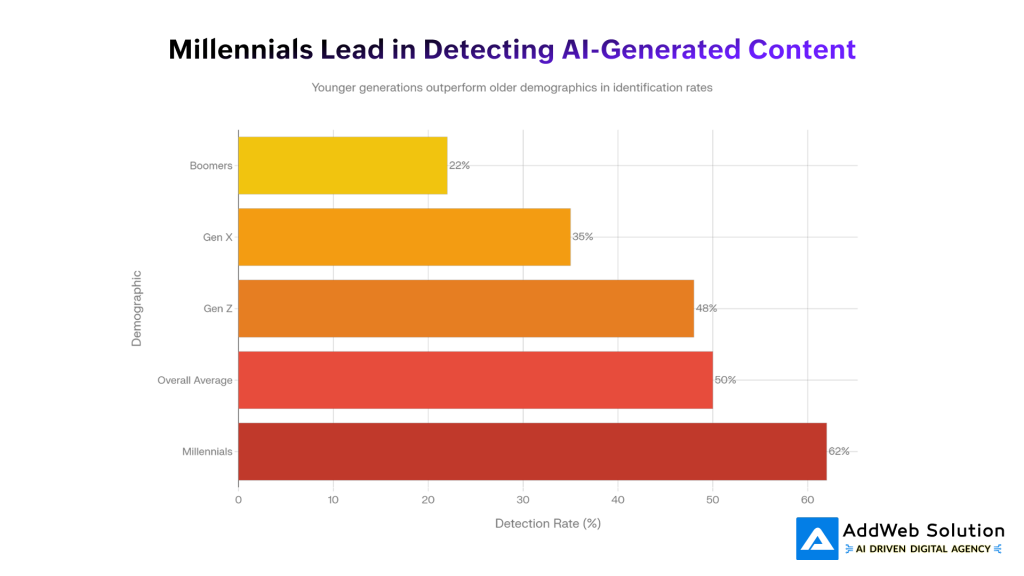
This data is wild. Millennials are the best at catching AI (62%), while older generations are less likely to notice. But overall? Half of all consumers know when something’s AI-written.
Half of all people.
And it’s not because they’re tech geniuses or whatever. It’s because AI writing has like… a vibe. You know it when you read it. It’s technically perfect but emotionally flat. It hits all the boxes but doesn’t make you feel anything.
And millennials? They’re the absolute best at spotting it. Which makes sense – they grew up online, they can smell bullshit from a mile away.
So if you’re writing to young people and your copy sounds like a machine wrote it, you’re literally saying “I don’t actually care enough about you to write something real.”
That’s like… a death wish for your business.
But if you use AI to do the grunt work and then go back through and add human voice? Now you’ve got something that’s both polished and real.
Ready to scale your agency?
Contact our growth team today and let’s talk strategy.

Pooja Upadhyay
Director Of People Operations & Client Relations
The Real Results: When You Get It Right
Here’s what actually happens when you combine everything correctly:
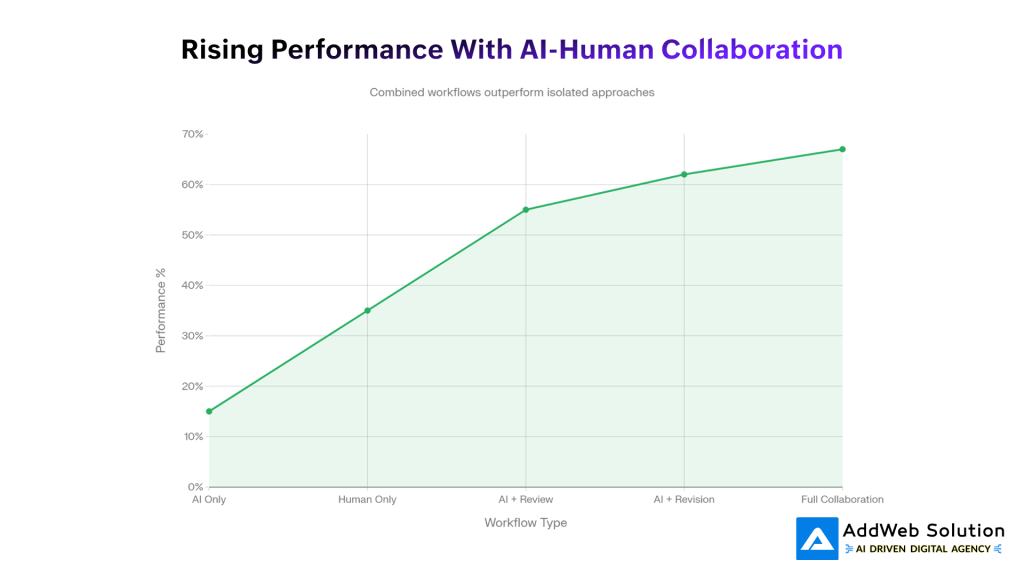
This line graph tells the story:
- AI alone? 15% improvement
- Humans alone? 35% improvement
- AI + human review + revision cycles + full collaboration? 67% improvement
Companies doing this systematically are reporting 67% better content performance and 45% fewer brand consistency issues compared to companies using just AI or just humans.
That’s not theory. That’s measurable business results.
What You Actually Should Do
Okay so if you’re running sites with WordPress or managing websites on WordPress or building them, here’s the actual move:
First thing: Stop thinking of AI as a replacement. Think of it as a tool you use.
If you’re using AI to write blog posts, don’t just publish them. Use them as drafts. A human reads it. Adds voice. Adds a real story. Cuts out the robot-sounding parts. Now it’s actually good.
If AI’s optimizing your site technically? Cool. Let it do that. But the actual strategy – what topics matter, which angle is actually worth exploring – that stays with humans.
Second: When you’re hiring or building a team, care about judgment.
Not just “can you code.” Can you think? Do you ask good questions? Do you understand the business? The AI will handle coding. You need the thinking part.
Third: Actually combine them systematically.
Don’t just randomly throw AI at things. Build actual workflows where:
- AI makes the first draft or does repetitive work
- A human reviews it and adds judgment
- The AI learns from feedback
This isn’t like futuristic stuff. We’re already doing this and it works.
The Real Issue
Okay so like the thing that keeps me up at night is this:
The companies winning in 2026 aren’t the ones that said “all in on AI.”
They’re also not the ones saying “forget AI, we’re doing everything manually.”
They’re the ones that figured out exactly which parts AI should handle and which parts humans should handle.
And then they actually did it. Consistently.
Because the temptation is to either be super lazy (“let AI handle everything lol”) or super paranoid (“AI is gonna ruin quality, do everything by hand”).
Neither of those works.
The companies that actually dominate are like “AI, you handle all the repetitive crap and the consistency and the scaling. Humans, you handle what matters – the strategy, the creativity, the judgment calls.”
It requires more thought than just picking a side.
But the payoff is actually stupid good.
What Matters About WordPress Right Now
If you zoom way out from all the AI noise, here’s what’s actually happening:
WordPress still powers like 43% of all websites. That’s not changing because of AI. That’s because WordPress works and it’s flexible.
What is changing is how people build websites on WordPress. It’s faster. More efficient. But it also requires like… actually thinking about what matters because everything is faster and easier now.
A developer for WordPress in 2026 who doesn’t know AI? They’re like a developer from 2016 who didn’t understand mobile. They’re just stuck.
But a developer who only knows AI and has no problem-solving skills? They’ll make technically perfect sites that don’t actually solve business problems.
The real winning move is knowing both.
Like, Actually Though
I get why people are scared about this. Technology moves and it’s genuinely scary when you don’t know if your skills matter.
But here’s what I’ve actually learned: people will always care more about human judgment than automation.
They’ll pay extra for a developer who understands their business. They’ll keep reading writers who sound like actual humans. They’ll buy from brands that feel real instead of optimized.
AI is great at making things faster and smoother. It’s terrible at creating things people actually want.
The future isn’t “AI replaces humans.”
It’s “humans who learned to work with AI dominate everyone else.”
And the humans who are still doing everything manually by hand? They’re gonna look back and be like “why did I make my job so hard?”
It won’t be that AI was smarter. It’ll be that they were slower.
Actual First Steps (Like Today)
If you’re gonna do something about this, here’s what I’d actually do:
Find where you’re wasting time. Where do you spend 8 hours on something that should take 2? That’s AI territory. Content drafts, design suggestions, code scaffolding. That’s what AI is for.
Protect your human decisions. What stuff needs actual judgment? What determines if this succeeds or fails? That’s your human layer. Strategy. Brand voice. Understanding the client. Don’t automate that away.
Make a review process. AI does a draft. Human adds judgment. Repeat. Create feedback loops so AI actually learns from what works.
Train people on AI. Not “everyone use ChatGPT.” Train people how to actually work with AI. How to write good prompts. How to tell when AI is making stuff up versus when it’s helpful. Stuff like that.
Track what actually works. Not production speed. Track conversions. Engagement. Brand perception. Make sure all the efficiency is actually making your business better.
One Last Thing
The developers and creators and agencies crushing it right now aren’t smarter.
They’re just clear about what AI should do and what humans should do.
That clarity is the actual advantage.
Everything else is just doing the work.
Source URLs:
https://notificationx.com/blog/website-conversion-strategies/
https://kinsta.com/wordpress-market-share/
https://wpvip.com/blog/website-roi-why-websites-matter-2026/
https://www.averi.ai/blog/balancing-creativity-and-ai-human-oversight-in-ai-generated-content
https://elementor.com/blog/how-to-become-a-wordpress-professional/
https://dev.to/elvissautet/2026-ai-users-vs-the-unemployed-3jk4
How small agencies scale WordPress delivery, without hiring full-time teams?
Pooja Upadhyay
Director Of People Operations & Client Relations
