


The Coffee Shop Moment (And Why Your Website Needs One)
You know that feeling when you walk into your regular coffee spot and the barista just gets it?
“The usual?” they ask, already reaching for the oat milk. You didn’t have to explain anything. No awkward ordering dance. They just knew—because they’ve seen you a hundred times before.
Your website should work exactly like that.
For the longest time, “personalization” online meant slapping someone’s first name into an email subject line or showing them a generic “Welcome back!” banner. That’s not personalization. That’s lazy automation.
In 2025, we’re seeing something fundamentally different happening. Websites aren’t just getting smarter—they’re getting attentive. They’re watching how you browse, remembering what you looked at, understanding where you came from. And then they adapt. In real-time.
At AddWeb, we’ve watched this shift go from “nice marketing thing to try” to absolute business necessity. If your WordPress site treats a loyal customer the same way it treats someone landing there for the first time, you’re doing yourself a disservice. Badly.
Let’s talk about why this is happening and how you can actually build it.
Table of Contents
- Why Generic Websites Are Broken Now
- What Changed: The Tech Behind “Liquid” Websites
- The Real Numbers: Why This Actually Matters
- The Tools WordPress Gives You (It’s Not Magic)
- Quick Facts That’ll Stick With You
1. Why Generic Websites Are Broken Now
Here’s something that stuck with me recently: we tested a client’s WordPress site with both a brand new visitor and a returning customer. Same homepage. Same messaging. Same everything.
The returning customer had already spent $2,400 with the company. But the site showed them a generic “Shop Our Collection” banner, no acknowledgment whatsoever, no discounts, nothing that said “we remember you.”
New visitor? Same treatment.
Does that sound right to you? Of course not.
The gap between what modern users expect and what most businesses deliver is enormous. People have been trained by Amazon, Netflix, and Spotify to believe that every good website should know them. When they land somewhere that doesn’t? Frustration sets in fast.
And frustration is costly.
We pulled data from multiple sources tracking consumer behavior in 2024-2025, and the numbers are pretty eye-opening. Three-quarters of shoppers walk away when websites feel irrelevant to them. Not because the products are bad. Not because the price is too high. Just because the experience felt generic and dismissive.
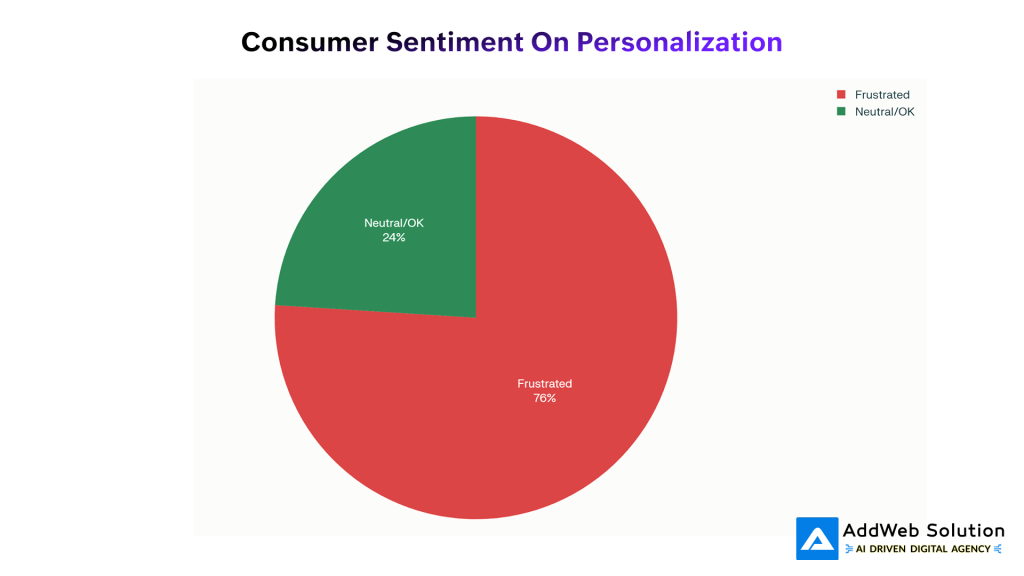
Chart Caption: Consumer Sentiment: The Cost of Generic Experiences (2025). 76% of consumers report frustration when websites lack personalization.
When seven out of ten people visiting your site are internally groaning at how impersonal it feels, that’s not a traffic problem. That’s a welcome problem.
2. What Changed: The Tech Behind “Liquid” Websites
You might be thinking this sounds like enterprise-level technology that costs six figures to implement.
I get it. Five years ago? You’d be right. Today? Not even close.
The WordPress ecosystem has caught up hard. We’re now seeing AI-powered plugins, behavioral trigger tools, and dynamic content systems that cost what you’d spend on a coffee subscription per month. The barrier to entry has essentially disappeared.
What we’re seeing is a real shift away from “manual segment building” (where you spend hours creating customer groups in a spreadsheet) to automatic AI-driven prediction. The technology just watches your visitors and figures out what they care about.
Here’s how the landscape actually evolved:
| Aspect | The Old WordPress (Static) | 2025 WordPress (Hyper-Personalized) |
| How users are greeted | “Welcome to our store!” (Everyone sees this) | “Sarah, your size 9 running shoes are back in stock—here’s 15% off.” |
| Hero section | One banner for all visitors | B2B visitors see “Enterprise Solutions.” Freelancers see “Solo Plans.” |
| Timing matters | Nope. A pop-up shows up whether someone is interested or not. | Pop-up only triggers after they’ve scrolled halfway, spent 20 seconds, and clicked on a product. |
| Technology stack | A caching plugin. Maybe. | AI engines (ChatGPT API integration, Logic Hop, WP Fusion), dynamic rendering, behavioral tracking. |
| The actual goal | Show them what we have. | Anticipate what they want before they ask. |
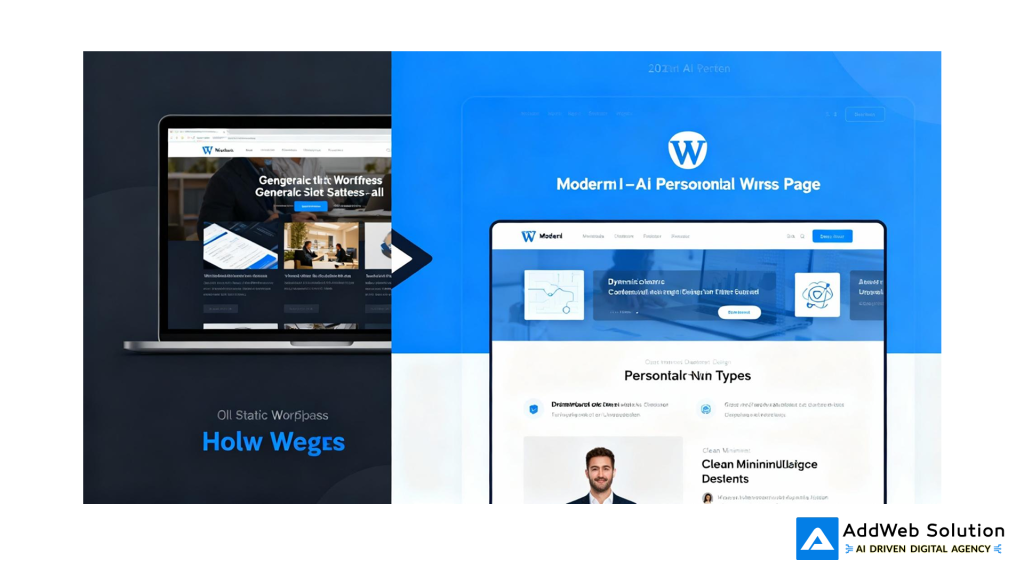
Chart Caption: The Shift from One-Size-Fits-All to Hyper-Personalized: How WordPress Changed Between 2020 and 2025.
This isn’t just plugin juggling. Real strategy has to come first. Before we build anything at AddWeb, we map out user journeys. Who is showing up? A first-time organic search visitor looks completely different from someone coming from a paid ad. What should they see? What should happen next?
Once you answer those questions, the tech falls into place.
3. The Real Numbers: Why This Actually Matters
Let’s get straight to business: does any of this actually move the needle?
Yes. Dramatically.
I’m talking about metrics that make CFOs sit up and pay attention. When you stop broadcasting to everyone and start talking to individuals, the conversion numbers shift in ways that are hard to ignore.
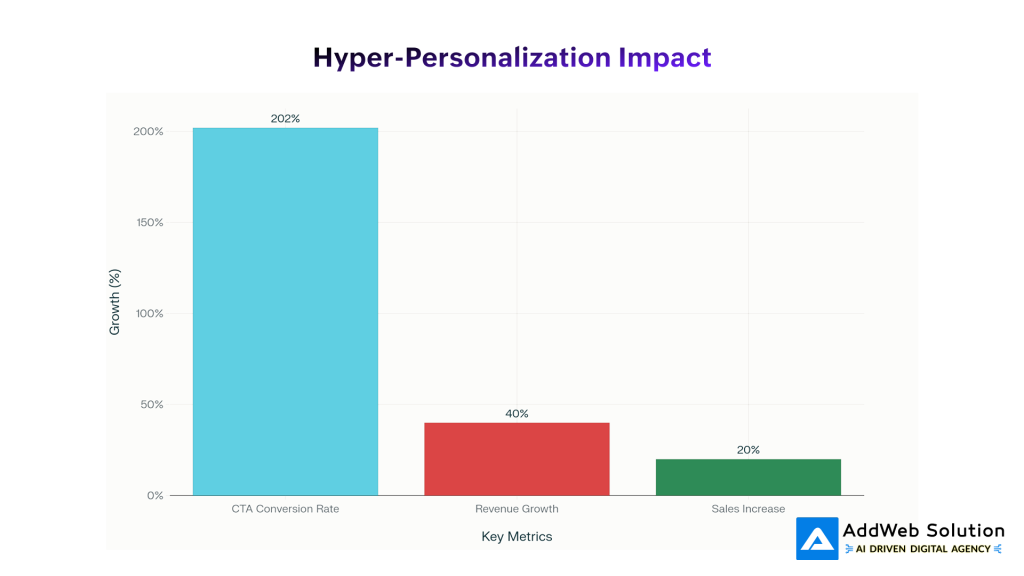
Chart Caption: Performance Uplift: Generic vs. Hyper-Personalized Tactics (2025 Benchmarks). The data shows why personalization matters.
What we’re seeing in the data:
A call-to-action button that says “Complete Your Checkout” blows away “Continue Shopping.” We’re talking about a 202% improvement in click-through rates when the button actually matches what someone is trying to do. It sounds obvious when you say it out loud, but most sites still don’t do it.
Revenue growth is hitting 40% for companies that are executing personalization well. These aren’t unicorns or massive tech companies with unlimited budgets. These are mid-market e-commerce brands, SaaS companies, and agencies. Real businesses seeing real results.
And it compounds. Sixty percent of people become repeat customers after a personalized experience. One good interaction doesn’t just convert them once—it flips a switch in their head that says “this company gets me.” They come back.
The margins we’re talking about here—doubling conversions on CTAs, 40% revenue bumps—these are the kinds of improvements that restructure a business. Suddenly your marketing budget is 40% more efficient. Your payback period shrinks. Your customer acquisition cost drops.
In an economy where every percentage point counts, this isn’t fluff. This is operational leverage.


4. The Tools WordPress Gives You (It’s Not Magic)
If you’re running WordPress, you don’t need to rebuild from scratch or migrate to some proprietary system.
The tools that power hyper-personalization are already available in the WordPress ecosystem. Tools like If-So let you conditionally display content based on visitor data. Logic Hop goes deeper—it can segment users based on behavior, geography, referral source, even time of day. WP Fusion connects your WordPress site to AI engines and CRM platforms so your personalization logic gets smarter over time.
None of these require PhD-level technical knowledge. Most are drag-and-drop if you’re comfortable in WordPress. Some companies we work with have built sophisticated personalization systems in weeks, not quarters.

Chart Caption: The Hyper-Personalization Workflow: From Visitor Arrival to Conversion.
The real challenge isn’t technology. It’s the thinking. You have to actually know what different user segments want to see. A CEO visiting your site needs different information than a freelancer. Someone arriving from a “case study” link needs a different experience than someone arriving from a “pricing” link.
Map that out. Build the content variants. Plug in the tools. Watch your numbers improve.
How small agencies scale WordPress delivery, without hiring full-time teams?

Pooja Upadhyay
Director Of People Operations & Client Relations
5. Quick Facts That’ll Stick With You
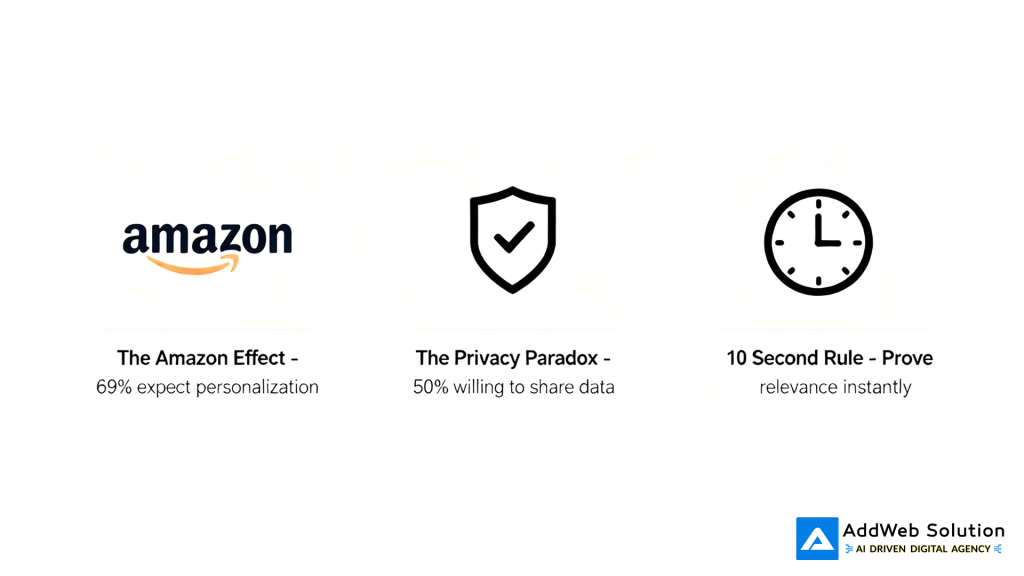
Chart Caption: Key Personalization Statistics That Matter in 2025.
➜ The Amazon Effect Is Real
Sixty-nine percent of today’s internet users expect your website to behave like Amazon—with recommendations, history, personalized everything. If you’re not doing that? To them, your site feels broken. Not slow. Not ugly. Broken.
➜ The Privacy Paradox
People say they care about privacy, and they do. But here’s the thing: more than half are willing to share personal data if it means getting a better deal or a genuinely useful experience. It’s not a binary choice for users. They’re trading privacy for value, and they’re okay with it.
➜ You Have Less Than 10 Seconds
Nope, not 10 minutes. Not even 10 seconds to prove relevance to a visitor. Show them something generic or irrelevant, and they’re gone. Personalization is the only tool that makes the cut in that time frame. It’s literally the fastest way to say “we see you, and we’ve got what you want.”
The Bottom Line
Hyper-personalization isn’t a trend that’s going to fade. It’s not experimental anymore. It’s the baseline expectation.
Users have tasted Amazon, Netflix, and Spotify. They’ve experienced what it’s like when a platform actually knows them. Every generic website now feels slightly rude by comparison, like you’re being ignored.
The good news? Building a hyper-personalized WordPress site doesn’t require an engineering army or venture capital. The tools exist. The best practices are documented. What’s left is execution.
If your WordPress site is still showing everyone the same thing, you’re not just missing out on conversions. You’re actively pushing people away.
The upgrade from static to liquid content isn’t optional anymore. It’s table stakes.
Turn website personalization into smarter growth with WordPress
Pooja Upadhyay
Director Of People Operations & Client Relations
Want to Get Started?
If you’re looking to move beyond generic and build a WordPress site that actually knows your visitors, we’d love to talk. At AddWeb, we’ve helped dozens of companies transform their WordPress presence from forgettable to unmissable.
Get in touch—let’s build something better.
