


Combining the speed and flexibility of the MERN stack (MongoDB, Express, React, Node.js) with the power of machine learning (ML) is transforming what startups can achieve. By making intelligent features more accessible, founders are deploying recommendation engines, predictive analytics, chatbots, and automated decisioning into live products—often with minimal infrastructure or cost.
Why MERN + ML Is a Startup Game-Changer
MERN’s JavaScript foundation enables seamless data collection, model integration, and feature delivery across the stack.
· MongoDB serves as a flexible, document-based store for diverse training data and model outputs, unlike rigid SQL schemas.
· Node.js/Express allows robust API creation to connect with ML services, external APIs, or microservices enabling real-time inference and feedback.
· React delivers dynamic, interactive UIs that consume, display, and act on predictions without reloads.
· JavaScript ML libraries (TensorFlow.js, Brain.js) and cloud AI APIs (OpenAI, AWS ML, Google AI) are easily consumed from Node or React.


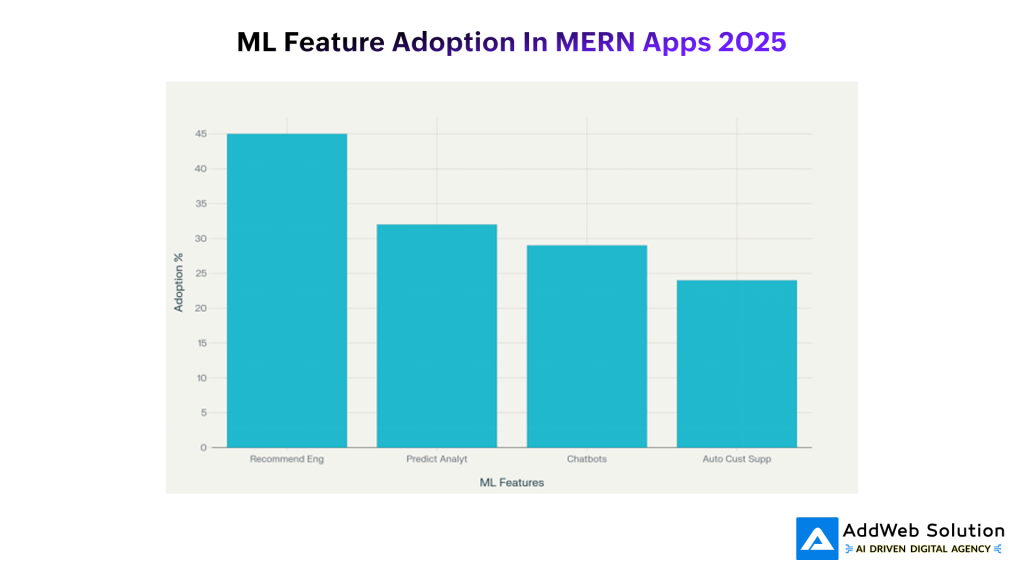
Top 2025 Startup ML Features in MERN Apps
| ML Feature | Adoption Rate (%) |
| Recommendation Engines | 45 |
| Predictive Analytics | 32 |
| Chatbots | 29 |
| Automated Customer Support | 24 |
Startup Adoption Rate of ML Features in MERN Apps (2025)
Three Proven Integration Approaches
1. Direct JavaScript ML Libraries
· Tools like TensorFlow.js and Brain.js run models in Node or the browser.
· Suitable for client-side predictions, adhoc scoring, spam detection, or personalization in React components.
· Example: A fitness app running calorie estimators and health scorers in-browser, reducing server load.
2. ML-Powered APIs
· Connect to lightweight REST endpoints that run models hosted in Python/SciKit-Learn, cloud (AWS, Google), or third-party NLP/image tools.
· Fast to implement in Node.js Express: call the API, pass results to MongoDB or React.
· Example: An e-commerce startup calling a Python image classification API to auto-tag products from user-uploaded images.
3. Full ML Pipelines in the Cloud
· For advanced use cases, model training, deployment, monitoring—Node.js backends connect to Amazon SageMaker, Azure ML, or Google ML ops tools.
· MongoDB logs input/output, tracks model versions, and enables A/B testing or retraining.
· Example: A fintech app running loan approval risk models, monitoring bias, accuracy, and feeding retraining loops.
Case Studies: Real Startup Impact
· On-demand Delivery: A food-delivery company scaled from 10,000 to 500,000 users using MERN for real-time location ML, order ETAs, and fraud detection.
· EdTech: Adaptive learning platforms leveraged MERN for rapid module prototyping and AI-driven content recommendation, boosting retention and outcomes by over 20%.
· Healthcare: Regional clinics used MERN to power chatbots, appointment triage, and symptom monitoring, reducing staff overhead and improving patient outcomes.
· E-Commerce: Automated product search and NLP chatbots in MERN increased conversion by 25% and reduced manual support needs.
Technical Blueprint: ML Pipelines in MERN
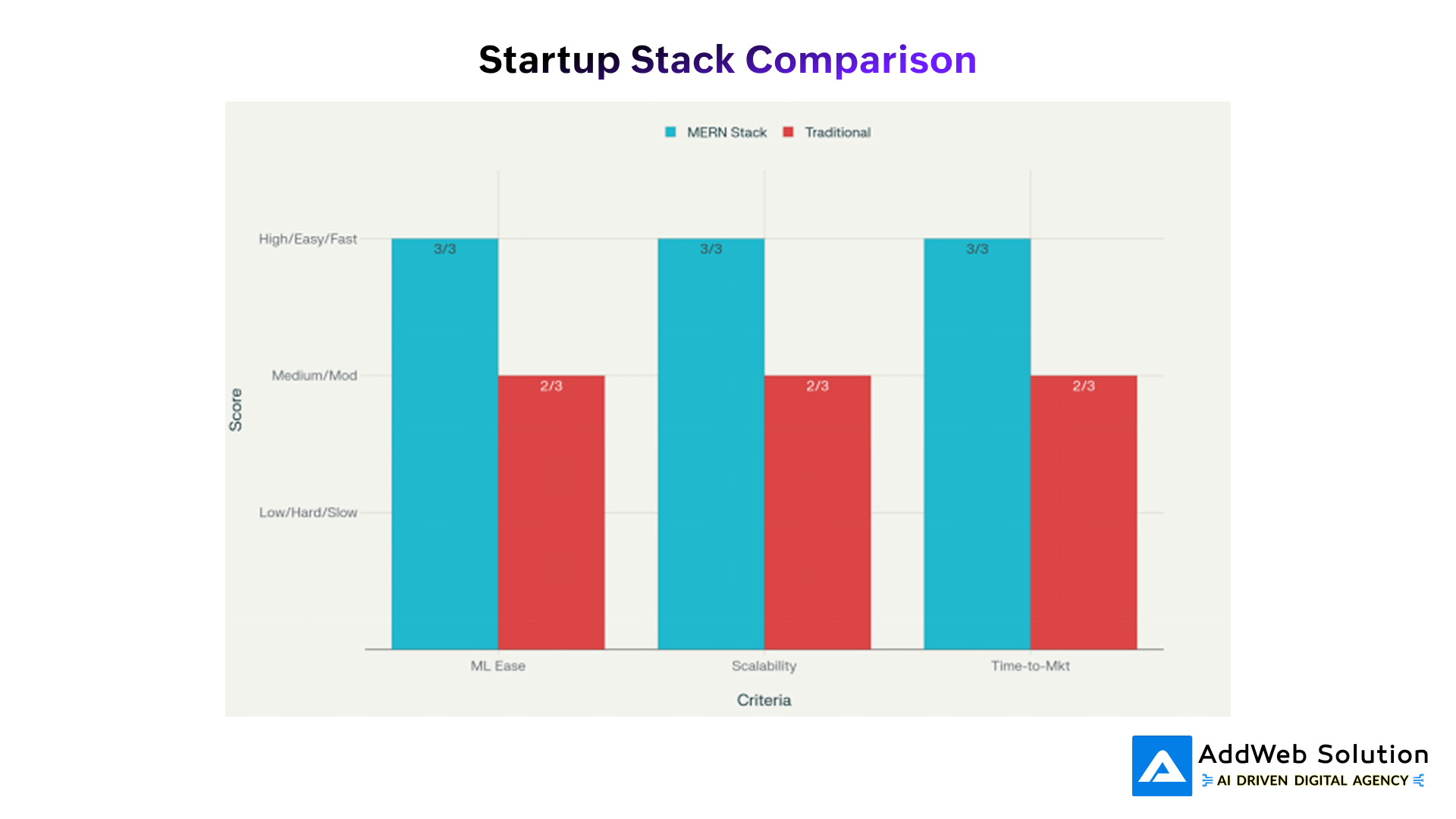
Stack Comparison: ML Integration and Startup Agility
| Criteria | MERN Stack | Traditional Stacks |
| ML Integration Ease | Easy | Moderate |
| Scalability | High | Medium |
| Time-to-Market | Fast | Medium |
· Modular project structure (client/server separation, clear API routes, test automation).
· Containerized deployments using Docker for both Node.js backend and ML inference pipelines (Python, R, or cloud-managed).
· Shared utility modules for data cleaning, model invocation, and logging.
· API gateway in Express securely brokers all ML, data, and analytics requests—implementing authentication, rate limiting, and logging.
Best Practices for AI in MERN Startups
· Isolate ML logic: Keep models and APIs decoupled from business logic for easier updates and improved testing.
· Secure all prediction endpoints: Protect ML services with token authentication, rate limiting, and HTTPS.
· Standardize data preprocessing: Share modules for data cleaning both client- and server-side to avoid skew and improve results.
· Log everything: Store predictions, inputs, errors, and user corrections in MongoDB for traceability, audits, and model retraining.
· Monitor latency and usage: Instrument both front- and backend for performance, predicting bottlenecks before they impact users.
Beyond MERN: MERN vs. Python Full Stack for ML
| Stack | ML Library Ecosystem | Ease of ML Service Integration | Best Use Cases |
| MERN (JavaScript) | TensorFlow.js, Brain.js, ONNX.js | Extremely easy, fast for RESTful APIs | Fast web/mobile apps, real-time UX, client-side ML |
| Python Full Stack | scikit-learn, TensorFlow, PyTorch | Deep options, best for in-depth pipelines | Heavy data apps, complex AI, scientific/analytic |
MERN excels for rapid MVPs, client-facing ML, and flexible AI experiments; Python stacks remain ideal for pure data science and deep modeling.
Leverage the full power of MERN + ML to stay ahead in 2025

Pooja Upadhyay
Director Of People Operations & Client Relations
The DevOps & MLOps Layer
Modern startups can tie CI/CD (using GitHub Actions, Jenkins) directly to the MERN + ML project, automating testing, deployment, and even model retraining. With Dockerized microservices, scaling up from dozens to millions of users is seamless.
Conclusion
The blend of MERN and machine learning lets startups harness the best of both rapid developer productivity and cutting-edge intelligence.
· Seamless integration, modularity, and scalability mean founders can go from MVP to production with advanced analytics, automation, and UX features with ease.
· Strong community support, open-source tools, and a wide range of deployment strategies deliver lasting value, cost-effectiveness, and innovation at scale.
· MERN + Machine Learning isn’t just for tech giants. With smart project structure and best practices, early-stage teams can deliver competitive, AI-powered products—turning data into true differentiation.
The future of agile, intelligent startups is already here—with MERN and ML leading the way.
Source URL:
1. https://www.linkedin.com/pulse/technical-approach-integrating-ai-mern-stack-mukesh-ram-max–8kz0f
2. https://www.cmarix.com/blog/how-to-build-ai-powered-web-app-with-mern-stack/
3. https://www.addwebsolution.com/blog/ai-in-mern-stack-development
4. https://www.aalpha.net/blog/mern-stack-for-mobile-app-development/
5. https://hanzala.co.in/blog/mern-stack-project-workflow-a-complete-guide-to-streamline-development/
6. https://www.innomatics.in/mern-vs-full-stack/
7. https://www.imaginarycloud.com/blog/tech-stack-software-development
10. https://digitaldefynd.com/IQ/machine-learning-case-studies/
11. https://www.projectpro.io/article/machine-learning-case-studies/855
12. https://www.addwebsolution.com/blog/mern-stack-trends-2026
13. https://interviewkickstart.com/blogs/articles/machine-learning-case-studies
14. https://neptune.ai/blog/building-end-to-end-ml-pipeline
15. https://www.geeksforgeeks.org/machine-learning/top-20-mlops-case-studies-success-stories-in-2024/
16. https://moldstud.com/articles/p-harnessing-the-power-of-machine-learning-in-mern-applications
17. https://www.growexx.com/blog/best-practices-for-model-deployment-in-machine-learning/
19. https://buildprompt.ai/blog/case-studies-startups-successfully-using-ai-to-disrupt-industries/
20. https://rishabhraj43.hashnode.dev/integrating-machine-learning-model-with-web-app
