


Manual stock tracking feels harmless when operations are small, but at scale it quietly eats margin, cash flow, and customer trust. Modern inventory platforms like Zoho Inventory turn that chaos into a predictable, data-driven system that can actually keep up with how fast business moves now.
Why manual stock tracking is hurting your business
For many small and mid-sized businesses, inventory still lives in Excel, Tally exports, and a stack of paper GRNs on someone’s desk. The trouble is that manual inventory tracking is one of the highest-risk processes to keep “old school”: up to 78% of inventory mistakes come from manual processes such as hand-entered stock counts and spreadsheet updates. Employees can end up spending around 40% of their time on manual inventory tasks alone, which is an enormous drag on productivity.
Those errors and delays are not just irritating, they are expensive. Global research on retail and supply chains shows that inventory distortion (the combined cost of overstocks and out-of-stocks) drains roughly 1.73 trillion dollars from retailers every year. A separate survey of North American SMBs found that 78% are still not using purpose‑built inventory management software, which means most companies are fighting this trillion-dollar problem with spreadsheets and gut feel.
Visually, the gap between manual and automated inventory is easy to understand: one side is built on late, inconsistent data; the other runs on real‑time signals and structured workflows. The rest of this article breaks down what that shift looks like in practice, and how Zoho Inventory fits into the picture.
Figure 0: Many growing businesses still rely on manual stock tracking with spreadsheets and paper registers, which don’t scale once sales and SKUs take off.
From manual to smart inventory: what really changes
The simplest way to see the impact of automation is to compare where errors and effort actually come from. Studies on manual tracking show that human errors occur in about 1–4% of manual entries, and as many as 27% of operations can be affected by those inaccuracies. When stock data is wrong at the source, it flows through purchasing, sales, accounting, and fulfillment, creating “phantom inventory” on paper and angry customers at the door.
At the same time, the wider market is moving decisively towards software-driven inventory. The global inventory management software market is estimated at around 3.58 billion dollars in 2024 and is projected to reach 7.14 billion dollars by 2033, with small and medium enterprises expected to be the fastest‑growing segment due to the affordability of cloud tools. In India specifically, e‑commerce GMV has already crossed 60 billion dollars with double‑digit growth, which naturally pushes even traditional distributors and retailers toward real‑time, multi‑channel stock visibility.

Pie chart showing that 78% of inventory errors are due to manual processes and 22% from other causes.
This is exactly why digitizing supply chains is a strategic priority. Analysis derived from McKinsey’s work on digital supply chains shows that digitalizing supply chains can reduce operational costs by up to 30% and cut lost sales by up to 75% in just two to three years when properly implemented. That level of impact simply isn’t achievable when inventory still lives in offline sheets and siloed tools.
Comparison table: Manual tracking vs generic tools vs Zoho Inventory
Table 1: How different inventory approaches stack up in daily operations (Alt text: Table comparing manual tracking, generic tools, and Zoho Inventory across accuracy, time, scalability, and visibility.)
| Dimension | Manual spreadsheets / registers | Generic inventory tool | Zoho Inventory (cloud, Zoho ecosystem) |
| Data accuracy | Highly error‑prone; 1–4% entry error rate typical | Better, but still depends on manual updates | Real‑time updates with barcode and serial/batch tracking reduce human errorzoho+1 |
| Time spent on inventory | Staff can lose 25–39 hours per week on manual tasks | Some time saved, but workflows often disjointed | Automation can cut manual inventory work by 60–80% in many implementations |
| Multi‑channel selling | Difficult to reconcile orders from marketplaces | Often requires extra connectors | Native ecommerce integrations with platforms like Shopify and Amazon |
| Multi‑warehouse control | Very hard to track stock across locations manually | May support locations, often with limited reports | Dedicated multi‑warehouse features, transfers, and warehouse reports |
| Reordering & alerts | Manual review of sheets; reorders often late | Basic low‑stock alerts in some tools | Configurable reorder levels, alerts, and automated purchase workflows |
| Shipping & fulfilment | Courier booking done separately; tracking disjointed | Some shipping integrations | Integrations with 50+ shipping carriers, automatic tracking updates |
| Reporting & analytics | Static reports; high effort to produce | Limited dashboards | Real‑time warehouse and item-level reports for sales and purchase trends |
The differences become stark as soon as order volume, SKU count, or channel complexity crosses a certain line. At that point, manual processes are not just “inconvenient” they are structurally incapable of giving leadership the visibility needed to make confident decisions on procurement, pricing, or expansion.
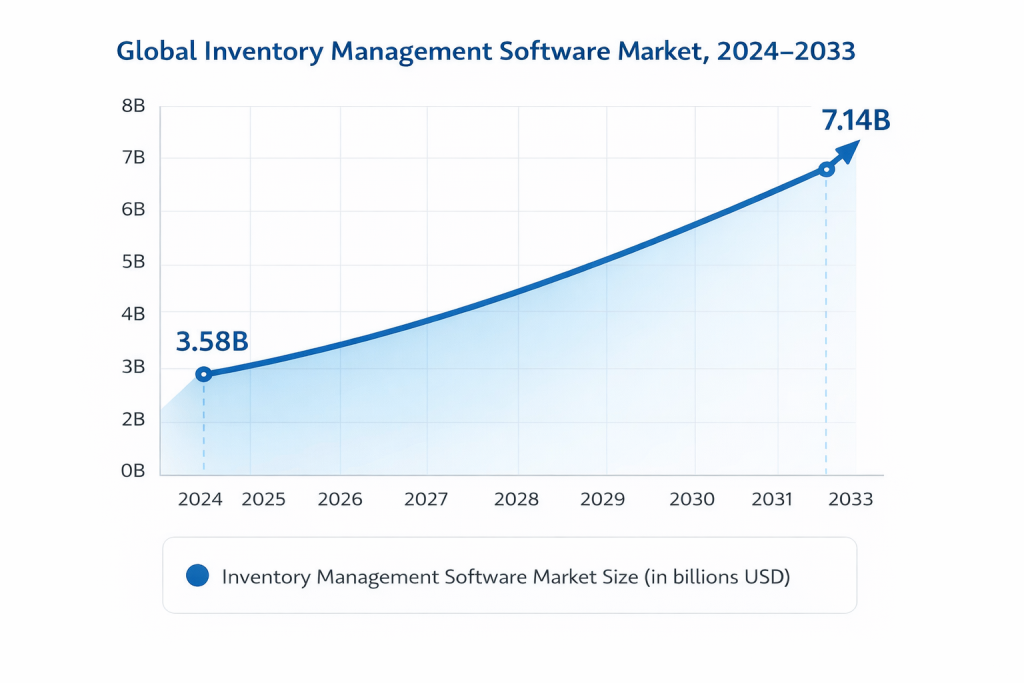
Line chart starting at 3.58B in 2024 and rising to 7.14B by 2033, showing a strong upward trend in inventory software adoption.
This overall market trajectory mirrors what is happening inside individual businesses: leaders are realizing that inventory is a strategic asset, not a static list of items. Tools like Zoho Inventory are becoming the “operating system” for products, orders, and cash tied up in stock.


What Zoho Inventory actually does differently
Zoho Inventory is designed to take that messy, manual stock reality and turn it into a set of consistent, trackable workflows, especially for businesses already using Zoho Books, Zoho CRM, or Zoho Commerce. At its core, Zoho Inventory offers multiple tracking modes (physical stock vs accounting stock), real‑time item visibility, and serial/batch tracking so every item can be traced from purchase to sale and even through returns.
For businesses working across multiple locations, Zoho Inventory can manage several warehouses under a single system, support transfers between them, and even suggest which warehouse should fulfil a given order to minimize delivery distance and shipping cost. Integrated reorder levels and automatic low‑stock notifications help prevent last‑minute “urgent PO” chaos by signalling when replenishment is needed well before a stockout hits customer orders.
Zoho Inventory also sits in the middle of the wider sales and fulfilment stack. It integrates with popular ecommerce platforms and shopping carts so sales from marketplaces and web stores can flow into a single stock ledger, while around 50+ shipping carrier integrations ensure that fulfillment and shipment tracking stay synced with actual inventory movements.
Real-world scenario: a fast-growing D2C brand
Consider a mid‑sized D2C skincare brand selling across its own Shopify store, Amazon, and a few offline resellers. Before automation, the operations team might be exporting orders into Excel, doing manual stock adjustments in Tally or Zoho Books, and updating a shared Google Sheet once a day. When a product goes viral on Instagram and demand spikes, this lag typically leads to overselling online and awkward calls to customers about cancelled or delayed orders.
With Zoho Inventory sitting in the middle, every order from each ecommerce channel updates stock levels in real time, regardless of where the order originated. If a particular SKU falls below the defined reorder threshold, the purchasing team gets an alert and can trigger a PO or even use predefined workflows to automate parts of that process.
For brands that store products in more than one location, Zoho Inventory’s multi‑warehouse capabilities help them route orders from the closest warehouse and transfer stock between locations when one region is running hot on a particular product. The result is fewer stockouts, fewer “we’ll call you back” moments for customers, and a lot less time spent reconciling who sold what from where at the end of the month.
Interesting Fact Box
Alt text: Highlighted box showing three key statistics about inventory mistakes, software usage, and global losses.
- Up to 78% of inventory mistakes are caused by manual processes like hand entry and spreadsheet updates, according to industry analysis of manual tracking.
- A survey of North American SMBs found that 78% are still not using purpose‑built inventory management software, despite significant supply chain disruption and rising warehousing costs.
- Global retailers are estimated to lose around 1.73 trillion dollars annually to inventory distortion (combined out‑of‑stocks and overstocks), underlining how expensive poor stock visibility really is.
These numbers put a hard financial edge on what often feels like a “purely operational” problem. Switching from manual tracking to an integrated platform like Zoho Inventory is not just a process improvement; it is a P&L decision.gegosoft+1
Quote Section
“The next decade will see technology advancements that rival 30 years of previous innovation in retail supply chain operations.”
— Greg Buzek, President, IHL Group
This captures the broader direction of travel: inventory technology is not in a “nice-to-have” phase; it is where competitive advantage is being built in retail and distribution.
Insights summarizing McKinsey’s work on digital supply chains show that organizations that digitize their supply chains can reduce operational costs by up to 30% and cut lost sales by as much as 75% in two to three years, while significantly reducing inventory levels.
Together, these viewpoints reinforce a simple message: the cost of staying manual is no longer just about inconvenience; it is about being structurally less competitive than peers that have automated.
How to know you’re ready to move to Zoho Inventory
Some businesses resist switching tools because they “aren’t big enough yet,” but in practice the tipping point arrives sooner than expected. A few clear signals usually mean it is time to look seriously at Zoho Inventory or similar systems: stock numbers rarely match physical reality, sales teams and warehouse staff argue about availability, and finance spends days every month trying to reconcile what actually moved.
On the economic side, ROI models for inventory management software consistently show strong returns. Case studies and calculators from industry providers cite 300–500% ROI in the first year by combining labor savings, lower carrying costs, and revenue protection from fewer stockouts. Those gains are amplified when software sits at the center of your tech stack, syncing orders, shipments, and accounting instead of leaving them fragmented across tools.
Zoho Inventory is particularly compelling when the rest of the stack is already on Zoho, Zoho Books, Zoho CRM, Zoho Commerce, Zoho Analytics because inventory data then flows cleanly into finance, sales, and reporting without custom glue code. Even for non‑Zoho environments, its ecommerce and shipping integrations, combined with robust warehousing and tracking features, make it a strong hub for any business ready to move beyond manual stock tracking.
