


AI in CRM is no longer a “nice to have experiment” sitting in a lab or a side project inside marketing. It is quietly becoming the control layer for how revenue, support, finance, and operations run day to day. For Zoho customers, that control layer is being built on three pillars: AI-driven CRM, AI-infused analytics, and end-to-end automation all moving toward a 2026 reality where agents do work, not just assistants.
For growing businesses, especially in the SMB and mid-market band, the takeaway is simple: by 2026, the competitive gap will be less about “which CRM you picked” and more about how deeply you’ve wired AI into your Zoho stack to make decisions, trigger actions, and surface insights in real time.
1. Why AI-Driven CRM Is No Longer Optional
The CRM market is no longer a sleepy back office category. It has become one of the fastest growing software segments, driven largely by AI and automation.
Analysts estimate:
- The global AI in CRM market grew from about USD 4.1 billion in 2023 and is projected to reach USD 48.4 billion by 2033, a 28% CAGR.
- The broader CRM software market hit around USD 80 billion in 2024, up 10.5% year-over-year, and is projected to reach the USD 106–107 billion range by 2028–2029.
- McKinsey’s 2024 AI study found that overall AI adoption jumped from ~50% to 72% of organizations using AI in at least one business function; marketing and sales saw the biggest surge.
Generative AI has moved even faster. McKinsey’s 2024/2025 insights show that:
- Only about 33% of organizations used generative AI in 2023, but
- Around 65% reported regularly using generative AI in at least one function in 2024.
This shift is visualised below.
Visual 1: Generative AI adoption in organizations (2023–2024)

Generative AI adoption has almost doubled in a single year, moving from fringe experiment to mainstream business capability.
For sales, marketing, and service teams, this isn’t abstract. Salesforce’s 2024 data shows 83% of sales teams using AI saw revenue growth versus 66% of teams without AI, underscoring that AI is now a real performance divider, not just a buzzword.
In other words:
- CRM is becoming the system of record for customer data.
- AI and analytics are becoming the “brain” that interprets that data.
- Automation is turning those interpretations into consistent actions.
Zoho’s 2026 vision is essentially about tightening this triangle CRM + AI + Automation into one continuous loop.
2. Inside Zoho’s AI Stack: CRM, Analytics, and Automation Working Together
Zoho’s roadmap over the last 18–24 months has been remarkably consistent: embed AI into every layer, keep it privacy-conscious, and make it usable for non-technical teams.
2.1 Zoho CRM: Zia as the Sales and CX Brain
Zoho CRM is no longer just a place to store leads and deals. With Zia, Zoho’s AI engine, it has become a decision and action hub for sales, service, and marketing teams.
Some of the more impactful capabilities include:
- AI agents and automation suggestions
- Zia can now identify repetitive activities and recommend workflows, macros, and assignment rules based on how your team actually works.
- AI agents can autonomously execute sales-related tasks inside CRM, augmenting (not replacing) your reps’ daily work.
- Predictive intelligence
- Lead and deal scoring based on past interactions, behaviors, and profile data.
- Churn prediction for subscription businesses, with indications of which product or service is at risk.
- Sales forecasting that uses historical data and current pipeline behavior to produce more realistic, scenario-based forecasts.
- Content and communication intelligence
- Generative AI support to help draft emails, follow-ups, and summaries inside CRM.
- Zia Email Intelligence can analyze sentiment and urgency, flagging high-priority messages for faster response.
- Data quality and enrichment
- Zia can enrich records with additional public data, detect duplicates, and highlight anomalies in your CRM data.
From an implementation perspective, what matters is that these AI features are no longer “optional add-ons”. They are increasingly baked into everyday CRM workflows scoring, predicting, enriching, and nudging users toward higher-value actions.
2.2 Zoho Analytics: From Reporting Tool to AI-Powered Decision Fabric
If CRM is the operational front line, Zoho Analytics is becoming the intelligence fabric that sits across CRM, finance, marketing, support, and custom apps.
The 2024 revamp delivered 100+ new AI-driven features, including:
- Ask Zia – conversational BI
- Natural language queries that generate charts, pivot tables, and dashboards on the fly.
- Multi-language support and integration with collaboration tools like Microsoft Teams.
- Zia Insights and diagnostic analytics
- Narrative explanations answering “what changed, and why?” instead of just plotting numbers.
- Key driver analysis, anomaly detection, and contextual recommendations.
- Auto Analysis and AutoML
- Automatic creation of dashboards and reports based on your data model, cutting time-to-insight significantly.
- A Data Science & Machine Learning Studio that lets analysts and business users build predictive models forecasts, churn models, and demand predictions without heavy coding.
- Massive connectivity and data governance
- 500+ data connectors and a strengthened data management hub to unify CRM, ERP, marketing, support, and custom app data.
The practical effect: by 2026, executives and front-line managers will be spending far more time in Analytics-driven views of CRM data, not in static pipeline reports.
2.3 Automation: Zoho Creator, Flow, and the Hyperautomation Shift
The third pillar is automation where Zoho Creator, Zoho Flow, and workflow engines across Zoho apps are evolving toward hyperautomation: the convergence of RPA, AI, analytics, and process mining.
Key trends shaping 2025–2026:
- Hyperautomation and end-to-end flows
- Automation is moving from “single-task macros” to cross-app, conditional workflows (if/else chains, time-based triggers, and multi-app orchestration).
- Offline workflows, geo-tagged field operations, and AI-enhanced routing for mobile teams are now part of Zoho’s field operations story.
- Time and cost savings from workflow automation
- Formstack’s data shows 51% of workers spend at least two hours per day on repetitive tasks, and McKinsey estimates that up to 60% of employees could save 30% of their time with automation.
- Workflow automation has been shown to reduce repetitive tasks by 60–95% and save up to 77% of time on routine activities for some organizations.
- Finance and operations workflows alone can save an average of USD 46,000 per year per organization through automation of invoicing, approvals, and reporting.
For Zoho users, this is exactly where Creator and Flow become strategic—tying together CRM events, Analytics insights, and back-office systems into one automated fabric.


2.4 How the Stack Fits Together (Zoho CRM + Analytics + Automation)
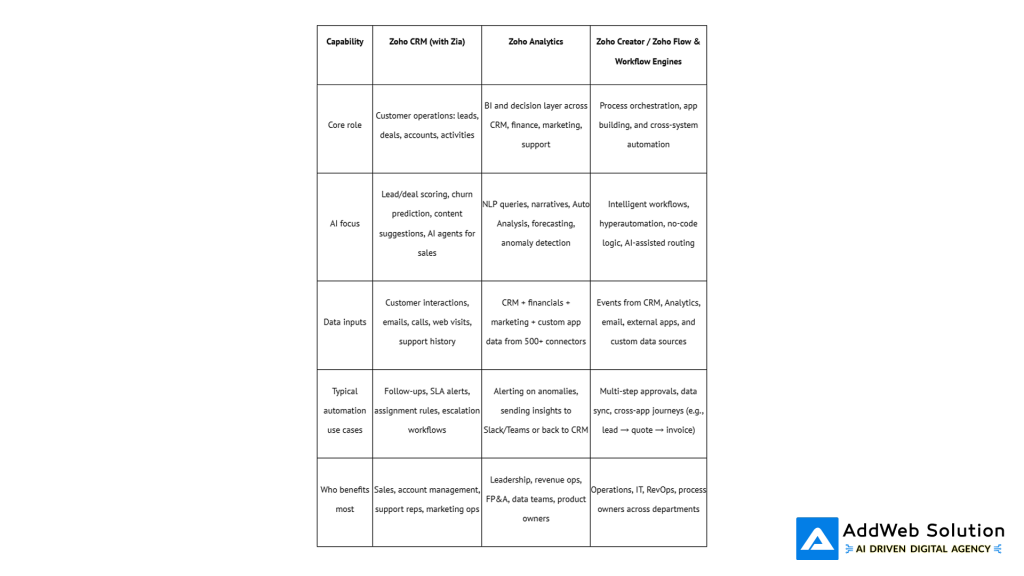
Table comparing how Zoho CRM, Zoho Analytics, and Zoho automation tools (Creator/Flow) handle AI, analytics, and workflow automation.
3. From AI Assistants to AI Agents: Zoho’s 2026 Direction
Zoho has been very explicit: the future is not just AI assistants that answer questions but AI agents that take action.
An AddWeb-authored roadmap analysis of Zoho’s 2025 announcements highlights three key moves:
- Zia LLM – Zoho’s own large language model, purpose-built for business and enterprise context.
- 40 pre-built Zia Agents – task-specific agents for sales, support, finance, and operations.
- Zia Agent Studio – a no-code environment to design, configure, and deploy custom AI agents.
By late 2025, Zoho signalled support for Agent2Agent (A2A) protocols, enabling Zoho agents to collaborate with agents in other platforms critical for cross-stack workflows.
On top of this, Zoho CRM’s own AI page is already positioning AI agents for sales as a first-class capability: agents that execute business tasks autonomously, not just reply to prompts.
What does this actually look like by 2026 in a typical Zoho-powered business?
- Proactive retention workflows
- An AI agent monitoring subscription data in Zoho Billing + engagement from CRM + usage signals from custom apps built in Creator.
- When churn risk crosses a threshold, it automatically opens a “Save Plan” play in CRM, assigns the right rep, drafts a personalized offer, and tracks response.
- Revenue operations without spreadsheets
- An agent continuously compares pipeline health in Zoho CRM with historical close patterns in Zoho Analytics.
- It flags deals likely to slip, proposes forecast adjustments, and opens tasks for deal rescue sequences without a sales manager pulling manual reports.
- Agent-to-agent collaboration across tools
- A Zoho agent coordinating with an external support or logistics agent via the emerging A2A ecosystem to complete complex workflows (for example, arranging replacements, refunds, or escalations across multiple systems).
Crucially, Zoho is pairing this agentic push with a privacy-first, data-sovereign AI strategy:
- Zoho’s AI models are explicitly described as not using customer data to train generic models; customer data is used only for customer-specific models and is not retained beyond processing.
- Zia LLM runs on Zoho-owned data centers, with smaller, right-sized models (e.g., 1.3B and 7B parameters) tuned for business tasks like summarisation, lead scoring, and report generation reducing both risk and infrastructure cost.
That combination of agents + privacy-first LLMs is what makes Zoho’s 2026 AI vision distinct from the “AI for everything” hype.
4. Data-Driven Outcomes: What Businesses Are Actually Seeing
The conversation about AI often swings between “magic” and “hype”. Zoho’s ecosystem, and the broader research around AI in CRM and automation, paints a more grounded picture: meaningful gains, when implemented thoughtfully, with clean data and clear workflows.
4.1 Where the AI-in-CRM Money Actually Is

Pie chart showing that software accounts for 71.5% of AI in CRM revenue, while services account for 28.5%.
A 2024 market report estimates that software captured over 71.5% of the AI in CRM market in 2023, with services making up the remaining 28.5%. This reinforces a key strategic point for Zoho customers:
- The platform choice (Zoho CRM + Analytics + automation) is where most of the economic value sits.
- Service and consulting multiply that value, but they can’t compensate for a weak underlying platform.
4.2 AI and Automation Performance Gains
Several independent datasets now converge on a similar set of outcomes:
- Top-line and revenue impact
- Companies using AI in CRM have seen 44% higher lead generation and up to 10% higher offer acceptance rates according to one AI-in-CRM market analysis.
- Sales teams leveraging AI are 1.3× more likely to report revenue growth, with 83% of AI-enabled teams seeing growth vs 66% of teams without AI.
- AI-driven sales strategies can deliver 13–15% revenue growth through better targeting and shorter sales cycles.
- Productivity and time savings
- 51% of workers spend at least two hours a day on repetitive tasks. Workflow automation can cut a large portion of that, and many organizations report up to 77% time savings on routine processes.
- Managers often spend eight hours per week on manual data tasks automation significantly reduces that burden, especially in HR, finance, and operations.
- Marketing and personalization lift
- Personalized emails deliver around 29–41% higher open and click-through rates, and personalized calls-to-action can drive dramatically higher conversion rates compared to generic CTAs.
- AI-powered hyper-personalization has been associated with up to 40% increases in conversion rates and 42% improvements in marketing ROI.
Interesting Fact Box – AI & Automation Snapshot (2024–2025)
- AI in CRM CAGR: 28% growth expected from 2024–2033, from USD 4.1B to 48.4B.
- AI adoption: 72% of organizations now use AI in at least one function, up from roughly 50% previously.
- Gen AI usage: Regular use of generative AI jumped from 33% to around 65% of organizations in about a year.
- Repetitive work: 51% of workers spend 2+ hours daily on repetitive tasks automation can remove 60–95% of this in some workflows.
These are the macro signals. In practice, Zoho customers that wire Zia, Analytics, and automation together are seeing outcomes like faster lead response, more accurate forecasts, self-healing data, and fewer manual “swivel-chair” operations between tools.
Ready to grow? Dive in now and see how streamlined processes boost your results.

Pooja Upadhyay
Director Of People Operations & Client Relations
5. How to Prepare Your Zoho Stack for the 2026 AI Wave
By 2026, the gap will not be between “AI users” and “non-AI users”. Almost everyone will have access to AI features. The meaningful gap will be between those who integrated AI into their operating model and those who simply turned features on.
From an AddWeb implementation lens, here’s a practical way to prepare your Zoho environment.
5.1 Fix the Foundations: Data Quality and Integration
Zia and Zoho Analytics are only as good as the data they see. The first step is painfully unglamorous:
- Clean duplicates, incomplete fields, and inconsistent naming in Zoho CRM.
- Standardize key entities (accounts, contacts, products, territories).
- Connect Zoho CRM with Books, Desk, Campaigns, and external systems where needed, so Analytics can see full funnel journeys.
Zia’s data enrichment, anomaly detection, and deduplication features can actively help here but they should be used as part of a deliberate data quality program, not as a band-aid.
5.2 Start with One High-Impact AI-Driven Workflow
Rather than “AI everywhere”, 2025–2026 winners are focusing on one or two high leverage workflows first:
Examples in a Zoho stack:
- AI scored inbound leads in Zoho CRM automatically routed to the right rep, with time based follow-up sequences triggered through workflows.
- A churn risk dashboard in Zoho Analytics combining subscription, usage, and ticket data, with alerts sent back into CRM when risk spikes.
- Automated quote-to-cash flow: when a deal hits a certain stage and score, Zoho Flow/Creator kicks off approvals, document generation, and invoice creation.
Once one workflow is reliable and generating ROI, extending the pattern is far easier than starting “AI projects” in every department.
5.3 Bring Analytics to the Front Line
Many businesses still treat BI as an executive only tool. Zoho’s current trajectory suggests a different model:
- Sales reps asking Ask Zia inside Analytics, not waiting for a weekly Excel export.
- Support and success teams getting anomaly alerts when ticket types spike or CSAT dips.
- Product and operations leaders using Auto Analysis to see what changed this week, without building a new report every time.
By 2026, a “good Zoho implementation” will look like this: front line teams consume insights directly from Zoho Analytics and Zia, and those insights automatically trigger workflows in CRM and Creator.
5.4 Treat Privacy and Governance as Design Constraints, Not Afterthoughts
Zoho has been vocal about its trust and privacy stance: not monetizing customer data, not using it to train generic AI models, and keeping AI infrastructure under its own control.
Internally, teams should mirror that mindset:
- Be explicit about what data AI agents can access and which actions they can perform.
- Use Zoho’s identity, access, and security tools (Directory, Vault, OneAuth, Ulaa, etc.) to ensure AI-powered workflows respect roles and permissions.
- Explain to end users employees and customers when and how AI is used in your workflows, in line with Zoho’s own guidance on transparency and security in AI systems.
That’s how AI becomes trusted infrastructure and not a black box that people work around.
Quote Section
“Our entire SaaS business is based on the trust that we do not access customer data and we do not use it for selling stuff to them.”
— Sridhar Vembu, Zoho Founder
This philosophy is directly reflected in Zoho’s AI strategy: privacy first, owned infrastructure, and no ad based monetisation of user data.
“The teams that win with AI in Zoho aren’t the ones who switch on every feature; they’re the ones who pick a few critical workflows, wire CRM, Analytics, and automation around them, and then iterate relentlessly.”
— AddWeb Solutions Zoho Practice Lead
6. Bringing It All Together for 2026
By 2026, AI-driven CRM, analytics, and automation in Zoho won’t feel like “AI projects”. They will feel like the normal way business runs:
- CRM as a living system of record, constantly enriched and scored by Zia.
- Analytics as the decision fabric, explaining what changed and why in plain language, pushing insights directly into workflows.
- Automation and agents as the execution layer, quietly handling approvals, follow-ups, escalations, and cross system tasks.
The market numbers are clear: AI in CRM is compounding at 28% annually, CRM overall is marching toward a USD 100B+ market, and AI adoption has crossed from experiment to expectation.
For Zoho customers and for teams working with partners like AddWeb the question over the next 12–24 months is not “Should we use AI in our CRM?” That debate is over.
The real question is:
Will your Zoho stack be ready for a world where AI agents, privacy first LLMs, and hyperautomation are simply how revenue, support, and operations get work done?
