


Running a business on gut feel worked when margins were fat and competition was local. Today, your competitors are watching real-time dashboards while many owners still flip between Excel sheets, WhatsApp screenshots, and half-updated CRM reports.
That gap is where money is lost. Not because business owners lack instinct but because instinct without data is like driving at night with your headlights off.
Zoho Analytics changes that. It turns scattered numbers into a single, trustworthy story about how the business is really performing and does it in a way that’s accessible to non-technical founders, finance heads, and operations leaders.
This article breaks down how Zoho Analytics helps business owners stop guessing and start knowing using current market data, real examples, and practical tips you can act on immediately.
Why Gut Feel Isn’t Enough Anymore (And What the Data Says)
The business intelligence (BI) market isn’t a niche IT trend anymore, it’s a core layer of how modern companies are run. The global BI market was worth around 31.34 billion USD in 2024 and is projected to roughly double by 2034, hitting about 63.17 billion USD. That kind of growth only happens when something moves from “nice to have” to “how everyone operates.”
Self-service analytics where business users, not just data teams, can explore and build reports themselves, is exploding. Gartner predicts that by 2024, 75% of organizations will adopt self-service analytics so business users can get insights without waiting on IT. This is exactly the space Zoho Analytics lives in.
Zoom in on small and mid-sized businesses, and the picture gets even clearer. In India, about 60% of SMEs are already using big data analytics and report gains in efficiency, customer satisfaction, and sales. At the same time, research on SMEs shows that when leaders actually use data analytics in strategic decision-making, profitability and productivity go up because decisions are more grounded in real customer, market, and operations data.
For owners, this boils down to a simple reality: the businesses that thrive in 2024–25 are the ones that treat data as a daily operating tool, not a quarterly afterthought.
How Business Data Is Typically Scattered Today

This is the starting point for many owners AddWeb teams meet:
- Sales data lives in one system
- Accounting in another
- Marketing in yet another
- Operations in spreadsheets or even paper
Zoho Analytics doesn’t just “add reports” it pulls those islands together so you finally see the whole business on one canvas.
What Zoho Analytics Actually Does for a Business Owner
Zoho Analytics is a modern self-service BI and analytics platform. In plain language: it connects to your existing tools, pulls the data together, cleans it, and helps you see it through dashboards, reports, and AI-powered insights you can actually act on.
Recent updates have pushed it far beyond basic dashboards. Industry analysts note that Zoho Analytics has added over 100 enhancements, with deep integration of AI, an improved data science and machine learning studio, and better data management options positioning it as a serious competitor to tools like Tableau and Qlik, at a more accessible price point.
Some of the capabilities that matter specifically to business owners:
- Unified dashboards across tools
Connect CRM, accounting, e‑commerce, support, inventory, and marketing into a single view. Zoho now supports 500+ data connectors, including streaming data sources. - AI assistant (Zia) for natural-language questions
Type or say: “Show monthly revenue by channel for the last 12 months” and let the system build the chart. Zia now offers contextual, diagnostic insights helping you understand not just what happened, but why. - Data Science & Machine Learning Studio
Create predictive models (e.g., churn risk, sales forecasts) without deep data science skills through AutoML, while power users can go deeper with Python in the same environment. - Unified Metrics Layer
Define “revenue”, “active customer”, or “qualified lead” once, and use that definition everywhere, reducing reporting conflicts between finance, sales, and marketing. - Ready-made domain dashboards
Prebuilt dashboards for sales, finance, marketing, support, and operations mean you start with a solid base and then customize for your business.
Table: How Zoho Analytics Changes the Reporting Game
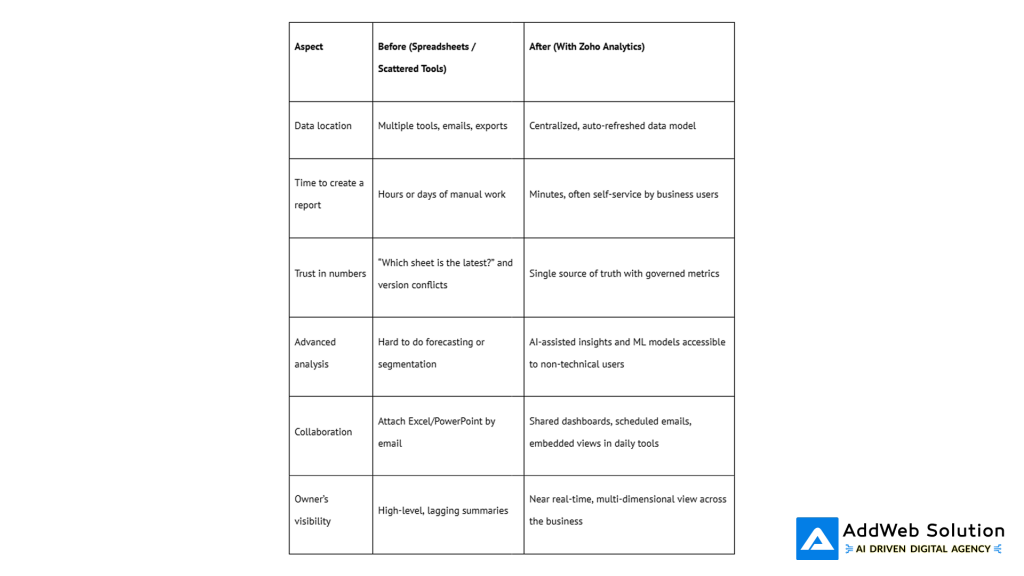
Table 1: Practical shift in reporting and decision-making when moving to Zoho Analytics.
Alt text: Table comparing current spreadsheet-based reporting with a Zoho Analytics-powered environment, highlighting gains in speed, trust, and depth of analysis.
From Spreadsheets to Smart Decisions: A Day in the Life With Zoho Analytics
To make this concrete, imagine a mid-sized distributor struggling with slow reporting. This is not theoretical Nucleus Research documented a real company, Sparex, that implemented Zoho Analytics and achieved an eye-opening 1,160% ROI with a payback period of just 1.2 months. They saw:
- Around 9% productivity improvement across 190 internal users
- 43 hours saved every week from faster reporting and report development
- Direct cost savings because teams could drive decisions with fewer specialized reporting resources
That’s what “stop guessing, start knowing” looks like in practice. Here’s how a typical day changes for a business leader once Zoho Analytics is in place:
- Morning: One dashboard, not ten tabs
- Open a single “CEO Snapshot” dashboard.
- See revenue, margins, collections, pipeline, stock-outs, and support tickets in one place.
- Spot that online orders are up, but repeat purchase rate has dipped in one region.
- Late morning: Ask questions in plain language
- Use Zia to ask: “Why did repeat orders drop in the South region last month?”
- Get a breakdown by product category, sales rep, and customer segment.
- Notice that delivery delays spiked after a logistics vendor change.
- Afternoon: Take decisions backed by numbers
- Call operations with clear data: delayed deliveries correlated with lower repeat orders and higher cancellations in specific pin codes.
- Run a “what-if” analysis: what happens to monthly revenue if on-time delivery improves by 10% for that region?
- End of day: Automatic reporting, no Excel drama
- Schedule daily/weekly reports for finance, sales, and operations.
- Key stakeholders receive tailored dashboards via email or embedded in their tools no one waits for last-minute Excel fixes.
This is the difference between reacting to problems after the quarter closes and catching them while there’s still time to fix them.
Visualizing the Shift: Market Proof That Analytics Is No Longer Optional
It’s one thing for vendors to say “data is the new oil.” It’s more useful to look at what the numbers say about businesses that actually invest in analytics and AI.
Salesforce’s global SMB research shows that 91% of small and medium businesses using AI say it boosts their revenue, and nearly 80% believe AI will be a game-changer for their company. The same study reports that 74% of growing SMBs are increasing their data management investments compared to just 47% of declining SMBs. In other words: growth and serious investment in data tend to go hand in hand.
On the broader BI side, the business intelligence market is projected to grow from about 31.34 billion USD in 2024 to roughly 63.17 billion USD by 2034. Self-service BI tools specifically were already a 6.3 billion USD market in 2023, with an expected compound annual growth rate of around 15% from 2024 to 2032. That’s a strong signal that organizations are doubling down on tools that let non-technical users work with data directly.
BI & Self-Service Analytics Market Growth

Figure 2: Business intelligence and self-service BI tool market growth, highlighting how analytics has become a mainstream capability, not a niche IT investment.
When this kind of growth coincides with accessible platforms like Zoho Analytics, the pattern is clear: waiting on analytics is increasingly a competitive risk, not just a “to-do for later.”
What Makes Zoho Analytics Different From “Just Another BI Tool”
There are many BI platforms in the market. What often makes Zoho Analytics stand out for owners and mid-market teams is the blend of capability, usability, and cost. Analysts observing Zoho’s latest release point out that the platform now combines advanced AI, data science, and robust data management, while still positioning itself as an accessible self-service BI tool.
Here are differentiators that matter in real projects:
- End-to-end in one ecosystem
For businesses already using Zoho CRM, Books, Inventory, Desk, or Zoho One, Zoho Analytics slots in naturally. It can also integrate with external tools, but the “Zoho inside Zoho” experience tends to be smoother and faster to roll out. - AI everywhere, not just as a buzzword
Zia is embedded across the platform: from natural language queries to automated insights and diagnostic analysis. Business users get guided narratives (“Revenue dropped 8% in Q3 mainly due to lower repeat orders in the North region”) instead of staring at raw charts. - Democratized Data Science
The Data Science and Machine Learning Studio plus AutoML features effectively place predictive analytics within reach of business analysts, not just data scientists. For example, predicting which customers are at risk of churn or which SKUs are likely to stock out. - Unified metrics and cross-BI integration
Larger organizations often suffer from “dueling dashboards” across tools. Zoho’s Unified Metrics Layer and BI Fabric approach aim to create one source of truth for KPIs, even when data also flows through tools like Power BI or Tableau. - Cost-effective for growth-focused businesses
Independent reviews highlight Zoho Analytics as competitively priced compared to leading BI platforms, with strong ROI when rolled out properly. This matters for owners who don’t want a tool that costs more to maintain than the value it unlocks.
Zoho Analytics in the Modern Tech Stack

Figure 3: Conceptual view of Zoho Analytics as a central analytics hub in a modern business tech stack.
Interesting Fact Box: Quick Stats Owners Should Know
Data & Analytics Fast Facts for 2024–25
- The global business intelligence market is valued at about 31.34 billion USD in 2024, projected to reach 63.17 billion USD by 2034.
- Self-service analytics is expected to be adopted by 75% of organizations by 2024, according to Gartner.
- In India, 60% of SMEs already use big data analytics, reporting better efficiency, customer satisfaction, and sales.
- A real-world Zoho Analytics deployment (Sparex) generated 1,160% ROI with payback in 1.2 months, along with 43 weekly hours of reporting time saved.
These aren’t abstract numbers; they reflect a shift in how businesses of all sizes are choosing to operate.


Is Your Business Ready for Zoho Analytics? A Quick Owner’s Checklist
Not every business needs full-blown analytics on day one. But there are clear signals that it’s time to move beyond spreadsheets. If several of these feel familiar, Zoho Analytics is likely worth a serious look:
- Reports are late, inconsistent, or heavily Excel-dependent
- Different teams argue because their numbers don’t match
- You rely on intuition for pricing, discounting, and territory planning
- Monthly or quarterly reviews feel like autopsies instead of a live health check
- You’re investing in AI, but your data foundation is shaky
Research on SMBs shows that while many small businesses still hesitate, 96% of SMB owners say they plan to adopt emerging technologies like AI. The same reports highlight that the most successful implementations start with data readiness, clean, connected, and trusted data before jumping into advanced AI use cases. Zoho Analytics helps build exactly that foundation.
Visual: Simple Owner-Focused Readiness Matrix
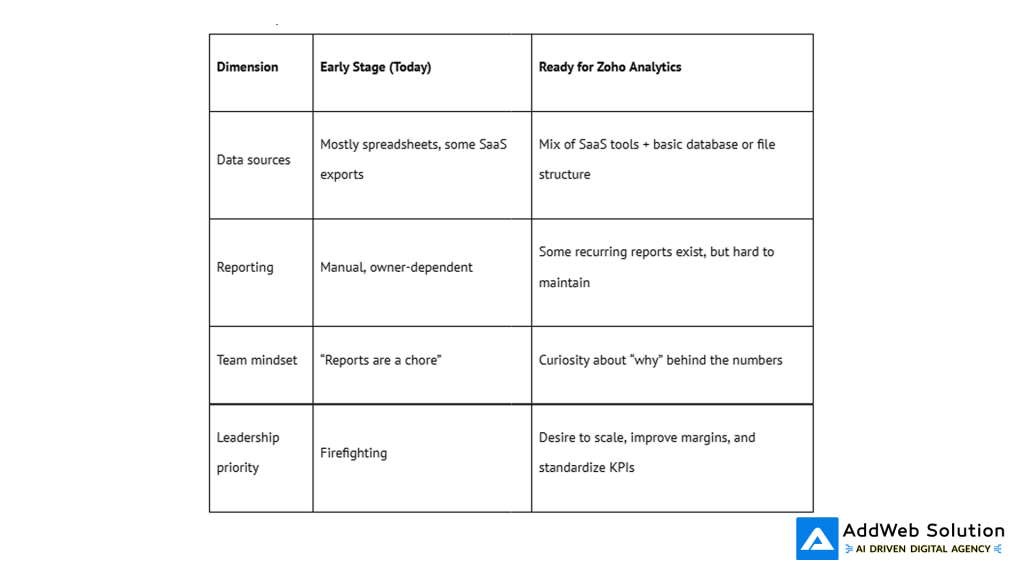
Table 2: Simple readiness snapshot for business owners evaluating when to invest in a BI platform like Zoho Analytics.
Alt text: Table outlining characteristics of early-stage vs analytics-ready businesses across data, reporting, mindset, and leadership priorities.
Ready to grow? Dive in now and see how streamlined processes boost your results.

Pooja Upadhyay
Director Of People Operations & Client Relations
Quotes & Takeaways: How Leaders Think About Data
Industry watchers and practitioners are remarkably aligned on where analytics is going. As one analysis of Zoho’s latest release put it, Zoho is “raising the bar in the self-service BI market” by combining AI capabilities, data science, and enhanced data management into a single platform that can appeal to a wide range of organizations.
From a practical, on-the-ground perspective, the mindset shift is just as important as the tooling. A principle often used inside consulting teams at AddWeb is simple:
“Data doesn’t need to be complex to be powerful. The moment a business owner sees all key numbers in one clean dashboard, the quality of the conversation changes from opinions to options.”
And that’s the real promise of Zoho Analytics for business owners: not dashboards for the sake of it, but clearer conversations, faster decisions, and fewer expensive surprises.
