


There is one thing your spreadsheet just called your attention to that you’ve managed to duck until now: You’re paying $22,200 per year for your 10-member team to use three separate tools. Salesforce for your CRM needs, QuickBooks for accounting matters, Monday.com for project management. They all speak different languages. Your team spends the better part of the morning copying information from one tool into the other. Don’t even get started on training and IT expenses.
This is the silent drain that is occurring in every office. Every company on average has 254 SaaS applications that they deal with. Each application that was introduced solved a particular problem. However, the collective effect is something that has resulted in an even more costly outcome.
Well, what if there was a better way? There is.
The Real Problem: Software Sprawl Isn’t About Too Many Tools
Here’s what executives don’t understand about software sprawl: It’s not that having several software solutions is necessarily a problem. The difficulty is whenever an enterprise purchases several software solutions in the absence of strategy, leading to some software solutions overlapping, some solutions being redundant, or some with tough integrations.
A report conducted by Zylo showed that on average, a company loses $21 million each year due to unused or redundant licensing. This affects small businesses that lose $2 million a year while the large enterprises lose a staggering $127 million. That is not a rounding error that leads to the difference between hiring a staff or innovating.
The sprawl develops over time. Sales receives Salesforce first. Then marketing asks HubSpot for campaigns. Finance requires QuickBooks. HR selects Workday. Operations require Asana. Every department was fighting for tools that addressed individual issues. No one was trying to coordinate.
The irony is that approximately 50% of the software licenses that your firm is purchasing are never utilized at all or are grossly underutilized. Someone leaves the company, and the license automatically renews year after year. An upgraded feature set is available, but your firm is using the old one anyway because that’s what your team is accustomed to using or because the integrations were always promised but never delivered.
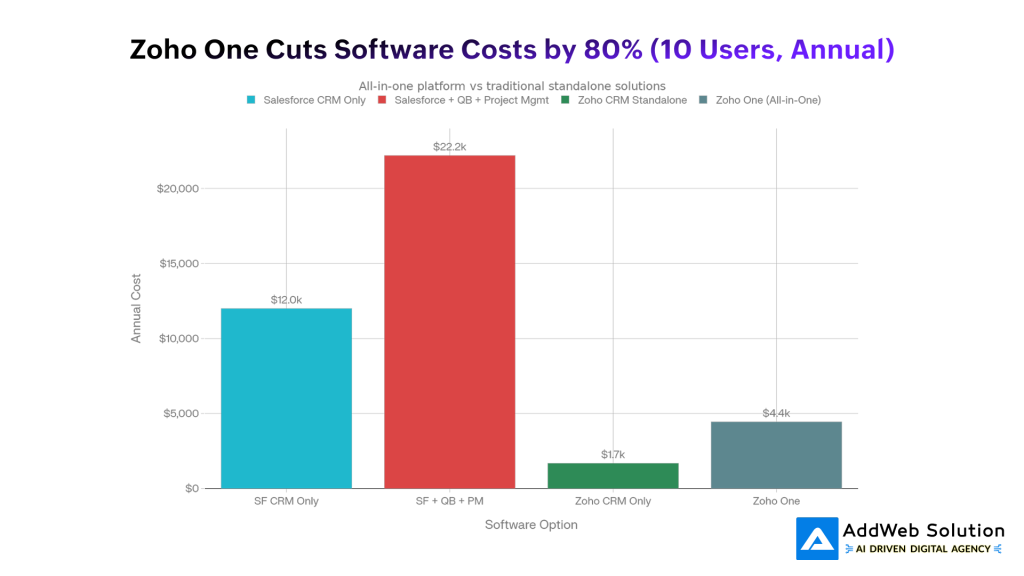
Annual Software Costs for a 10-Person Team: Standalone Tools vs. Zoho One (Based on standard pricing with annual billing)
The Hidden Costs No One Talks About
The monthly subscription fee is just the tip of the iceberg. Here’s where the real expenses hide:
1. License Waste and Shelfware
The companies are wasting funds on licensing fees, which have been paid out of excitement but never fully leveraged. This happens when a manager decides to procure a system because they are sure the employees will adopt it. Three months down the line, two of the ten people have regularly logged in to use the system. The remaining eight have simply continued paying. This particular aspect accounts for approximately 30% of all the hidden expenses incurred in software sprawl.
2. Cost of Integration and Middleware
Without a cohesion between your own tools, you have middleware, costly ‘glue code’ between systems, speaking one language on one side and another on the other. The worldwide market for middleware presently stands at 88.91 billion dollars in 2025 and is increasing at a rate of almost 7% a year all this purely for attempting a remedy for badly integrated systems. A medium-sized firm could be paying 15,000 to 50,000 dollars a year or more for integrating badly matching systems.
3. Manual Data Entry and Context Switching
This is the productivity killer that is not being measured effectively. According to Harvard Business Review, the average knowledge worker spends 1,200 application switches per day. It takes the average person 23 minutes to refocus after a lost opportunity. According to an Asana study, on average, employees spend 3.6 hours a week switching applications.
Do the math. A 10-person team paying $120,000 on average loses $300,000 in productivity every year due to the change in apps. And that is a conservative estimate.
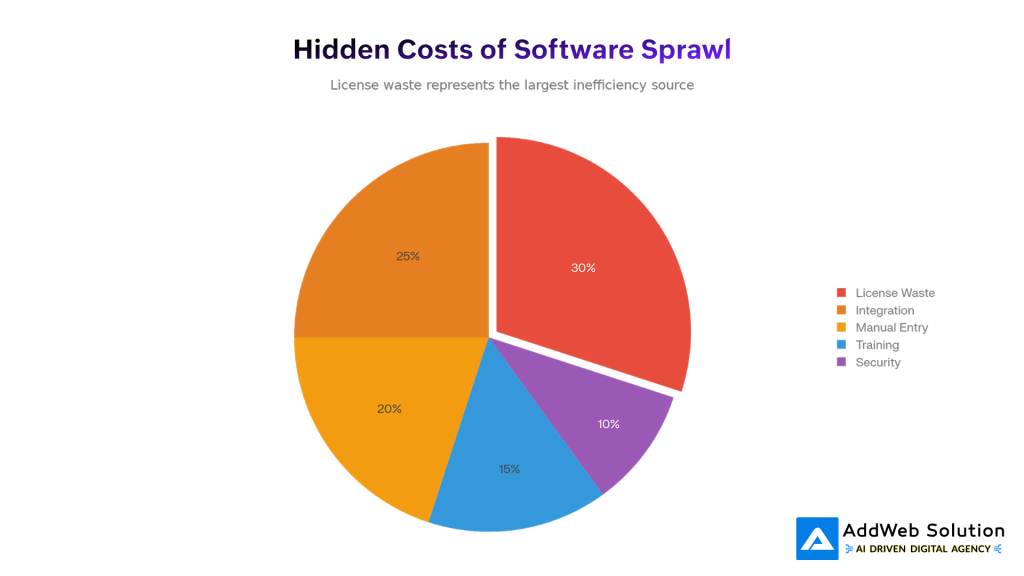
Where Your Money Really Goes: The Hidden Cost Breakdown of Software Sprawl
4. Training, Support, and Administrative Overhead
Each new system also needs to have users onboarded and trained once it’s acquired and implemented. The IT department will spend time maintaining user lifecycles (joiners/mover/leaver processes) and interacting with vendors for IT support services to handle the day-to-day activities of an organization that employs hundreds of staff.
5. Security, Compliance, and Data Silos
The greater the toolbox, the greater the number of security points. Shadow IT, or unapproved apps procured by departments, is estimated to be 10x what IT is aware of. Each tool has its own level of access, sometimes low or non-existent SSO/MFA, and also different data retention policies. When it’s time for compliance, integrating data from seven different systems takes weeks, not hours.
When Zoho Makes Financial Sense
Zoho One: it’s not an “everything platform.” It’s an intelligence-driven consolidation solution for companies frustrated by the madness.
Zoho One consists of over 45 applications that integrate across:
- C.R.M and Sales: Customer management, Sales forecasting management and Territory management
- Finance: Accounting (Zoho Books), Invoicing, Expenses, Payroll
- Project and Operations: Project operations, Task or ticket management, Automating operations
- Marketing: Email campaigns, Social Media, Marketing Automation
- HR: Recruitment, HR onboarding, managing employees
- Analytics: Business intelligence and reporting for all modules
- Communication: Collaborative tools and team features
This is why this architecture is so important: All information is stored within the same database. Customer data from the CRM is automatically visible within the accounting system. When there is a project deadline, the system will automatically send that customer an email. When the salesman closes the deal, the financial team will see that deal within the forecasting system instantly. There is no need for copying and pasting, no need for custom development by the IT team for integration, and no need for fixing discrepancies by hand.
The Cost Reality
Pricing of Zoho One:
- All Employee Plan (Annually Billed): $37/user/month – Must license all employees
- Flexible User Plan ( annual payment ): $90/user/month – No minimum, but greater per-unit rate
As context, Salesforce’s basic tier begins at $25/user/month, and that’s just for CRM functionality. When you tack on QuickBooks ($30/user), a project management app ($25/user), and marketing automation functionality ($20/user), you’re quickly at a price of $100+/user/month for similar functionality
Annual Software Costs for a 10-Person Team: Standalone Tools vs. Zoho One (Based on standard pricing with annual billing)
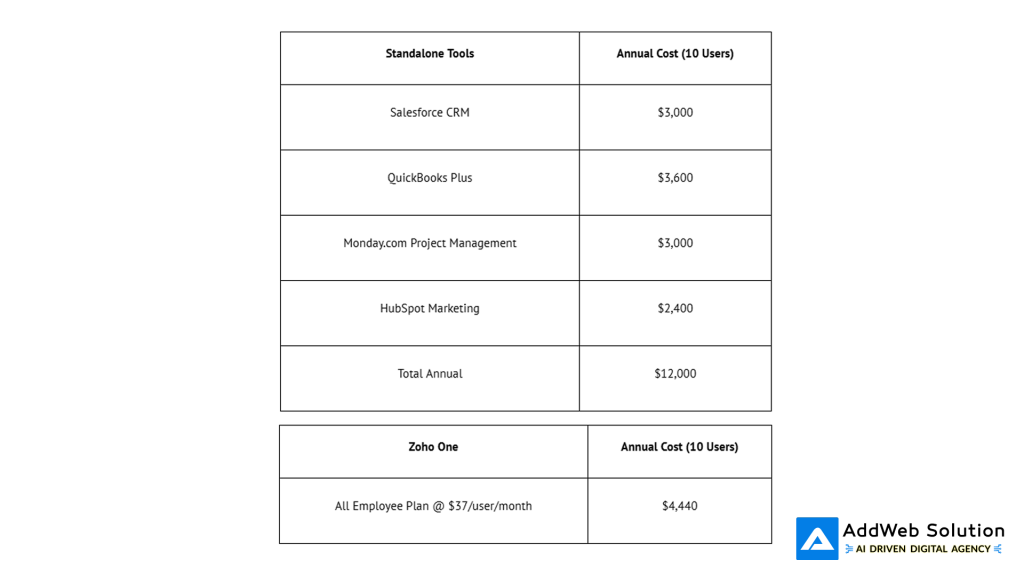
Savings: $7,560/year, or 63% less expensive.
And that is all before considering the value of the time that will no longer be spent manually doing the integrations.
The Numbers That Matter: ROI and Payback
We should start a discussion about the experiences that actually occur at the organizational level after making a change.
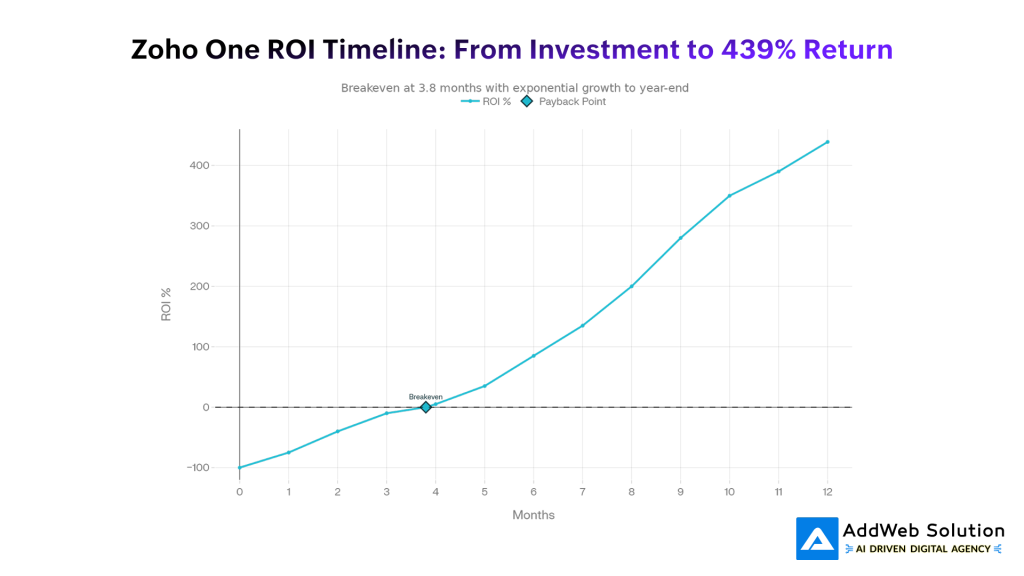
The Fast Path to Profitability: Zoho One Delivers 439% ROI with 3.8-Month Payback Period
Nucleus Research conducted a detailed ROI analysis of Zoho One deployments across organizations ranging from 150 to over 1,500 employees. The findings are striking:
- 439% average ROI – For every dollar spent on Zoho One, organizations see $4.39 in return
- 3.8-month payback period – Most organizations break even in under four months
- 57% increase in sales productivity – Sales teams spend 68% less time on manual reporting and prospecting, translating into a 3% boost in revenue
- 59% increase in support productivity – Some organizations report improvements up to 93%, with resolution times dropping by 24% while customer satisfaction (NPS) improves by 7%
- 47% reduction in total cost of ownership – Organizations migrating from Salesforce reduced TCO by 68%; those from Dynamics saved 53%
- 30% reduction in IT overhead – Fewer system conflicts, less maintenance, fewer vendor relationships to manage
- 15% higher end-user adoption rates – Simpler platforms with integrated workflows drive better usage
SOFTWARE ANNUAL COSTS FOR A 10- MEMBER TEAM: INDIVIDUAL SOFTWARE VS. ZOHO ONE (Based on standard rates and annual payment)
These aren’t theoretical numbers. A retail solutions provider switching from Salesforce achieved a 660% ROI with a 2.4-month payback period, recovering its entire investment before the year’s first quarter ended. The organization saved over $700,000 annually in avoided labor costs and deployed freed-up staff to sales and customer support roles.
A U.S.-based manufacturing company (Purolite) implemented Zoho CRM and achieved 271% ROI within four months, saving 800+ administrative hours annually.

Zoho One in Action: Documented Productivity Gains Across Core Business Functions
Real-World Examples: What Consolidation Actually Looks Like
Example 1: The Manufacturing Company
A mid-sized manufacturer had been running Salesforce, NetSuite, Slack, and four separate communication tools. Sales reps would close deals in Salesforce, but operations wouldn’t see them in NetSuite for three to four days due to manual data entry. Customer support tickets would get lost between email and Slack. Management couldn’t get a real-time dashboard of what was actually happening.
After consolidating to Zoho:
- Day 1: A deal closes in Zoho CRM. It immediately appears in Zoho Books for invoicing and Zoho Projects for fulfillment planning
- Day 2: Operations has a complete order and can begin fulfillment without chasing down details
- Week 1: Management can run a single report showing revenue, cash flow, and project status across the organization
Cost savings: $18,000 annually on redundant subscriptions. Time savings: ~15 hours per week previously spent on manual data entry and reconciliation. Revenue improvement: Better visibility led to faster order fulfillment and a 12% improvement in on-time delivery, improving customer retention.
Example 2: The Service Business
A growing professional services firm was bleeding productivity. Project managers used Asana, but time tracking lived in Harvest. Invoicing was QuickBooks. Customer communication bounced between email, Slack, and Freshdesk. When clients had questions, staff had to jump between four systems to pull together a response.
After implementing Zoho:
- Unified customer view: One project, one dashboard, all related communication, timesheets, and invoices visible in one place
- Automated invoicing: Hours logged in Zoho Projects automatically flow to Zoho Books for invoicing
- Better forecasting: Management can see actual project profitability vs. estimates in real time
Cost savings: $12,000 annually on tool redundancy. Productivity gain: Projects close 23% faster due to fewer process delays. Client satisfaction: Response time to inquiries dropped from 8 hours to 2 hours because information is consolidated.
Unpacking the Reality of Implementation
Let’s be honest: switching platforms is not a “flip a switch” operation. But it’s far less disruptive than conventional wisdom suggests.
The typical timeline:
- Weeks 1-2: Audit current systems, identify what data you actually need, plan which teams migrate first
- Weeks 3-4: Set up Zoho environment, configure basic workflows, import historical data
- Weeks 5-8: Pilot with one department (usually sales or support), fix problems, refine processes
- Weeks 9-12: Roll out to remaining departments with overlapping support from both old and new systems
- Week 13+: Decommission old platforms after confidence is established
Common concerns covered:
“We’ll lose data in migration” When in fact, most shops will gain insight. A good migration will uncover what the really valuable information is and flush out the garbage that’s built up over the last few years. While the old information may not migrate cleanly, you’ll be amazed how often you look at stuff that’s five years old.
“Our team will never adapt” – This is because the interfaces of all of Zoho’s products are much simpler to learn than the complex systems that currently exist in most companies. It will take most teams only 1-2 weeks to get adapted. The end-user adoption rates will rise by at least 15%, but that is because they are simpler and not more complex.
“It won’t have the custom features we built in our old system.” Zoho Creator allows users to build applications on their own without any knowledge of coding and does 95% of what organizations took years to customize in their old system.
Hidden benefit: Sometimes, the process assessment that is forced during the migration finds inefficiencies in processes that had not been picked up on before. A firm discovered that its approval process in three steps was not needed, thanks to the growth of the firm. Another discovered that 30% of its customer reports in the past were obsolete.


Making the Switch: A Practical Roadmap
If you’re seriously thinking of leaving a cluttered technology stack, below is how success shall be measured:
Step 1: Audit (Weeks 1-2)
Make a list of all the software that you pay for. Record the monthly subscription cost, the number of licenses/users, and the primary functionality of each software. You will be surprised to see the sum. Many companies underestimate their SaaS spending by 20-30%.
Quick math: As a 50-person company with the average software spend per person per year being $6,500 (industry average), your current software expenses are $325,000 per annum. Assuming 30-50% of your software expenses are wasted, wasted space, and wasted utilization potential that represents $97,500 to $162,500 wasted annually.
Step 2: Identify Consolidation Targets
Not every tool needs to move. Focus on the ones that:
- Overlap in functionality (three project management tools? Only need one)
- Require manual data transfer between them (red flag)
- Have the highest licensing waste (adoption below 40% of licensed users)
- Create the most context-switching friction
Typically, three to five tools account for 80% of your pain and 80% of your potential savings.
Step 3: Construct the Business Case
Frame it as investment, not cost-cutting. A typical consolidation delivers:
- $X in eliminated subscription costs
- $Y in recovered productivity (fewer hours on manual processes)
- $Z in operational improvements (faster decision-making, better data quality)
For a 50-person team, this often totals $150,000-$300,000 in annual value.
Step 4: Phased Implementation
Start with one department (usually sales because they see ROI fastest), prove the value, then expand. This approach:
- Reduces risk by validating the approach with one team first
- Creates internal advocates who can help convince skeptical departments
- Allows you to refine processes before scaling
- Makes change management more digestible
Step 5: Measure What Matters
Track metrics that directly show ROI:
- Hours spent on manual data entry (should drop 70%+)
- Report generation time (should drop 60%+)
- User adoption rates (should be 85%+ vs. 45% industry average for legacy systems)
- Time to close deals or projects (should improve 15-25%)
- Headcount needed for operational support (should decrease 20-30%)
Why Consolidation Wins for Specific Industries
Manufacturing: Improved visibility in real-time throughout the supply chain brings down discrepancies and enables on-time delivery. Supply chain optimization optimizes inventory costs by 15-25%.
Professional Services: The provision of integrated timesheet, project management, and billing capabilities enables better visibility of project profitability. Projects with 20% lower margin or worse are identified instantly and priced accordingly in the case of contract renewal. One firm achieved a 23% improvement in project margin visibility.
Retail: Integrated information about customers in a retail company can lead to effective personalization. A retail company was able to increase the efficiency of new customer acquisition by 20%.
SaaS/Tech Companies: When CRM, service, and analytics solutions are fully integrated, product groups are able to view customer feedback in a usage context. This alone can speed product feedback cycles up by as much as 40%.
Ready to Streamline Your Business with Zoho?

Pooja Upadhyay
Director Of People Operations & Client Relations
The Real Cost of Waiting
There’s an opportunity cost to staying fragmented. Every month you delay:
- You’re still wasting $21,000 (industry average) on unused licenses
- Teams are still losing 3.6 hours per week to context switching
- You’re missing insights buried in data silos
- Integration costs keep compounding
- Vendors raise prices 8-12% annually while your contract renews
The typical company that consolidates software says they should have done it 2-3 years earlier.
The Bottom Line
Software consolidation isn’t about buying the biggest platform. It’s about ending the financial and productivity drain of fragmentation. Switching from multiple standalone tools to Zoho One typically delivers:
✓ 60-80% reduction in software costs
✓ 439% ROI in year one, with 3.8-month payback
✓ 57-59% productivity improvements across sales and support
✓ 68% reduction in manual reporting time
✓ 30% lower IT overhead
✓ Better data, faster decisions, happier teams
The math is clear. The implementation is straightforward. The only question is: What are you waiting for?
Quick Facts & Stats
The scale of the problem: The average company manages 254 SaaS applications, with enterprises using 364 different tools.
License waste is rampant: Companies waste an average of $21 million annually on unused or redundant licenses, with most organizations using only 50% of purchased software.
Context switching kills productivity: Employees switch between applications 1,200 times daily, costing organizations up to $450 billion annually in lost productivity.
Zoho One delivers: 439% ROI, 3.8-month payback, 57% sales productivity increase, and 47% total cost of ownership reduction.
What Industry Leaders Say
“Software sprawl is one of the most underestimated productivity killers in modern business. Most organizations don’t realize how much of their budget is bleeding into unused licenses and integration complexity. Consolidation forces healthy discipline around what tools you actually need.” — IT Cost Optimization Research, BCG, 2025
“Organizations moving to integrated platforms like Zoho One consistently report one surprise: The productivity gains often exceed the cost savings. Teams spend more time on strategic work and less time on system administration.” — Nucleus Research, Zoho One ROI Analysis, February 2025
Ready to stop funding software sprawl?
At Addweb Solution, we’ve helped dozens of organizations consolidate their tech stacks and recover millions in wasted spend while dramatically improving operational efficiency. If you’re curious about what consolidation could mean for your specific situation, we’re here to have the conversation, no pressure, just data-driven analysis tailored to your business.
