


If you work in marketing or run a business, you’ve already felt it: the same rankings, the same SEO effort, yet fewer clicks and more “mysterious” drops in organic traffic from certain query types. What changed isn’t just Google’s algorithm—it’s the interface itself, and the rise of AI answer engines that sit between your content and the user.
What “post-Google” really means in 2026
Globally, Google still holds roughly 89–90% of the search engine market share across devices as of early 2026. Bing, Yahoo, Yandex, DuckDuckGo, and Baidu split most of the remaining single‑digit percentage points.
So no, Google hasn’t been “killed.” But the Google era of ten blue links is being eroded on three fronts:
- AI Overviews and summaries on Google itself: Studies show AI Overviews (and similar features) now appear on a large share of US queries and can reduce organic clicks by 58–70% when they show up.
- Standalone AI answer engines: ChatGPT, Gemini, Perplexity, Claude, and others are where users increasingly go first for research, coding help, and decision support.]
- Zero‑click behavior: Zero‑click rates have climbed above 60% for some query sets, with users getting what they need directly on the results page or inside an AI chat, without visiting any website.
The result: traditional search is no longer the only, or even primary, discovery layer for a growing slice of information‑seeking behavior.
From keyword boxes to conversations
For twenty years, search meant: type two or three keywords, scan the SERP, click a few links, and stitch together your own answer. AI answer engines flip that pattern.
How AI answer engines work (at a high level)
- They interpret natural‑language questions, not just keywords, using large language models trained on huge corpora.
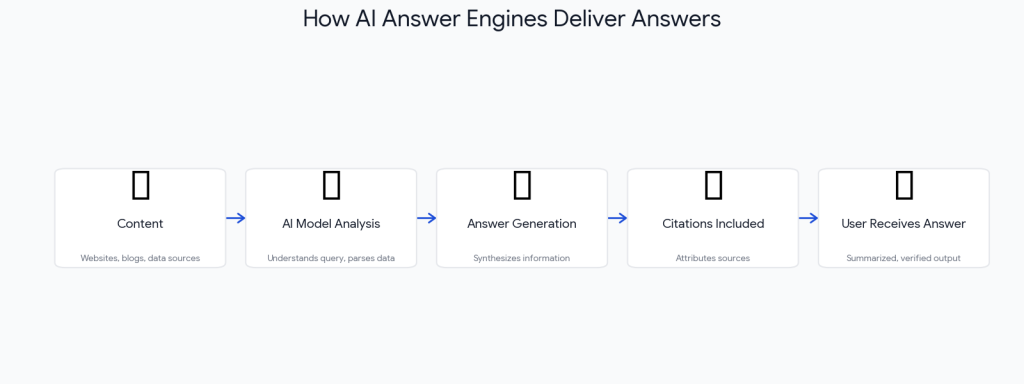
- They retrieve and synthesize information from multiple sources (web pages, documents, knowledge graphs) into a single, coherent answer.
- They cite sources inline, but they don’t require the user to click through unless they want to go deeper.
- They support back‑and‑forth refinement: “make that shorter,” “compare option A vs B,” “now give me a step‑by‑step plan,” etc.
In short, the work of query refinement, comparison, and synthesis—which users used to do manually across multiple tabs—is now handled by the AI layer.
Visual snapshot: Search vs AI answer engines (2024 traffic share)
Based on a 24‑month traffic study, the top 10 AI chatbots accounted for about 2.96% of total search‑like traffic in 2024, while traditional search engines still handled the other ~97%—but AI chatbot visits grew more than 80% year‑over‑year in the same period.
Those percentages are still small in absolute terms, but the trajectory is the story: chatbot visits climbed from around 3.1 billion in April 2024 to 7.0 billion in March 2025, a 124% increase.
Adoption data: How fast behavior is shifting
The “AI instead of Google” behavior is no longer hypothetical; we have numbers.
- A two‑year traffic analysis found AI chatbot visits grew ~80–124% YoY, while overall search engine visits slightly declined (around 0.5% down) over the same period.
- A consumer survey in 2025 reported that 10% or more of internet users now start specific searches directly in generative AI tools (ChatGPT, Bing AI, etc.), bypassing search engines entirely for those tasks.
- Another study found 36% of generative‑AI users say they have started replacing traditional search with AI assistants for at least some queries.
- In a US survey of 1,040 search users, 72% said they use Google’s AI Overview when it appears, and nearly half believe AI will eventually replace search engines as we know them.
Simple bar “graph”: AI chatbot traffic growth
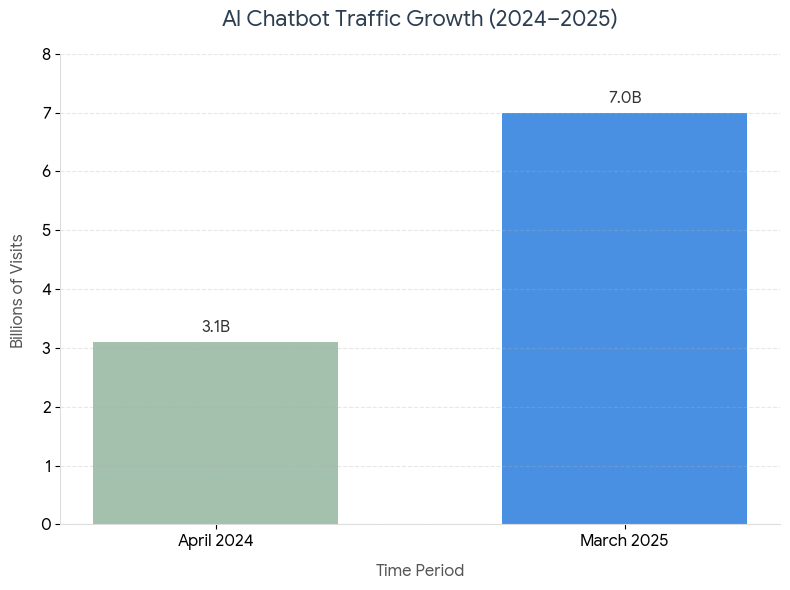
Those two data points—3.1B to 7.0B visits—are enough to show the direction of travel: AI assistants have moved from novelty to a mainstream habit in under two years.
Table: Traditional search vs AI answer engines in 2026
| Dimension | Traditional search engines (Google era) | AI answer engines (2026) |
| Core output | Ranked list of links with snippets | Direct, synthesized answer, often with citations |
| User effort | High: refine query, scan SERP, open multiple tabs, self‑synthesize | Lower: ask a natural question, get a ready‑to‑use summary or plan |
| Query style | Short, keyword‑heavy (“best HVAC contractor Ahmedabad”) | Conversational, multi‑step (“Audit my HVAC marketing funnel and suggest 5 experiments”) |
| Click behavior | Multiple site visits per query | Often zero‑click, with optional clicks on cited sources |
| Monetization | Ads around and above organic results | Still evolving: sponsored answers, “preferred providers,” deep integrations |
| Measurement | Impressions, clicks, sessions, rankings | Citations, mentions inside answers, “AI referrals,” brand recall within AI responses |
Most of the data points on click behavior and zero‑click patterns come from studies of AI Overviews and AI‑enhanced SERPs between 2024 and 2025.


Why clicks are disappearing (even when rankings don’t)
For many queries, especially informational and comparative ones, users no longer feel the need to leave the SERP or the AI chat.
Key drivers:
- AI summaries on SERPs: Tests have shown that when AI Overviews appear on Google, clicks on organic results for those queries can drop by 50–70%.
- Zero‑click search culture: With featured snippets, knowledge panels, “People also ask,” and now AI summaries, an estimated 60%+ of searches already end without a click in some markets.
- Closed‑loop AI chats: Inside tools like ChatGPT, Gemini, or Copilot, the default experience is “get the answer here,” not “go explore the web,” which naturally suppresses referral traffic.
From a user’s perspective, that’s a win: fewer clicks, less noise, faster clarity. From a publisher or brand perspective, it feels like traffic leakage—even when you’re the one being quoted.
How big players are responding
The “post‑Google” landscape is not AI startups versus search engines; it’s a convergence.
- Google has rolled out AI Overviews (and subsequent iterations) in the US and many other markets, with plans to cover a large share of commercial and informational queries worldwide.
- Microsoft has repositioned Bing around Copilot, integrating conversational answers directly into the search experience and Windows ecosystem.
- OpenAI launched dedicated search modes and answer‑engine behaviors in ChatGPT, signaling a direct play at search‑like use cases.
- Perplexity AI and similar tools market themselves explicitly as “answer engines,” with cited, conversational responses and growing MAUs in the tens of millions.
One 2026 industry analysis notes that ChatGPT has grown to billions of monthly active users, with Gemini, Perplexity, and Claude also capturing notable shares of AI query volume.
Visual: The AI answer engine workflow
The rise of Answer Engine Optimization (AEO)
Just as classic SEO grew up around ranking signals and SERP features, AEO focuses on one question: “How do I become the answer that AI quotes?”
Core pillars emerging across 2025–2026:
- Structured, explicit answers: Content that clearly and succinctly answers specific questions in plain language is more likely to be extracted and summarized.
- Credibility signals: E‑E‑A‑T‑style signals (expertise, experience, authority, trustworthiness) matter because answer engines aim to avoid hallucinations and low‑quality sources.
- Contextual coverage: Comprehensive topical clusters (guides, FAQs, comparisons, tools) give AIs more context to pull from than thin, single‑keyword landing pages.
- Technical clarity: Clean markup, structured data, and clear headings help machines understand what piece of your content answers which query.
In other words, we’re optimizing less for a specific snippet box and more for inclusion in an algorithmic briefing delivered by an AI.
Quick table: SEO vs AEO focus areas
| Area | Classic SEO focus | AEO / AI‑era focus |
| Primary goal | Rank a page for a keyword | Be cited as the best answer for a question |
| Content format | Long‑form pages, blog posts, optimized landing pages | Modular answers, FAQs, how‑to blocks, comparison tables |
| Success metric | Organic traffic, rankings, CTR | AI citations, assisted conversions, branded mentions in answers |
| Optimization unit | Page / URL | Entity, topic, and specific question‑answer pairs |
| Channel mix | Search engines | Search + AI chatbots + in‑product assistants |
These shifts are being emphasized by agencies and consultants who’ve started packaging AEO as a distinct discipline by late 2025.
How this changes content strategy in practice
If you’re planning content or campaigns in 2026, here’s what the data and trends imply.
1. Treat AI answers as a new “homepage”
In many journeys, the first meaningful touchpoint with your brand will be inside an AI answer, not on your website.
That means you need:
- Clear brand naming and positioning that reads well in one or two sentences.
- Distinctive value props that an AI can summarize without losing what makes you different.
- Consistent messaging across your site, docs, and external profiles so the model sees a coherent story.
2. Build “answer‑ready” assets
Instead of only thinking in blog posts and landing pages, think in question‑answer units:
- FAQ‑driven content hubs around key problems and buyer questions.
- Data‑backed comparison tables that are easy for AI to quote (“Feature A vs B vs C”).
- Step‑by‑step frameworks with clear labels (“3‑step HVAC maintenance schedule,” “5‑part SaaS onboarding funnel”).
These formats map closely to how people prompt AI—and how AI prefers to respond.
3. Optimize for “AI‑assisted” journeys, not last‑click
With rising zero‑click rates and AI summaries, many discovery touchpoints won’t immediately show up as referral traffic.
You’ll increasingly measure:
- Branded search lift after major AI mentions.
- Direct / dark social traffic that correlates with AI campaigns or new guides.
- Assisted conversions where the first interaction was “I saw you recommended in ChatGPT/Perplexity.” (You’ll hear this in sales calls and forms before you see it cleanly in analytics.)
Example “pie chart” for an internal dashboard
You can communicate the shift to stakeholders with a simple distribution chart of “query starting points” based on the latest surveys and your own analytics.
Let’s say your own customer survey roughly mirrors wider data where:
- 65% start with Google or another search engine
- 15% start directly in an AI assistant (ChatGPT, Gemini, Copilot, etc.)
- 10% go to social (LinkedIn, YouTube, Instagram) first
- 10% use other channels (direct, bookmarks, internal tools)
That illustrative split would look like:
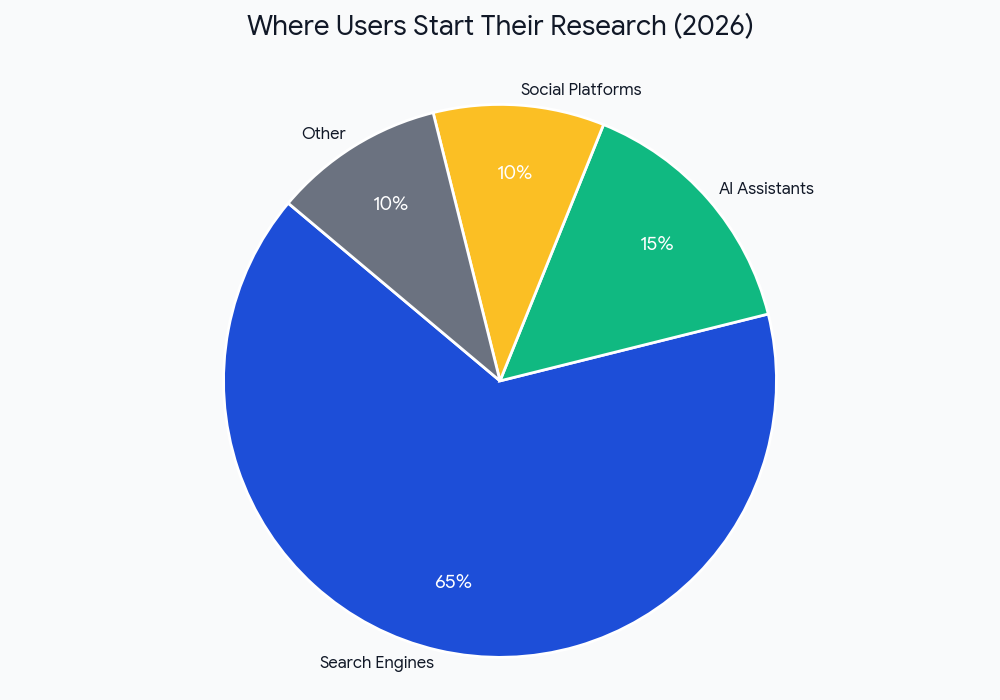
The exact numbers will vary by audience and industry, but external studies already show at least 10% of users starting certain searches directly in AI tools, with 36% of AI users replacing some traditional queries.
Practical playbook for 2026: What to do now
Here’s a concise, human, reality‑based checklist you can actually execute.
For marketing and content leaders
- Audit your “answer coverage”
- List your top 50–100 high‑intent questions (not keywords).
- Check whether your site provides a clear, 2–4 sentence answer for each.
- Create an AEO‑friendly content hub
- Build topic clusters with FAQs, how‑tos, comparisons, and checklists.
- Add schema/structured data where appropriate (FAQ, HowTo, Product, Organization).
- Monitor AI citations
- Periodically ask leading AI tools the questions your buyers ask.
- Note which brands and URLs are being cited—and whether yours shows up.
- Shift reporting expectations
- Educate stakeholders about zero‑click and AI‑mediated behavior.
- Track brand lift, direct traffic, and lead quality alongside classic SEO metrics.
For product and CX teams
- Design for AI‑mediated support
- Expect customers to arrive already “briefed” by AI—and sometimes mis‑briefed.
- Enable your own docs and knowledge base to power in‑product assistants.
- Close the loop with real conversations
- Ask customers in forms and sales calls: “Did you use AI tools in your research? Which ones?”
- Use that data to prioritize which answer engines to study and optimize for.
So… are AI answer engines “killing” traditional search?
They’re not killing search so much as absorbing it. Google still dominates raw query share, but a rapidly growing share of search intent is being satisfied by AI layers—inside Google, inside third‑party answer engines, and inside products.
For marketers and business owners in 2026, the mindset shift is simple but profound:
Don’t just ask, “How do I rank in Google?”
Ask, “How do I become the answer that AI trusts enough to quote?”
If you design your content, brand, and measurement around that question, you’ll be playing the right game in the post‑Google era—while many competitors are still obsessing over a shrinking slice of blue‑link clicks.
Want your brand to stay visible in the AI-first search era? Get an SEO & AI visibility audit today.

Pooja Upadhyay
Director Of People Operations & Client Relations
⁂
- https://cacm.acm.org/news/answer-engines-redefine-search/
- https://www.orbitmedia.com/blog/ai-vs-google/
- https://www.statista.com/statistics/1381664/worldwide-all-devices-market-share-of-search-engines/
- https://gs.statcounter.com/search-engine-market-share/all-worldwide/worldwide/2024
- https://gs.statcounter.com/search-engine-market-share
- https://www.webmasterworld.com/google/5116692.htm
- https://onelittleweb.com/data-studies/ai-chatbots-vs-search-engines/
- https://indianexpress.com/article/technology/artificial-intelligence/google-vs-perplexity-ai-chatbots-search-traffic-2024-study-9997864/
