


Introduction: The Shift No One Expected
There’s a moment that happens in every conversation about business software, usually around the fourth or fifth meeting where someone finally admits the truth: “We’re spending way too much time on tasks that shouldn’t require this much attention.”
This year, that conversation shifted from frustration to action. In 2025, the companies that took the leap toward integrated, AI-powered business platforms didn’t just survive their digital transformation journey. They actually came out the other side with measurable wins: faster sales cycles, happier customers, lean teams doing the work of departments twice their size, and IT teams that finally got their time back.
Zoho sits at the center of this shift, not because it promises magic (it doesn’t), but because it solved a real problem that’s plagued mid-market and growing companies for years: the scattered-system problem. You know the one CRM in one place, invoicing in another, customer support in a third, projects somewhere else entirely. Each system is decent on its own, but they don’t talk to each other, so you’re perpetually copying data between spreadsheets, making manual notes, and hoping nothing falls through the cracks.
The question this year wasn’t whether you needed to integrate your systems. It was whether you could afford not to. And the data tells a pretty compelling story.
Understanding Zoho’s Market Position in 2025
By the numbers, Zoho’s 2025 performance tells you something important about where the market is heading. The company now serves over 700,000 businesses globally across 150+ countries. That’s not startup energy anymore, that’s market infrastructure. And unlike the early days when Zoho was primarily a CRM alternative for cost-conscious startups, 2025 shows something more significant: Zoho became the platform of choice for organizations that got tired of being locked into complicated, expensive ecosystems.
Zoho’s global revenue reached $1.4 billion in 2024, a 27% increase from the previous year. More interestingly, 250,000+ businesses specifically adopted Zoho CRM in 2024, representing 30% year over year growth. But what really changed this year was the composition of that user base. Over 50% of Zoho’s users are now small and medium-sized businesses (SMBs), which matters because it means Zoho wasn’t scaling just with enterprises, it was solving real problems for the businesses that actually drive local economies.
The ecosystem itself has become strikingly mature. Zoho now offers 55+ integrated applications spanning CRM, finance, HR, marketing, analytics, projects, and customer support. This isn’t a collection of point solutions. It’s a coordinated system designed so that when someone fills out a form, updates a sales deal, or processes an invoice, the entire platform knows about it. No manual data entry. No sync delays. No guessing games.
The competitive benchmark is worth noting too. Zoho holds an 8.4% global CRM market share, placing it solidly in the top 5 worldwide. More importantly, Gartner Peer Insights rated Zoho CRM at 4.3 out of 5, marginally ahead of Salesforce’s 4.2. The gap narrows further when you consider pricing Zoho costs significantly less while delivering comparable (and in many cases, superior) automation capabilities.
Real World Zoho One: From 439% Average to 660% Peak Performance
What 700,000 Businesses Actually Get Out of Zoho
Numbers are one thing. The reason behind those numbers tells you whether Zoho’s growth is sustainable or just temporary market enthusiasm. So let’s talk about what happens when a real organization implements Zoho One, their unified platform and what they actually achieve.
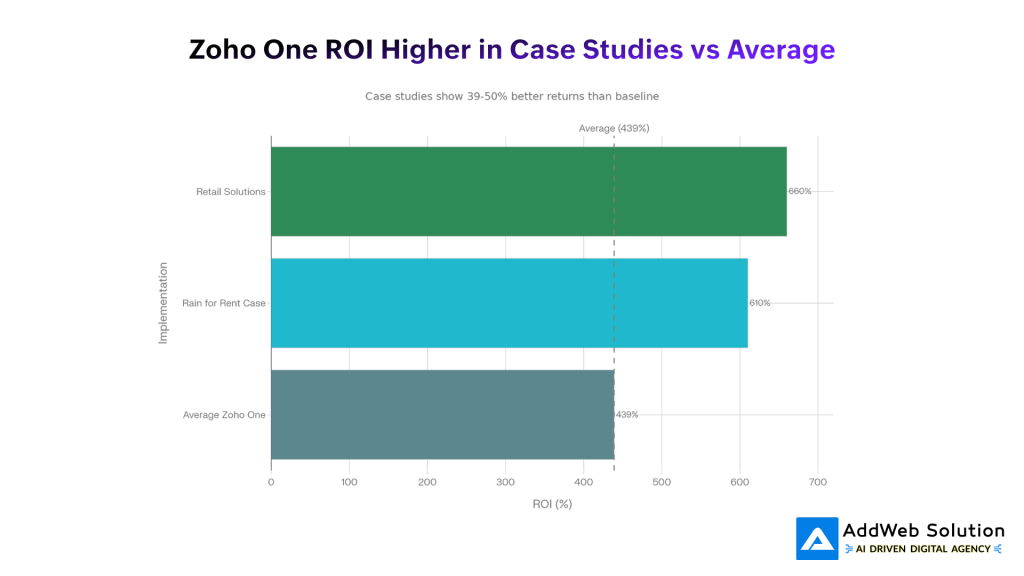
Nucleus Research conducted a comprehensive analysis of Zoho One deployments across organizations ranging from 150 to over 1,500 employees. Their findings, published in February 2025, showed an average ROI of 439% meaning for every dollar a company invests in Zoho One, they get back $4.39. The average payback period? 3.8 months. Not years. Months.
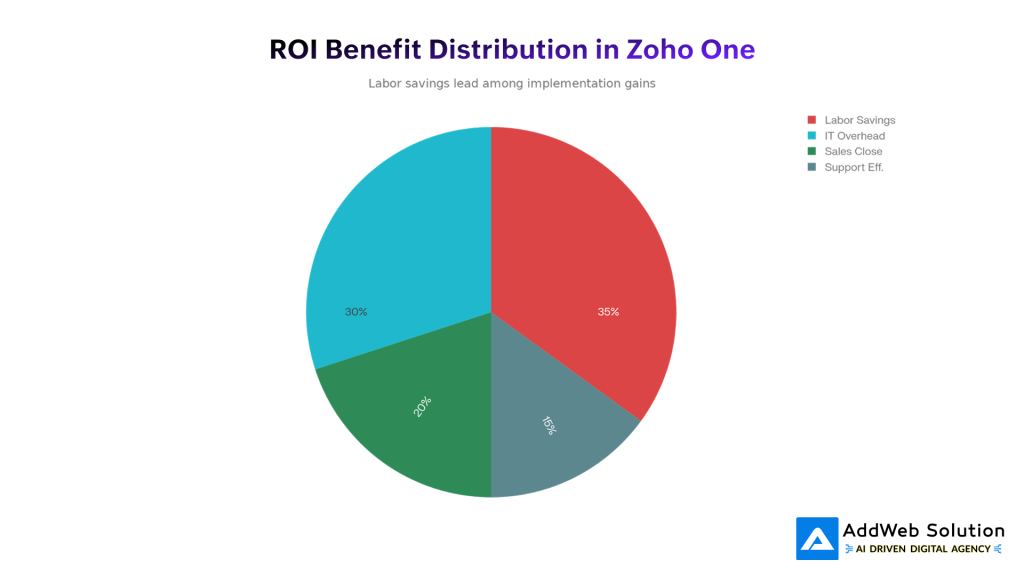
This isn’t theoretical. It’s based on actual implementations. And the ROI breaks down across three specific, measurable areas:
Sales Teams Spending Less Time on Busy Work
Organizations implementing Zoho One reported a 57% increase in overall sales productivity, which translated into approximately 3% revenue growth. The mechanism is straightforward: sales teams spent 68% less time on manual reporting and prospect research. When you have a unified customer view across Zoho CRM, Zoho Analytics, Zoho Campaigns, and Zoho SalesIQ, you’re not juggling data sources anymore. You’re seeing the complete picture of what every customer is doing, which deals are progressing, and which leads are ready to move forward.
One outcome from this unified view: close rates improved by an average of 6.5%. That’s not marginal. For a sales organization closing $10 million annually, that’s potentially $650,000 in additional revenue from the same number of conversations.
Support Teams Freed to Actually Support Customers
The second productivity gain comes from customer support. Organizations using Zoho Desk reported a 59% increase in support productivity—and some achieved up to 93% improvement. The automation piece matters here. When ticket creation, call tracking, and escalation management are automated into a single platform, you eliminate the manual work that was eating up support team time. One organization saved over $70,000 annually (20% of their labor costs) just by automating the ticket creation and tracking tasks that previously required a dedicated employee.
Beyond cost, there’s the customer experience metric. Support teams using Zoho across email, phone, live chat, and self-service reported a 24% reduction in average resolution time while improving net promoter scores (NPS) by 7%.


The Cost of Ownership Actually Drops
This is the part that surprises people who’ve been burned by enterprise software before. Organizations migrating to Zoho achieved a 47% lower total cost of ownership while maintaining, and sometimes enhancing, overall functionality. The companies switching from Salesforce saw a 68% TCO reduction. Those leaving Microsoft Dynamics saved 53%.
The savings come from multiple angles: lower licensing costs (no hidden per-user fees), significantly less IT oversight required (approximately 30% less), and higher user adoption rates (15% increase on average). When your system is intuitive and doesn’t require constant IT intervention, people actually use it, and your support team focuses on strategy instead of troubleshooting.
Zoho’s Impact: Productivity Gains Across Business Functions (Real Data)
Real-World Examples: Companies That Proved This Works
The Nucleus data is solid, but individual case studies make it tangible.
Rain for Rent: 610% ROI in Less Than 2.4 Months
This equipment rental company reduced the average time a salesperson spent finding client or prospect data from over 18 minutes to about 10 minutes. That savings alone enabled sales teams to increase value producing contacts by three per day, generating $750,000 in additional annual revenue. The company realized 610% ROI and recovered its initial investment in less than 2.4 months. After the success with CRM, they expanded to Zoho One and achieved comparable results with increased productivity and labor cost reductions of more than 6%.
Retail Solutions Provider: 660% ROI
This organization switched from Salesforce specifically because high customization costs and platform complexity were hindering their ability to scale. Upon adopting Zoho One, they achieved 20% efficiency gains in new client onboarding and redeployed staff across sales and customer support functions. The final number: 660% ROI with a 2.4 month payback period and over $700,000 in avoided labor costs annually.
Zaaroz: Scaling Across 55 Locations With One Accountant
The real world efficiency gain that probably matters most to CFOs: Zaaroz, a food retail chain, now operates with a single chief accountant managing financial processes across all 55 locations. That’s what a truly integrated, automated financial platform looks like in action. Zoho Books (their accounting solution) and Inventory handle the transaction volume automatically. API integrations ensure precise data flow with zero manual errors.
What made this possible? Automated processes, particularly banking integration and reconciliation, drastically reduced manual effort and eliminated the need for a finance team proportional to the organization’s size.
Where Zoho’s 439% ROI Comes From: Breaking Down the Value
The 2025 Inflection Point for AI in Business Software
There’s a moment in every technology’s lifecycle when it stops being an add-on feature and becomes the actual product. For business software, 2025 was that moment for AI.
The numbers tell the story. Small business AI adoption jumped from 6.3% in February 2024 to 8.8% by August 2025 a dramatic acceleration, though still conservative. More telling: 96% of SMBs now plan to adopt emerging technologies including AI. Among those already using AI, 63% use it daily and report saving 20+ hours per month. That’s not experimental anymore. That’s operational.
What changed this year wasn’t the technology. It was what actually works with it.
Zoho introduced significant updates to Zia, their AI assistant, in 2025. The headline features included generative AI for content creation (emails, proposals, reports automatically drafted), enhanced predictive analytics with sharper forecasts for sales cycles and customer behavior, OpenAI integration for more natural conversations, and context-aware smart prompts that suggest your next action.
But the feature that actually moved the needle for most organizations was AI-powered sales forecasting. Instead of manually crunching historical data and guessing, Zia analyzes historical sales data, customer behavior, and market trends to predict which deals are most likely to close and when. For sales leadership, that means knowing your probability of hitting targets with actual confidence scores attached, not hoping.
The practical outcome: 55% of Zoho CRM users directly credited Zia AI with contributing to revenue growth. That’s not everyone. But the people it works for, it works really well.
Zoho also launched something that’ll matter more in 2026 than it does today: advanced workflow automation with if/else logic chains, time triggered updates, and cross module automation. It sounds technical, but what it means operationally is that your workflows can now handle conditional logic. If a customer hasn’t engaged in 90 days, then flag for outreach. If an invoice is marked paid, then automatically move the deal to “Closed Won” in CRM. These aren’t manual processes anymore. They’re rules the system enforces.
Field teams got attention too. Offline workflow automation means processes continue even without internet connectivity. Voice-to-note functionality lets field reps dictate meeting notes, which Zia automatically tags by contact or deal. Geo-tagged check-ins verify field visits and optimize routes for on-site teams. For companies with mobile-heavy operations, this was a meaningful leap.

The SMB AI Adoption Surge: From 6.3% to 8.8% in Just 18 Months
The Integration Story That Matters More Than You Think
Here’s something you won’t hear in a typical Zoho pitch: the real competitive advantage isn’t any single feature. It’s that the entire system talks to itself.
Imagine this typical scenario from 2024: A prospect fills out a contact form on your website. That data lives in your form software. Someone manually copies it into your CRM. Sales emails that prospect, using an email system that doesn’t integrate with CRM, so there’s no record of the email in the contact history. The prospect clicks a link in an email and ends up on your website where a chatbot (using a third tool) offers a demo. They schedule it in your calendar (separate system), which should update CRM but doesn’t always.
By the time the prospect enters the sales process, you’re working with stale or fragmented data.
Now imagine the 2025 version with Zoho’s integrated ecosystem: That same form submission automatically creates a contact in Zoho CRM. Zoho SalesIQ recognizes the visitor on your website in real time and offers relevant guidance based on their company and interest history. When the sales team emails that prospect, the email integrates with CRM, so the entire conversation history lives in one place. Zoho Analytics tracks engagement patterns across all these touchpoints, and Zia surfaces insights about whether this prospect is ready to buy.
The result? One organization improved onboarding efficiency by 20% simply by integrating Zoho Forms with Zoho CRM and automating the workflows between them. The integration eliminated manual data entry, reduced follow-up delays, and created a single source of truth for customer interactions.
This matters because the alternative of maintaining disparate systems creates what I call the “integration tax”: the hours you spend copying data, verifying it’s correct, and troubleshooting when systems go out of sync. That’s not strategic work. It’s busy work. And it’s surprisingly expensive.

Modern integrated business platform enabling seamless team collaboration and data flow
What’s Actually Coming in 2026, And Why It Matters Now
The future isn’t coming in 2026. It’s already here for the companies paying attention. Zoho has already started rolling this out.
AI Agents, Not Just AI Assistants
Zoho announced Zia LLM (a custom large language model), 40 pre-built Zia Agents, and Zia Agent Studio (a no-code agent builder) coming to general availability by the end of 2025. The distinction between an AI assistant and an AI agent matters more than it sounds. An assistant responds to what you ask. An agent actively works on your behalf, monitoring conditions and taking action without prompting.
Experts forecast that by 2026, up to 40% of enterprise applications could integrate task-specific AI agents, a dramatic leap from current levels. This means your sales system might automatically identify at risk customers and initiate retention outreach. Your finance system might autonomously process invoice approvals (up to a threshold). Your support system might handle entire categories of customer requests without human intervention.
Zoho is also planning to support the Agent2Agent (A2A) protocol, which is essentially the plumbing that allows AI agents from different platforms to collaborate on complex workflows. That’s important because it means your Zoho agents can coordinate with agents in other tools, creating truly cross-platform automation.
The Efficiency Multiplier
Here’s what matters: organizations that are building these agent-centric workflows now will have a 12 month head start by the time this becomes standard. They’ll have learned what works, what doesn’t, and how to use these tools without disrupting their actual business operations.
The projected impact is significant. Deloitte estimates that organizations with effective change management programs around AI implementation achieve 143% of expected ROI, compared to just 35% for those with little change management. The difference isn’t the technology. It’s preparation.
A Note on Challenges
It’s worth being honest: not everything is moving smoothly. Enterprise integration challenges in 2025 remain real. Data silos still plague large organizations. Real time decision making requires infrastructure that many companies haven’t built yet. Security and compliance complexities are increasing, not decreasing.
But these challenges are solvable, which is partly why Zoho’s unified approach is winning. Instead of integrating five different point solutions (each with its own API, its own data model, its own support team), you’re solving these problems once, within a cohesive platform.
The Conversation You Should Be Having Right Now
If you’re responsible for operations, sales, finance, or customer support at a growing company, 2025 has given you a clear message: the economics of business software have fundamentally shifted.
The old playbook invests heavily in a legacy system, customize it extensively, train your team, hope it pays off, generate modest ROI improvements in the 15-30% range and take years to recoup costs. The new playbook implements a modern, integrated platform with strong defaults, automates core workflows, and uses AI for the repetitive judgment calls generating 439% ROI with 3.8-month payback periods.
The 439% figure matters not because it’s guaranteed (some organizations achieve higher, others achieve lower), but because it’s real. It’s based on actual implementations, measured through rigorous analysis, published by independent analysts. It’s the kind of number that makes CFOs and operations leaders start asking better questions.
Here’s what those questions look like:
- What are we currently spending on software licenses, integrations, and IT support? (Most organizations discover they’re spending 40-60% more than they think when they include everything.)
- How much manual work is happening in spreadsheets, email, and across disconnected systems? (This is your “integration tax.”)
- If we cut that integration tax in half, what could our team actually focus on? (Sales excellence. Customer relationships. Strategic initiatives. Not data copying.)
- Do we have a plan for AI automation, or are we waiting until it’s table stakes? (The companies winning in 2025 made a choice. The companies scrambling in 2026 waited too long.)
Ready to grow? Dive in now and see how streamlined processes boost your results.

Pooja Upadhyay
Director Of People Operations & Client Relations
Quick Fact Box: The Numbers That Matter
- 700,000 businesses use Zoho globally, serving 150+ countries
- 439% average ROI from Zoho One implementations with 3.8 month payback
- 57% increase in sales productivity for Zoho customers
- 24% reduction in support resolution times
- 68% TCO reduction for companies switching from Salesforce
- 96% of SMBs now plan to adopt emerging technologies including AI
- $4.39 return for every dollar invested in Zoho One
Looking Ahead: What We Learned From 2025
2025 taught us that business transformation doesn’t require ripping everything out and starting over. It requires making intentional choices about which tools solve problems, how those tools talk to each other, and where automation actually adds value (spoiler: it’s not everywhere).
The companies that executed well this year shared a few characteristics: they were honest about their current challenges, they chose platforms that emphasized integration over customization, they automated their core workflows (not their exceptions), and they started playing with AI in controlled ways before betting the business on it.
Zoho didn’t invent this playbook. But they’ve executed it with particular effectiveness, which is why the growth numbers, the ROI numbers, and especially the customer retention numbers, are what they are.
2026 will bring AI agents, agentic workflows, and probably some significant surprises about how AI is actually used (versus how we think it’ll be used). But the foundation for that is being built right now. The companies that get there first will be the ones that automated their foundations and are ready to build more sophisticated intelligence on top of them.
That’s not a prediction. That’s the pattern we’re already seeing.
Share your thoughts: What’s changed about how your organization approaches business software in 2025? The companies that are executing well on this are sharing insights and they’d probably appreciate knowing they’re not alone in this shift.
