


Mobile apps aren’t just about functionality anymore. In 2025, users expect experiences that are not only smooth and cross-platform but also intelligent and personalized. That’s exactly where Flutter + AI is making waves.
Today, 67% of Flutter apps already include AI-driven features, fueling a market worth $38.4 billion — projected to hit $54.6 billion by 2026. This isn’t just another tech upgrade; it’s a fundamental shift in how businesses design, launch, and scale mobile applications.
We’re entering an era where apps don’t just run everywhere — they learn everywhere.
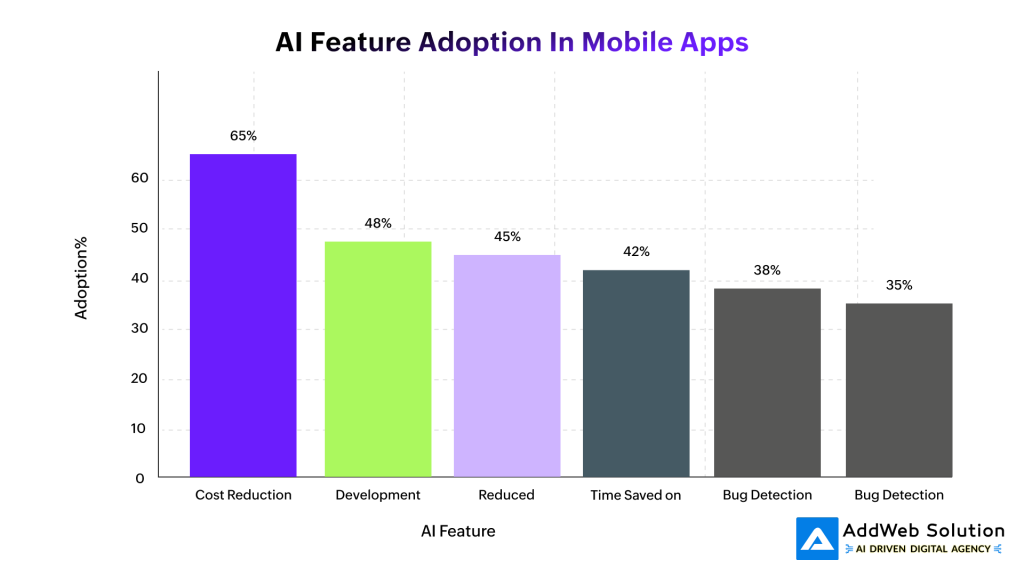
AI Feature Adoption in Mobile Apps (2025)
Why Businesses Are Betting on Flutter + AI
When executives evaluate technology, they’re typically seeking three key outcomes: lower costs, faster launches, and enhanced customer engagement. Flutter delivers the first two. AI powers the third. Together, they create an unbeatable combination.
- Speed and savings: With a single codebase, Flutter cuts development costs by up to 50% and reduces build time by 35–40%.
- Long-term efficiency: Updates roll out once and apply everywhere, reducing ongoing maintenance costs by 30–40%.
- Smarter engagement: AI personalization boosts user engagement by 60% and reduces churn by up to 30%.
- Revenue upside: AI-driven recommendations and upsells can lift conversion rates by 40–50%.
For global giants like Google, Alibaba, and BMW — and for ambitious startups — these numbers translate directly into market share, customer loyalty, and competitive advantage.

Flutter vs React Native: AI Integration Comparison


Real-World Success Stories
Flutter Entertainment: Reinventing Customer Experience
Flutter Entertainment, a leading sports betting provider with 7 million customers, was struggling with poor engagement (NPS -10) and minimal automation. By integrating AI-powered chatbots, predictive analytics, and smarter escalation systems into their Flutter app, they flipped the script:
- NPS jumped from -10 to +40
- Online activity grew 140%
- Customer service automation rose to 70%
- Operational savings topped £4M, with £12M in avoided increases
The result? A leaner, a more efficient business, and customers who feel understood.
Google Ads Companion: Enterprise-Scale AI at Work
Managing ad campaigns across platforms is complex. Google’s Ads Companion app, built with Flutter, uses AI for real-time campaign optimization and predictive analytics at a massive scale.
- Customer satisfaction climbed 33% after the redesign
- Millions of advertisers now access consistent cross-platform performance
- Advanced analytics provide actionable insights instantly
This case demonstrates that Flutter isn’t just for startups — it can power AI at an enterprise scale.
Alibaba’s Xianyu: AI-First E-commerce
Alibaba’s Xianyu app, with more than 300 million registered users, proves how Flutter can support AI at e-commerce scale. AI powers product recommendations, fraud detection, and UX optimization.
- 50% boost in user engagement
- Simplified maintenance via a single codebase
- Enhanced trust with AI-powered fraud detection
The takeaway: Flutter + AI isn’t just about speed — it’s about building trust and scale in crowded digital marketplaces.
Key Business Benefits
1. Engaged, Loyal Customers
AI-powered personalization keeps users coming back. Apps can predict behavior, deliver content when it matters most, and adapt in real time.
- Personalized content → higher satisfaction
- Predictive analytics → lower churn
- Smarter notifications → reduced fatigue, higher engagement
2. Revenue Growth
- 40–50% higher conversions
- Increased average order values
- Lower acquisition costs through retention
- Premium feature adoption based on user insights
3. Operational Efficiency
Automation doesn’t just save money — it scales businesses.
- 70% of inquiries can be handled with AI-driven support
- Predictive maintenance cuts operational costs by 30%
- Real-time monitoring ensures consistent service quality
In short: AI frees teams to focus on strategy, while apps handle the heavy lifting.
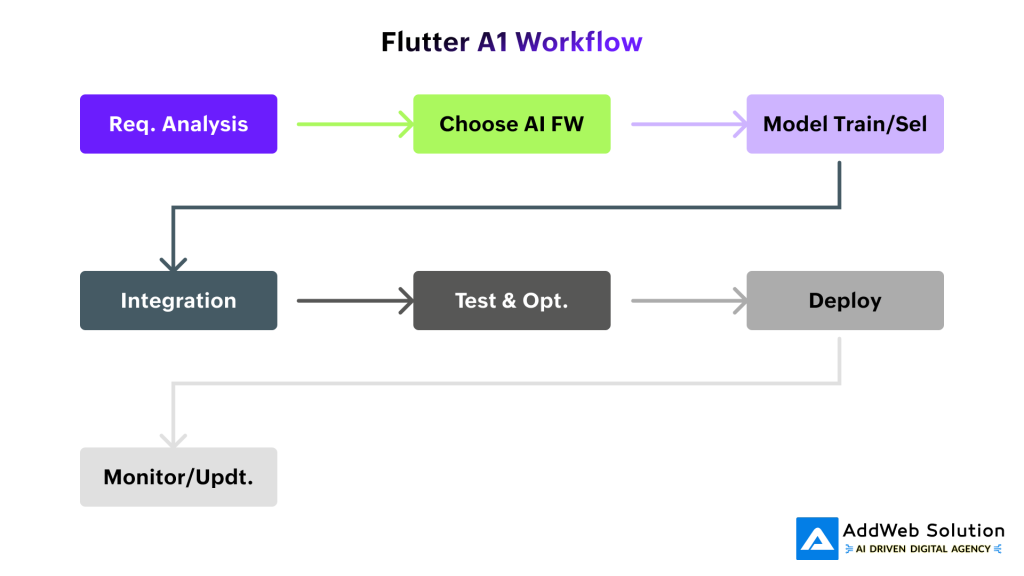
Flutter AI Development Workflow Timeline
Strategic Implementation Approaches
AI Framework Selection for Business Success
Successful Flutter AI implementations require careful framework selection based on business objectives and technical requirements. TensorFlow Lite offers the highest performance for on-device processing
while Firebase ML Kit provides the easiest integration path for businesses seeking rapid deployment.
Framework Considerations:
- TensorFlow Lite: Best for performance-critical applications requiring local processing
- Firebase ML Kit: Ideal for rapid prototyping and cloud-based AI services
- Google Gemini AI: Optimal for conversational AI and natural language processing
- Custom Models: Suitable for specialized business requirements with dedicated AI teams
Building Flutter AI Apps: Smart Approaches
Choosing the Right AI Framework
Not all AI frameworks are created equal. The best fit depends on your goals:
- TensorFlow Lite: For performance-heavy apps needing local processing
- Firebase ML Kit: For rapid deployment and cloud AI
- Google Gemini AI: For conversational and NLP-driven apps
- Custom Models: For businesses with specialized needs
Companies seeing the biggest gains with Flutter AI follow structured, agile approaches:
- Start with clear requirements and an MVP
- Iterate quickly and integrate user feedback
- Use cross-functional teams to accelerate problem-solving
- Monitor performance closely at every stage
This cuts development cycles by 40–60% compared to traditional approaches. Development Best Practices
What’s Next: Market Trends in 2025
AI in Flutter is evolving fast. Here’s what’s shaping the landscape now:
- Generative AI is speeding up code generation and testing
- Conversational interfaces creating assistant-like experiences
- Predictive UX that adapts proactively to user needs
- Automated testing and optimization improve app quality
Industry-specific use cases are also exploding:
- Healthcare: patient engagement, health monitoring, appointment management
- Finance: fraud detection, personalized investment guidance
- Retail: product recommendations, inventory optimization
- Transportation: route planning, predictive maintenance
The ROI Equation
Businesses that invest in Flutter + AI are seeing ROI between 200% and 400% within two years.
The math works because:
- Single codebase = lower dev and maintenance costs
- AI = higher engagement and conversions
- Automation = lower operational expenses
- Smarter apps = stronger competitive positioning
Managing the Risks
Like any strategic move, success depends on smart risk management. Companies leading the way tend to:
- Start with proofs of concept before scaling
- Roll out in phases to maintain quality
- Build in user feedback loops
- Audit security and data protection continuously
This ensures innovation doesn’t compromise performance or trust.
Final Word: The Strategic Imperative
Flutter and AI together aren’t just a trend — they’re the new baseline. Businesses that integrate the two are getting faster launches, lower costs, smarter apps, and higher revenues.
The market is racing toward $54.6B by 2026. Companies that act now will set the standard. Those that wait will be left scrambling to catch up.
The success stories are clear — from Flutter Entertainment to Google Ads to Alibaba. The only question left for leaders is:
👉 How fast can you bring AI into your Flutter apps?
Because in 2025, speed isn’t just an advantage. It’s survival.
Sources:
