


“The headless approach with Drupal has radically transformed our ability to offer consistent and personalized omnichannel experiences. The separation of content and presentation has given us unprecedented flexibility to innovate across different touchpoints.”
Introduction
Picture this: a customer discovers your brand on Instagram, adds a product to their cart on mobile, walks into your store to try it, confirms availability on an in‑store kiosk, and finally completes the purchase on desktop that evening. That’s a real‑world buying journey in 2026, not a CX workshop fantasy.
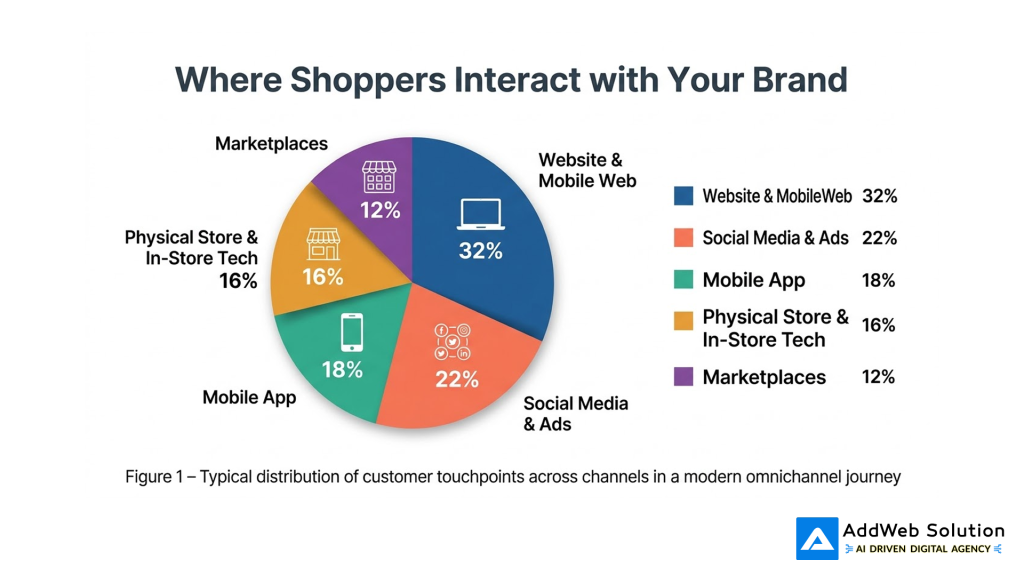
Research shows that around 73% of retail shoppers already engage across multiple channels in a single buying journey, often touching six different points before purchasing. At the same time, 90% of customers expect those interactions to feel unified and consistent, regardless of where they happen. Omnichannel is no longer a “nice to have”; it’s the baseline. The question is: can your CMS keep up?
This is where Headless Drupal shines-turning Drupal from a traditional website CMS into an omnichannel content hub that can serve web, apps, kiosks, IoT, and more from a single source of truth.
What Omnichannel Really Looks Like (and Why Headless Drupal Fits)
Omnichannel isn’t just “being on many channels”; it’s about orchestrating one coherent experience across them. Studies show that omnichannel retailers see up to 179% faster revenue growth than those that don’t integrate their channels, while brands with strong omnichannel engagement retain 89% of customers compared with just 33% for weaker implementations.
On the behavior side, a Harvard Business Review–cited study found that 73% of shoppers use multiple channels during their journey and integrate an average of six touchpoints. Another report notes that 81% of shoppers start their retail journey online, even if they finish in‑store, and 72% use smartphones to compare prices or read reviews while physically in the store. This blending of digital and physical touchpoints is exactly the scenario headless Drupal is designed to support-content is created once and delivered via APIs everywhere it needs to live.


Real‑world Drupal Headless Omnichannel Example
An implementation described by SparkFabrik showcases a major retailer using a headless Drupal backend to power:
- A React‑based e‑commerce site
- Native iOS and Android mobile apps
- In‑store touchscreen kiosks
- Digital signage and screens in physical stores
The results were tangible:
- 70% reduction in time to launch new cross‑channel campaigns
- 35% improvement in Net Promoter Score (NPS)
- Lower operational costs thanks to centralized content management
This is the kind of omnichannel outcome you want Drupal to enable-not just another CMS upgrade.
Traditional Drupal vs Headless Drupal for Omnichannel
Drupal started life as a monolithic CMS: content and presentation tightly coupled in the same system. That model still works for classic websites, but it becomes a bottleneck when you need to serve content consistently to SPAs, native apps, in‑store devices, voice assistants, and more.
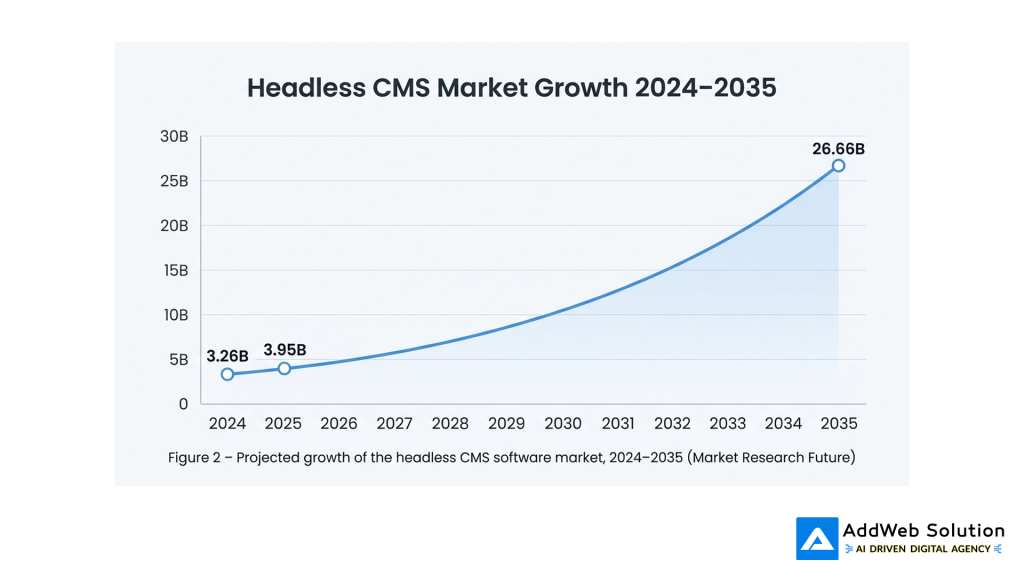
Headless CMS adoption is growing fast because it addresses exactly that limitation. One 2024 report notes that 48% of organizations still using traditional CMS plan to switch to a headless CMS within two years, and 89% of businesses already using headless CMS report a significant improvement in omnichannel content delivery. Another analysis projects the headless CMS software market to grow from around 3.26 billion USD in 2024 to 26.66 billion USD by 2035-over 8x growth at a ~21% CAGR.

By moving to headless Drupal, you’re essentially turning Drupal into a content operating system-one brain orchestrating many heads. That’s where a partner like AddWeb Solution typically comes in: designing the content model, API strategy, and integration patterns so marketing, product, and engineering can all move without stepping on each other.
Growth of Headless CMS and Omnichannel Outcomes
If you want a sanity check on whether this is a passing trend, just look at the market numbers. Future Market Insights estimates the headless CMS software market at about 973.8 million USD in 2025, projecting it to reach 1.19 billion USD in 2026 and a massive 9.16 billion USD by 2036 at a 22.6% CAGR. Another forecast from Market Research Future sees the space growing from 3.26 billion USD in 2024 to 26.66 billion USD by 2035, at roughly 21% CAGR. Different baselines, same directional story: headless is where content management is heading.
On the omnichannel side, campaigns that use an omnichannel approach report up to a 494% higher order rate than single‑channel campaigns, and omnichannel strategies deliver around 90% higher retention compared to single‑channel approaches. Existing customers already tend to spend 67% more than new ones, so improving retention through omnichannel is amplified by headless delivery stacks directly into revenue.
How Headless Drupal Delivers Omnichannel in Practice
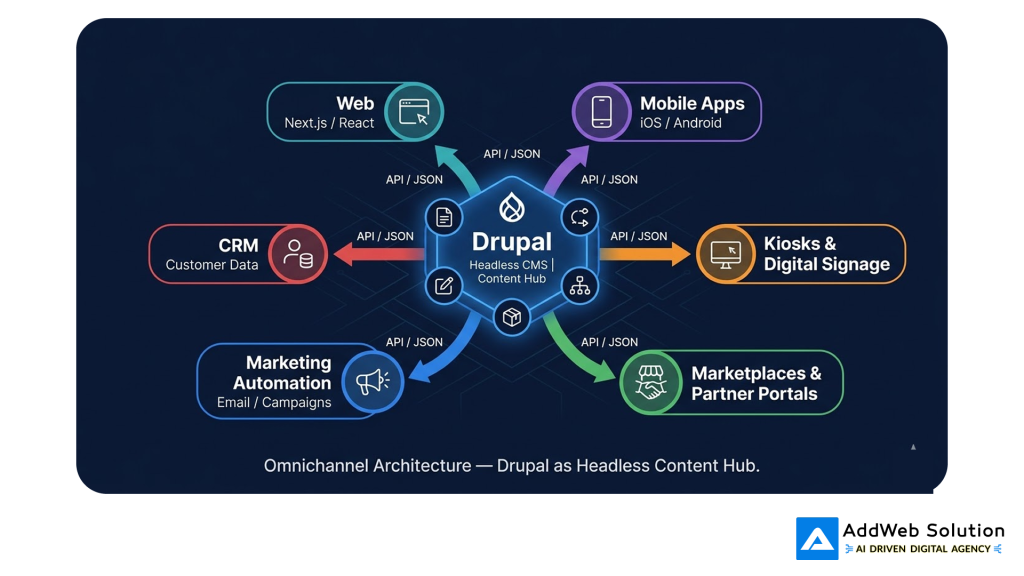
From an implementation standpoint, a typical headless Drupal–powered omnichannel stack looks like this:
- Drupal as content hub: Editorial teams create products, campaigns, blog content, help articles, and UI copy in structured content types.
- API delivery: JSON:API or GraphQL exposes that content to front‑end applications, mobile apps, kiosks, and even connected devices.
- Channel‑aware variants: Editors can manage language, region, device, or channel‑specific versions (e.g., shorter copy for mobile, localized offers for specific cities).
- Integration layer: Commerce, inventory, CRM, CDP, and marketing automation tools plug into the same ecosystem, enabling real‑time personalization and consistent messaging.
One 2024 dataset notes that 82% of users report improved SEO outcomes after moving to a headless CMS, largely due to performance gains and flexibility, while 43% of businesses report faster time‑to‑market for content once headless is in place. In parallel, 78% of CMOs identify agility and speed as the most significant benefits of headless CMS adoption.
For a Drupal‑savvy partner like AddWeb, that translates into practical patterns such as:
- Drupal + Next.js for high‑performing storefronts
- Drupal powering in‑store kiosks and mobile apps via shared APIs
- Drupal content feeding marketing automation journeys based on behavior across channels
Conclusion
If you’re serious about omnichannel, the key is to treat Drupal as your content brain, not just your website CMS. That means:
- Modeling content for reuse across channels, not just pages.
- Implementing JSON:API or GraphQL in a way that’s stable and versioned.
- Designing front‑ends (web, app, kiosks) that are loosely coupled but semantically aligned.
- Wiring in analytics, personalization, and experimentation across all those experiences.
Market data shows that omnichannel shoppers deliver higher lifetime value and drive faster revenue growth, while headless CMS adoption significantly improves omnichannel content delivery and time‑to‑market. Headless Drupal sits at the intersection of those two trends-especially when implemented by a team that understands both the platform and the business outcomes.
At AddWeb Solution, we typically start with an assessment of your existing Drupal setup and customer journeys, then design a phased path to headless: starting with one or two experiences (like a new React storefront or mobile‑first customer portal) and gradually extending the same content hub to additional channels. That way, you get quick wins while building a sustainable omnichannel foundation.
Power Your Website with Drupal’s Excellence!

Pooja Upadhyay
Director Of People Operations & Client Relations
Source URLs
- https://marketingltb.com/blog/statistics/omnichannel-statistics/
- https://blog.contactpigeon.com/omnichannel-statistics/
- https://worldmetrics.org/headless-cms-industry/
- https://www.futuremarketinsights.com/reports/headless-cms-software-market
- https://www.marketresearchfuture.com/reports/headless-cms-software-market-34090
- https://desku.io/stats-hub/omnichannel-statistics/
- https://www.uniformmarket.com/statistics/omnichannel-shopping-statistics
