


A real-world case study on transforming a legacy Python monolith into a scalable microservices architecture
Executive Summary
Picture this: Your Python application starts hanging when more than 3,000 users are online. Deploy times stretch to 45 minutes. Your development team spends 60% of their time fixing bugs instead of building features. Sound familiar?
This was the reality for one of our enterprise clients – until we helped them save $3 million annually through strategic architecture refactoring. Here’s the complete story of how poor Python architecture was silently draining their resources and how we turned it around.

Clean architecture model illustrating layered separation of concerns for maintainable and scalable software design.


The $3M Problem: When Technical Debt Becomes Critical
The Hidden Costs That Add Up
When we first audited our client’s Python codebase, the numbers were staggering:
- 800 hours per month lost to technical debt issues
- $250K monthly maintenance costs
- 3,000+ user limit before system failures
- 45-minute deployment cycles killing productivity
But here’s what most companies don’t realize: technical debt isn’t just about slower development. It’s a financial hemorrhage that compounds over time.
The Anatomy of Python Technical Debt

Annual Technical Debt Costs Breakdown – Total $3M Impact
Our analysis revealed seven critical problem areas eating away at their budget:

Total Impact: 800 hours/month, $200K monthly cost, $2.4M annually
Why Python Architecture Matters More Than You Think
Python’s Technical Debt Advantage
Before diving into the solution, let’s understand why Python was actually part of the answer, not the problem. Research from CAST Software shows that Python has significantly lower technical debt compared to other popular languages:
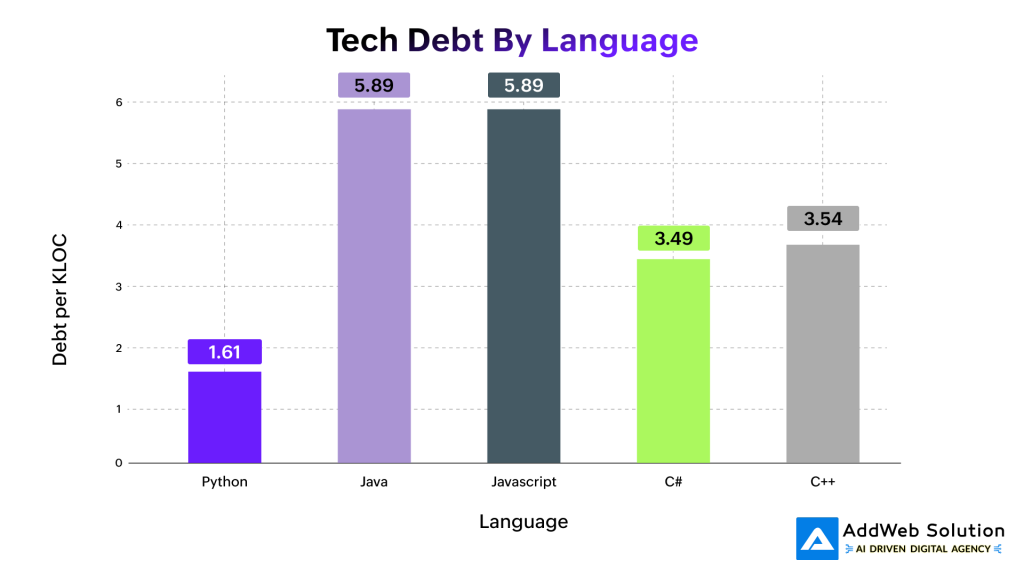
Technical Debt by Programming Language (Per 1000 Lines of Code)
This means Python codebases are inherently more maintainable – when architected correctly.
The Monolith Trap


Comparison of monolithic, microservices, and modular monolith architectures highlighting key components and deployment units.
The real culprit wasn’t Python itself, but the monolithic architecture that had grown organically over years:
Problems with the Existing Monolith:
- Single point of failure affecting entire system
- Impossible to scale individual components
- Deploy-all-or-nothing mentality
- Cross-team dependencies blocking development
- Technology lock-in preventing optimization
The $1.7M Solution: Strategic Refactoring Approach

The code review pyramid highlights essential questions for assessing code quality across style, tests, documentation, implementation, and API semantics, guiding efforts to reduce technical debt.
Phase 1: Assessment and Strategic Planning (2 weeks, $40K)
We started with a comprehensive technical debt audit using proven methodologies:
- Code Quality Analysis: Using tools like SonarQube and CodeAnt.ai
- Performance Profiling: Identifying bottlenecks and resource constraints
- Architecture Review: Mapping dependencies and identifying service boundaries
- ROI Calculation: Quantifying costs of current state vs. refactoring investment
Phase 2: Architecture Design (3 weeks, $90K)
Instead of a complete rewrite (which would have cost $5M+), we designed a gradual migration strategy.
- Microservices Architecture: Breaking monolith into focused services
- API Gateway Pattern: Centralized routing and authentication
- Database Per Service: Eliminating shared database bottlenecks
- Containerization: Using Docker for consistent deployments
Phase 3: Monolith Decomposition (8 weeks, $400K)
The critical phase where we carefully extracted services:
- User Management Service: Authentication and user profiles
- Payment Processing Service: Financial transactions and billing
- Notification Service: Email, SMS, and push notifications
- Analytics Service: Data processing and reporting
Key Strategy: We maintained the monolith while gradually moving traffic to microservices, ensuring zero downtime.
Phase 4: Service Implementation (12 weeks, $720K)
Building robust, scalable Python microservices using modern frameworks:
- FastAPI Framework: High-performance async APIs
- PostgreSQL: Optimized database schemas per service
- Redis Caching: Reducing database load by 70%
- Comprehensive Testing: 85% code coverage with automated tests

Clean Architecture layers illustrating how software components interact and depend on one another, providing a foundation for building maintainable applications.
Phase 5: Data Migration (4 weeks, $160K)
The trickiest part: migrating data without losing consistency.
- Dual-Write Pattern: Writing to both old and new systems
- Gradual Cutover: Service-by-service migration
- Data Validation: Ensuring integrity throughout transition
Phase 6: Testing & Deployment (6 weeks, $240K)
Ensuring reliability at scale:
- Load Testing: Validating 10,000+ concurrent users
- Canary Deployments: Gradual rollout with automatic rollback
- Monitoring Setup: Comprehensive observability with alerts
Phase 7: Monitoring & Optimization (2 weeks, $40K)
Long-term success through continuous improvement:
- Performance Monitoring: Real-time metrics and alerts
- Cost Optimization: Right-sizing resources based on usage
- Documentation: Comprehensive guides for future maintenance
Total Investment: $1.69M over 37 weeks
The Results: $3M in Annual Savings
Quantifiable Improvements

Before vs After Refactoring: Key Performance Improvements
The transformation delivered measurable improvements across all key metrics:
The Financial Impact
- Monthly Savings: $150K
- Annual Savings: $1.8M
- 3-Year ROI: $5.4M – $1.7M = $3.7M net benefit
- Payback Period: 11 months
Beyond the Numbers: Business Impact
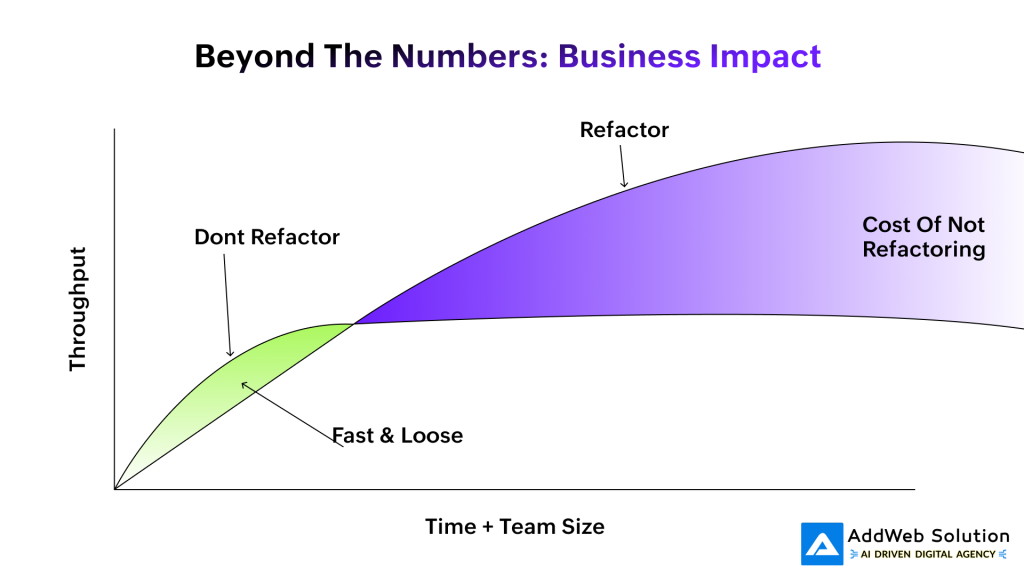
Graph showing how not refactoring code can lower throughput over time and team size, highlighting the cost of technical debt in software development.
Scalability: System now handles 15,000+ concurrent users without issues
Developer Productivity: Team can now focus on features instead of firefighting
Time to Market: New features deploy in hours instead of weeks
Customer Satisfaction: 99.9% uptime vs. previous 97% uptime
Security: Modern security practices and automated vulnerability scanning
Lessons Learned: The Architecture Principles That Made the Difference
1. Gradual Migration Over Big Bang Rewrites
“The worst thing you can do is rewrite everything from scratch. We’ve seen this fail countless times. Instead, extract services incrementally while maintaining business continuity”.
2. Domain-Driven Design is Critical
Proper service boundaries aren’t technical decisions – they’re business decisions. We aligned services with business capabilities, not technical convenience.
3. Monitoring is Non-Negotiable
You can’t manage what you can’t measure. Comprehensive monitoring from day one prevented issues before they became expensive problems.
4. Test Coverage Pays for Itself
The investment in comprehensive testing (bringing coverage from 45% to 85%) prevented countless bugs and reduced deployment anxiety.
5. Python’s Ecosystem is a Competitive Advantage
Using mature frameworks like Django for business logic, FastAPI for high-performance APIs, and Celery for background tasks accelerated development significantly.
The Technical Debt Prevention Strategy
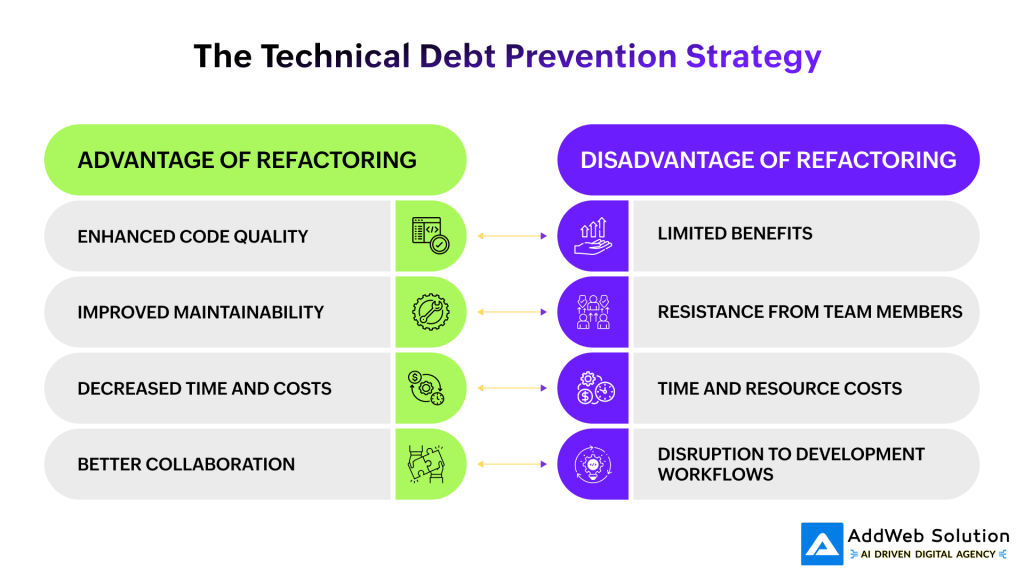
Advantages and disadvantages of software refactoring summarized with icons and brief points.
Clean Architecture Principles
We implemented clean architecture patterns throughout:
- Separation of Concerns: Business logic isolated from infrastructure
- Dependency Inversion: High-level modules don’t depend on low-level modules
- Single Responsibility: Each service has one reason to change
- Open/Closed Principle: Open for extension, closed for modification
Code Quality Gates
Comparison table highlighting differences between refactoring and rewriting in software development across key requirements.
Automated Quality Checks:
- SonarQube integration in CI/CD pipeline
- Automated code formatting with Black
- Type hints enforcement with mypy
- Security scanning with Bandit
- Dependency vulnerability scanning
Review Process:
- Mandatory peer reviews for all code changes
- Architecture review for significant changes
- Performance impact assessment for database changes
Continuous Technical Debt Management
Monthly Technical Debt Reviews:
- Identify code smells and architectural issues
- Prioritize refactoring based on business impact
- Allocate 20% of sprint capacity to debt reduction
Metrics Tracking:
- Code complexity trends
- Test coverage changes
- Build time evolution
- Bug density per service
How Smart Python Refactoring Saved $3M in Costs

Pooja Upadhyay
Director Of People Operations & Client Relations
Common Pitfalls to Avoid
1. Over-Engineering the Solution
Don’t create microservices for everything. We started with 4 core services instead of 20+ mini-services.
2. Ignoring Data Consistency
Distributed systems are hard. Plan for eventual consistency and implement proper saga patterns for complex transactions.
3. Underestimating Operational Complexity
Microservices require sophisticated monitoring, logging, and deployment processes. Budget for DevOps complexity.
4. Neglecting Team Training
Technology changes are only 30% of the challenge. Ensure your team understands distributed systems concepts.
The ROI Formula: When Refactoring Makes Sense
Calculate Your Technical Debt Cost
Use this formula to quantify your technical debt:
Annual Technical Debt Cost =
(Developer Hours Lost × Hourly Rate × 12) +
(Infrastructure Overhead × 12) +
(Opportunity Cost of Delayed Features) +
(Security Risk Costs) +
(Customer Churn from Poor Performance)
Refactoring ROI Threshold
Generally, refactoring makes financial sense when:
- Technical debt costs > 40% of development budget
- Feature velocity declining > 20% year-over-year
- System availability < 99% due to architecture issues
- Critical talent spending > 50% time on maintenance
Tools That Made the Difference
Architecture and Design
- Draw.io: Service architecture diagrams
- PlantUML: Sequence diagrams for complex flows
- C4 Model: Structured architecture documentation
Code Quality and Analysis
- SonarQube: Comprehensive code quality analysis
- CodeAnt.ai: AI-powered code review and automatic fixes
- Black: Automated Python code formatting
- mypy: Static type checking
Development and Deployment
- FastAPI: High-performance Python web framework
- Docker: Containerization and deployment
- Kubernetes: Container orchestration
- Terraform: Infrastructure as code
Monitoring and Observability
- Prometheus: Metrics collection
- Grafana: Visualization and dashboards
- Jaeger: Distributed tracing
- ELK Stack: Centralized logging
Future-Proofing Your Python Architecture
Emerging Patterns to Consider
Event-Driven Architecture: Using message queues for loose coupling
CQRS (Command Query Responsibility Segregation): Optimizing read and write operations separately
Serverless Functions: For specific, stateless operations
API Versioning: Planning for backward compatibility
Python-Specific Optimizations
AsyncIO: Leverage Python’s native async capabilities
Type Hints: Improve code quality and IDE support
Dataclasses: Reduce boilerplate and improve readability
Modern ORM: Consider SQLAlchemy 2.0 or Django 4.x improvements
Conclusion: The $3M Decision
The transformation from monolithic technical debt to scalable microservices architecture wasn’t just a technical upgrade – it was a business investment that paid for itself in 11 months and continues generating value.
Key Takeaways:
- Technical debt is financial debt – it compounds over time and must be managed strategically
- Python’s low technical debt profile makes it ideal for long-term maintainability
- Gradual refactoring beats big bang rewrites every time
- ROI-focused approach ensures architectural decisions align with business value
- Comprehensive monitoring and testing prevent regression into technical debt
The client now has an architecture that scales, developers who focus on innovation instead of maintenance, and $1.8M in annual savings to invest in growth.
The question isn’t whether you can afford to refactor your Python architecture – it’s whether you can afford not to.
About the Authors
Ravi Maniyar – Senior Python Developer & Architecture Specialist
Ravi Maniyar has over 13 years of experience in Python development and software architecture. He specializes in modernizing legacy systems, improving performance, and designing scalable solutions. Known for his ability to cut deployment times and streamline processes, Ravi combines technical depth with practical problem-solving.
Want to assess your own technical debt costs? Contact us for a free architecture audit and ROI analysis.
- https://stackoverflow.com/questions/3681000/how-to-refactor-legacy-code-effectively-and-efficiently
- https://stackoverflow.com/questions/1790431/how-do-you-estimate-a-roi-for-clearing-technical-debt
- https://stackoverflow.com/questions/60939409/refactoring-views-in-django-rest-framework
- https://www.reddit.com/r/Python/comments/1c4u5ml/meta_used_monolithic_architecture_using_python_to/
- https://www.reddit.com/r/ExperiencedDevs/comments/1acym7u/the_untalked_about_cost_of_refactoring/
- https://www.youtube.com/watch?v=eottf0UHT60
- https://www.freecodecamp.org/news/legacy-software-maintenance-challenges/
