


The face of the software development world is in the midst of a paradigm shift. With the growth of no-code/low-code tools and artificial intelligence being everywhere, the traditional role of the Python developer is changing fundamentally into something new, from code writing to management of intelligent systems.
In 2026, an estimated 75% of all new business applications are expected to have been developed using low-code or no-code tools, which in turn is changing the definition of a “developer” altogether. The future isn’t about having fewer developers but developers differing fundamentally in their skills, which are more into intelligent systems management than into code writing scenarios.
The Seismic Shift in the Market: No Code AI Becomes Mainstream
The numbers paint a convincing picture of what is happening in this industry. The low-code development market is experiencing explosive growth, increasing from 45.5 billion in 2025 to 187 billion in 2030, a fourfold growth in five years. This is not a passing fancy; rather, this is a paradigm shift in software application development.

Low-Code/No-Code Market Growth Projection
What is fueling this boost? Several forces are at play. First, there is a critical talent Gap. The world economy has a talent gap of 85.2 million workers in 2030, and a new technology such as no-code platforms has emerged as a key response to this barrier.
There just aren’t enough developers available for companies to employ quickly enough, and a new technology that allows for the democratization of software development has become a game-changer for companies. Secondly, the infusion of AI capabilities into the no-code platform has made it incredibly powerful. What took six months can be completed in days with AI.
Take the adoption curve; just five years ago, in 2020, the adoption level of applications built using low-code or no-code tools stood at 25%, while now it is 70%, which is set to reach 75% by 2026. This is not adoption; it is a revolution, a sea change in how enterprise software is built.
Today, as of 2025, 78% of enterprises around the world have already adopted AI in some business function, most of it accomplished with the help of low-code or no-code infrastructure for speed and scalability.
The Orchestrator Paradigm: From Coder to Conductor
The classic view of a Python coder or developer as a code writer or maintainer is being rewritten at a fundamental level.” Today, instead of this traditional profile of a coder or developer, a new “archetype” has come into being—the Orchestration Specialist for AI systems or AI Orchestration Specialist. Instead of their talent being replaced, a strategic shift of their roles has happened here.
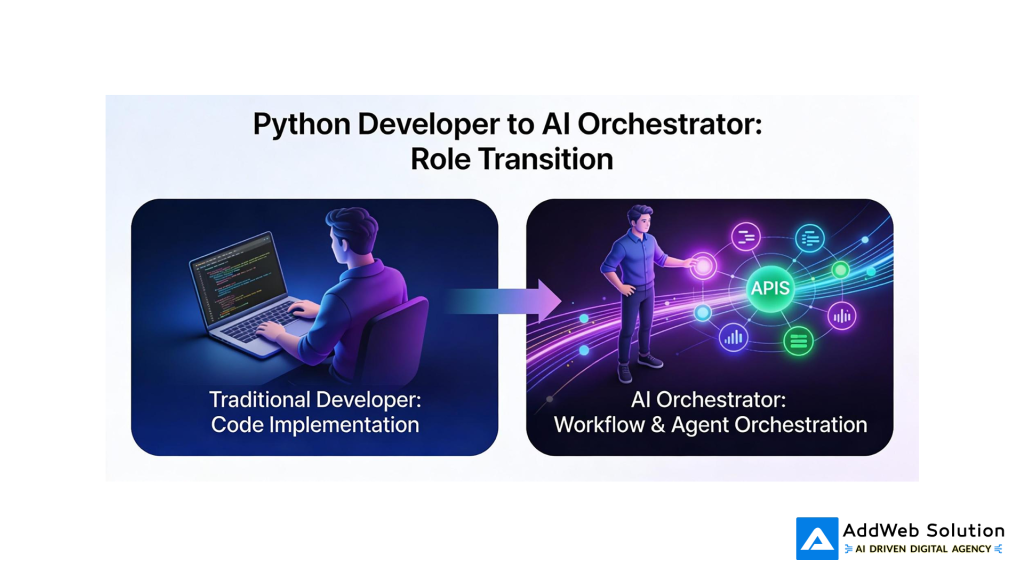
Python Developer to AI Orchestrator: The Evolution of Dev Roles
An AI orchestrator is intelligent middleware for the interaction between the needs of a business and a complex technology stack.
They are not concerned with activities like writing code but with planning the interaction of different AI entities and services.
Let’s take a practical example: they would pick the appropriate trained AI models to cooperate with other predefined APIs and determine the logic of interaction between them without needing to see a line of code.
AI orchestrators are remarkably intelligent by themselves.
These intelligent middleware entities in AI technology are not concerned with activities like writing code as in other programming principles.
They are involved in planning the interaction of different entities and services in AI technology.
For example, if a person needs to create a fraud detection system but does not have experience with AI technology, they
Skills For this kind of work, skills will be quite different from the skills of traditional software developers. Traditional Python software developers will be very good at things like system design, API design, or optimization.
AI orchestrators will have to learn skills in areas that would not have been considered important by traditional software developers. Skills in these areas include prompt engineering (writing good instructions to give to large language models), workflow design (understanding how to sequence several AI tools), context design, or governance.
Highlights from McKinsey’s 2025 survey indicate that 62% of companies are at least piloting AI agents, and 23% of companies have already started scaling AI agents through their companies. However, most of these companies lack the capabilities to effectively deal with these complicated orchestrations. Here is where an orchestrator really matters; they act as a bridge between business results and technical feasibility.
Why Python Developers Are Uniquely Positioned
This is a paradox: Python programmers are very well-positioned to be AI orchestrators, despite being seemingly completely unrelated to what Python programmers do. The key to understanding why is to remind yourself what backend programmers do, at a fundamental level—they create systems to coordinate components and data flow while being able to scale to handle complexity.
The skill transition from being a python backend developer to being an AI orchestrator relies on many intersecting skills:
1. API-Centric Thinking – Python developers who’ve built FastAPI or Flask services already understand how to design clean interfaces between systems. This translates directly to orchestrating multiple AI services and APIs.
Instead of building monolithic applications, they’re now architecting systems where ChatGPT handles conversational logic, Claude handles complex reasoning, and specialized models handle domain-specific tasks.
2. Asynchronous Workflow Management – Any experienced Python developer has worked with background jobs, task queues, and async operations. These exact patterns apply to managing multiple AI agents working in parallel, handling fallbacks when one model underperforms, and managing the non-deterministic nature of AI outputs.
3. Data Pipeline Expertise – Building reliable data transformations has been central to backend development for years. Orchestrating AI systems requires similar skills: validating inputs before they reach models, transforming outputs into business-usable formats, and routing data intelligently based on context.
The orchestration layer must handle data validation, schema management, and error recovery, all skills Python developers possess.
4. System Thinking – Backend developers are trained to think in terms of distributed systems, fault tolerance, and cascading failures. These mental models are precisely what’s needed when building orchestrated AI systems that must remain reliable even when individual models occasionally produce nonsensical outputs or APIs go down.
Real-World Implementation: Laravel Meets AI
While the orchestrator paradigm applies broadly, Laravel developers face a specific and immediate challenge: how do you integrate sophisticated AI capabilities into a framework designed primarily for traditional web applications? The answer reveals the powerful convergence happening between web frameworks and intelligent systems.

Laravel AI Integration Architecture: From Backend to Intelligent UX


Laravel provides the perfect integration layer for AI-powered applications. Consider practical implementations:
AI-Powered Chatbots
Laravel applications can integrate with OpenAI’s API, Google’s Dialogflow, or Watson to provide conversational interfaces. Rather than building custom NLP systems,
Laravel developers leverage pre-trained models through simple API calls, handling authentication, rate limiting, and response caching within familiar controller logic. The orchestrator’s responsibility is defining how the chatbot routes complex queries to specialist models and how it maintains conversation context across requests.
Predictive Forms and Intelligent UX
Imagine a form that adapts based on user input, suggesting options, pre-filling fields with AI-generated recommendations, or validating entries against predictive models.
This is possible through Laravel’s event system and reactive middleware. An orchestrator would design how user input flows through multiple AI models (entity recognition, intent detection, validation), then determines which predictions to surface.
Real-Time Personalization
E-commerce platforms built with Laravel can deliver hyper-personalized experiences by orchestrating recommendation engines.
Rather than storing pre-computed recommendations, the system calls multiple AI services in real-time: collaborative filtering for similar users, content-based models for product similarity, and behavioral prediction models for timing and context.
The Laravel orchestrator defines the priority when these models disagree and how results are cached for performance.
Fraud Detection and Risk Assessment
Financial applications need to evaluate transaction risk across multiple dimensions. A Laravel orchestrator would design a workflow where transactions flow through multiple specialized models simultaneously, one detecting unusual patterns, another evaluating merchant behavior, a third checking against known fraud signatures, then combines their outputs into a unified risk score.
The Business Case: ROI and Operational Impact
The investment in moving toward no-code AI and orchestration is yielding measurable returns. Organizations implementing AI-powered workflow automation achieve a 240% average ROI, typically recovering their investment within 6-9 months. More specifically, enterprises report:
- 47% faster processing with 42% cost reduction through intelligent orchestration
- 92% of early AI adopters reach positive ROI, earning $1.41 for every dollar spent
- 25-30% productivity gains in automated processes
- 40-75% error reduction compared to manual workflows
What explains these dramatic improvements? The answer lies in how orchestration transforms business processes. Traditional workflows move data so humans can make decisions. AI orchestration makes decisions and takes actions, involving humans only for exceptions. This fundamental inversion, from “move data, wait for human decision” to “understand context, decide, act”, is where the value lives.
Consider a practical example: a mid-sized logistics firm implemented automated supply chain management through intelligent orchestration. The results were stunning: 30% reduction in inventory holding costs, 25% improvement in on-time deliveries, and 40% cut in order processing times. These aren’t marginal efficiency gains, they’re transformation-level improvements.
AI Adoption Across Enterprise: Where We Stand Today
The enterprise AI landscape reveals both opportunity and challenge. As of 2025, 78% of companies have adopted AI in at least one business function, yet adoption varies dramatically by company size and maturity.

Current State of AI Agent Adoption in Enterprises (2025)
McKinsey’s latest survey shows that 88% of organizations report regular AI use in at least one business function, but this masks a critical reality: approximately two-thirds are still in the experimenting or piloting phase, with only one-third reporting they’ve begun scaling AI programs.
The breakdown is revealing:
- Companies with over $5 billion in revenue: 47% have reached scaling phase
- Companies with less than $100 million in revenue: 29% have reached scaling phase
This gap reflects both capability maturity and the orchestration challenge. Larger organizations have more resources to build sophisticated coordination layers. Smaller organizations struggle not because they lack data or AI services, but because they lack people trained in orchestration patterns.
Across industries, AI adoption is most advanced in IT and knowledge management functions, where agentic AI orchestration is most mature. But the trend is spreading: AI agents are increasingly deployed in technology, media/telecommunications, and healthcare sectors, with emerging use cases in financial services, manufacturing, and supply chain management. Leveraging an AI agent builder can help organizations streamline the creation of these intelligent agents without extensive coding, ensuring quicker deployment and easier updates.
The Role Transformation: Developer as Strategic Architect
The most important insight is this: developers aren’t being replaced by no-code platforms; they’re being liberated from commodity coding tasks. According to industry data, 87% of professional developers already use low-code platforms, and they report 50% productivity improvements as a result. This isn’t saturation or displacement, it’s acceleration.
The transformation breaks down along clear lines:
| Aspect | Traditional Developer Role | AI Orchestrator Role |
| Primary Activity | Writing and debugging code | Designing workflow coordination |
| Time Allocation | 60-70% coding, 30-40% thinking | 20-30% configuration, 70-80% strategic design |
| Key Skill | Programming language mastery | System thinking & workflow optimization |
| Success Metric | Code quality & performance | Business outcome & system reliability |
| Learning Curve | Syntax, algorithms, frameworks | Domain knowledge, AI capabilities, governance |
| Career Progression | Senior developer → Architect | Developer → Orchestrator → Chief Architect |
Gartner’s forecasts paint a clear picture: by 2026, 80% of low-code users will be business technologists, people outside formal IT departments. This means developers must evolve from being gatekeepers of technical capability to being enablers of business-driven innovation. The strategic value shifts from “I can build this” to “I can orchestrate this better than anyone else.”
Orchestration Frameworks and Practical Tools
The emergence of dedicated orchestration frameworks signals the industry’s recognition that this is a distinct discipline requiring specialized tooling. Frameworks like LangChain, LlamaIndex, and Haystack provide the structural foundation for building orchestrated AI systems:
- Prompt management: Storing, versioning, and dynamically refining prompts based on task requirements
- Workflow composition: Chaining multiple AI calls where outputs from one model become inputs to the next
- API integration: Seamlessly connecting multiple external services into coordinated workflows
- Error handling: Implementing fallbacks and retry logic when AI services fail or produce unusable outputs
- Monitoring and observability: Tracking AI system behavior, debugging failures, and optimizing performance
These tools remove the boilerplate complexity that would otherwise consume a developer’s time, allowing them to focus on the higher-order question: How should these intelligent systems work together to create business value?
The Democratization Effect: Citizen Developers and AI
No discussion of the future of development would be complete without addressing the rise of citizen developers. By 2026, 80% of low-code users are expected to be non-IT professionals, business analysts, marketers, operations managers, building applications for their own functions.
This democratization isn’t cannibalizing professional developer roles; it’s creating a new ecosystem where professionals focus on governance, integration, and complex orchestration while citizen developers handle routine automation.
Organizations with the most success report implementing Centers of Excellence dedicated to citizen development, providing governance frameworks that ensure security and compliance while enabling rapid innovation.
This hybrid model reveals itself across leading enterprises: professional developers architect the orchestration platform and AI integration layer, citizen developers build specific workflows and automations atop that infrastructure, and business users activate these systems to solve day-to-day challenges. The result is an organization that moves at the speed of innovation while maintaining control and security.
Practical Skills for the Transition
For Python developers aspiring to become AI orchestrators, the transition is systematic and achievable:
Phase 1: AI Service Integration (Months 1-2)
- Integrate existing AI services into backend applications
- Add sentiment analysis to APIs
- Implement classification services with FastAPI
- Build document processing pipelines
Phase 2: Orchestration Middleware (Months 3-4)
- Create authentication and rate-limiting services for AI APIs
- Build context management systems for conversation history
- Implement monitoring systems for AI-specific metrics
- Design error handling and fallback strategies
Phase 3: Full-Stack Implementation (Months 5-6)
- Understand how different AI models make decisions
- Master prompt engineering and dynamic refinement
- Learn to compose multiple AI services into workflows
- Build end-to-end AI systems that produce business value
The foundational truth is this: your existing backend development skills are the bedrock. You don’t need to abandon Python or start from scratch. Instead, you’re adding a new layer of capability on top of expertise you already possess.
Future-Proof Your AI Stack with Python’s Powerhouses

Pooja Upadhyay
Director Of People Operations & Client Relations
Conclusion: The Future Is Orchestration, Not Coding
The future of development is not about writing more code, it’s about orchestrating more intelligence. As no-code AI platforms mature and AI capabilities become commoditized through APIs, the competitive advantage shifts from individual engineers writing elegant code to teams coordinating sophisticated systems that drive business transformation.
Python developers are exceptionally well-positioned for this transition. Your understanding of backend systems, your experience building reliable services, and your facility with API design, these aren’t becoming obsolete. They’re becoming the foundation for a more strategic role: the AI orchestrator who doesn’t just build systems, but designs how intelligent systems work together to create unprecedented business value.
The organizations that will thrive in the next 5-10 years won’t be those with the most developers writing code. They’ll be those with developers orchestrating intelligent systems effectively. That’s not a threat to the profession, it’s an evolution that makes development more intellectually interesting and strategically valuable than it’s ever been.
The question isn’t whether you’ll become an orchestrator; the question is when you’ll make the transition, and what competitive advantage you’ll gain by leading rather than following the shift.
- https://research.aimultiple.com/low-code-statistics/
- https://www.hostinger.com/tutorials/how-many-companies-use-ai
- https://www.mckinsey.com/capabilities/quantumblack/our-insights/the-state-of-ai
- https://labelyourdata.com/articles/llm-fine-tuning/llm-orchestration
- https://mirascope.com/blog/prompt-orchestration
- https://www.deloitte.com/us/en/services/consulting/articles/5-keys-to-success-with-citizen-developers.html
- https://mitsloan.mit.edu/ideas-made-to-matter/why-companies-are-turning-to-citizen-developers
- https://www.walkme.com/blog/ai-adoption-statistics/
