


The Reality: The companies using AI to target new customers are reaching an astonishing 30-40% lower CAC compared to the usual approaches, and they’re also seeing an uptake in engagement rates by as much as 74% because the key to it all is to use Python automation and AI systems, which operate and run 24/7 to turn leads into clients.
The playing field has never been tougher for today’s marketers. Increasing customer acquisition costs squeeze profit at all levels. Meanwhile, those companies winning in business growth have not raised their expenditure; instead, they have optimized using AI-based personalization, predictive intelligence, and Python-based workflow optimization. These companies not only cut what they spend on customer acquisition; in fact, they have changed how they do customer acquisition altogether.
The CAC Crisis: Why the Traditional Approach to Marketing Is No Longer Sufficient
The implication is that tomorrow, as of 2025, customer acquisition cost for B2B stands to be between $500 and $700, and organizations that integrate AI effectively cut 30-37% of that cost relative to traditional approaches. This is a savings of $30,000+ per month for a mid-market SaaS firm spending $100,000 per month on customer acquisition.
What is fueling these cuts is not one strategy but an underlying transformation of how acquisition itself is to be done.
The old-fashioned approach to marketing is all about broad targeting, static messaging, and hoping for the best. In other words, you launch a marketing campaign and look at your data weeks later and hope your conversion rates have improved. AI-based marketing changes this entirely. It all comes down to thousands of real-time signals.
What Companies Face Today:
- Ad spending waste: The absence of targeted marketing means that spending will be allocated to an undeserved audience
- Generic messaging: One-size-fits-all messaging lacks relevance so use personalized messages that convert 2× better.
- Manual process overhead: Teams are bogged down by endless hours on manual, redundant work rather than focusing on the strategy
- Slow optimization cycles: Missing optimization opportunities in long optimization cycles
AI & Python automation solves all these friction points.
The Proof: How AI Achieves 40% Reductions in CAC
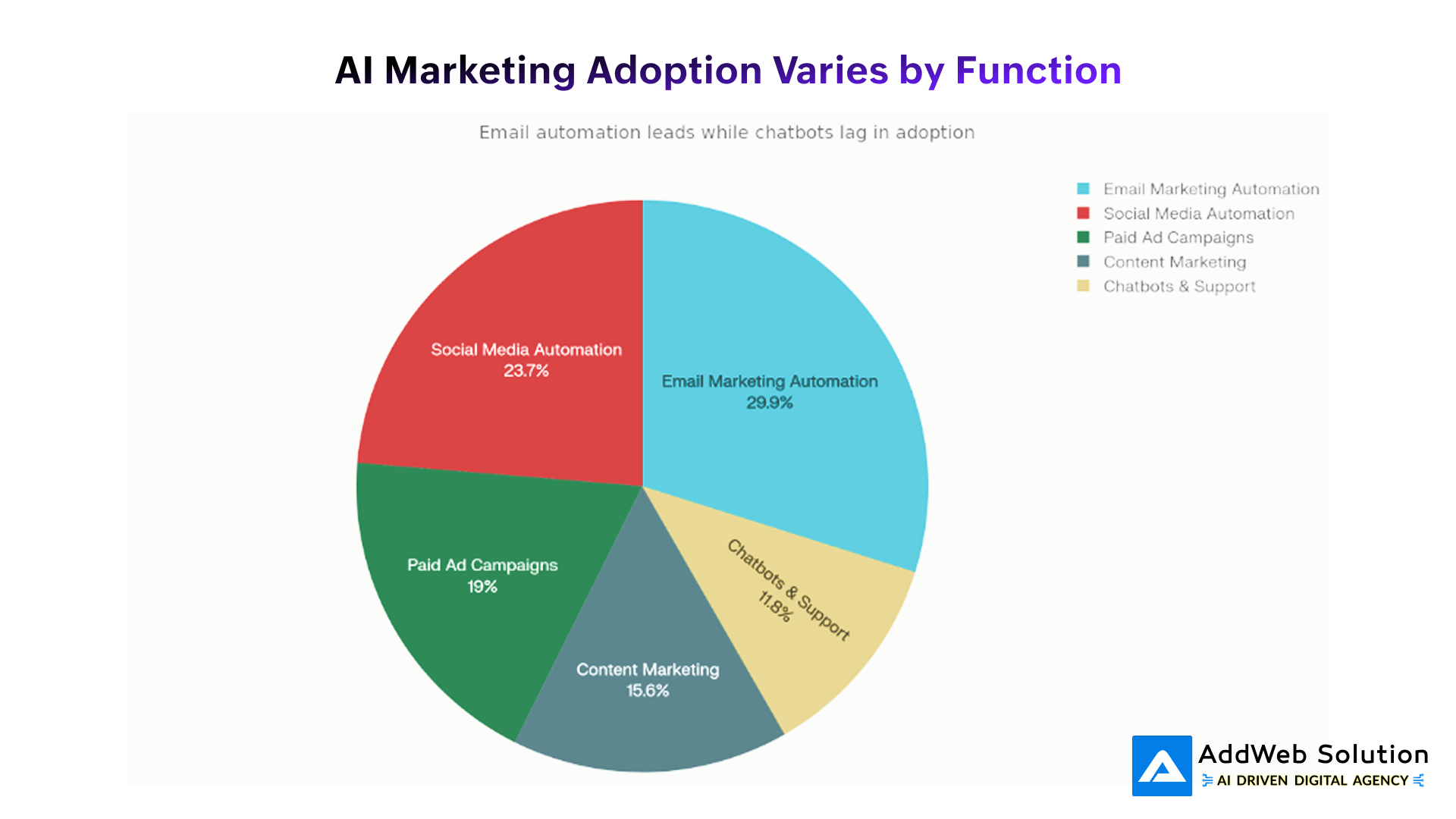
AI & Automation Adoption Trends for Marketing Functions in 2025
We can examine what exactly is happening with respect to figures. If companies apply AI-based systems effectively, they record certain improvements with respect to different parameters:


Precision Targeting With Zero Unwanted Spending
Targeting with AI goes past demographically driven targeting and into behaviorally and intent-based driven targeting. For example, instead of targeting software developers in the US, AI targets those actively looking for solutions to their problems.
The impact: Companies using intent and first-party data targeting decrease CAC 30-50 percent just by focusing budget on high-intent leads. When combined with lookalike modeling (the AI discovering a new audience similar to your best customers), this is a compounding effect.
Personalization That Converts
This is where the magic begins. Engagement campaigns with AI-based personalization result in as much as 74% increased engagement. But engagement is only the start. When messages are customized to each prospect based on behavior, preferences, and buyer cycles:
- Email campaign experiences 30-50% increase in open rates, 20-35% increase in click-through rates
- The conversion rate increases 25% when leads read personalized content.
- Bounce rates are reduced by 25% in the presence of dynamic recommendations
In the world of B2B marketing, that’s very relevant. Personalized experience is not a nicety. It’s what causes a prospect to ignore your message vs. progressing to the next level of consideration.
Predictive Analytics and Lead Scoring
Predictive analytics moves the focus from asking how many leads one can produce to asking how many qualified leads one can produce.
Machine learning algorithms can predict the following using historical data:
It’s helpful to ask questions such as:
- Which prospects are likely to convert (predictive lead scoring delivers 40–60% improvement in sales efficiency)
- When customers are at risk of churn (enabling proactive retention before the cost of chasing them is wasted)
- What will appeal to particular groups of people
Sales teams employing AI in lead scores dedicate less time to the cold leads and more time to closing the warm leads.
The result: faster sales cycle time and lower cost of acquisition.
Automation That Reclaims Hours
What’s often not mentioned: many marketing tasks can be automated. The following are handled by Python automation:
- Email sequences: Triggered emails delivered based on user actions without requiring human input
- Lead Routing: Automatic lead scoring and routing to sales at optimal times
- A/B Testing: Variants are continually tested, and traffic is routed to the winning variations
- Data synchronization: The CRM system, analytic platforms, as well as online advertisement platforms are synchronized.
While the potential rewards for marketers utilizing this technology are huge, with 2.3 hours per campaign saved, not to mention 91% claiming it increases productivity, for those who handle dozens or even hundreds of projects per year, it amounts to weeks annually.
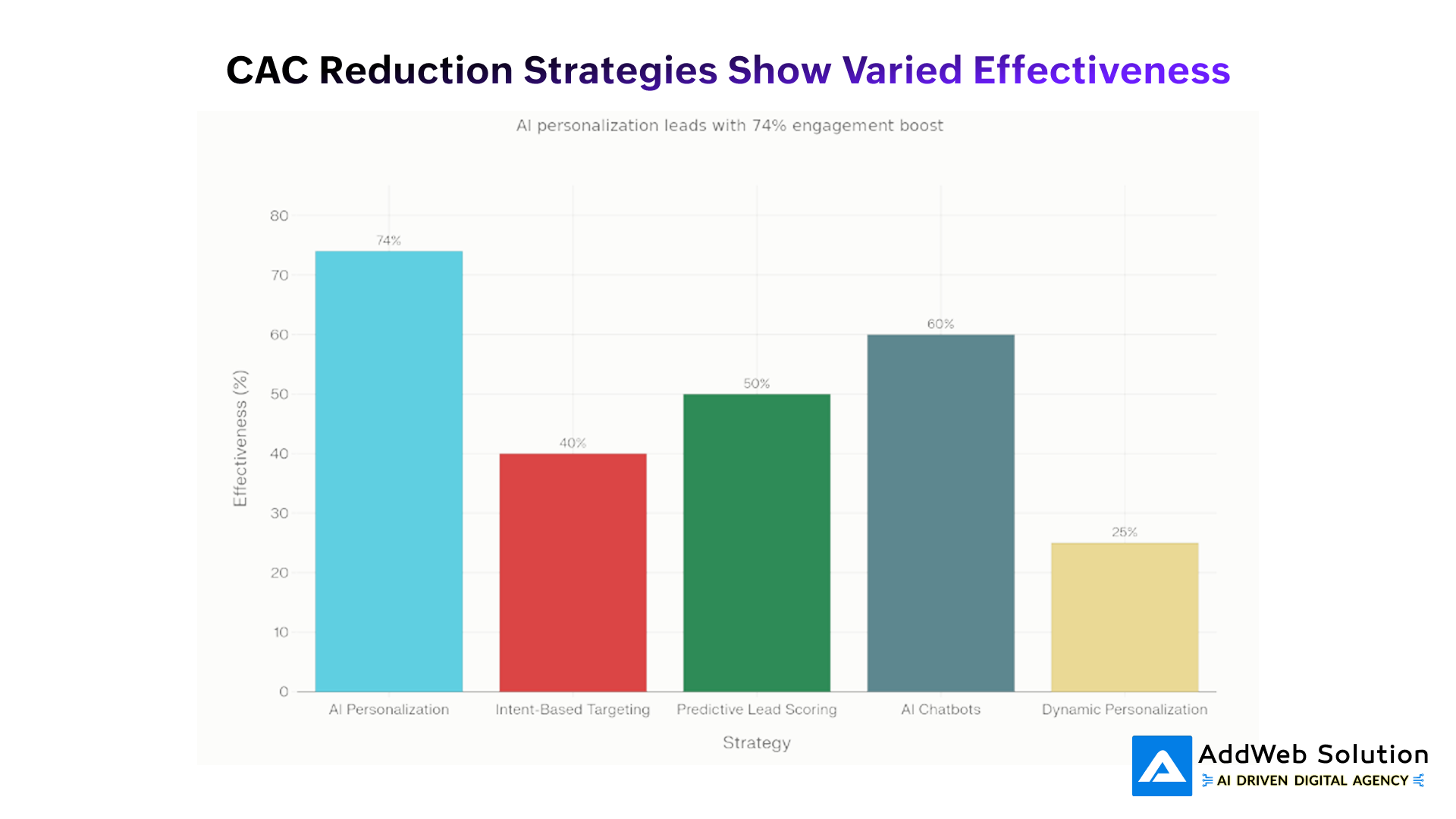
Effectiveness of Key AI-Driven CAC Reduction Strategies (Percentage Impact)
Python and Laravel: The Technical Foundation
Here’s where the conversation gets practical. Building these AI-powered systems isn’t theoretical—it requires solid technical architecture. Python has become the lingua franca of marketing automation and AI implementation, and Laravel provides the framework for building scalable, intelligent web applications that integrate AI seamlessly.
Python’s Role in Marketing Automation
Python excels in marketing automation for three core reasons:
1. Data Processing at Scale
Libraries like Pandas and NumPy handle massive datasets effortlessly. Marketing teams can:
- Analyze customer behavior across thousands of interactions
- Clean and prepare data for machine learning models
- Extract actionable insights from raw analytics
Example: A company with 100,000 customers can analyze their entire interaction history, segment them by behavior, and identify which messaging works best for each segment—all in minutes, not weeks.
2. Machine Learning for Predictions
With Scikit-learn, TensorFlow, and PyTorch, teams build predictive models for:
- Churn prediction: Identify customers likely to cancel, enabling proactive retention offers
- Sales forecasting: Predict demand accurately, optimizing marketing spend allocation
- Lead scoring: Automatically prioritize prospects based on conversion likelihood
These models constantly learn from new data, improving accuracy over time.
3. Workflow Automation
Python scripts can orchestrate entire marketing workflows:
- Send triggered emails based on user actions
- Sync data across CRM, email, analytics, and ad platforms
- Score and route leads to sales automatically
- Generate personalized recommendations for each visitor
This automation isn’t just time-saving; it ensures consistency and speed impossible with manual processes.
Laravel: Building the Intelligence Layer
While Python handles the heavy lifting (data, ML, automation), Laravel provides the web application framework where marketing systems come to life.
Laravel excels at:
- API Integration: Connecting to marketing tools, CRMs, and data sources seamlessly
- Real-Time Personalization: Using events and queues to deliver dynamic content instantly
- Chatbots and Conversational AI: Building intelligent chatbots that guide prospects through buyer journeys
- Scalability: Handling thousands of concurrent users without performance degradation
A practical example: Laravel chatbots integrate with your knowledge base and CRM. When a prospect asks a question, the bot retrieves relevant information and suggests next steps—all in real-time, all without human intervention. The interaction feeds back into your analytics, continuously improving future conversations.
Another example: Predictive forms that adjust dynamically based on what you know about the visitor. If your system recognizes a prospect as a “high-intent technical buyer,” the form emphasizes technical specifications and integrations. For a “business buyer,” it emphasizes ROI and timelines. Same form, completely personalized experience.
Real-World Impact: Metrics That Matter
The shift to AI-powered marketing automation isn’t gradual. When implemented correctly, the business impact is immediate:
| Metric | Impact | Source |
| Revenue per dollar spent | $5.44 return per $1 invested in automation | 7 |
| Average revenue increase | 34% attributed to marketing automation | 7 |
| Lead volume increase | 80% more leads for businesses using automation | 7 |
| Conversion rate improvement | 77% higher conversion rates with automation | 7 |
| Time saved per campaign | 2.3 hours saved on average | 7 |
| Customer engagement lift | 2× higher engagement with AI personalization | 3 |
| Support cost reduction | 40–60% reduction with AI chatbots | 4 |
| Sales efficiency gain | 40–60% improvement with predictive lead scoring | 1 |
What these numbers reveal is critical: AI automation pays for itself quickly. Most businesses recoup their automation investment in under 6 months. After that, it’s pure margin improvement and competitive advantage.
The Implementation Playbook: From Strategy to Results
Implementing AI-powered marketing automation isn’t overwhelming—but it does require a structured approach:
1. Audit Your Current State
Start by mapping current marketing processes:
- Which channels drive qualified leads?
- Where are manual bottlenecks?
- What data silos exist (CRM separate from analytics, separate from email)?
- What’s your current CAC by channel?
This baseline is critical for measuring improvement later.
2. Integrate Your Data Foundation
Siloed data prevents AI from working effectively. Connect:
- CRM to see the full customer journey
- Analytics to understand behavior
- Email platforms to track engagement
- Ad platforms to optimize spend in real-time
Python scripts or tools like Zapier bridge these systems. Once data flows seamlessly, AI can optimize across channels instead of channel-by-channel.
3. Quick Wins Deployment Follows First
Avoid trying to do too many changes at once. Choose “high-impact, low-complexity” projects
- Email Automation: Use Triggered Campaigns to Nurture Leads Based On Behaviors
- Chatbots: Add a bot to your website to answer frequently asked questions and qualify leads.
- Lead scoring: Use a Predictive Model to Rank Sales Follow-ups
- Dynamic content: Personalize landing pages based on visitor source or behavior
These early victories drive momentum, produce ROI, and help to lay the groundwork for more complex campaign
4. Scale Strategic Initiatives
After quick wins demonstrate their effectiveness, extend:
- AI-Driven A/B Testing: Automate Tests for Variants and Switch Traffic to Winning Versions in Real-Time
- Predictive Personalization: Entire user experience adjustments depending on behavior
- Multi-touch attribution: Get true ROI by channel (not just last-click)
- Predictive Analytics: Demand forecasting, Churn prediction, Optimization of Inventory
Get Scalable Python Solutions Tailored for 2026 and Beyond

Pooja Upadhyay
Director Of People Operations & Client Relations
5. Continuously Measure and Optimize
Track metrics that matter:
- CAC by channel and campaign: Know exactly what acquisition costs and where to optimize
- LTV:CAC ratio: Ensure sustainable unit economics (healthy ratio is 3:1 or higher)
- Conversion rates by segment: See which audiences, messages, and offers perform best
- Lead quality metrics: Track not just quantity but conversion likelihood
AI systems improve with data. Continuous measurement feeds learning, driving incremental improvements month after month.

AI-Powered Marketing Automation with Python and Laravel Integration
The Future: What’s Next for AI-Driven Acquisition
“The path is clear. In 2026, we will witness:
Autonomous Campaign Management: Artificial intelligence handling end-to-end campaigns involving audience targeting to creative and budget optimization without human intervention.
Hyper-Segmentation at Scale: Instead of having to worry about five, ten, or maybe fifteen audience segments, AI systems will have thousands to handle, each with its own messaging and offers related to demographics, interests, and other info about the target
Predictive Content Generation: The task of crafting different versions for A/B testing is not done by human writers, and instead, predictive algorithms produce tens of thousands of different variations for testing.
Real-Time Optimization: No longer do marketers wait weeks or months to evaluate a campaign. AI-powered marketers make adjustments in mere hours, stopping non-performing campaigns, scaling successful ones.
Conversational Acquisition: AI-powered chatbots transform into intelligent companions that help the customer through the entire buying journey, answering all his queries, objections, and eventually acquiring him.
Those companies at the forefront of the curve will acquire customers for a price that’s effectively halved when benchmarked against their competition—not only due to their advanced tools but because of their focus on cultivating a smart marketing system rather than a series of isolated efforts.
The Bottom Line: 40% Isn’t the Ceiling
The 40% CAC reduction cited throughout this post isn’t a fantasy or a best-case scenario—it’s what mid-market and enterprise companies are achieving today by implementing Python-powered automation, AI-driven personalization, and intelligent lead management systems.
For your business, this means:
- Immediate cost savings from eliminating ad spend waste and consolidating overhead
- Faster sales cycles from better lead qualification and nurturing
- Higher margins from acquiring customers more efficiently
- Competitive advantage from deploying AI before competitors catch up
The tools are there. Python libraries for data science and machine learning have matured. Laravel takes care of the integration. It’s no longer a question of whether you can use AI for marketing automation. It’s a question of whether you will or your competition will.
“The leaders in each industry in 2026 won’t be those who can afford to spend the most money. It’ll be those who have automated their acquisition process, who have used data to enable personalization, and who have made marketing a smart process versus a form of art.”
This is an advantage that begins right now
Key Takeaways
✓ AI-Powered Marketing – Reduces CAC by 30-40% but increases engagement by 74%
✓ Python and Laravel form the technical backbone for scalable and intelligent automation
✓ Increase sales efficiency by 40-60% using the power of Predictive analytics & Lead Scoring.
✓ Email, Chatbots, and Personalization drive highest ROI increases
✓ Marketing automation saves 2.3 hours per campaign and offers 5.44x return on investment
✓ The integration of data is the starting point—not having it leads to ineffective AI.
✓ Quick Wins First: Automate email, chatbots, and lead scoring before more complex projects
✓ Continuous measurement verifies the improvement of AI systems
Resources
- https://www.mckinsey.com/capabilities/quantumblack/our-insights/the-state-of-ai
- https://www.pwc.com/us/en/tech-effect/ai-analytics/ai-predictions.html
- https://ieeexplore.ieee.org/document/10099189/
- https://www.shopify.com/in/blog/ai-conversion-rate-optimization
- https://www.copy.ai/blog/cost-per-lead
- https://365datascience.com/tutorials/python-tutorials/how-to-build-a-customer-churn-prediction-model-in-python/
