


“When marketers can ship without waiting for engineering, websites stop being projects and start becoming growth engines.”
The Quiet Revolution: Why Webflow’s Moment Matters
It’s easy to tune out market stats, but this one matters. Webflow’s share of all websites jumped from 0.25% in 2021 to 1.2% by 2025. That’s a five-times jump in a space long dominated by WordPress, and it signals a real shift in how websites are being built.
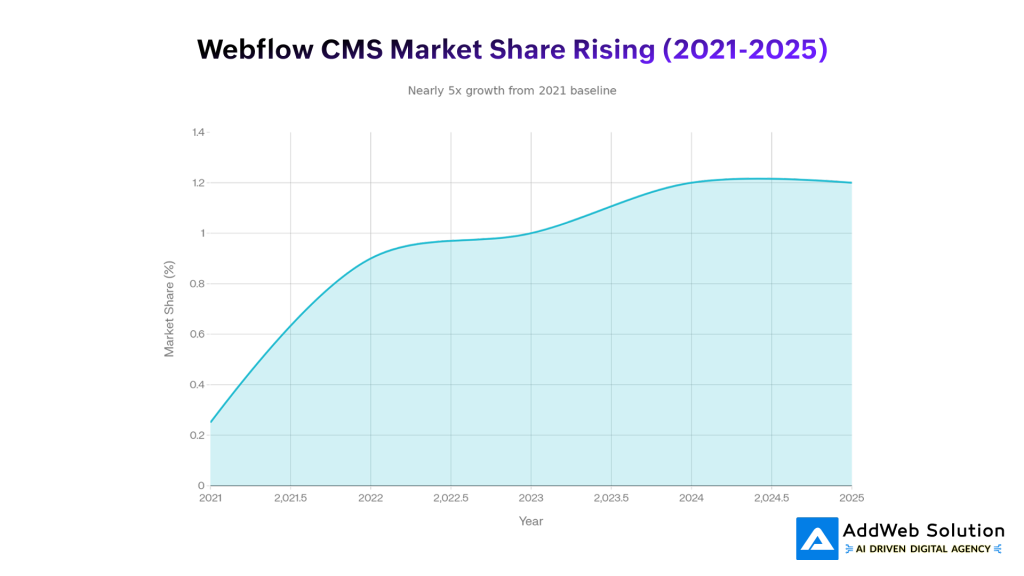
No-code and low-code tools are growing fast, but the real story isn’t the numbers. It’s what happens when teams stop waiting on engineering. Upwork’s marketers can now publish pages without touching a dev backlog. Discord moved its blog to Webflow and finally took full control of its brand.
This isn’t about replacing developers. It’s about freeing them from repetitive work so they can focus on the problems that actually matter.
The Strategic Acquisitions That Changed Everything
Here’s the thing about platform strategy: it’s determined by which bets you’re willing to make public. In 2024, Webflow made three bold bets.
First: Intellimize (April 2024)
The company acquired Intellimize, an AI-driven platform that personalizes webpages for individual visitors, for an undisclosed eight-figure sum. This wasn’t a random move. Intellimize had built something genuinely useful – a system that runs AI experiments on webpage elements (copy, layout, images) and delivers the highest-performing variant to each visitor based on their behavior and origin. Companies like Sumo Logic, Dermalogica, and ZoomInfo were already paying for it.
What Webflow understood: personalization and conversion rate optimization (CRO) are now table stakes for serious brands. If you’re spending money on building a beautiful website, you need to know that beauty is actually converting visitors into customers.
Second: GreenSock (October 2024)
Then came GreenSock – arguably the most respected animation library in web development. GSAP (GreenSock Animation Platform) powers animations on some of the web’s most visually stunning sites. By acquiring it, Webflow essentially said: we’re making world-class animation capabilities native to our platform.
This matters because beautiful animations aren’t just eye candy. They’re part of how modern websites communicate, guide user attention, and create emotional connection. Animations that feel sluggish kill the experience. Native GSAP integration means designers on Webflow can now create magazine-quality motion without worrying about performance bottlenecks.
The Vision Behind Both Moves
Webflow CEO Vlad Magdalin has been explicit about the endgame: building a Website Experience Platform (WXP) – a single environment where teams can design, build, optimize, and personalize websites without context-switching. No separate CRO tool. No external animation library. No custom code bottlenecks.
This is positioning Webflow not as a design tool, but as the operating system for modern web experiences.
From Design Tool to Experience Platform
The announcement at Webflow Conf 2025 crystallized what’s been brewing for the past year. The company is moving beyond visual design into agentic AI – meaning AI that can autonomously generate production-grade code, content, and optimization strategies.
Here’s what was announced:
Webflow AI (Prompt-to-Production)
Generate entire applications and React components directly from natural language prompts. No intermediary steps. One click to publish to your live site.
AI Assistant (Conversational Interface)
Think of it as having an expert designer and developer inside the editor who can write code, generate CMS content, help with CSS, and answer questions about the platform – all without leaving the canvas.
AI-Powered SEO & Schema
Automatically generate metadata, schema markup, and Answer Engine Optimization (AEO) elements that help your site get discovered by both Google and AI-powered search tools like Perplexity and ChatGPT.
Next-Gen CMS
A complete overhaul of the CMS to handle larger datasets, more flexible design options, and better performance scaling – critical for enterprise teams managing thousands of pages.
Real-Time Collaboration
Multiple team members can work on the same site simultaneously, with visibility into changes happening live across the platform.
The through-line here is clear: Webflow is building for a world where non-technical people can make technical decisions in real time. Where “that requires an engineer” stops being a blocker.



Real-World Impact: How Companies Are Winning with Webflow
Case studies often feel polished and unrealistic. These stand out because they show everyday bottlenecks and how teams removed them.
Upwork: From Weeks to Minutes
Upwork’s marketing team was stuck waiting on engineering for even small changes. After moving to Webflow CMS, marketers and designers could publish pages, test copy, and make updates instantly. The result was simple but powerful: the team started moving at marketing speed, not engineering speed.
Discord: Owning the Brand
Discord’s blog lived on Medium and lacked consistency. Moving to Webflow gave them full control. By connecting their Figma design system to Webflow components, multiple teams could publish content while keeping the brand tight, fast, and consistent.
Dropbox Sign: From Months to Days
Dropbox Sign’s custom-coded site created constant developer bottlenecks. After switching to Webflow Enterprise, developer requests dropped by 67%. Pages shipped faster, and a major rebrand that usually takes six months was completed in just two.
The common thread is not just faster websites, but freed-up engineers who could focus on building real products instead of maintaining marketing pages.
The Numbers Behind No-Code: A Data-Driven Shift
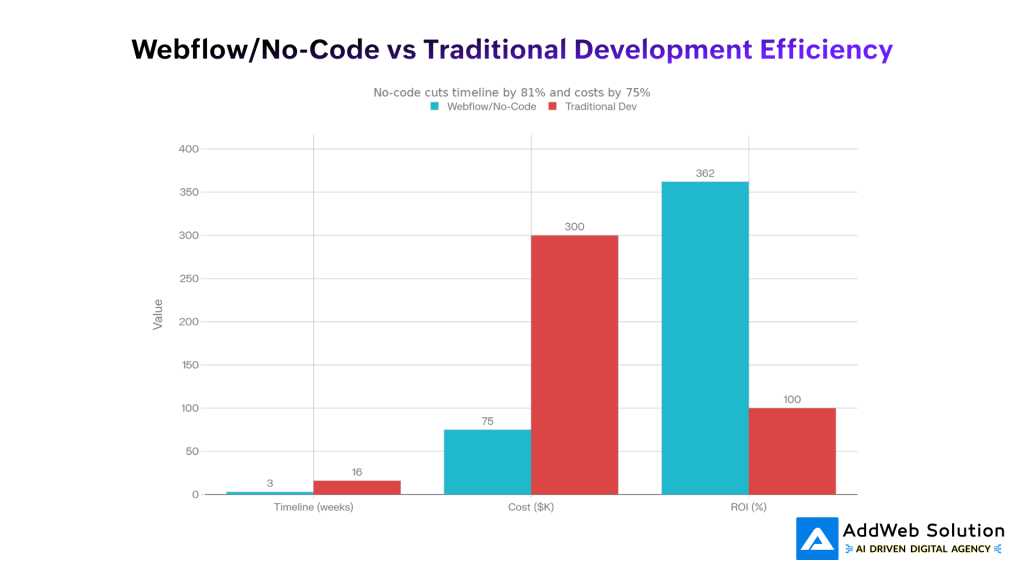
Adoption stats can feel distant, but their impact is very real. No-code apps are built up to 10 times faster than traditional ones, and most low-code teams ship complete applications in under three months. That kind of speed is rare in conventional development.
The cost difference is just as stark. Companies save around 70% on development, turning a $300K project into something closer to $75K. Productivity jumps too, with teams seeing up to a 4x increase because marketers, designers, and analysts can finally build instead of waiting.
Even developers are on board. Nearly 9 out of 10 already use low-code tools, not because they’re being replaced, but because it lets them focus on harder problems.

In practice, this changes everything for small teams. Instead of spending $50K on a custom site or settling for a generic template, a five-person marketing team can hire a Webflow designer once and stay in control forever. They can launch pages, test ideas, and adapt fast. That’s a completely different way of working.
AI + Design = The New Competitive Advantage
AI in web development is no longer experimental. It’s becoming table stakes. The AI development platform market is growing fast, and over 70% of businesses are already using AI to move quicker and work smarter.
What matters more than the numbers is this: AI lets teams do today what wasn’t possible six months ago. Webflow’s AI shows this clearly.
- Code generation: Describe a component in plain English and Webflow AI generates production-ready code.
- Content creation: Generate pages or product descriptions that match your brand voice.
- SEO automation: Metadata, schema, and AEO created automatically.
- Design suggestions: AI flags accessibility issues and suggests layout improvements based on real data.
AI won’t replace great designers or developers. It removes the busywork. Designers get options faster. Developers skip repetitive tasks. Teams spend less time executing and more time thinking.
The shift is simple but powerful: AI doesn’t replace creativity, it compresses it. What once took weeks can now take days, giving teams more time for strategy and impact.
What Traditional Development Can’t Do (Yet)
Let’s be honest. Traditional development still makes sense for complex systems, custom security needs, or deep legacy integrations. It gives you total control, unlimited customization, and no platform dependency.
Webflow trades some of that freedom for speed and accessibility. You cannot build everything, and you do rely on Webflow’s infrastructure. That’s the trade-off.
But the gap is closing fast. The list of things no-code cannot handle keeps shrinking, and Webflow is actively pushing those boundaries.
For about 95% of websites like marketing sites, content hubs, SaaS pages, and brand experiences, Webflow is becoming the smarter choice. Not just because it’s more affordable, but because moving faster is one of the strongest competitive advantages today.
Core Web Vitals: Why Performance Matters More Than You Think
Google doesn’t just reward fast sites. It requires them. Core Web Vitals (Largest Contentful Paint, First Input Delay, Cumulative Layout Shift) are now explicit ranking signals that impact search visibility.
The numbers are unambiguous: Pages that meet all Core Web Vitals thresholds are 24% more likely to rank in the top 10 search results.
Breaking this down by individual metrics:
- LCP ≤ 2.5 seconds: +15% higher rankings, 20% decrease in bounce rate
- FID ≤ 100ms: +10% ranking improvement, 18% increase in engagement
- CLS ≤ 0.1: +12% ranking boost, reduced user frustration

Here’s what makes Webflow particularly powerful in this context: the platform is built by engineers who understand web performance from first principles. Every template is optimized. The CDN is global. Image optimization is built in, not bolted on.
Compare this to a typical WordPress site, where you’re juggling 20 different plugins – each adding JavaScript, each slowing down your site, each potentially conflicting with the others. Or a custom-coded site where performance is only as good as your DevOps team’s expertise.
On Webflow, performance is architected into the foundation. That’s not a marketing claim. That’s how they’ve consistently helped clients hit green scores on PageSpeed Insights.
The Designer/Developer Divide Is Collapsing
One quiet but important shift in web development is that the line between designers and developers is fading. The roles still exist, but the tools now overlap. Designers can build interactions and animations on their own. Developers can handle simple changes without digging deep into code. Marketers and product managers can prototype and iterate without waiting.
This is not a threat to developers. It’s a relief. Senior developers want to work on hard problems, not rebuild the same login form again and again. Webflow removes that friction by letting routine work happen without engineering involvement.
The real bottleneck today isn’t developer capacity. It’s knowing what to build and being able to test and improve it quickly.
What This Means for Your Organization
If you’re a marketing leader, an agency owner, or someone responsible for your company’s digital presence, here’s the practical question: Are you optimizing for speed or for control?
Speed means:
- Launching new campaigns in days instead of weeks
- Publishing content without engineering bottlenecks
- Iterating based on performance data in real time
- Reducing your dependency on specialized talent
Control means:
- Absolute customization
- No vendor dependency
- Ability to optimize for any metric
- Long-term flexibility
For most organizations, the answer isn’t one or the other. It’s a mix. A large e-commerce platform with complex infrastructure might build on traditional tech. But the marketing site, the campaign landing pages, the blog, the customer hub? Those are perfect candidates for Webflow.
The opportunity right now is that most of your competitors are still waiting for engineers or cutting corners with template-based solutions. You could be shipping something differentiated in half the time.
Unlock the Power of Webflow Today

Pooja Upadhyay
Director Of People Operations & Client Relations
Conclusion
Webflow’s evolution reflects a broader shift in how modern websites are built and maintained. As AI, design, performance, and personalization come together in a single platform, slow workflows and fragmented tools are becoming a competitive disadvantage. Webflow is not about replacing developers or eliminating code. It is about removing friction and enabling teams to act faster.
The real advantage is speed. Teams that can launch, test, and optimize in days gain a learning loop their competitors cannot match. Webflow’s product direction makes websites living products rather than static projects.
For most organizations, the question is no longer whether Webflow can handle the job. It is whether waiting longer still makes sense in a market where speed defines who wins.
Source URLs
https://webflow.com/feature/ai
https://webflow.com/blog/pricing-and-product-updates-wxp-2024
https://webflow.com/blog/webflow-conf-2025-an-invitation-to-play
https://finance.yahoo.com/news/webflow-unveils-ai-prompt-production-150000242.html
https://techcrunch.com/2024/04/19/webflow-intellimize-acquisition-web-development-ai/
https://www.mckinsey.com/capabilities/quantumblack/our-insights/the-state-of-ai
