


“When we brought Boundless Payments to life, it had to resonate. That meant unshackled humans who bring creativity. With Webflow, we brought a new brand experience to life in 10 days – and it’s delivering that brand promise around the world.” – Liz (Verifone Brand Lead)
Introduction
Every founder knows this truth: speed wins. In 2025, the difference between leading the market and chasing it is measured in weeks, not months. Yet many startups are still stuck waiting – long dev cycles, endless dependencies, and competitors moving faster.
What if it didn’t have to be that way?
What if your marketing team could launch 30+ localized sites in days, not months?
What if your product went live while others were still planning sprints?
This isn’t a theory anymore. Startups are already doing this with no-code tools like Webflow, shrinking timelines from quarters to weeks. The shift is real – and today, your website can either fuel your growth or slow it down.


Why Speed Now Matters More Than Ever
Startup stats are brutal: 90% fail, and most don’t make it past years two to five. But here’s what often gets missed – it’s not always the product that fails. It’s speed.
MVPs are being built faster than ever. Thanks to AI and modern tools, development time has dropped sharply. In Silicon Valley, startups now launch MVPs nearly 40% faster than just five years ago. That’s not a small gain – it’s a shift in how markets move.
The problem? Many teams are still building like it’s 2015. While competitors ship in weeks, they’re stuck in months-long dev cycles.
The reality is simple: speed no longer means lower quality. Today, the fastest teams ship great experiences, learn quicker, and adapt faster. And in this phase of the market, learning speed – not just ideas – is what decides who wins and who disappears.
The Timeline Breakdown: Traditional vs. No-Code vs. Webflow
Let’s cut through the marketing noise and look at what the data actually shows:
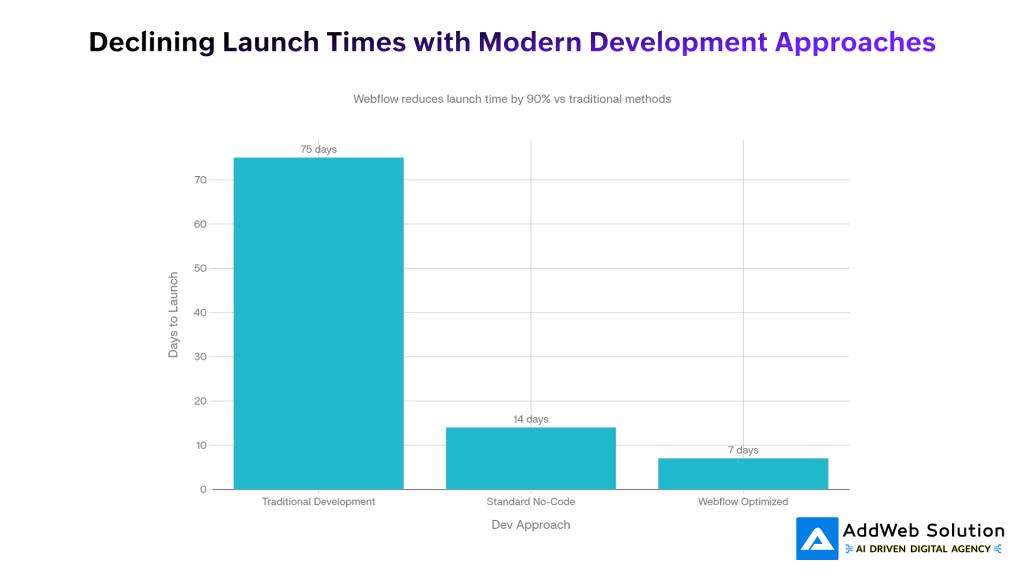
Traditional custom dev: 2–3 months. Discovery, designs, backend work, reviews, testing – every small change needs a developer, and delays pile up fast.
Typical no-code tools: 2–3 weeks. Faster, yes – but advanced features often mean hacks, extra tools, and awkward collaboration.
Webflow (done right): 1–2 weeks. Design, CMS, hosting, APIs, and collaboration all in one place. No tool-stitching. No slow handoffs. Just speed without giving up flexibility.
That speed adds up. Copy.ai cut publishing from days to minutes. Talkspace went from weeks of updates to hours. Verifone launched 32 localized sites in 10 days – something that would’ve taken months the old way.
The No-Code Market Moment
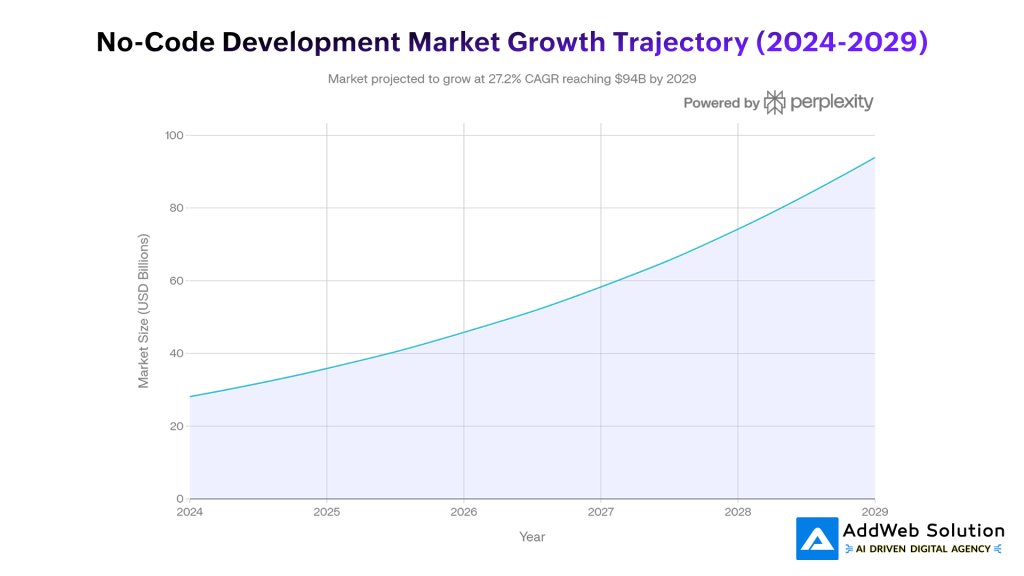
The market data confirms this isn’t fringe. The no-code development platform market reached $28.11 billion in 2024 and is projected to grow to $35.86 billion in 2025, then accelerate to $93.92 billion by 2029 – representing a 27.2% compound annual growth rate.
That’s not adoption among small indie builders anymore. Enterprise teams at Dell, Zendesk, and Verifone are standardizing on these platforms. Webflow specifically has grown from 0.6% market share to 0.8% in just one year, and 3.4% of the world’s top 1,000 websites now run on Webflow. The e-commerce segment is accelerating fastest: Webflow e-commerce sites grew from 9,943 in Q2 2023 to 12,501 in Q2 2024 – a 25.73% year-over-year jump.
This is the inflection point where no-code platforms graduate from “good enough for small projects” to “genuinely preferred for speed-critical work.”
What’s Actually Possible in 14 Days?
This isn’t theoretical. Let’s walk through what a realistic 14-day launch looks like:
Days 1-2: Strategy & Scope
- Define your core value proposition in 2-3 clear statements
- Map critical user journeys (signup, onboarding, first action)
- Decide: landing page only, or product-integrated site?
- Choose your CMS structure if content will scale
Days 3-5: Design System & Build Foundation
- Create 5-7 reusable page templates using Webflow’s component library
- Build navigation, footer, and core interactive patterns once (then reuse infinitely)
- Set up typography, color system, and spacing rules
- This investment pays dividends on iteration speed
Days 6-10: Launch Pages
- Build homepage, about/product pages, pricing, and contact
- Integrate with Zapier, HubSpot, or email service for lead capture
- Set up analytics, UTM tracking, and conversion monitoring
- Test responsive design on mobile, tablet, desktop
Days 11-13: Content & Optimization
- Publish copy, images, and calls-to-action
- Run SEO checks using Webflow’s native tools
- A/B test headlines and button copy using Webflow Optimize
- Set up DNS and domain configuration
Day 14: Go Live
- Publish to production
- Monitor analytics and error tracking
- Prepare post-launch content and social campaigns
- Document what worked (you’ll do this faster next time)
This isn’t possible by accident. It requires ruthless scope discipline: you’re not building the dream site. You’re building the minimum viable presence that generates first customers, captures feedback, and positions you for iteration.
Ready to Transform Your Online Presence? Begin with Our Expert Webflow Development Services!

Pooja Upadhyay
Director Of People Operations & Client Relations
Real Case Studies: Where Theory Meets Execution
Verifone
A global rebrand. 32 countries. An “impossible” deadline.
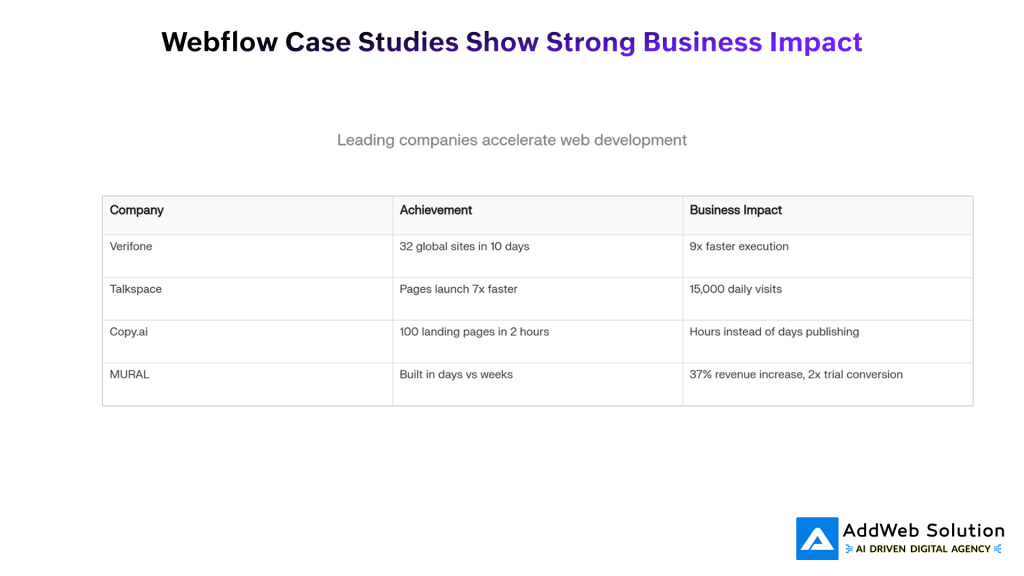
On their old stack, it would’ve taken 3–4 months. With Webflow and BX Studio, all 32 localized sites went live in just 10 business days. Translation dropped from weeks to a day – and marketing could finally publish without waiting on engineering. That shift alone changed how they moved as a company.
Talkspace
Dozens of sites. Multiple CMSs. Slow updates.
After moving to Webflow, pages launched 7× faster. Updates that once took weeks now take hours. One full rebrand shipped in a day – and their Teenspace NYC site now sees 15,000 daily visits.
Copy.ai
They needed to publish at massive scale, but their CMS was the bottleneck.
By connecting Webflow with automation, they published 100 landing pages in 2 hours – work that once took months. The same team now ships ~30% more content and drives millions in organic pipeline.
MURAL
Great design, zero agility. Every change needed dev time.
After Webflow, marketing could test and launch on their own. The result: 2× higher trial conversions and 37% more revenue from self-serve users.
Different companies. Same lesson: when speed goes up, learning accelerates – and growth follows.
The 5 Key Features That Enable This Velocity
Speed doesn’t happen by accident. Webflow has architected specific capabilities that collapse development timelines. Understanding them shows why generic website builders fall short:
1. Visual CMS (No Code, No Waiting)
Instead of waiting on developers, marketers can create and manage content themselves. Pages like blogs, case studies, or job listings can go live in hours – not weeks. Huge win for lean teams.
2. Hosting Built In (One Less Headache)
Hosting, scaling, and global performance are handled out of the box. Your site stays fast during launches or traffic spikes – no DevOps work, no extra setup.
3. API-Ready, Not Locked In
Webflow works visually and headlessly. You can manage content once and reuse it across apps, custom frontends, or other platforms. Flexible now, future-proof later.
4. Reusable Components = Faster Iteration
Build a component once, use it everywhere. Update it once, and it updates across the site. What used to take days now takes minutes – and your brand stays consistent.
5. Built for Teams, Not Silos
Designers, marketers, and PMs can work together at the same time with staging, approvals, and version control. Less friction, more flow – especially for fast-moving startups.
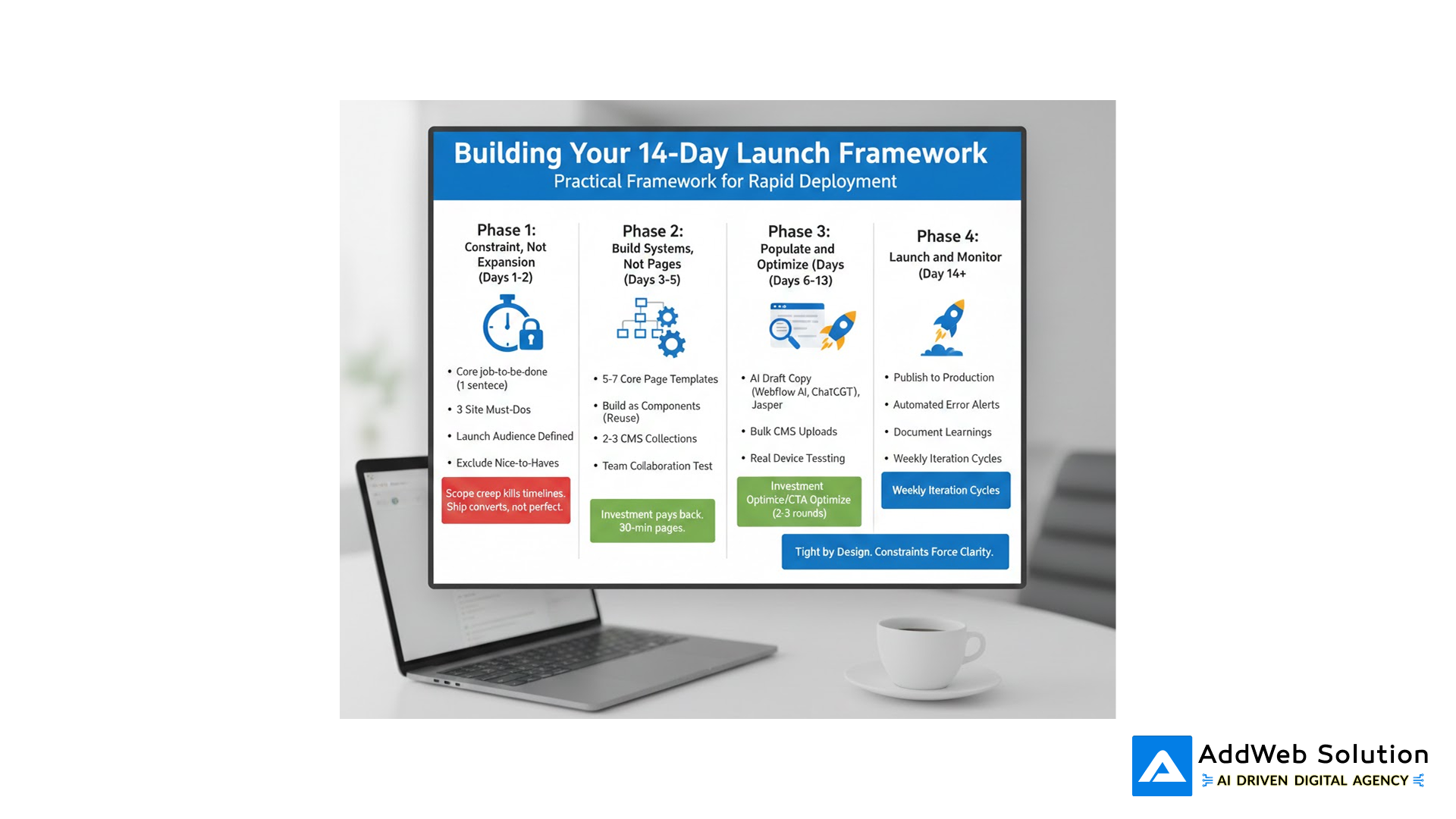
Building Your 14-Day Launch Framework
If you’re ready to move this direction, here’s the practical framework:
When Speed Is Essential (And When It Isn’t)
Let’s be honest: 14 days isn’t right for every startup.
14-Day Launch Makes Sense When:
- Your market is hot and timing is everything (fintech, climate tech, AI tools)
- You’re validating a specific hypothesis before raising funding
- You’re entering a crowded category and execution matters more than perfection
- Your team is experienced and can make fast decisions
- The website’s primary job is lead generation or community signup
You Should Slow Down When:
- You’re building a consumer product where brand positioning is the entire moat (D2C fashion, premium services)
- Your site is also your product (SaaS apps that run in-browser)
- Regulatory compliance adds complexity (fintech, healthcare, legal tech)
- You need international localization and cultural adaptation
- Customer success depends on smooth onboarding experiences
The framework isn’t “always launched in 14 days.” The framework is “know why you’re taking the time you are taking.” Most startups default to slowness by inertia, not by necessity.
Integration: How This Applies to Enterprise Digital Transformation
At AddWeb Solution, we work with enterprises undergoing digital transformation at scale. The principles here apply directly to enterprise websites managing millions of users and complex organizational needs.
When large organizations need to launch new market initiatives, rebrand divisions, or consolidate fragmented digital properties, the Webflow approach scales through:
- Distributed team workflows: Enterprise teams in different time zones can work simultaneously without merge conflicts
- CMS decoupling: Business users (marketing, product) operate independently from infrastructure teams
- Enterprise hosting guarantees: Built-in compliance, uptime SLAs, and security protocols
- Rapid A/B testing: Webflow Optimize enables marketing teams to test and iterate without engineering involvement
Verifone’s 10-day 32-site launch wasn’t a small startup story – it was an enterprise payments company proving that infrastructure shouldn’t slow you down. That’s the principle translating across scales.
Conclusion
The startup graveyard is full of companies with superior products that moved too slowly. They waited for perfection while competitors shipped, iterated, and dominated.
No-code platforms like Webflow have fundamentally restructured what’s possible in 14 days. A designer and marketer can now accomplish what previously required a four-person engineering team and three months. The difference? Companies like Verifone, Talkspace, and Copy.ai realized that moving faster wasn’t optional – it was survival.
Here’s the uncomfortable truth: your website infrastructure probably isn’t slowing you down because of technical complexity. It’s slowing you down because your organization treats websites like infrastructure instead of marketing. The moment you flip that framing and give teams autonomy to move, everything changes.
Fourteen days to launch isn’t just a productivity hack. It’s an organizational design principle. It signals that your company moves at market speed, not bureaucratic speed.
Next step: audit your current process. How long does it take to publish a new landing page? Change a headline? If the answer is “file a ticket and wait for engineering,” you’ve already lost velocity to competitors who figured this out.
The companies leading their categories in 2026 aren’t the ones with the most sophisticated architecture. They’re the ones that decoupled business velocity from technical constraints and moved faster because they could.
Your competitors are probably already moving. Don’t let them ship twice while you’re still in planning.
Source URL
- https://www.thebusinessresearchcompany.com/report/no-code-development-platforms-global-market-report
- https://www.researchandmarkets.com/reports/5983882/no-code-development-platforms-market-report
- https://www.precedenceresearch.com/low-code-and-no-code-development-platforms-market
- https://www.integrate.io/blog/no-code-transformations-usage-trends/
- https://www.embroker.com/blog/startup-statistics/
- https://webflow.com/customers
- https://webflow.com/customers/verifone
