


“We think of Webflow as a visual development environment; a place where you can develop software visually… not just another website builder.”
– Vlad Magdalin, Co‑Founder and CEO of Webflow
Modern teams are tired of the same conversation.
Designers present a pixel-perfect Figma, everyone nods, and a few sprints later the live site looks… “close enough.” Margins are off, typography is slightly different, interactions feel heavier. The product ships, but everyone knows something got lost between design and development.
That quiet erosion of quality is not just an aesthetic problem; it burns time, budget, and team morale. A 2024 DesignOps survey found that two-thirds of respondents waste between 25% and 50% of their work time on design delivery inefficiencies such as clarifying specs, fixing inconsistencies, and rework.
Webflow and visual development are changing that equation. Instead of handing off static mockups and hoping for the best, designers can ship production-grade, responsive, CMS-powered websites directly – without surrendering control over the details that matter.
This article looks at why “pixel-perfect without the headaches” is no longer a fantasy, how Webflow reduces design compromise in real teams, and where a partner like AddWeb Solution fits into that picture.

Why “Pixel-Perfect” Usually Means Compromise
Designers and developers want the same thing: a beautiful, performant site that ships on time. But the workflow often pits them against each other. Designers thrive in fluid tools; developers need structure, constraints, and clean code. Zeplin and DesignOps Assembly’s 2024 benchmark work highlights that friction in design-to-dev collaboration is one of the biggest pain points for product teams worldwide.
The cost is very real. In that 2024 DesignOps survey, about two-thirds of respondents said they waste between 25% and 50% of their work time on design delivery inefficiencies – things like chasing missing specs, reconciling outdated frames, or reiterating spacing and type scales. Another study on UX handoffs suggests that “developer-ready” assets alone can save 20–40% of total development time by reducing guesswork at build time. For a cross-functional team, that’s weeks of velocity lost or gained every quarter.
Traditional workflows create a fragile translation layer:
- Designers hand off static files (Figma/Sketch/etc.).
- Developers interpret them in code, under time and platform constraints.
- Stakeholders arrive late with feedback.
- Small misalignments snowball into visual debt and compromise.
The more ambitious the design – custom grids, micro-interactions, content-driven layouts – the more likely it is to get “normalized” into whatever the front-end can manage within the sprint. That is where teams silently give up on pixel perfection.

With that much of the week spent fighting the process, not the problem, “pixel-perfect” often becomes a luxury. Webflow’s value is that it moves a big chunk of this work out of the translation layer and back into a single, visual source of truth.


How Webflow Changes the Design-to-Development Equation
Webflow is not just “a nicer website builder.” Webflow’s own leadership has long framed it as a visual development environment – a place where teams can design, build, and launch production-grade sites visually rather than writing every line of front-end code by hand.
That shift matters because it changes who controls fidelity and when constraints enter the conversation:
- Designers work directly in a CSS-box-model-based canvas, not a flat artboard.
- Layouts, interactions, and CMS schemas exist in the same tool that publishes the live site.
- Developers can focus on integrations, performance, and complex logic rather than re-implementing every spacing token.
This aligns with broader no-code and low-code trends. Gartner-backed research aggregated by AIMultiple estimates that around 70% of new applications will use low-code or no-code technologies by 2025, up from less than 25% in 2020. In parallel, a Statista analysis of a 2024 Onymos survey found that 84% of U.S. organizations report extreme or somewhat reliance on low-code/no-code SaaS solutions.
In other words, moving design closer to production is no longer experimental. It is becoming the mainstream way digital products are built.

These shifts line up with broader low-code data. One 2025 analysis notes that no-code and low-code platforms can deliver applications 5–10 times faster than traditional development, with most users shipping full applications in under three months. For content-heavy websites and marketing properties, the acceleration can be even more dramatic.
When Webflow Fixes Design Compromise – and When It Does Not
Visual development is not a silver bullet for every scenario. Enterprise-grade products with deeply custom logic, real-time data streams, or strict internal hosting policies may still need a heavier engineering stack. But for many use cases, the trade-offs favor Webflow:

For many brands and agencies, the sweet spot is a hybrid model: Webflow for public-facing experiences where design nuance and speed matter, paired with APIs, custom services, or headless systems for complex back-end logic.
The Data: Webflow’s Growth and the No-Code Wave
Beyond workflow comfort, it helps to look at the numbers. Webflow has moved well past the “side project” phase and into serious platform territory.
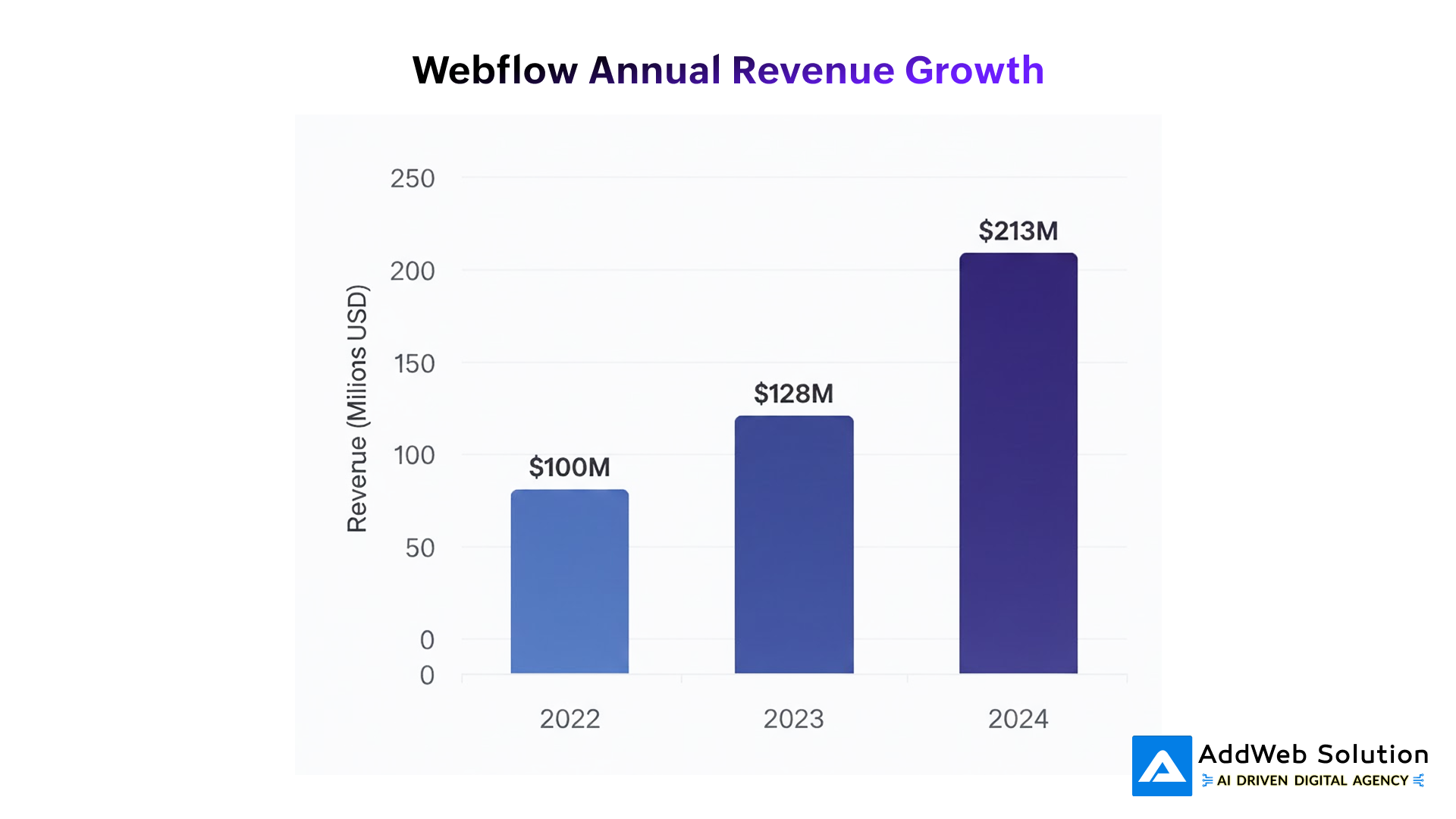
- Analysis compiled from Forbes and other sources suggests Webflow generated 213 million dollars in revenue in 2024, up from 128 million in 2023 and 100 million in 2022.
- That same dataset pegs Webflow at roughly 0.8% of all websites on the internet, or about one in every 125 sites.
- Separate research notes over 3.5 million designers and teams using Webflow across 190 countries, including more than 100,000 paying customers. (Source:
Zooming in on eCommerce is particularly telling. From 2020 to 2023, the number of active Webflow eCommerce websites jumped from 1,598 to 11,950, a 647.81% increase. By Q2 2024, that number had reached 12,501, representing a 25.73% year-on-year increase.
At the same time, the no-code development platforms market is exploding. One report estimates it will grow from 28.11 billion dollars in 2024 to 35.86 billion in 2025, on its way to 93.92 billion by 2029, with a compound annual growth rate of more than 27%.
For decision-makers, this matters for one simple reason: tools that eliminate design compromise and handoff friction are not niche anymore. They sit inside a market that is outgrowing much of the traditional development tool landscape.
Conclusion
Pixel-perfect design has long been treated as an ideal that inevitably gets diluted somewhere between concept and launch. But that compromise was never about ambition – it was about process. Traditional handoffs introduce translation, interpretation, and rework, and with each step, fidelity slips and momentum slows.
Webflow changes that dynamic by collapsing design and development into a single, production-ready environment. When the same tool controls layout, responsiveness, interactions, and content structure, what teams design is far closer to what users actually experience. The result is not just visual precision, but faster delivery, fewer revisions, and stronger alignment across teams.
Of course, no platform fits every technical scenario. But for many marketing sites, brand experiences, and content-driven products, Webflow offers a practical way to protect design integrity without adding complexity.
In a landscape where speed, consistency, and experience quality define competitive advantage, eliminating design compromise is no longer a luxury – it’s a strategic decision. And with the right implementation partner, teams can turn visual precision into real, measurable business impact.
Source URLs
- https://enricher.io/blog/webflow-market-share-statistics
- https://taptwicedigital.com/stats/webflow
- https://webflow.com/resources/report/2025-state-of-the-website
- https://www.researchandmarkets.com/reports/5983882/no-code-development-platforms-market-report
- https://www.statista.com/statistics/1490978/reliance-level-of-low-code-and-no-code-saas-us-2024/
- https://userguiding.com/blog/no-code-low-code-statistics
- https://www.thealien.design/insights/webflow-usage-statistics-2025
Unlock the Power of Webflow Today

Pooja Upadhyay
Director Of People Operations & Client Relations
