


The startup game has changed at its core. Those days are behind us when it took months of development time and a six-figure investment just to get a professional website off the ground. Now’s smart entrepreneurs are tapping into no-code tools like Webflow to design, deploy, and grow their online presence quicker than ever before—all without onboarding a single developer.

Illustration of a startup team watching a rocket launch, symbolizing growth and success in business development
The No-Code Revolution is Here (And It’s Massive)
The figures don’t deceive. The no-code industry has grown from $13.2 billion in 2022 to a projected $26.9 billion in 2025. Webflow alone made $213 million in 2024—a whopping 66% annual growth. This is not a trend, but rather a radical shift in the way that businesses are developing for the web.

Growth trends of the no-code market and Webflow revenue from 2022 to 2025
Why the rush? Conventional development is now holding innovation back. As legacy companies negotiate technical specifications for months, fast-moving startups with Webflow are already testing, iterating, and stealing market share.
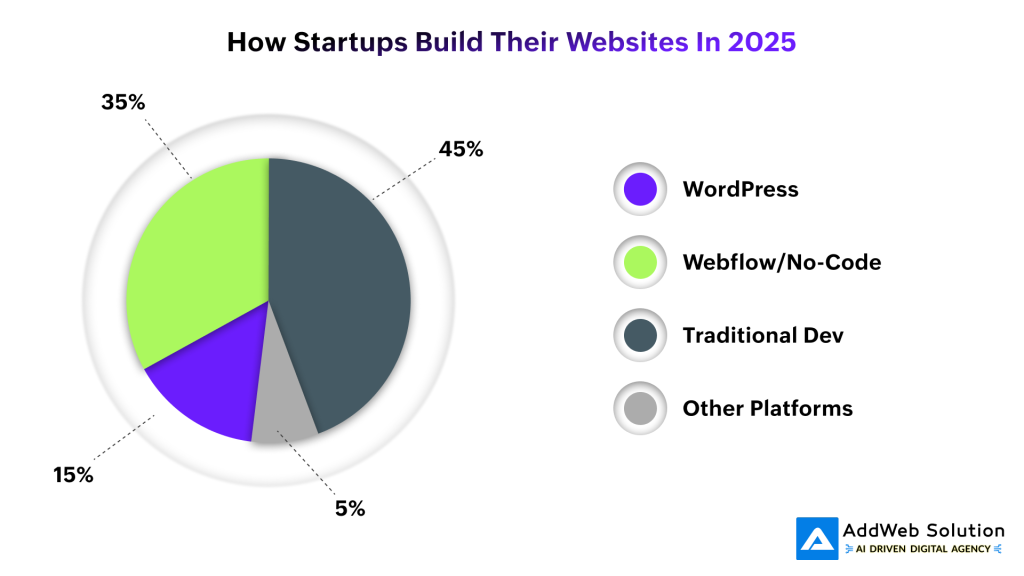
Distribution of website development approaches among startups in 2025


The Real Cost of Traditional Development (Spoiler: It’s Brutal)
Let’s talk numbers that will make any startup founder wince. The median developer salary in 2024 hit $133,080, and that’s just for one person. Factor in hosting, maintenance, tools, and quality assurance, and you’re looking at nearly $200,000 in first-year costs alone.
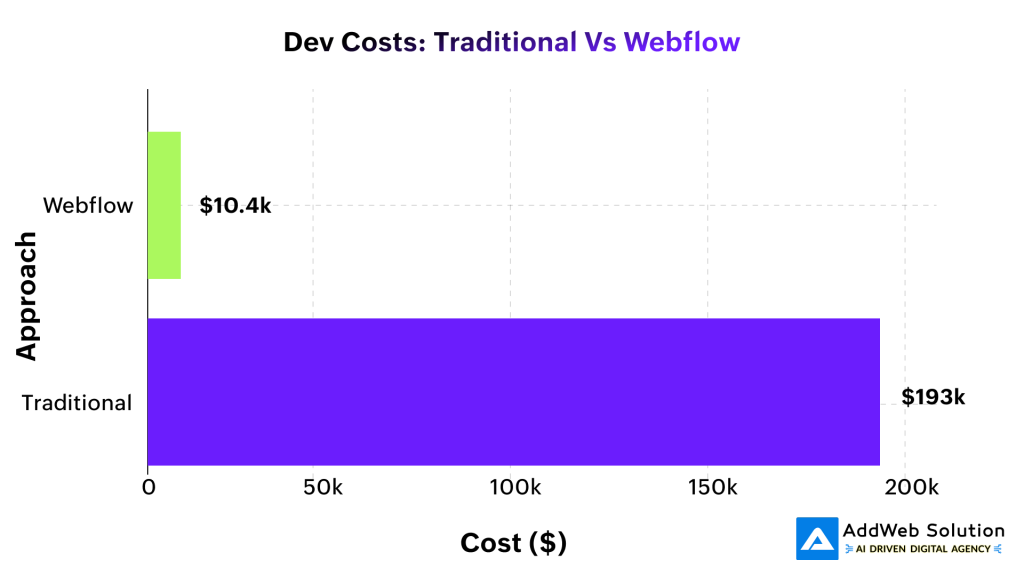
Total cost comparison between traditional development and Webflow for startup projects
Compare that to Webflow’s approach: most startups can launch a professional website for under $10,400 annually—a 95% cost reduction. That’s not just savings; that’s runway extension that could mean the difference between success and shutdown.

Speed: Where Webflow Absolutely Dominates
Time is the ultimate startup currency. While traditional development teams spend 4-32 weeks building websites, Webflow users are launching in 1-12 weeks—often achieving the same functionality in a quarter of the time.

Comparison of development time between traditional coding and Webflow for different project types
Real startups are seeing these results:
- Scribly.io: Built a $30K MRR content service in 6-8 weeks using Webflow, Airtable, and Zapier
- Bloom Institute of Technology: Launched their education platform MVP for 3,000 users using Webflow and no-code tools, eventually raising $122 million
- Reiterate: A fintech startup used Webflow to create a visually striking website that aids in both lead generation and talent acquisition

Screenshot of the Webflow visual editor demonstrating drag-and-drop design for a data insights page with charts and call-to-action buttons
The Technical Debt Myth: Separating Fact from Fear
Critics often warn about “technical debt” with no-code platforms. Here’s the reality: 90% of no-code users report that these tools helped their companies grow faster. The supposed limitations? They’re largely theoretical concerns from developers protecting their territory.
Modern Webflow offers:
- Enterprise-grade scalability: Handling millions of visitors with 99.99% uptime
- Advanced integrations: Headless CMS capabilities and robust API access
- Security compliance: SOC 2 compliance and enterprise-level security features
The platform now supports websites with 100,000+ CMS items, custom scalability levels, and performance that rivals traditionally coded sites.
Success Stories That Prove the Point
Major brands aren’t just experimenting with Webflow—they’re migrating entire operations:
- Typeform reclaimed website ownership, improved SEO performance, and accelerated speed-to-market
- DocuSign gained creative freedom and global recognition in the Intelligent Agreement Management space
- AutoTrader improved development efficiency and accelerated time to market for car brand shopping experiences

chaKey differences between web design and web development in terms of roles, tools, and focus areas
These aren’t small experiments; they’re strategic business decisions driven by results.
The Learning Curve Reality Check
“But isn’t Webflow hard to learn?” It’s a fair question. The answer depends on your starting point, but most people can grasp the basics in 15-20 hours of focused learning. Compare that to the years required to become proficient in traditional web development.
Learning Timeline for Webflow:
- Week 1: Basic interface and simple layouts
- Month 1: Responsive design and CMS basics
- Month 3: Advanced animations and integrations
- Month 6: Complex projects and optimization
The beauty of Webflow’s visual approach is that you see results immediately. No abstract code concepts—just drag, drop, and design.
Turn Webflow into your startup growth engine

Pooja Upadhyay
Director Of People Operations & Client Relations
Key Features That Make Webflow Startup-Ready
Visual Development That Actually Works
Unlike traditional page builders that feel like toys, Webflow generates clean, semantic code that performs like hand-coded websites. You get the speed of visual development with the quality of custom coding.
Collaboration Without Chaos
Multiple team members can work simultaneously without the version control nightmares that plague traditional development. Designers design, marketers create content, and founders make strategic decisions—all in real-time.
Built-in Growth Tools
- SEO optimization tools that actually work
- Analytics integration out of the box
- A/B testing capabilities for continuous optimization
- E-commerce functionality that scales with your business
Scaling Strategies for Growing Startups
As your startup grows, Webflow grows with you:
Phase 1: MVP Launch (0-6 months)
- Simple landing pages and basic functionality
- Core Webflow plan ($23-39/month)
- Focus on validation and user feedback
Phase 2: Growth Acceleration (6-18 months)
- Enhanced features and integrations
- Business plan with advanced CMS
- Custom workflows and automation
Phase 3: Scale Preparation (18+ months)
- Webflow Enterprise for unlimited scalability
- Advanced integrations and custom development
- Performance optimization for high traffic
Making the Strategic Decision
The question isn’t whether no-code platforms like Webflow are “good enough”—it’s whether traditional development is worth the massive time and cost investment for most startups.
Choose Webflow when:
- Speed to market is critical
- Budget constraints are real
- Your team lacks technical expertise
- You need design flexibility
- Iteration speed matters
Consider traditional development when:
- You’re building highly complex, custom applications
- You have unlimited budget and time
- Your product requires unique technical architecture
- You already have a strong development team
The Future is No-Code (Whether You’re Ready or Not)
The startup game itself has evolved. Those are days in the rearview when it cost months of development time and a six-figure sum simply to launch a professional website. Today’s smart founders are leveraging no-code platforms such as Webflow to create, launch, and scale their online presence faster than ever before—without bringing on a single developer.
Your Next Move
The No-Code Revolution has Arrived (And It’s Big)
The numbers don’t lie. The no-code market expanded from $13.2 billion in 2022 to an estimated $26.9 billion in 2025. Webflow alone generated $213 million in 2024—an astonishing 66% year-over-year growth. This is not a trend, but an unprecedented change in the manner in which companies are building for the web.
Source URLs:
- https://taptwicedigital.com/stats/webflow
- https://userguiding.com/blog/no-code-low-code-statistics
- https://mycodelesswebsite.com/webflow-statistics/
- https://www.adalo.com/posts/29-data-points-showing-how-no-code-slashes-development-costs-by-65-on-average
- https://www.nomtek.com/blog/no-code-startups
- https://storeleads.app/reports/webflow
- https://enricher.io/blog/webflow-market-share-statistics
