


For most founders, the nightmare is the same: brilliant ideas trapped in an endless loop of development bottlenecks. You pitch to investors with a compelling vision, but the technical team says it’ll take 6 months to build. By the time you launch, market conditions have shifted, competitors have moved faster, and you’ve burned through a runway that could’ve extended your runway by quarters.
Here’s the uncomfortable truth – traditional development isn’t just slow; it’s a revenue killer for startups. But what if I told you that the fastest-moving founders are launching MVPs in weeks instead of months, testing product hypotheses in days instead of months, and iterating based on real user feedback faster than their competitors can even plan their roadmap?
Welcome to the Webflow playbook for product experimentation.
The Traditional Development Trap: Why Speed Matters
Let me start with a hard number: 95% of new products fail, according to Harvard Business Professor Clayton Christensen. That’s not because the ideas are bad. It’s because by the time founders validate their assumptions, market windows close, user preferences shift, and runway depletes. The average startup spends 6 to 12 months on product development using traditional approaches – and in a fast-moving market, that’s essentially an eternity.
The financial burden is equally staggering. The median developer salary in 2024 hit $133,080, and that’s before factoring in hosting, infrastructure, deployment pipelines, and QA overhead. Most startups easily spend $150,000 to $200,000 just to get a functional website or product prototype off the ground. For bootstrapped founders or early-stage teams operating on seed funding, that spend often represents 30-40% of their annual budget, leaving precious little for marketing, hiring, or pivoting when data demands it.
But here’s what’s shifting the game: no-code platforms and modern builders like Webflow are fundamentally rewriting the economics of product launch. Research shows that organizations using no-code solutions experience 26% faster time-to-market, and some achieve speeds 56% faster than traditional development. That’s not just nice-to-have; that’s existential for startups operating in markets where first-mover advantage matters.
Webflow’s Design-to-Launch Pipeline: A Real-Time Advantage
Here’s what separates Webflow from the WordPress-Shopify ecosystem: the designer and developer are working in the same environment, not handing off work like a relay race that keeps dropping the baton.
In traditional workflows, you get a handoff hell: designer creates mockups → developer codes → QA tests → developer goes back to make changes → stakeholders approve → deployment happens. Each handoff introduces friction, miscommunication, and delays. Studies show that these handoff cycles alone can add 4-8 weeks to a project.
With Webflow, the moment a designer approves the visual design, it’s already the website. There’s no separate coding phase, no plugin hunting, no integration debugging. The CMS is built in. The hosting is secure and global. The SEO structure is clean from day one. An experienced Webflow agency reports delivering full custom 5–8 page sites in 4–8 weeks—something that would take 12-16 weeks with traditional development.
But speed is only half the picture. The real innovation is rapid iteration. Once a site is live, marketing teams no longer need to submit tickets to developers for every change. They can update copy, add new landing pages, adjust CTAs, and launch A/B tests in hours instead of weeks.
Dropbox Sign’s team saw a 67% decrease in developer ticket requests after moving to Webflow, and more importantly, they could launch new pages in days instead of weeks. That capability freed their dev team to focus on high-impact features instead of churning out simple pages.
For founders running product experiments, this changes everything. You’re not locked into a 3-month iteration cycle. You can test ideas, measure results, and pivot or double down in real time.


From Hypothesis to Market Validation: The Experimentation Cycle
Here’s where product experimentation meets modern development: the build-measure-learn feedback loop, a core pillar of the Lean Startup methodology, only works if you can actually build, measure, and learn within a compressed timeframe.
The problem with traditional development is that each experiment feels like a full product launch. You spend 2 months building, 2 weeks testing, 1 week analyzing, and if the hypothesis fails? You’ve burned 2.5 months of runway on learning that your assumption was wrong. You can’t afford to fail fast; each failure costs too much.
Webflow inverts this equation. Here’s a realistic experimentation cycle:
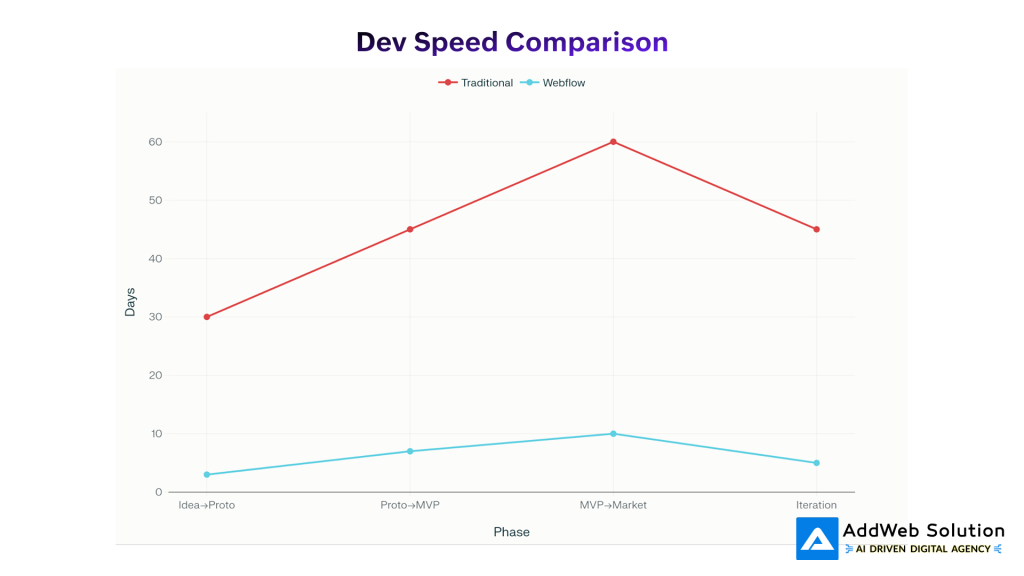
Phase 1: Idea to Prototype (3 days with Webflow vs. 30 days traditionally)
You sketch out a landing page, validate your copy hypothesis with early users, and iterate based on micro-feedback. You’re not building the full product; you’re testing whether the core hypothesis has merit.
Phase 2: Prototype to MVP (7 days with Webflow vs. 45 days traditionally)
Once the concept validates, you build a minimal viable version. With Webflow’s visual CMS, you can wire up dynamic content, forms, and basic automation without touching code. Tools like Airtable integration and Zapier hooks let you create sophisticated workflows that would normally require backend development.
Phase 3: MVP to Market (10 days with Webflow vs. 60 days traditionally)
Deployment, monitoring, and initial performance tuning happen within days. Webflow’s global CDN, automatic image optimization, and security infrastructure mean you launch production-ready, not beta-ready.
Phase 4: Iteration Cycle (5 days with Webflow vs. 45 days traditionally)
Test performs okay but engagement is lower than expected? Update the messaging, redesign the CTA, add a new section—all within a week without needing a developer.
Real-World Impact: Companies That Accelerated Their Go-to-Market
Let’s move beyond theory. Here’s what’s happening in the real world:
Esstart: From 2.1% to 6.8% Conversion Rate
Esstart, a downloadable live event platform, needed to launch a user-friendly website quickly for two distinct audience segments. Traditional development would’ve taken 3-4 months. They used Webflow with expert specialists and completed the project in 7-8 weeks.
The results after launch:

Table: Esstart’s 90-day performance metrics after migrating to Webflow. The conversion rate tripled, form completions nearly quadrupled, and organic traffic surged nearly 7x—all driven by improved UX, faster load times, and better SEO structure.
Why did this happen? Webflow’s clean code architecture meant better SEO without manual optimization. The responsive design ensured mobile users had a frictionless experience. Most importantly, Webflow’s visual CMS let Esstart’s marketing team iterate on messaging and design without bottlenecks, so they could respond to performance data in real time.
Lattice (HR SaaS): Speed Meets Conversion
Lattice, an HR platform, redesigned their marketing site on Webflow. Result: 20% increase in organic traffic, 20% increase in conversion rates, and the ability to launch new pages in 2 days instead of 2 weeks. Their marketing team could now spin up targeted landing pages for webinars or campaigns on short notice while maintaining the polished brand consistency that HR buyers expect. The kicker? The website now supports 100+ updates per day without bottlenecks.
Dropbox Sign: Empowered Teams, Faster Growth
Michelle Keene, Senior Marketing Director at Dropbox Sign, led a rebrand from HelloSign to Dropbox Sign on Webflow. The result:
- 67% decrease in developer ticket requests (marketing could self-serve)
- 4x faster speed to market for web content (pages that took a month now launched in a week)
- 2x increase in content publication after implementing a user-friendly Resource Center
- Successfully executed a full rebrand in a fraction of the time such projects typically take
Jasper (AI Writing): Immediate Demo Lift
Jasper, an AI writing platform, redesigned their website on Webflow. In the first week post-launch:
- Site traffic jumped 4.2%
- Demo requests surged 15%
- Conversion rate from demo request to qualified lead improved 10%
The bold brand expression and fast iteration capability let them respond to real-time feedback and market opportunities—something sluggish development cycles simply don’t allow.
See the Webflow features that change everything

Pooja Upadhyay
Director Of People Operations & Client Relations
The Economics of Speed: Cost vs. Timeline
Let’s talk numbers, because for founders, ROI is everything.
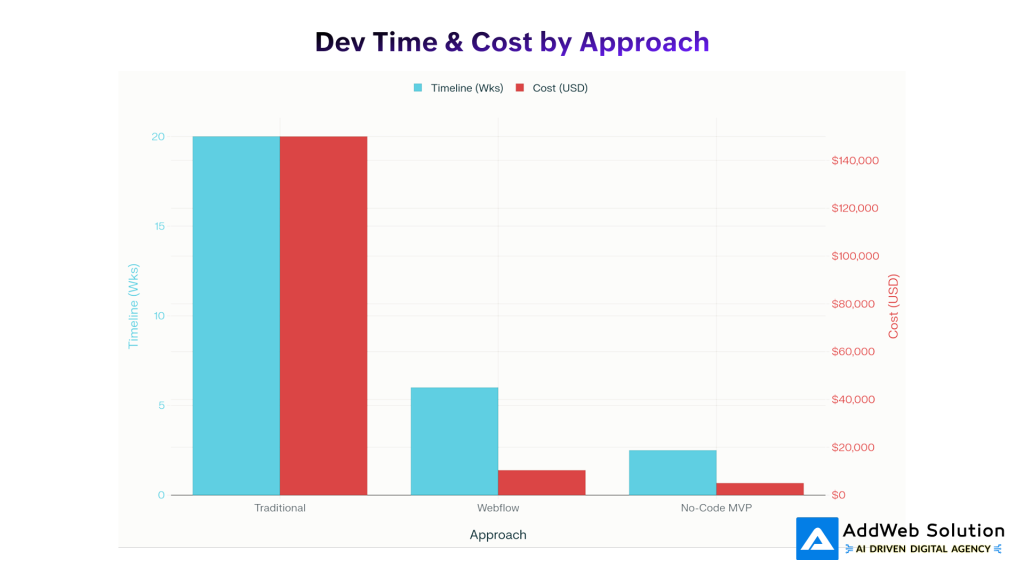
Traditional Custom Development:
- 20 weeks timeline
- $150,000+ upfront cost
- Fixed team overhead (salary, benefits, management)
- Risk: Misalignment on vision mid-project = scope creep and delays
- ROI timeline: 4-6 months before you’re even validating your market hypothesis
Webflow:
- 6 weeks timeline
- $10,400 annual platform cost (or project-based with agencies: $15,000-$40,000 total)
- Flexible team structure (no full-time dev needed; contract designers or agencies as needed)
- Risk: Minimal—you can test hypotheses cheaply before investing heavily
- ROI timeline: Weeks to months, allowing faster validation and iteration
That $140,000 difference isn’t just accounting – it’s the difference between a startup that runs out of runway and one that scales sustainably. Here’s the math:
- 6-month runway for a pre-seed startup = roughly $100,000 to $150,000
- If you spend $150,000 on development alone, you’ve spent your entire seed before proving product-market fit
- If you spend $10,400 with Webflow, you’ve used ~7% of your runway on your website, leaving 93% for iteration, marketing, hiring, and customer acquisition
Broader Statistics on No-Code Impact
Research reinforces this advantage:
- Organizations save an average of $1.7 million annually using no-code platforms (Forrester Research)
- Companies report 40-70% cost reductions compared to traditional development
- No-code MVPs launch 78% faster, often in just 2-4 weeks
- 84% of enterprises are adopting low-code/no-code solutions specifically to reduce strain on IT resources and accelerate time-to-market
Quick Facts on Product Experimentation ROI
🎯 Fact Box:
- Companies that run early-stage product experiments can cut development costs by up to 50% and significantly reduce time-to-market
- 90% of no-code users believe their company has grown faster as a result
- Webflow projects deliver an estimated 332% ROI for businesses because marketing teams can iterate faster and drive traffic independently
Best Practices for Rapid Experimentation with Webflow
Now, here’s the catch: speed without strategy is just chaos. Here’s how the best founders approach rapid experimentation on Webflow:
1. Start with a Clear Hypothesis
Don’t build for building’s sake. Define exactly what you’re testing: “Adding a visual progress bar to the onboarding flow will increase sign-up completion rates” or “Location-targeted landing pages will convert 15% better than generic landing pages.”
Set a sprint question that you can answer with a yes or no. At the end of 5 user tests, you should know whether your hypothesis holds. Unless at least 3-4 are a strong yes, iterate and try again.
2. Use Webflow’s CMS for Rapid Scaling
Webflow’s visual CMS isn’t just for blogs. Create collections for:
- Landing page variants for A/B testing
- Case study libraries that auto-populate
- Localized content for different geographic markets
- Dynamic pricing or feature comparison pages
This structure lets you test at scale without creating new pages manually. Add one collection item, and it automatically appears everywhere it’s referenced.
3. Integrate Experimentation Tools
Wire Webflow to your analytics and experimentation stack:
- Segment or Mixpanel for event tracking and funnel analysis
- Optimizely or VWO for A/B testing within Webflow
- Airtable + Zapier for workflow automation (form submission → lead tracking)
- HubSpot for lead scoring and nurturing
Webflow’s open API and native integrations make this painless. You’re building a single source of truth for your experimentation pipeline.
4. Measure the Right Metrics
Avoid vanity metrics. Focus on:
- Conversion rate (visitors to qualified leads or customers)
- Time on page (engagement)
- Bounce rate (messaging alignment)
- Cost per acquisition (efficiency)
- Feature adoption (usage of new pages or flows)
Real data beats guesswork every single time. Companies like Dermalogica now run hundreds of experiments across six global sites on Webflow, uncovering insights that shape both customer experience and business investments.
5. Iterate Weekly, Not Quarterly
With Webflow’s editing speed, you can implement daily or weekly changes without dev sprints. Test a headline change. Measure. Adjust. Repeat. This cadence is simply impossible with traditional development, which requires advance planning, coding, QA, and deployment cycles.
Key Insights: Why This Matters Now
We’re at an inflection point in product development. The no-code market is projected to reach $84.47 billion by 2027, growing at a CAGR of 28.9%. This isn’t fringe; this is becoming the default.
Here’s the reality for founders:
- Speed is competitive advantage. Markets move faster than ever. Product windows close in weeks.
- Data-driven decisions beat gut instinct. Rapid experimentation lets you make decisions on evidence, not hunches.
- Lean beats fat. A $10k/year Webflow setup that iterates weekly will outcompete a $150k traditional build that updates quarterly.
- Founder control matters. You don’t need to wait for developers. You can test your own hypotheses, move fast, and maintain vision alignment.
Conclusion: The Founder’s Playbook for 2025
The founder who launches their MVP in 2 weeks instead of 2 months gets a 10-week head start on user learning. They pivot faster. They iterate on real user feedback instead of theoretical assumptions. They extend runway by optimizing spending. They attract investors who see a team that executes.
Webflow isn’t just a website builder. It’s an acceleration mechanism for product experimentation. It lets founders spend less time managing tech bottlenecks and more time answering the questions that matter: Do users want this? Will they pay for it? How can we improve?
The teams winning in 2025 aren’t those with the biggest dev teams or the largest budgets. They’re the ones moving fastest with the clearest hypotheses. They’re testing product assumptions weekly, not quarterly. They’re using tools like Webflow to compress what used to take months into days.
If you’re building a startup right now, the question isn’t whether you can afford Webflow—it’s whether you can afford not to use it. The cost of traditional development isn’t just financial; it’s the cost of moving slow in a market that rewards speed.
At AddWeb Solution, we work with founders every day who need to move fast without compromising on quality. Whether you’re validating an idea, scaling a successful product, or redesigning your go-to-market presence, Webflow combined with data-driven experimentation is the blueprint that works. We’ve helped teams launch MVPs in weeks, iterate based on user feedback in days, and achieve conversion lifts of 200%+ through rapid testing.
The founders who win aren’t the ones with the biggest ideas—they’re the ones who execute the fastest.
Source URLs:
- https://userguiding.com/blog/no-code-low-code-statistics
- https://www.itonics-innovation.com/blog/product-experimentation
- https://www.mindtheproduct.com/rapid-prototyping-philip-pantelides-on-the-product-experience/
- https://www.pragmaticinstitute.com/resources/articles/product/23-metrics-mapped-to-the-product-life-cycle/
- https://www.effectiveexperiments.com/blog/experimentation-program-metrics/
- https://www.embroker.com/blog/startup-statistics/
- https://maze.co/blog/rapid-prototyping/
